Restructuring of Foreign Automakers’ Position in China: A Dual-Oligopoly Emerges as Marginal Brands Face Exit
 01/23 2026
 491
491
Author / Liu Wei | Produced by / Insight Auto
Data from the China Association of Automobile Manufacturers (CAAM) reveals that China’s auto market has maintained annual production and sales exceeding 30 million units for three consecutive years. Domestic brands are nearing a 70% market share, while the penetration rate of new energy vehicles (NEVs) continues to climb.
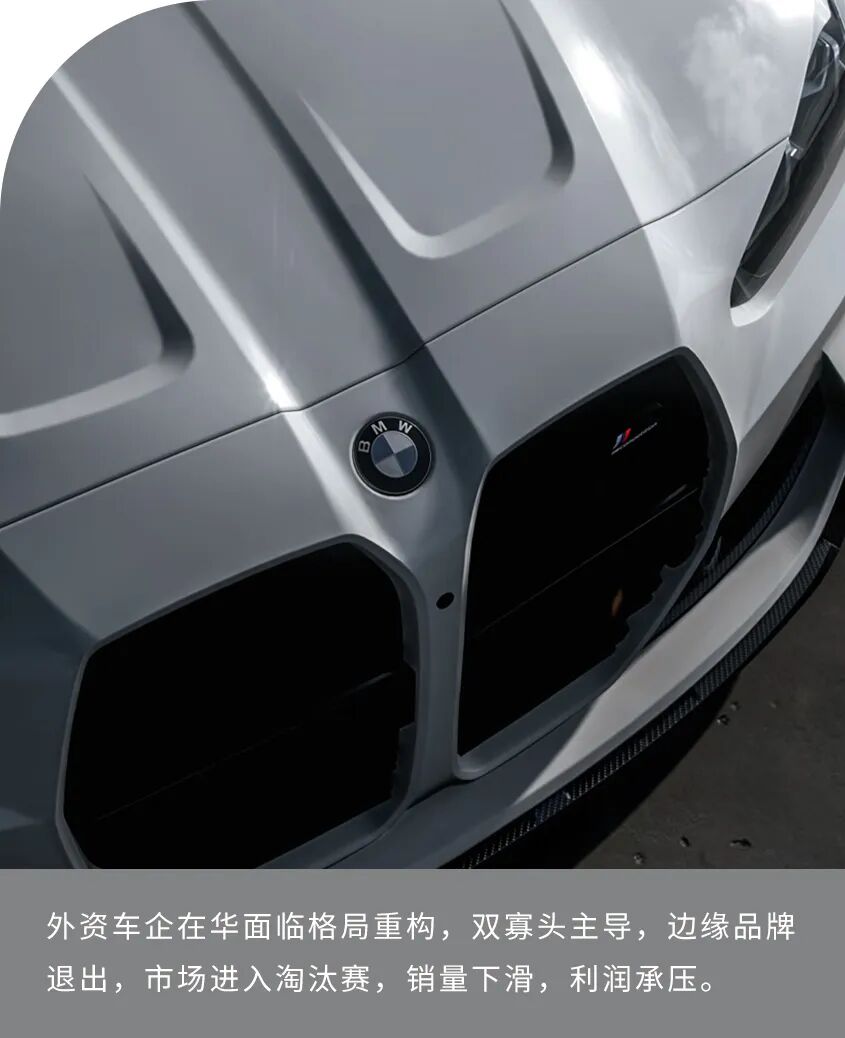
Behind these industry dividends, foreign automakers are undergoing a profound restructuring. While collectively trapped in negative growth, internal differentiation within the group has become increasingly stark—Volkswagen and Toyota have solidified a dual-oligopoly leadership pattern, while some marginal brands teeter on the brink of exit. China’s auto market has officially entered a phase of consolidation, marked by shrinking competition and rising barriers to survival.
Analyzing the performance of 18 multinational automakers in China in 2025, their total sales contracted by nearly 700,000 units year-on-year to 9.09 million units. Their market share dropped from 42.79% to 38.43%, losing 4.36 percentage points in a single year.
Five years ago, multinational automakers dominated the market and captured the lion’s share of profits. Today, most have shifted to a defensive stance, with only four achieving positive growth and nine companies falling below the multinational group’s average growth rate of -7%. “Falling behind” has become the norm.
The restructuring of market structure exhibits multiple characteristics. The concentration effect at the top is pronounced, with Volkswagen leading at 2.02 million units and Toyota at 1.78 million units, forming the first tier. Together, these two automakers account for 48.6% of the multinational market share, creating a dual-oligopoly “eating the meat” pattern. Third-placed Nissan sold just 650,000 units, creating a million-unit gap with the leaders and leaving the remaining dozen automakers to compete for the remaining half of the market. Behind this Matthew effect lies Volkswagen and Toyota’s extensive after-sales networks across all city tiers and their long-standing user reputation, making them safe choices for consumers.
The 500,000–600,000 unit range has emerged as the midfield of competition, with seven automakers clustered here. The annual sales gap between third-placed Nissan and ninth-placed General Motors is only 118,000 units, averaging less than 1,000 units per month. This range is highly volatile: Honda entered due to a 24% sales decline, while General Motors broke in with a 23% increase. Tactical missteps or new model failures can lead to drastic ranking changes, and falling below 500,000 units risks marginalization.
The 100,000-unit threshold has become an insurmountable survival line for multinational automakers. In 2025, five automakers saw sales fall below this mark, with Jaguar Land Rover and Dongfeng Peugeot Citroën newly entering the list and Ford teetering on the brink with 125,000 units. Annual sales below 100,000 units lead to underutilized capacity, high costs, and a chain reaction of dealer withdrawals and collapsed used-car residual values.
Porsche closed 36 stores net in 2025 and plans to further reduce its footprint to 80 stores in 2026, facing the risk of merging its China and Asia-Pacific regions.
Internal differentiation within the group has become increasingly pronounced. U.S. automakers have seen a polar reversal: General Motors achieved a 23% surge by delegating decision-making power, compressing product cycles, and strategizing for new energy high-end brands, becoming a transformation model. Ford, however, saw sales plummet by 42% due to product decision-making errors and new energy delays, with its Lincoln brand also halving, trapped in a price-cutting cycle.
Korean automakers have taken a “blooming inside the wall, smelling sweet outside” path, with Hyundai and Kia achieving counter-trend growth. Relying on a model of “exporting to maintain production volume and domestic sales to maintain the network,” they have transformed their Chinese factories into global export bases while receiving billions in group capital increases to prepare for new energy.
The competitive logic in the luxury car market is being rewritten. Tesla surpassed BBA (BMW, Mercedes-Benz, Audi) for the first time with 625,900 units sold, with its Shanghai Gigafactory delivering 851,000 units in 2025—52% for global export—demonstrating technological dominance rather than mere sales pursuit.
BBA maintained resilience by extending after-sales networks to county-level cities, selling nearly 1.8 million units annually, proving that operational quality matters more than scale in luxury car competition. Volvo broke through the market with its XC70 plug-in hybrid model, using safety differentiation to escape the new entrant’s material stack internal competition, with its new energy share jumping to 50%.
Notably, the gap between Honda and Nissan continues to narrow. Honda, with two joint ventures, sold 645,300 units annually, lagging behind Nissan’s 653,000 units. The Sylphy model alone contributed 52% of Nissan’s sales, while Honda relied on three fuel-powered models to support its performance, lagging in new energy transformation. Porsche’s four-year consecutive decline reflects the consumption shift among the new middle class, with asset shrinkage leading to a chill in high-end decorative consumption, becoming a microcosm of class consumption trends.
Industry analysts point out that the differentiation of multinational automakers in China is essentially a competition of localization capabilities, strategic adaptability, and technological iteration speed. Volkswagen and Toyota’s inertial advantages, General Motors’ transformation courage, and Korean automakers’ pragmatic strategies provide three survival paths for foreign brands. In the future, as competition in China’s auto market intensifies, the elimination race among multinational automakers will continue to escalate, and only those precisely adapting to market changes will stand firm.
END
-
![]()
Enflame Tech's IPO Journey: Navigating Over 5.9 Billion Yuan in Losses and Soaring Debt in Q1 This Year
-
![]()
Trillion-Yuan Giant Li Shufu 'Streamlines': Could Levc Be the Casualty?
-
![]()
AI Competes for Electricity and Generates Power in the Gobi Desert
-
![]()
The First Batch of Victims of the AI Bubble: Programmers
-
![]()
ByteDance, DJI, and Xiaohongshu Secure Top Three Positions Among China’s Fastest-Growing Unicorns
-
Tesla's in-car voice system in China is finally learning to 'understand human language'
-
![]()
Foreigners Are Amazed: Chinese Electric Vehicle Drive Systems Unveil Innovative 'Poses'
-
![]()
700,000 Brothers and the Future of Robots: Behind JD.com's 'Nirvana Plan'