Sales Dive by 28%: Is the 2026 Auto Market Slump Real or Just a Temporary Blip?
 01/26 2026
 657
657

Text/Mr. Wan
Edited by/Little Balloon
"Just the other day, I had a half-hour conversation with the owner of a dealership that's been selling joint-venture brands for over a decade. He kept sighing, mentioning, 'Ever since the policy ended, showroom foot traffic has plummeted by 30%.'"
According to the latest figures from the China Passenger Car Association, from January 1 to 18, nationwide retail sales of passenger cars reached a mere 679,000 units, marking a significant 28% year-on-year decline. The wholesale market didn't fare much better, with a 35% year-on-year drop.
With the adjustment of the purchase tax exemption policy for new energy vehicles (NEVs) in 2026—from full exemption to a 50% reduction—consumer purchasing costs have surged.

01 Sales Slump
At the dawn of 2026, China's auto market experienced one of its most pronounced cooling-off periods in recent memory.
Data reveals that from January 1 to 18, retail sales of passenger cars hit just 679,000 units, a sharp 28% year-on-year decrease, and a 37% drop compared to the same period last month. The wholesale market also underperformed, with a 35% year-on-year decline.
While full-month projections might be slightly less severe, the market's "cold start" is undeniable.
Behind these numbers lies a confluence of factors. The 2026 Spring Festival falls later than usual, delaying the pre-holiday car-buying rush to February, shortening the January sales cycle and directly impacting monthly sales.
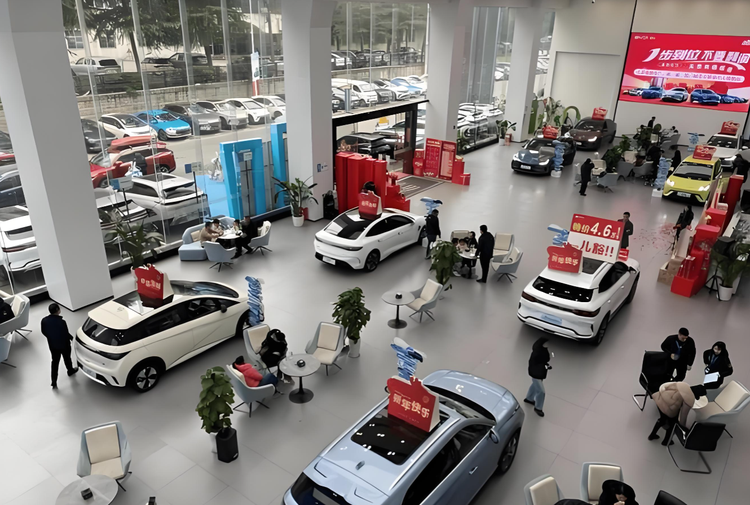
Additionally, market uncertainty during the policy transition led to a 30%-50% decline in showroom visitors.
02 Structural Challenges
Fuel vs. New Energy: NEVs show resilience, plug-in hybrids emerge as game-changers. Despite an overall downturn, the NEV market demonstrated significantly greater resilience than fuel-powered vehicles. From January 1 to 18, retail sales of NEV passenger cars reached 312,000 units, a 16% year-on-year decrease, outperforming the overall market by 12 percentage points, with a stable penetration rate of around 46%. Within this segment, plug-in hybrid models stood out, with some automakers reporting over 50% year-on-year growth, becoming the NEV market's core driver. In contrast, production of pure fuel light vehicles plummeted by 85% year-on-year, signaling an irreversible contraction in the fuel vehicle market. Notably, price differentiation emerged in the NEV sector, with the 100,000-200,000 yuan mainstream segment accounting for 58% of sales, while the 200,000-300,000 yuan mid-to-high-end market grew the fastest. Plug-in hybrids competed fiercely with pure electric models in this price range.
Joint Ventures vs. Domestic Brands: The gap widens in the NEV race. Chinese brands capitalized on their early NEV advantage to maintain strength in a sluggish market. From January 1 to 17, domestic brands' NEV sales grew 62% year-on-year, with their market share rising to 78%. In contrast, joint-venture brands exhibited an imbalanced "stable fuel vehicle, weak NEV" pattern. Companies like FAW-Volkswagen, SAIC Volkswagen, and SAIC General Motors relied on classic fuel models and intelligent upgrades for resilience, but their NEV sales grew only 12% year-on-year, far below the industry average. Despite terminal discounts averaging 20,000 yuan, inventory pressures persisted. This divergence stems from technological route choices, with domestic automakers' supply chain advantages from years of NEV focus proving more valuable post-policy adjustments.
Market concentration intensifies among leading automakers, with second-tier brands diverging. Top domestic brands performed strongly, with BYD leading NEV sales at 113,000 units, expanding its market share to 26.5%, followed by Tesla and Li Auto. Together, these three accounted for nearly half of the NEV market share, driving sustained industry concentration. Other domestic brands fared differently: Changan Qiyuan, Chery Fengyun, Great Wall, and Geely broke through in niche segments with plug-in hybrid technologies, while some brands lacking core technologies saw sales decline by over 40% year-on-year. Among luxury brands, traditional fuel models retained a stable base, but NEV models like NIO, BYD Han, and Xiaomi SU7 successfully entered the C-segment's top ranks, disrupting the luxury market's established hierarchy and marking the official start of direct competition between NEV and fuel luxury vehicles.
SUV remains the dominant segment, while MPV stays niche but premium-oriented. Despite an overall decline, the SUV market performed strongly in the NEV sector, with NEV SUV exports surging 78% year-on-year from January 1 to 17, becoming the core driver of export growth. In the sedan market, NEV models accelerated their replacement of fuel vehicles, particularly in the 150,000-250,000 yuan price range, where plug-in hybrid sedans diverted significant demand from traditional fuel sedans due to their lack of range anxiety. The MPV market, though small in share, showed a premiumization trend, with models equipped with intelligent cockpits and advanced driving assistance systems maintaining stable demand as family upgrade choices. Meanwhile, the low-end MPV market outperformed the overall passenger vehicle sector slightly, benefiting from preferential commercial vehicle subsidy policies.
03 Root Causes
The sales decline at the start of 2026 stemmed from a mix of policy, market, and seasonal factors, with the policy transition serving as the primary catalyst.
The shift in the NEV purchase tax exemption policy—from full exemption to a 50% reduction—means consumers buying a 200,000 yuan pure electric vehicle now face an additional 8,850 yuan in purchase tax. This change directly impacted purchasing decisions among price-sensitive consumers.
The most immediate effect was consumer hesitation. "Many visitors ask, 'Will the policy change again?' or 'Am I losing out by buying now?'" The NEV retail penetration rate dropped sharply from 59.1% in December 2025 to 46%.
Meanwhile, year-end promotions by automakers in late 2025 to meet sales targets heavily depleted purchasing power in early 2026. Incentives like purchase tax guarantees and cash discounts released significant pent-up demand from individuals and businesses.
Seasonal factors also played a role. The later 2026 Spring Festival delayed the pre-holiday car-buying rush to late January-February, whereas the previous year had already entered its peak sales period. This misalignment further amplified the year-on-year decline.
Cold weather in northern regions exacerbated "range anxiety" among NEV consumers, prompting some potential buyers to switch to fuel vehicles or delay purchases.
04 New Market Avenues
Facing the market downturn, mainstream automakers swiftly implemented countermeasures. In the first week of the new year, over 70 models launched aggressive promotional campaigns.
BMW adjusted prices for 31 models, with the i7 M70L seeing a 301,000 yuan price cut and the iX1 reduced by up to 24%. BYD also lowered prices across its lineup, with the SongPlus EV 520 Luxury trim dropping by 27,000 yuan and the Seal 06 DM-i's price falling below 80,000 yuan for the first time.
These promotions yielded short-term results, with daily retail sales of passenger cars rising to 50,000 units in the second week of January, a 67% increase from the first week's 30,000 units. However, sustained price cuts eroded automakers' gross margins, while interest-free and subsidized financing policies increased capital costs.
Simultaneously, profound structural shifts occurred in the market. Data shows NEV models were less affected than fuel vehicles.
As subsidies decline and competition intensifies, the NEV industry is entering a new phase of consolidation. Brand concentration continues to rise, with BYD, Tesla, and Li Auto accounting for nearly half of the NEV market.
The proliferation of intelligent driving technologies emerged as a new market highlight. In 2026, L2-level assisted driving penetration in new vehicles is expected to reach 64%.
Cost reductions drove this trend, with hardware costs for highway NOA (Navigate on Autopilot) dropping from 5,000-8,000 yuan in 2022 to 1,500-3,000 yuan in 2026, making intelligent driving features accessible in the "1,000-yuan era."
05 From Short-Term Struggles to Long-Term Gains
As the inaugural year of the 15th Five-Year Plan, 2026 marks a critical juncture for the automotive industry's transition from rapid growth to high-quality development.
Despite the weak January market performance, I remain cautiously optimistic about the full-year outlook.
The long-term growth trajectory of NEVs remains unchanged. In 2026, NEV sales are projected to exceed 20 million units, with their market share rising to 15%. Looking further ahead, NEV penetration is expected to surpass 70% by 2030, with their market share reaching 30%.
The automotive industry's global expansion is entering a new phase. Chinese auto exports are shifting from simple product trade to an ecosystem synergy model encompassing "vehicles + intelligence + batteries + components + services."
In 2026, Chinese auto exports (including overseas localized production) are expected to reach 8 million units, with overseas production and sales scaling to 10 million units by 2030.
Some automakers are redirecting resources previously allocated to marketing toward investments in solid-state batteries, advanced intelligent driving, and overseas localized production. Planned overseas factory capacity for 2026 exceeds 2 million units annually.
Industry convergence trends are creating new growth avenues. The automotive sector is accelerating its integration with robotics, low-altitude economy, and other industries, sharing a common AI core and approximately 70% of their supply chains. This trend is driving automakers to transform into "aggregated intelligent terminal enterprises" while offering component suppliers new "one-to-many" growth opportunities.
Facing policy adjustments and intensifying competition, companies must shift their focus from short-term tactics to long-term capability building. Qin Lihong, co-founder of NIO, pointed out that the industry's next phase of growth will "come less from scale expansion and more from high-quality growth driven by structural and experiential upgrades."
Final Thoughts
In conclusion, the January auto market decline resulted from multiple short-term factors rather than signaling an industry turning point. As policy details solidify, Spring Festival consumption unleashes, and overseas markets gain momentum, the market will gradually return to normalcy. For automakers, focusing on technological innovation and global expansion amid industry transition pains may offer the first lesson of 2026's auto market—seizing opportunities during transformation.
-
![]()
Enflame Tech's IPO Journey: Navigating Over 5.9 Billion Yuan in Losses and Soaring Debt in Q1 This Year
-
![]()
Trillion-Yuan Giant Li Shufu 'Streamlines': Could Levc Be the Casualty?
-
![]()
AI Competes for Electricity and Generates Power in the Gobi Desert
-
![]()
The First Batch of Victims of the AI Bubble: Programmers
-
![]()
ByteDance, DJI, and Xiaohongshu Secure Top Three Positions Among China’s Fastest-Growing Unicorns
-
Tesla's in-car voice system in China is finally learning to 'understand human language'
-
![]()
Foreigners Are Amazed: Chinese Electric Vehicle Drive Systems Unveil Innovative 'Poses'
-
![]()
700,000 Brothers and the Future of Robots: Behind JD.com's 'Nirvana Plan'