Joint Venture Quandary: Which Joint Venture Auto Brands Might Depart China Due to Sluggish Sales by 2026?
 01/26 2026
 522
522
Once a thriving hub, a Japanese joint venture brand's 4S store now stands as a stark contrast, its showroom a desolate space adorned only with large discount banners fluttering in the wind. The backdrop wall, emblazoned with the slogan 'Global Synchronized Technology,' appears lackluster and ineffective. This scene epitomizes the current state of numerous joint venture brands in China's automotive market as of 2025.
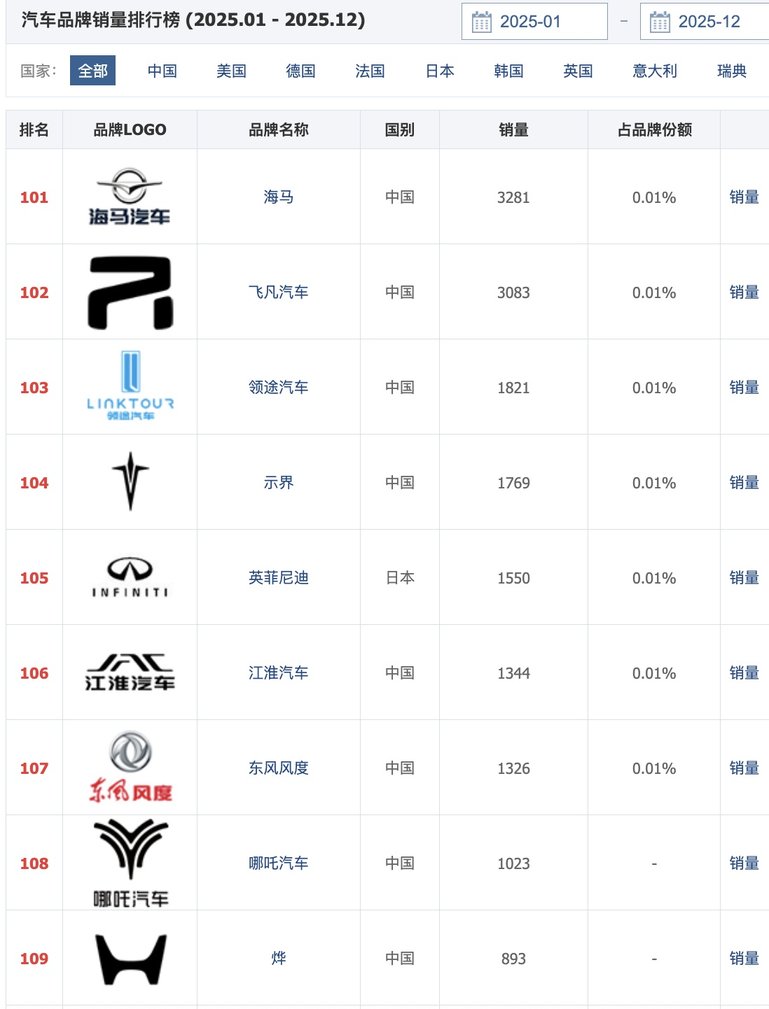
Data reveals that among the top ten best-selling brands in the Chinese market in 2025, traditional joint venture brands secured only four positions. Former automotive giants like Volkswagen, Toyota, and Honda, though still on the list, are grappling with sluggish growth, their market share rapidly dwindling in the face of competition from Chinese domestic brands. More alarmingly, several joint venture brands, including Peugeot, Citroën, Skoda, and Infiniti, have witnessed their annual sales plummet below the 'survival threshold' of 20,000 units. From the exit of 'Suzuki and others' to the current struggles of marginalized joint venture brands in 2025, a profound market upheaval is underway.
The 'Ebb Tide' of 2025: Transitioning from Joint Venture Production to Import Mode
The 2025 sales data has raised red flags for some joint venture brands. With the loss of localized production's scale advantages and high operational costs, 'exiting joint ventures and switching to imports'* has emerged as a rational strategy for certain brands to mitigate losses. This path has already been tread by brands like Suzuki and Acura.
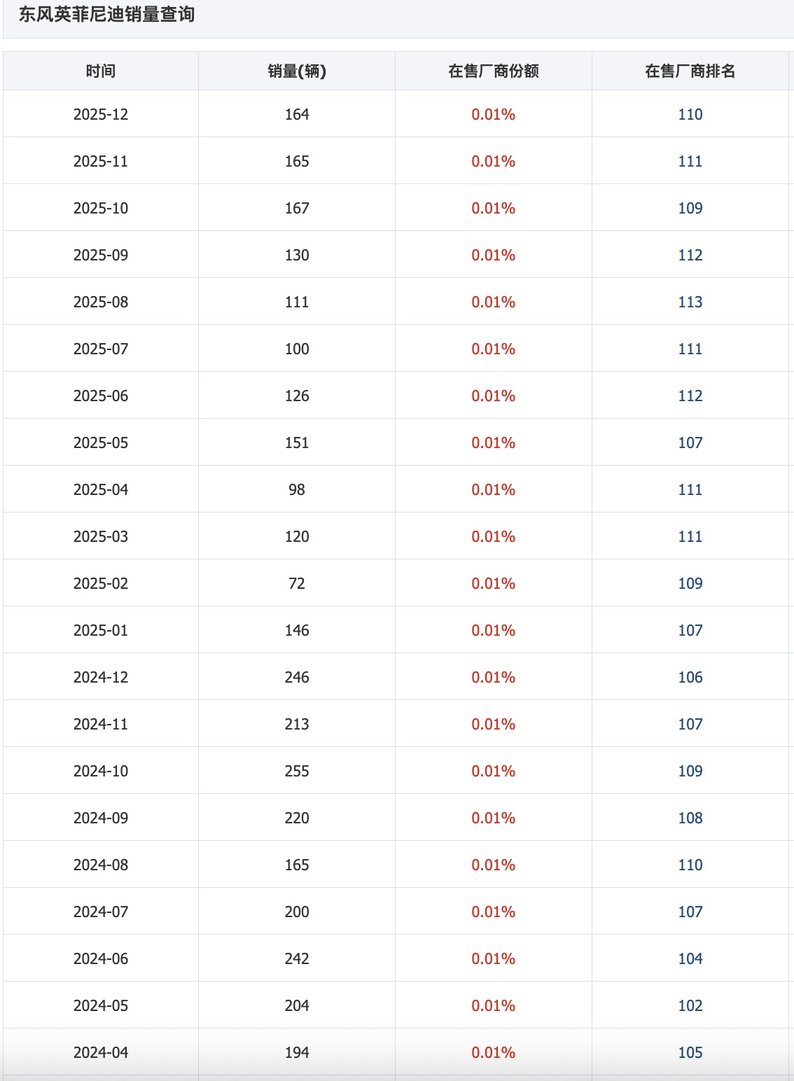
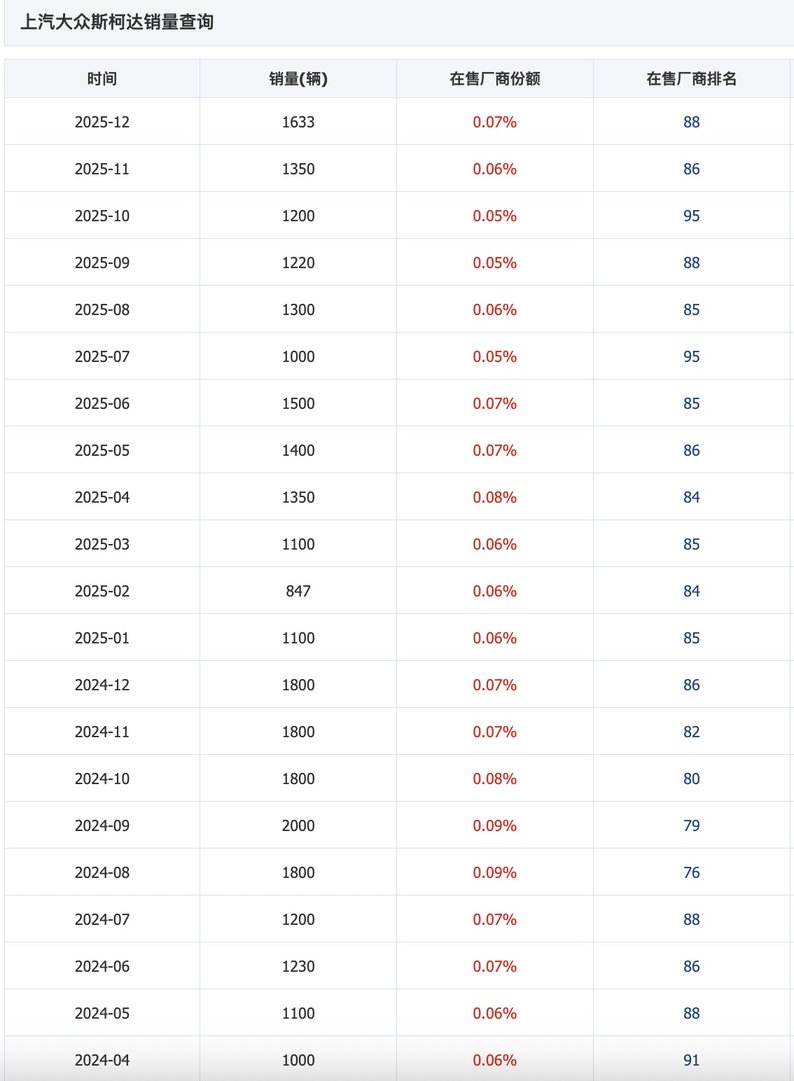
According to the data, Infiniti (with 1,550 units sold in China in 2025) and Skoda (with 15,000 units sold in China in 2025) are most likely to follow suit post-2025. Take Infiniti as an example; its annual sales pale in comparison to the monthly sales of leading brands, with dismal figures failing to sustain its independent production, sales, and R&D system in China.
Switching to imports, though it will inevitably drive up car prices and narrow the target audience, can significantly reduce the enormous costs associated with localized operations. This becomes a reluctant yet necessary move for parent companies to retain a 'spark' in the Chinese market. Skoda faces an even more precarious positioning, sandwiched between the Volkswagen brand and more cost-effective Chinese brands, with its brand value becoming increasingly blurred and sales remaining stagnant. The possibility of stripping away its joint venture business looms large.
2026 Warning: Marginalized Joint Venture Brands in the 'Danger Zone'
If 2025 marked the beginning, then market pressure will intensify further in 2026. Besides the aforementioned brands, other joint venture brands struggling with sales in the 20,000-50,000 unit range have also entered the 'danger zone'.
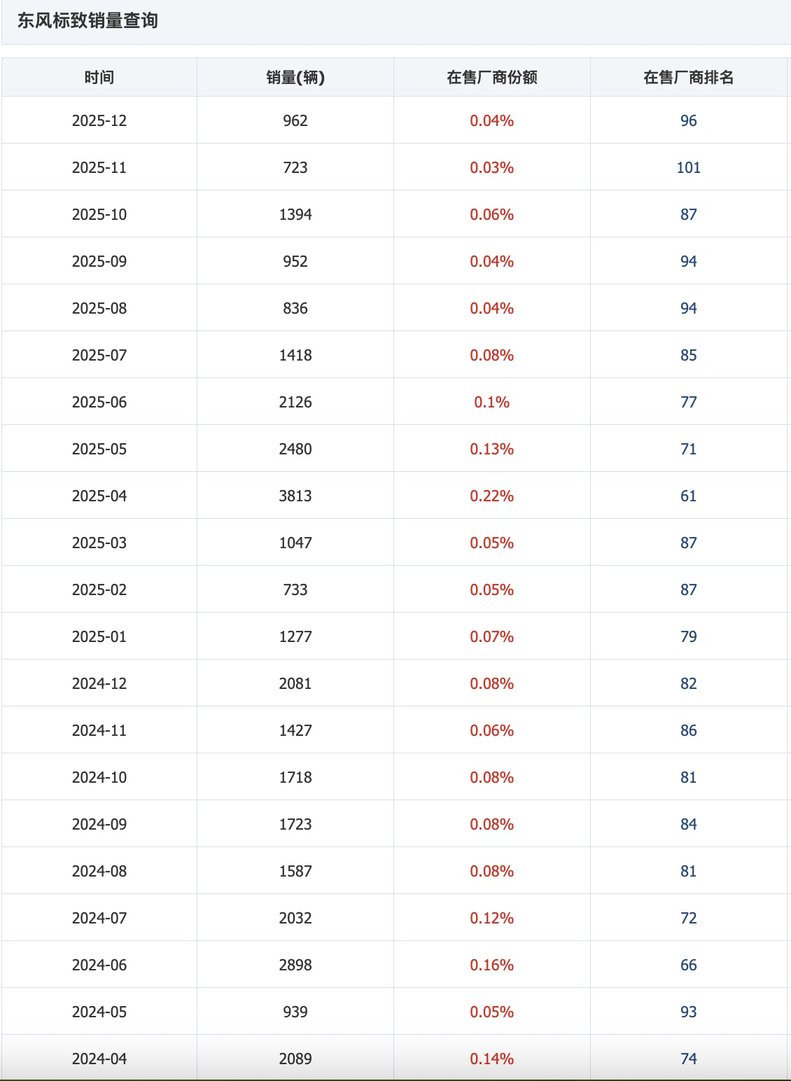
French brands (Peugeot and Citroën, with combined annual sales of approximately 36,000 units) are facing comprehensive marginalization. Their product designs and smart cockpits have long been out of sync with the mainstream demands of Chinese consumers. Even repeated adjustments to their China strategies by the parent company, Stellantis Group, have failed to reverse the sales decline. In 2026, without the introduction of revolutionary new products or a complete strategic shift, their presence in the Chinese market will further diminish, and the likelihood of exiting joint ventures will continue to rise.
The stories of Japanese luxury brands (Acura has already exited, and Infiniti is struggling) are equally grim. Their sluggishness in electrification transformation has left them silent in the new energy race. Chinese consumers' perceptions of 'traditional luxury' are being reshaped by new forces represented by NIO and Li Auto. Infiniti, lacking a distinct electric identity, faces a thorny future even if it switches to imports.
Why Has the Joint Venture Appeal Faded in China?
Behind the collective predicament of joint venture brands lies a fundamental shift in market dynamics.
Firstly, the era of 'technology for market access' has concluded. In the fuel vehicle era, joint venture brands established a competitive edge with their core technological advantages in engines and transmissions. However, in the electrification and intelligentization races, Chinese brands have achieved comprehensive leadership or parity. Consumers now realize they can obtain stronger power, longer range, smarter cockpits, and driving assistance systems at a lower cost in domestic brand models, causing the technological allure of joint venture brands to naturally wane.
Secondly, there is a severe mismatch between product iteration speed and user demands. The Chinese new energy vehicle market is characterized by intense competition, with product updates occurring frequently, sometimes on a monthly or even weekly basis. Traditional joint venture automakers, hampered by their global R&D systems and lengthy decision-making processes, often have model replacement cycles lasting 5-7 years, with mid-cycle facelifts appearing inadequate. This 'slow pace' cannot keep up with the rapid changes and pursuit of novelty among Chinese consumers.
Lastly, there is the dissolution and reshaping of brand value perception. In the past, joint venture brands symbolized quality, reliability, and a certain social status. Today, brands like BYD, Li Auto, and AITO have set new value benchmarks in their respective price segments. When 'domestic' becomes synonymous with technology, luxury, and trendiness, some joint venture brands find themselves trapped in a brand perception dilemma, being 'neither high-end nor affordable.'
Strategies for Breakthrough: The 'Five Survival Strategies' for Joint Venture Brands in 2026
Faced with an impasse, not all joint venture brands are destined for passivity. To turn the tide in 2026, they must demonstrate the courage to 'scrape the poison off the bone' and undergo a complete strategic reconstruction.
First Strategy: Electrification must be 'All In' and achieve 'China-Native.' Joint venture brands can no longer rely on introducing 'fuel-to-electric' conversions or transitional products from overseas markets to China. They must establish independent electrification R&D teams tailored to the Chinese market's characteristics or engage in deep, exclusive partnerships with China's top tech companies (such as Huawei, CATL, Horizon Robotics, etc.) to create truly competitive 'China-exclusive' pure electric products.
Second Strategy: Rebrand and find an irreplaceable 'niche.' The route of being large and comprehensive is no longer viable. Brands must discover their unique core values. For instance, they can deeply cultivate niche fields (niche segments) such as off-roading, travel, and personalized modifications, fostering a strong community culture and brand identity, shifting from 'selling cars' to 'operating a lifestyle.'
Third Strategy: Completely revolutionize distribution and service models. The vast network of 4S stores has become a cost burden. Joint venture brands should fully transition to more cost-effective models, such as mall experience stores, online direct sales, and a hybrid agency system. Simultaneously, they should standardize, transparentize, and digitize after-sales services to rebuild consumer trust, which was once an advantage of joint venture brands and now requires reinforcement.
Fourth Strategy: Humble themselves and compete on cost-effectiveness with genuine effort. They must acknowledge the reality that their product strength is no longer superior at the same price point. They need to optimize costs and increase localization procurement rates to bring product pricing back to its intrinsic value, daring to engage in honest price and value competition with Chinese brands at the same level.
Fifth Strategy: Shift from a 'global factory' to a 'global tech collaboration hub.' The most successful breakthrough makers may view the fierce competition in the Chinese market as a 'pressure test field' and 'innovation incubator' for their global transformation. They can reverse-export the electrification and intelligent solutions validated in the Chinese market to other global markets, completing a role transformation from 'market dependents' to 'technology exporters.'
Epilogue
2026 will be a pivotal year for the historic convergence and divergence of joint venture and domestic forces in China's automotive market. For joint venture brands, the era of 'easy wins' is over. Whether they exit gracefully like Suzuki and Acura or undergo a phoenix-like rebirth like a few forward-thinking pioneers depends on their ability to truly let go of past pride and embark on a self-revolution in China's global automotive market, which is both the most competitive and the most advanced. The market's judgment is cold and just, rewarding only those enterprises that most profoundly understand and meet user demands, regardless of their origin or whether they are 'joint venture' or 'domestic.'
-
![]()
Enflame Tech's IPO Journey: Navigating Over 5.9 Billion Yuan in Losses and Soaring Debt in Q1 This Year
-
![]()
Trillion-Yuan Giant Li Shufu 'Streamlines': Could Levc Be the Casualty?
-
![]()
AI Competes for Electricity and Generates Power in the Gobi Desert
-
![]()
The First Batch of Victims of the AI Bubble: Programmers
-
![]()
ByteDance, DJI, and Xiaohongshu Secure Top Three Positions Among China’s Fastest-Growing Unicorns
-
Tesla's in-car voice system in China is finally learning to 'understand human language'
-
![]()
Foreigners Are Amazed: Chinese Electric Vehicle Drive Systems Unveil Innovative 'Poses'
-
![]()
700,000 Brothers and the Future of Robots: Behind JD.com's 'Nirvana Plan'