What Will It Take to Excel in Electric Vehicle Sales by 2026?
 02/02 2026
 639
639
Introduction
Introduction
"Until the next technological leap occurs, driving range will remain the cornerstone, while intelligent driving capabilities will define the pinnacle of electric vehicle excellence."
Recently, I encountered a viewpoint that truly made me pause and think.
Before the dawn of the next technological singularity, the automotive sector is poised to enter a phase that, while seemingly mundane, will be a rigorous test of internal capabilities. In essence, amidst the fervor of the new energy transformation, a closer look at the market reveals that, after successive iterations and refinements, the comprehensive product strength of models introduced by mainstream players is becoming increasingly uniform.
Many features are now commonplace: "If you have it, so do I; it's a standard offering for all."
This raises new questions. Against this backdrop, what will it take for numerous automakers striving to make their mark to successfully sell their electric vehicles? In other words, what is the pivotal factor that can genuinely stimulate consumer demand?
From my vantage point, the following two aspects are indispensable considerations for 2026.
01 "Driving Range" Continues to Be the Primary Driver
In 2025, electric vehicles once again showcased their robust momentum.
According to data released by the China Passenger Car Association, cumulative retail sales soared to 12.809 million units, marking a 17.6% year-on-year increase. The corresponding market penetration rate reached 53.9%, signifying a successful "crossing the river" milestone. As an observer, it's heartening to witness electric vehicles' ability to reshape the market across various segments, with many players achieving a complete transformation of gasoline-powered vehicles. In my discussions with friends who have transitioned to electric vehicles, one aspect consistently emerges as their top priority: driving range.
Currently, there's a sentiment within the industry suggesting that "with charging stations ubiquitous, you can charge anytime, anywhere. A smaller battery is inconsequential; range anxiety is a thing of the past." In response, I would assert: "That indicates a lack of true understanding of most users' mindset. They desire the best of both worlds."
More bluntly stated, a sufficiently large battery and a well-established charging infrastructure have always coexisted. Especially in winter, under low-temperature conditions, a substantial driving range provides a safety net for owners and alleviates many users' concerns.
As we step into 2026, two notable developments stand out.
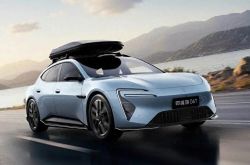
Firstly, let's focus on Xiaomi, which recently found itself embroiled in controversy. Without much fanfare or pre-launch hype (a term meaning "building anticipation"), it directly unveiled the new generation SU7 online and announced pre-sales starting at 229,900 to 309,900 yuan.
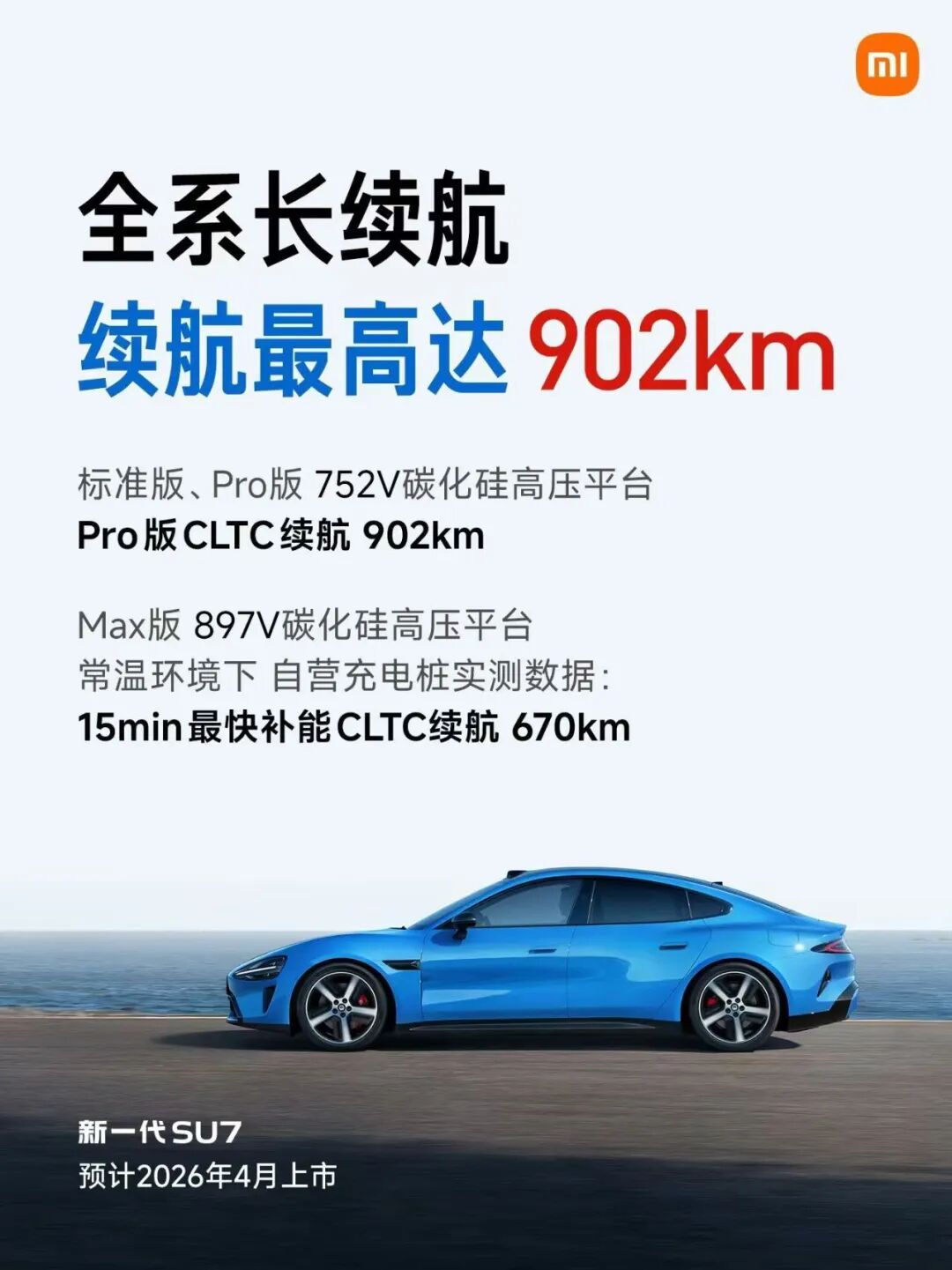
If I had to describe the approach to upgrading this all-electric coupe, which single-handedly outperformed the Model 3, in one word, it would undoubtedly be "addressing weaknesses and maximizing strengths."
Delving deeper, many of the enhancements to the new generation SU7's intelligent driving and chassis systems were anticipated, such as the standard inclusion of LiDAR across all models and the switch to a dual-chamber air suspension.
In contrast, extending the already advantageous driving range of the Pro version to an impressive 902 kilometers and making 800V standard across all models is even more thought-provoking. Xiaomi deeply understands that "for many potential customers, the strength of this dimension remains the primary catalyst."
Secondly, there's BYD, which successfully navigated the storms of the Chinese auto market in 2025 and achieved its sales target of 4.6 million units. As we enter 2026, it has also played its first "ace card."
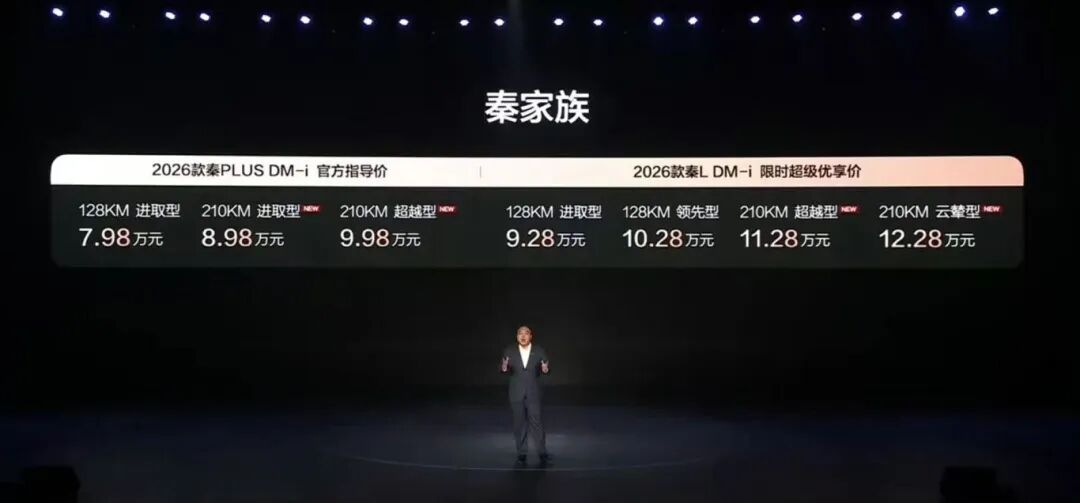
For the DM-i versions of many of its volume sellers, including the Qin PLUS, Qin L, Seal 05, Seal 06, and Song Pro, BYD has introduced large batteries across the board. Taking the Qin PLUS as an example, the upgraded pure electric driving range reaches 210 kilometers, far surpassing competitors in the same class, with a price tag of just 89,800 yuan.
"BYD's core competitiveness lies in its technological prowess. The company's team of 120,000 engineers is the key foundation and support for its subsequent technological breakthroughs and re-establishing its leading edge."
At the 2025 second shareholders' meeting, Wang Chuanfu, the helm, not only reflected on shortcomings but also provided a glimpse into how to counterattack in 2026.
Combining the "strategic moves" at the start of the year, "driving range" has clearly become one of BYD's primary focus areas. According to rumors, BYD will also introduce multiple models in 2026 with driving ranges exceeding 1,000 kilometers and equipped with megawatt flash-charging technology.
As the global leader in new energy vehicles, BYD clearly understands what consumers highly value at this stage. Regarding the protagonist of this section, BYD will undoubtedly make a significant impact, using actions and sincerity to alleviate the pressure on its domestic sales.
Taking a broader perspective, based on the actions of these two industry-leading automakers, to excel in electric vehicle sales by 2026, there must be no shortcomings in the driving range dimension.
As the saying goes, "Never assume that consumers don't need it."
02 "Intelligent Driving" Will Determine the Final Standings
If driving range sets the baseline for an electric vehicle, what defines its upper limit? My answer is straightforward: intelligent driving.
Although in 2025, due to certain "black swan" events, the development pace of this sector slowed down, and it was temporarily constrained in many dimensions, all automotive professionals understand that with the first half of electrification largely concluded, the second half of intelligence has officially commenced.
Intelligent driving is the most direct, visible, and crucial "battleground." Only by proving oneself in this fierce competition can one hope to remain a formidable contender in the Chinese auto market.
From recent industry signals, the widespread adoption of intelligent driving among a broader user base and its gradual advancement toward higher levels will remain the two main themes of the Chinese auto market in 2026. Precisely against this backdrop, whether automakers insisting on in-house development or renowned head suppliers (leading suppliers) are preparing to roll up their sleeves and make a significant push.
Little did we know that just last week at the Davos World Economic Forum, Tesla CEO Elon Musk personally revealed, "We hope the full-featured FSD will be approved in Europe, ideally next month, and then China may approve it around the same time."
This news instantly sparked intense discussions. As we all know, Tesla's current FSD in China is merely a "limited" version, with many features still unavailable.
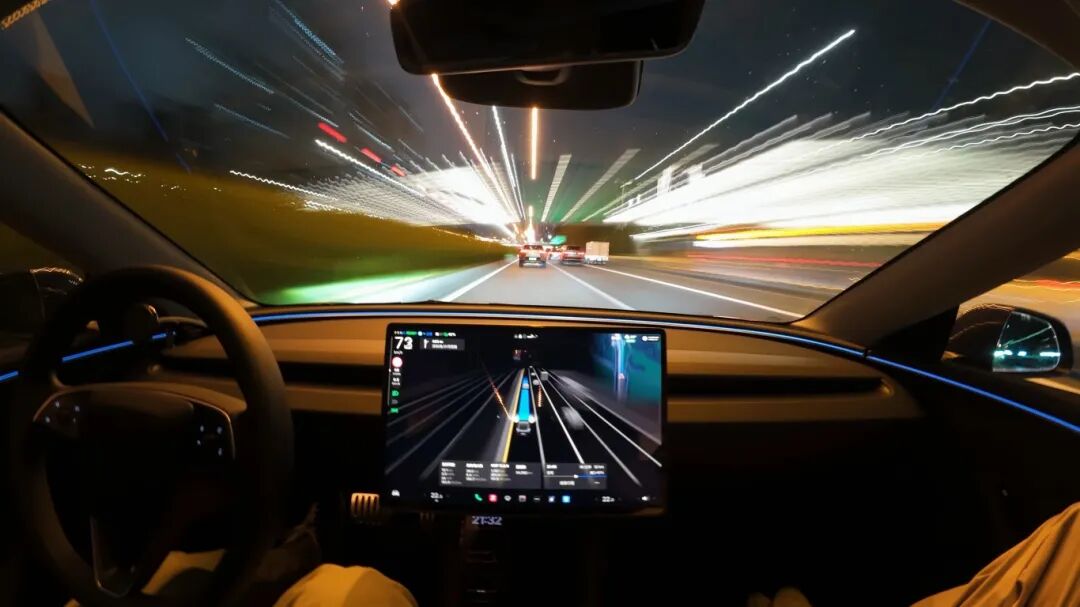
According to Musk, if the "full-featured" version arrives as scheduled, it will cover all scenarios, including urban roads, highways, automatic parking, and remote summoning. Subsequently, as long as the pricing is competitive, it will undoubtedly add fuel to the already fierce intelligent driving competition in the 2026 Chinese auto market.
Apart from Tesla, Huawei ADS will also be a major disruptor in this sector.
Based on the information released by its officials, 2026 will be a pivotal year for Huawei ADS, pursuing not just market share growth but also a transition from validation to system-level advancement. Multi-dimensional upgrades in safety, technology, ecosystem, and user experience will lay a more solid foundation for its long-term leadership in the Chinese intelligent driving market.
To summarize, Huawei ADS aims for both "quality" and "quantity." Its first true head-to-head confrontation with Tesla will undoubtedly be full of excitement.
Precisely because of their lead, no followers dare to take it lightly and must find a suitable development path by any means necessary. Everyone understands that a product's sales performance is increasingly tied to the strength of this dimension.
Again, the same viewpoint holds: "To excel in electric vehicle sales by 2026, driving range sets the baseline, while intelligent driving determines the ceiling."

Of course, if we attempt to summarize a more comprehensive set of survival rules, in this relatively mundane but extremely rigorous phase, for the mainstream mass market, it is essential to steadily introduce advanced configurations once exclusive to flagship models while ensuring quality, after-sales, and delivery without a hitch, maintaining the stability of residual value and pricing systems, and firmly upholding the trust of core user groups.
These seemingly ordinary actions actually construct the most solid fortress.
In the high-end luxury market, brand building, product experience, user needs, exclusive services, and emotional value should all take precedence. What matters is who can be patient and make consistent progress day by day.
Always remember that in the fiercely competitive Chinese auto market, "reliability and thoughtfulness" are the most precious flagship configurations. High-end and luxury are not just empty words; they require genuine dedication. Why do domestic brands always falter in their premium pushes? Impatience and lack of perseverance are the main culprits.
Before the next technological singularity arrives, the Chinese auto market has already shifted from incremental competition to increasingly fierce competition. In 2026, the banner of new energy transformation will undoubtedly continue to soar high, and the battles beneath it will become exceptionally intense. Everyone knows that electric vehicles are the future, but the future does not belong to everyone.
Finally, I would like to leave you with a quote from Xu Zhiyuan in the latest episode of "Thirteen Invitations": "Hold onto your initial passion and forge it into belief."
The same applies to car manufacturing...
Editor-in-chief: Cui Liwen Editor: He Zengrong
THE END
-
![]()
Enflame Tech's IPO Journey: Navigating Over 5.9 Billion Yuan in Losses and Soaring Debt in Q1 This Year
-
![]()
Trillion-Yuan Giant Li Shufu 'Streamlines': Could Levc Be the Casualty?
-
![]()
AI Competes for Electricity and Generates Power in the Gobi Desert
-
![]()
The First Batch of Victims of the AI Bubble: Programmers
-
![]()
ByteDance, DJI, and Xiaohongshu Secure Top Three Positions Among China’s Fastest-Growing Unicorns
-
Tesla's in-car voice system in China is finally learning to 'understand human language'
-
![]()
Foreigners Are Amazed: Chinese Electric Vehicle Drive Systems Unveil Innovative 'Poses'
-
![]()
700,000 Brothers and the Future of Robots: Behind JD.com's 'Nirvana Plan'