Self-driving Race: From Apollo Go, Pony.ai, WeRide, DiDi, HelloAuto to XPENG AEROHT, Who is Mapping the New Global Smart Mobility Landscape?
 03/02 2026
 505
505
Introduction
While Uber is still retrenching and Lyft remains confined to North America, Chinese autonomous driving companies are embracing an unprecedented globalization drive, ushering in a new 'Age of Great Navigation.'
This is not the reckless, cash-burning shared-bike expansion of 2016 but a systematic expedition driven by technology, ecosystems, and capital—
From DiDi's electric ride-hailing fleet in Brazil to WeRide's autonomous Robotaxis in Abu Dhabi;
From HelloAuto's bikes in Singapore to XPENG's flying cars soaring above Middle Eastern deserts, Chinese mobility forces are making dense [intensive] moves on the global map.
(For further reading, click: 'The Self-Driving 'Singularity' Has Arrived: As the U.S. Legislate to Race Ahead, How Can China Win This Global Competition? Insights from CPPCC Members and Industry Experts')
I. Platform Globalization 2.0: From 'Copy-Paste' to 'Ecosystem Co-Creation'
A decade ago, ofo and Mobike flooded London streets with bikes, only to collapse due to cultural mismatches.
Today, DiDi has transcended the rudimentary phase of 'APP export.'
In Brazil, it boasts 55 million users across 3,300 cities, launched the '99electric-Pro' electric ride-hailing service with over 30,000 BYD D1 vehicles, and co-built charging networks with automakers.
This is no longer mere product export but an ecosystem-driven expansion encompassing new energy vehicles, mobility platforms, energy infrastructure, and local life services.
(For further reading, click: 'GAC Aion: Collaborating with DiDi Autonomous Driving for 24/7 L4 Robotaxi Trial Operations, Jointly Organizing 'Open User Dialogues' with CATL and JD.com')
Similarly, CAOCAO Mobility, backed by Geely, leverages Yao Chuxing [Yao Chuxing], Geely Business Travel's global network across 12 cities, YiYi Interconnect's battery-swapping system, Timedotero satellite navigation, and even eVTOL aviation to construct a multi-dimensional global matrix spanning 'ground + air + energy + manufacturing.'
(For further reading, click: 'CAOCAO Mobility's 'Three-Chain Integration' Ambition: From Ride-Hailing Platform to Autonomous Driving Operator—Is 100,000 Custom RoboTaxis Achievable?')
This 'corporate army' approach leaves solo players like T3 and Ruqi far behind.
By Q3 2025, DiDi International averaged 12.63 million daily orders, with GTV surging 31% year-on-year—signaling that its overseas business now rivals domestic mainstream platforms in scale.
Chinese mobility platforms are evolving from 'followers' to 'rule-setters.'
II. Autonomous Driving: The Middle East Emerges as the 'New Silicon Valley,' a Third Pole Beyond China and the U.S.
If mobility platforms are the 'fleet,' autonomous driving is the 'artillery.'
WeRide, Pony.ai, Baidu Apollo, and DiDi Autonomous Driving are all turning their gaze toward the Middle East—a 'golden testbed' with open policies, abundant capital, and relatively driver-friendly road conditions.
(UAE: Full-speed commercialization of autonomous driving as Apollo Go, Pony.ai, and WeRide 'storm' the Middle East)
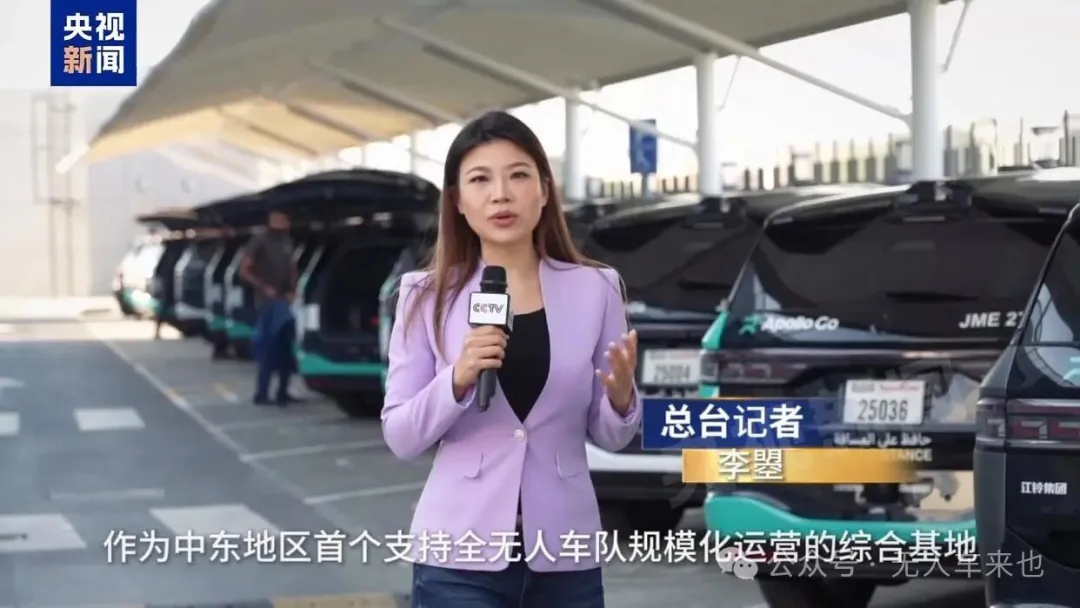
WeRide secured Abu Dhabi's world-first city-level L4 fully driverless commercial license, deployed a fleet exceeding 1,000 vehicles, and obtained operational permits across eight countries;
Pony.ai secured $100 million in funding from Saudi Arabia's NEOM City for a planned joint venture;
Baidu Apollo Go achieved 'debranded' technology export in Abu Dhabi through partnership with local operator AutoGo, skillfully navigating data compliance risks.
More intriguingly, the Abu Dhabi Investment Office has become a 'common shareholder' for Chinese autonomous driving firms—DiDi and CAOCAO Mobility both signed MoUs with it.
The Middle East is transforming from an oil exporter to a 'strategic buyer' and 'incubation hub' for smart mobility technologies.
Here, Chinese tech is no longer just a low-cost alternative but a core component of future urban infrastructure.
III. The X-Factor: From Two Wheels to Low Altitude, Mobility Boundaries Shatter
The real surprise comes from 'edge players' disrupting the status quo.
HelloAuto, a survivor of the shared-bike wars, now boasts over 10 million cumulative kilometers ridden in Singapore and quietly established L4 autonomous driving subsidiary 'Zaofu Intelligence,' aiming to disrupt Robotaxi with a 'Ant Group + CATL + HelloAuto' alliance.
(For further reading, click: 'HelloAuto's Autonomous Robotaxi Rolls into Changzhou, Jiangsu: From 'Two Wheels' to 'Four Wheels,' the Shared-Bike Giant's 'Autonomous Coming-of-Age Ceremony?')
The most shocking development, however, is the low-altitude economy's overseas surge.
In 2025, AutoFlight secured a $1 billion eVTOL order from the UAE;
XPENG AEROHT clinched 600 flying car orders, setting a global bulk procurement record.
While Europe and the U.S. debate eVTOL airworthiness standards, Chinese firms are already selling products to desert kingdoms. This represents not just tech export but strategic positioning for future urban transport paradigms.
Even Gaode, the once-beleaguered high-definition mapping company, turned profitable after a long winter and now prioritizes overseas expansion as strategic counterattack!
After all, with Tesla, Huawei, and XPENG all declaring 'abandonment of high-definition maps,' overseas markets may represent the last blue ocean.
IV. The Confidence Behind the Age of Great Navigation: Systemic Capabilities Nurtured by an RMB8 Trillion Market
None of this is accidental.
China's mobility industry reached RMB8 trillion in scale in 2024 and will surpass RMB10 trillion by 2029.
This vast domestic market has forged Chinese companies' unparalleled understanding of complex scenarios, relentless pursuit of cost efficiency, and groundbreaking innovations in multi-industry integration.
When these capabilities are projected globally, they form an irreplaceable composite advantage.
(For further reading, click: 'Global Financial Group Macquarie Predicts: Global Autonomous Taxi Fleet to Soar from ~7,000 in 2025 to Over 500,000 by 2030, Surpassing 3 Million by 2035—A 430-Fold Leap in a Decade')
More critically, Chinese mobility firms no longer operate in isolation.
Automakers (BYD, GAC), batteries (CATL), chips (Horizon Robotics), satellites (Timedotero), finance (Ant Group)... A complete 'mobility industrial system' has taken shape.
Global expansion is no longer a corporate gamble but a collective expedition by China's industrial chain.
V. Conclusion: Not Replicating Uber, But Defining the Next Uber
Today's Chinese mobility globalization has transcended the 'Silicon Valley benchmarking' phase.
We no longer ask, 'How to become the next Uber?' but answer, 'Who will define the future of global mobility?'
From ground to low altitude, from two wheels to driverless, from apps to ecosystems—
This Age of Great Navigation is not a contest of who burns cash faster but who can localize deeper, integrate resources better, and create value more sustainably.
As DiDi's electric vehicles navigate São Paulo, WeRide's Robotaxis pick up passengers in Abu Dhabi, and XPENG's flying cars test-fly in Dubai, the world witnesses not just 'Made in China' but 'China Solutions,' 'China Speed,' and 'China Imagination.'
In summary, WeRide Coming (WeChat ID: WeRide Coming) argues:
The Age of Great Navigation for global smart mobility has set sail.
This time, Chinese mobility firms led by autonomous driving giants aim to be their own Columbus.
What do you think, dear reader?
#WeRideComing #AutonomousDriving #SelfDriving #DriverlessCars
-
![]()
Can Chinese Automakers Pose Such Fierce Competition? Mercedes-Benz Cancels Year-End Bonuses for 90,000 Staff, Volkswagen to Lay Off 100,000 Employees...
-
![]()
Anhui and Zhejiang Vie for the Crown in New Energy Vehicle Dominance: Who Will Prevail?
-
![]()
Tmall 618 Rankings Unveil Trends Transforming the Home Appliance Industry
-
![]()
This Week in Home Appliances: Overseas Boom! Midea, TCL, Dreame Break Through; Casarte, Fotile, Gree, Hisense, Ronshen Lay Foundations
-
![]()
Aiming to Be the Alphard of the Electric Era! After D99's Launch, Leapmotor Will Release All-New Technologies to Pave the Way for a High-End Brand | Mirrormedia Pro
-
![]()
Over 5,200 Orders Placed on First Day: Can the Qijing GT7, Priced from 209,900 Yuan, Compete with the Z7 and SU7? | Mingjing Pro
-
![]()
AI Predicting the World Cup? It’s Time to Stop Insulting AI
-
![]()
iPhone 18 Pro Memory Costs Soar Threefold! Apple Seeks Trump Administration Approval for CXMT Memory Chips