February Auto Sales Show Increased Polarization Among Leading Car Manufacturers
 03/04 2026
 577
577
Author: Chen Jia
Produced by: Insight Auto
As March unfolds, domestic car manufacturers have sequentially announced their February sales results. Data from twelve major manufacturers indicate that amidst the combined effects of purchase tax policy adjustments and the Spring Festival holiday, these figures serve as a crucial test of manufacturers' resilience to risks.
A collective downturn in the new energy vehicle (NEV) sector emerged as the central theme of February's auto market. Performance varied significantly across different manufacturer groups: top-tier players maintained stability but faced intensified internal competition, new entrants accelerated their reshuffling, and the influence of joint venture brands continued to wane. The competition dynamics in China's auto market underwent a fresh round of restructuring, as evidenced by off-season data.
The leading five car manufacturers solidified their positions as SAIC Motor, Geely Auto, BYD, Chery Group, and Changan Automobile. Notable disparities in monthly sales and business structures underscored the varying quality of development among these industry leaders.
SAIC Motor retained its top spot with 269,465 units sold in February, nearing a cumulative total of 600,000 units from January to February. Dual growth in its self-owned brands and the NEV sector fortified its growth foundation, with particularly robust overseas performance: 204,000 exports from January to February, marking a 48.9% year-on-year increase. The MG brand's cumulative European sales surpassing 1 million units highlighted the effectiveness of its global strategy.
Geely Auto sold 206,160 units in February, retaining its title as the top-selling self-owned brand. NEV sales accounted for 57% of its total, with the Zeekr brand driving growth in the high-end segment. Overseas exports reached 60,879 units, doubling year-on-year, showcasing its formidable overseas business capabilities.
BYD sold 190,190 units in February, maintaining its leading position in the NEV market. However, its Dynasty and Ocean series experienced a year-on-year decline, raising concerns about growth reliance on a single category.
Chery Group sold 160,765 units in February, with exports accounting for over 70% of total sales. Its monthly exports of 124,929 units made it the first Chinese brand car manufacturer to surpass 6 million cumulative exports. Transitioning from price competition to technology export marked a new phase in its localized overseas expansion.
Changan Automobile sold 151,922 units in February, achieving a 12.8% month-on-month increase against the trend. Dual growth in NEV and overseas sales validated the effectiveness of its strategic adjustments, with sub-brands like Changan Kaiana forming product synergy through phased growth.
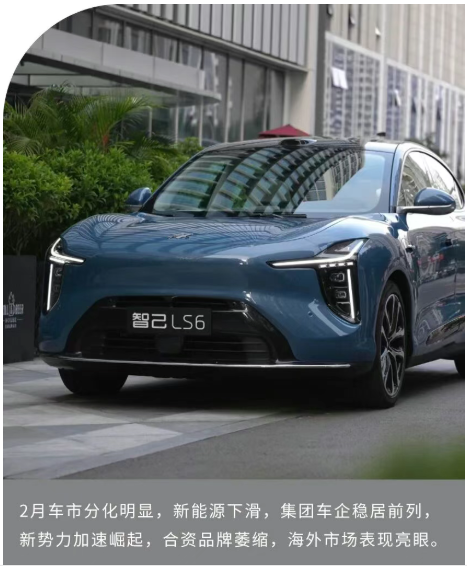
The top five new forces were led by HiPhi, Leapmotor, Li Auto, Zeekr, and NIO, with the pattern of competitiveness undergoing changes that reflect a reordering of core strengths.
HiPhi claimed the top spot among new forces with 28,212 units sold in February, up 31.1% year-on-year, and 86,127 cumulative units from January to February. The AITO brand's ecosystem advantages translated into sales momentum, making it a rare stable grower among new forces.
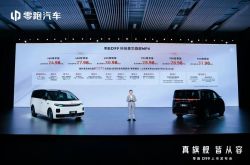
Leapmotor and Li Auto reported sales of 28,067 and 26,421 units, respectively. Leapmotor achieved 11% year-on-year growth through a comprehensive product matrix, with multiple new models poised for launch. Li Auto experienced a slight month-on-month decline due to the Spring Festival holiday, with its new-generation models becoming key to volume growth.
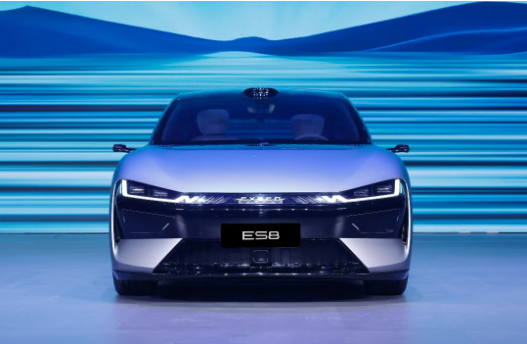
Zeekr's 23,867 units represented a 70% year-on-year surge, achieving dual growth and becoming Geely's new energy growth engine. Technology-driven high-end market breakthroughs solidified its position in the NEV luxury segment.
NIO sold 20,797 units, up 57.6% year-on-year, but a month-on-month decline necessitated increased March promotions. The effectiveness of its multi-brand strategy remains untested, with its participation in price wars reflecting growth pressures.
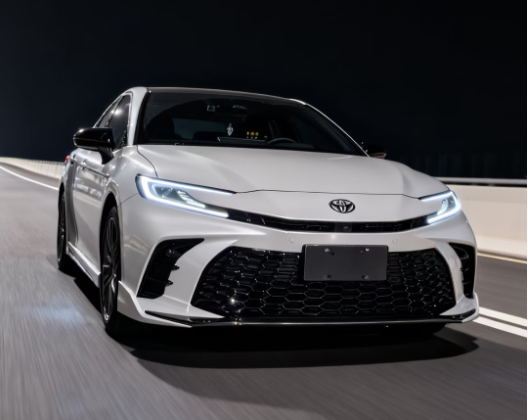
Joint venture brands experienced a collective cooling in February, with only GAC Toyota and Dongfeng Honda voluntarily disclosing sales, becoming rare exceptions amidst the industry downturn.
GAC Toyota sold over 40,000 units in February, achieving cumulative positive growth. Its three flagship models—Camry, Highlander, and Sienna—contributed 20,761 units, accounting for nearly half of total sales. Upcoming new product pre-sales aim to break through in the NEV sector and reverse the passive position of joint venture brands.
Dongfeng Honda sold 17,583 units in February, up 10.1% year-on-year, with the CR-V model exceeding 10,000 units and accounting for over half of sales, highlighting its core competitiveness in fuel vehicles. However, a narrow product matrix and absence in the NEV sector make it vulnerable to pressure from self-owned brands.
Other joint venture brands remained silent, confirming the market crisis caused by delayed NEV transformation. Squeezed by self-owned brands and new forces, joint venture brands' market share continues to shrink, with fuel vehicle advantages rapidly eroding and NEV layouts lacking core technologies, mired in development dilemmas.
High overseas growth by SAIC, Chery, and Geely confirms the value of globalization. Chery's expansion from Africa-Asia-Latin America to Europe, and its shift from price competition to localized technology, marks China's car manufacturers' entry into a new phase of localized operations and technology export.
The depth of NEV transformation determines market positions. Geely's high NEV share, Zeekr's high-end breakthroughs, and Changan's dual growth demonstrate the effectiveness of transformation. BYD's partial segment decline serves as a warning to the industry: NEV competition has entered a phase of refined operations, with product iteration and alignment with user demand becoming critical.
Amidst purchase tax adjustments and fluctuating consumer confidence, enterprises with complete product matrices, sufficient technology reserves, and deep globalization can achieve stable development.
Off-season data never marks an endpoint but a new competition starting point. In 2026, residual purchase tax policy impacts and consumer confidence recovery will become key variables in China's auto market.
Manufacturer competition will shift from sales volume battles to comprehensive contests in technology, products, and globalization. Overseas market opportunities will coexist with geopolitical risks, while the integration of intelligence and electrification in the NEV sector will become core competitiveness.
Market polarization will deepen, and industry reshuffling will accelerate. Only enterprises seizing overseas opportunities, deepening NEV transformation, and optimizing product matrices can take the initiative in competition.
END
-
![]()
Why is Hyundai Willing to Acquire Boston Dynamics at a Loss?
-
![]()
Can Leapmotor's New C-Series Take the Lead in Its Family Lineup?
-
![]()
Multimodal AI Model Revolutionizes Audio-Visual Perception in Steelmaking Safety: Hikvision and Nanjing Iron and Steel Forge New Pathways
-
![]()
Can Chinese Automakers Pose Such Fierce Competition? Mercedes-Benz Cancels Year-End Bonuses for 90,000 Staff, Volkswagen to Lay Off 100,000 Employees...
-
![]()
Anhui and Zhejiang Vie for the Crown in New Energy Vehicle Dominance: Who Will Prevail?
-
![]()
Tmall 618 Rankings Unveil Trends Transforming the Home Appliance Industry
-
![]()
This Week in Home Appliances: Overseas Boom! Midea, TCL, Dreame Break Through; Casarte, Fotile, Gree, Hisense, Ronshen Lay Foundations
-
![]()
Aiming to Be the Alphard of the Electric Era! After D99's Launch, Leapmotor Will Release All-New Technologies to Pave the Way for a High-End Brand | Mirrormedia Pro