Overseas Expansion Map: How Will Chinese Automakers Fare in Europe's Fiercely Competitive Auto Market?
 03/04 2026
 509
509
Lead | Introduction
As a market with annual sales exceeding 10 million units, the European auto market, while smaller in scale compared to China and the United States, serves as the stronghold for traditional automotive giants such as Volkswagen, Stellantis, and Renault. Additionally, Japanese and Korean automakers have also established a long-standing presence in Europe. Gaining a foothold in this market would significantly demonstrate Chinese automakers' strength and status on the global automotive stage.
Produced by | This article is produced : Heyan Yueche Studio
Written by | writing : Zhang Dachuan
Edited by | edit : He Zi
Full text: 3,335 characters
Reading time: 5 minutes
The European auto market is projected to experience moderate growth on the surface in 2025, but beneath the calm waters, turbulent currents rage.
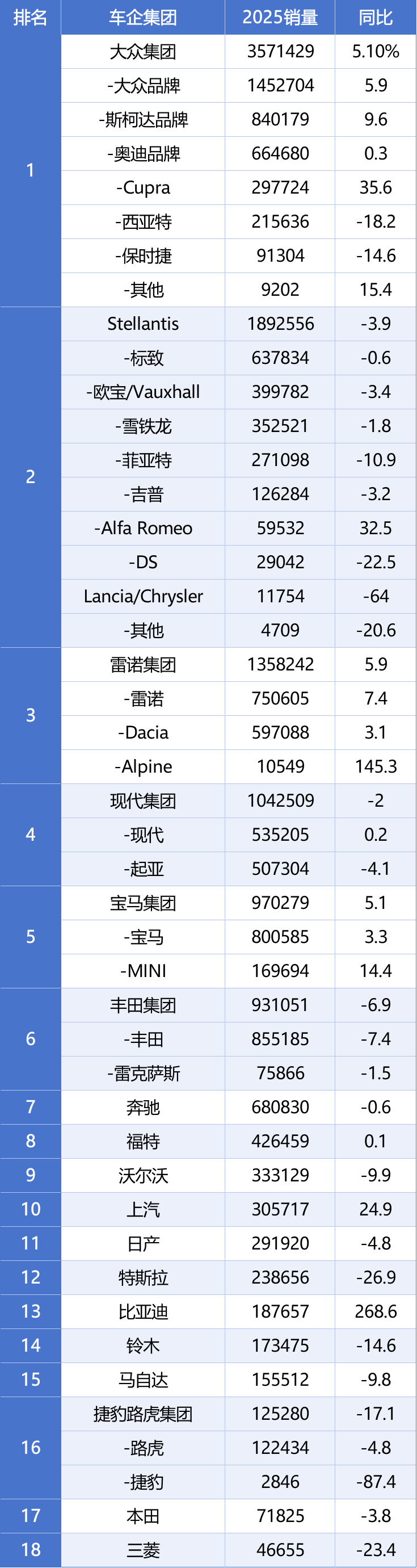
Last year, passenger car sales in Europe (EU + UK + EFTA, including Norway, Switzerland, Iceland, and Liechtenstein) reached 13.27 million units, up 2.4% year-on-year. Although this marked the third consecutive year of growth, overall sales remained approximately 2.5 million units below the pre-pandemic levels of 2019. The European automotive market still has a long way to go to regain its former levels.
Last year, Germany maintained its position as Europe's largest automotive market, with a 1.3% year-on-year increase, and continued to be Europe's largest electric vehicle market. Spain stood out as the best-performing country in Europe, with a 12.9% increase. Volkswagen Group remained the largest automaker in the European market and the best-selling electric vehicle brand. However, the best-selling model across Europe was not from Volkswagen but rather the Renault-owned Dacia Sandero, which retained its crown.
Data source: ACEA
How Does the European Auto Market Fare? Germany Remains a Stronghold for Gasoline Vehicles
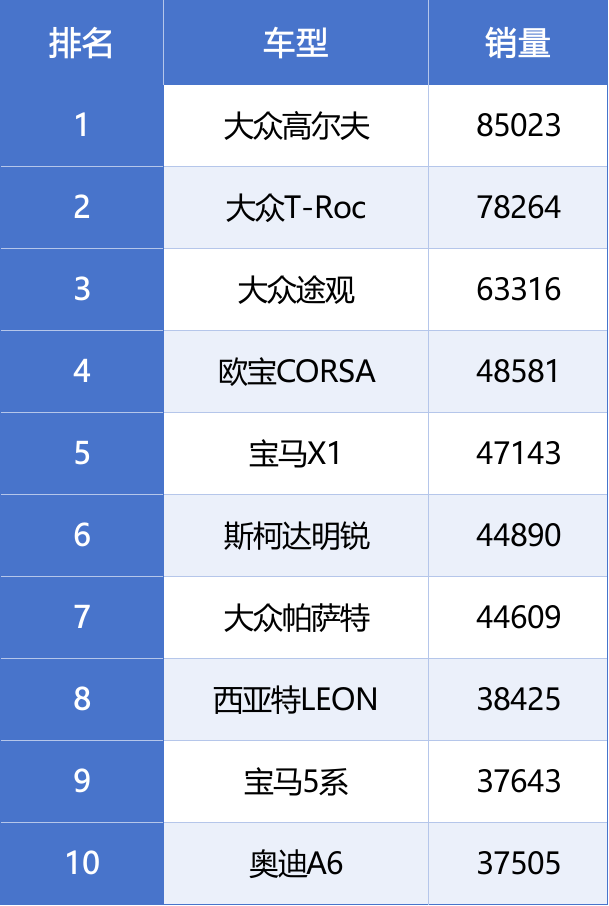
In 2025, new car sales in Germany increased by 1.4% year-on-year to 2,857,591 units. As the largest automotive market in continental Europe, Chinese brands failed to secure a spot in the top ten best-selling models in Germany.
The situation in 2025 remained somewhat similar to the previous two years, with the top three best-selling models in the German market being the Volkswagen Golf, T-Roc, and Tiguan. However, none of these models had electric vehicle (EV) variants, indicating significant growth potential for new energy vehicles in the German automotive market in the future. Additionally, the domestic Opel Corsa ranked fourth, while the Skoda Octavia was the best-selling foreign brand model in the German market. Considering that Skoda is also part of the Volkswagen Group and shares platforms and supply chains with the Volkswagen brand, many German consumers may opt for more cost-effective products.
In terms of new energy vehicles, the Volkswagen ID.7 (the all-electric version of the Passat) was the best-selling electric car in Germany but did not make it into the top ten overall. Among the top ten models, several contributed sales through their all-electric variants. For example, one-third of BMW X1 sales came from the all-electric version; one-fifth of BMW 5 Series sales were electric; over one-third of Audi A6 sales were electric; and the all-electric version of the Opel Corsa contributed approximately 7,000 units annually.
The UK Auto Market: A Melting Pot
In 2025, the UK's new car market grew by 3.5%, with a total of 2,020,520 newly registered passenger vehicles. The inclusion of the MG HS in the top ten list demonstrates that Chinese automotive brands have firmly established a presence in the UK market.
Overall, unlike the German automotive market, which is dominated by German brands, the UK automotive market is much more diverse. Although Volkswagen remained the best-selling brand in the UK for the fifth consecutive year, the Ford Puma once again became the best-selling model, while the Tesla Model Y, with 24,298 units sold, remained the best-selling electric vehicle in the UK.
In fact, the Ford Puma has been the best-selling model in the UK for three consecutive years and set a new record in 2025. For UK consumers, cost-effective models with balanced features remain the top choice. The Kia Sportage and Nissan Qashqai ranked second and third for the second consecutive year. The Corsa (a rebadged version of the Opel Corsa), from the UK's only remaining mass-market domestic brand, Vauxhall, entered the rankings by capitalizing on Ford's discontinuation of the Fiesta. Notably, the Volvo XC40, as the only luxury brand model on the list, outperformed the Volkswagen Tiguan and Hyundai Tucson, which is commendable.
France's Preference for Domestic Brands
In 2025, the French new car market contracted by 5% year-on-year, with total sales reaching 1,632,154 units.
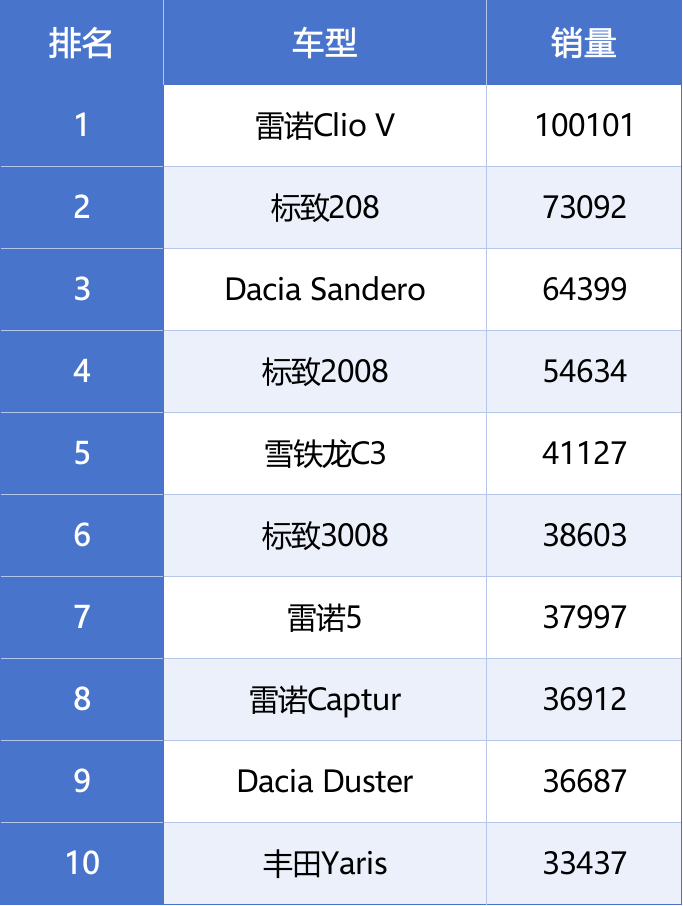
Renault, Peugeot, and Dacia remained France's best-selling automotive brands, with the Renault Clio, Peugeot 208, and Dacia Sandero being the top three models for the third consecutive year. In terms of new energy vehicles, only the Renault 5, an all-electric model, made it onto the overall rankings.
Unlike the UK and German markets, French consumers clearly show a stronger preference for small cars from domestic brands. These models offer relatively high cost-effectiveness and better align with French consumers' aesthetic preferences. This market dynamic makes it more challenging for non-European-produced economy models to break into the French market. In fact, France and Italy were relatively more aggressive in proposing taxes on Chinese electric vehicles. After all, more cost-effective Chinese models, whether fuel-powered or new energy vehicles, could become the biggest competitors to French brands if they enter the European market on a large scale, directly threatening the business performance of Stellantis and Renault.
Chinese Brands Face an Uphill Battle
The European market, with its strong purchasing power and unlike the United States, which has not completely blocked Chinese automobiles, has become a key overseas market that Chinese automakers have been vigorously expanding into in recent years. For Chinese automakers, selling new cars in Europe not only generates substantial profits but also enhances their global brand recognition.
In 2025, Chinese automakers sold 811,000 new cars in Europe, a 99% year-on-year increase, capturing a 6.1% market share. In 2024, Chinese automobiles held only a 3.1% market share in Europe. Notably, in December of the previous year, monthly sales of Chinese brand cars exceeded 100,000 units for the first time, reaching 109,900 units, a 127% year-on-year increase, with the market share jumping to 9.5%. Although the EU imposed high tariffs on Chinese pure electric vehicles, Chinese brands quickly shifted to plug-in hybrid models, effectively bypassing the EU's tariff barriers. The 10% import tariff, combined with high cost-effectiveness, made Chinese plug-in hybrid models highly popular in the European market.
In the European market, SAIC MG, BYD, and Chery have emerged as representatives of Chinese automotive brands. MG sold 307,000 units in Europe last year, a 26% year-on-year increase, becoming the best-selling Chinese brand in the European market. The MG brand performed particularly well in mainstream European markets such as the UK, Germany, and France. BYD, ranking second, surpassed Tesla in multiple European markets in 2025, further solidifying its position as the global leader in new energy vehicles. BYD's sales reached 187,000 units last year, a 276% year-on-year increase, showing a strong upward trend. As for Chery, its sales in Europe reached 120,000 units in 2025, compared to just 17,000 units in 2024. Spain and Turkey were the biggest contributors to Chery's rapid sales growth. However, Geely, which owns brands like Volvo and Polestar, did not perform particularly well in the European market, with Lynk & Co and Zeekr both showing relatively lackluster performance. Enhancing the sales of these two brands and introducing the Galaxy model to the European market should be Geely's next focus.
Among the new energy vehicle startups, only Xpeng and Leapmotor have initially established a foothold in the European market, while other new energy brands have a relatively low presence. Xpeng primarily relies on the G6 to gain market share in Europe, and Volkswagen, which has allied with Xpeng in the domestic market, has not provided significant support to Xpeng in Europe. Leapmotor, on the other hand, has benefited from Stellantis' channel empowerment, with some models even available for sale in Stellantis' dealerships. In particular, the Leapmotor T03 has become one of the most cost-effective choices in Europe's low-priced small car market.
However, it must be noted that European consumers' recognition of Chinese automotive brands remains low. Market research data shows that only 14% of consumers in Germany have heard of BYD, and only 1% are willing to purchase a BYD. Ten percent have heard of Lynk & Co, and 8% have heard of Xpeng. To change European consumers' car-buying perceptions and habits, Chinese automotive brands still have much work to do. Whether the spark can ignite a prairie fire depends on Chinese automotive brands' long-term commitment to challenging European domestic competitors with stronger comprehensive strength.
Commentary
The European automotive market is relatively mature and stable. Previously, Japanese and Korean automakers managed to carve out a niche in the European market by offering models with higher cost-effectiveness compared to European domestic brands. For Chinese automakers, given the significant technological transformations currently underway in the automotive industry, they cannot simply repeat the path taken by Japanese and Korean automakers. In addition to continuously strengthening their advantages in new energy and intelligent connected vehicle technologies, Chinese automakers must also prepare to establish a deep-rooted presence in the European market. By building a complete local industrial chain and a comprehensive system, they can truly create a new foothold in the European market.
(This article is original to Heyan Yueche and may not be reproduced without authorization.)
-
![]()
The Unstoppable Rise of 'Optical Progress and Copper Decline': Sunny Optical’s Strategic Vision for the Next Decade
-
![]()
AI + Going Global in the Second Half: No Intermission for Robot Vacuum Cleaners
-
![]()
The Suffering Endured in E-commerce, Walmart Doesn't Want to Repeat in AI
-
![]()
What Does the Doubling of New Energy Vehicle Exports Mean?
-
![]()
Ghosn: 'Only I Can Save Nissan'
-
![]()
Volkswagen Lays Off 100,000 Employees, The Elephant Sits Down
-
![]()
Expanding Production Capacity! Yutong Optics Acquires Approximately 1.5 Hectares of Industrial Land in Chang'an, Dongguan
-
![]()
Why Is Nokia Making a Comeback in the AI Era?