The Gunfire in the Middle East Shatters the Dream of 'Paradise': Are Robotaxi Companies Reduced to 'Nomadic Tribes'?
 03/06 2026
 610
610
By: Tan Qing Shuo AI
The ongoing situation in the Middle East has brought a black swan event to China's autonomous driving industry as it expands overseas.
According to Yicai Global, WeRide's Robotaxi fleet in Dubai, UAE, has temporarily suspended operations, awaiting notification of resumption.
Apollo Go stated that they have temporarily paused autonomous driving tests within the UAE.
Pony.ai, due to regional tensions, has suspended road testing in Dubai and Doha to comply with local authorities' unified deployments and ensure testing safety. After evaluation, testing in Doha resumed on March 2;
meanwhile, the company is maintaining communication with Dubai regulatory agencies and will resume local testing at an appropriate time once safety is ensured.
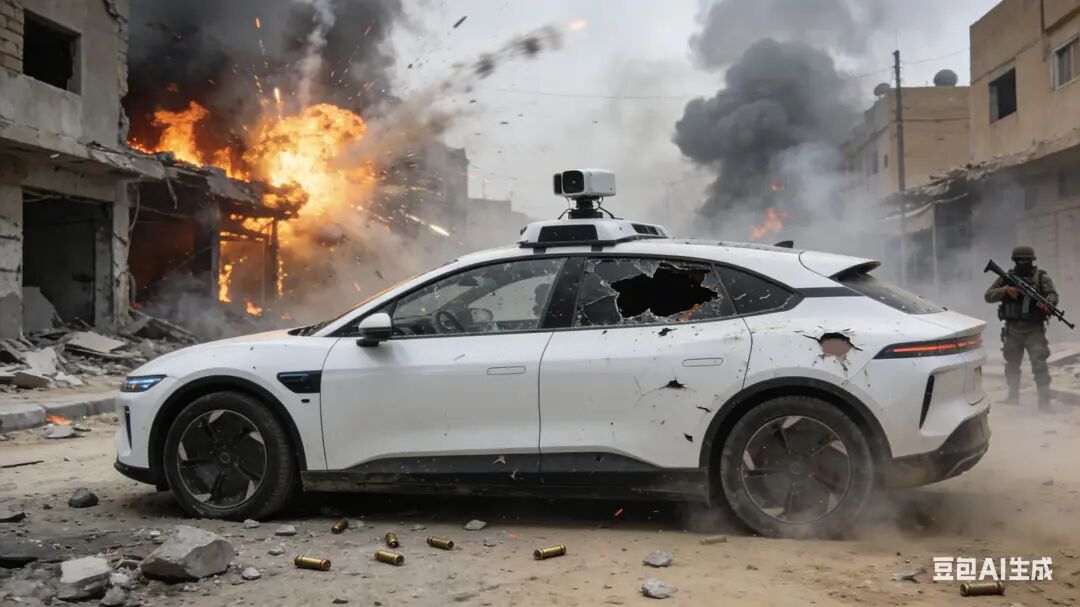
With the conflict just beginning and its duration uncertain, Chinese autonomous driving companies face a critical test in their overseas expansion plans.
//The Middle East Situation Disrupts Robotaxi Companies' Overseas Expansion Rhythm
In recent years, accelerated overseas layout (layout) by Chinese autonomous driving companies has become a notable industry trend.
Given that Robotaxi is still in its early marketization stage, companies need to continuously accumulate driving data and increase revenue in suitable market environments, making the choice of landing market crucial.
From a market perspective, the Middle East has long been regarded as a "fertile ground for overseas expansion" by autonomous driving companies.
Especially Abu Dhabi and Dubai, core tourist cities in the UAE, almost possess all necessary conditions for commercializing autonomous driving.
Firstly, compared to regions like Southeast Asia, the Middle East has financial resources, offering higher unit prices and a favorable profit environment.
Its per-kilometer fare is approximately 7.2 yuan (about 3.0 yuan domestically).
Compared to Europe, the Middle East has a more open regulatory environment for autonomous driving. Europe has the world's most stringent regulatory framework, while the Middle East adopts a relatively relaxed approach.
Taking the UAE as an example, its unique demographic composition effectively eliminates public opinion resistance to autonomous driving technology adoption.
In the UAE's population structure, local citizens account for only about 11% of the total population, while foreigners make up about 89%, with a high dependence on foreign labor in social services.
This reality has led the government to adopt a proactive attitude toward autonomous driving, significantly reducing policy costs and attracting Chinese companies like Apollo Go, WeRide, and Pony.ai to enter the market.
Among them, WeRide has the earliest and most extensive layout (layout) in the Middle East.
As early as 2021, WeRide publicly operated Robotaxis in the Middle East and obtained a UAE-wide operational license last year.
Currently, it operates Robotaxis in three cities: Abu Dhabi and Dubai in the UAE, and Riyadh in Saudi Arabia, with approximately 200 autonomous vehicles in the Middle East, accounting for about one-fifth of its total fleet.
Pony.ai and Apollo Go only obtained road testing qualifications last year.
However, the most extensive layout (layout) also means being the most vulnerable when war breaks out.
The suspension of services in Dubai is just the current situation. Given the escalating conflict in the Middle East and more countries being drawn into armed confrontation, whether WeRide's other operational regions will be affected in the future remains uncertain.
For WeRide, the Middle East is a strategic market. WeRide CEO Han Xu has stated that the surge in Robotaxi revenue in the second quarter of 2025 owes much to the Middle East market.
It is reported that WeRide's revenue surged eightfold in the second quarter of 2025.
This also means that once the conflict expands, WeRide's performance may face significant impact.
More critically, the rapid evolution of the situation may substantially interfere with its future layout (layout).
Currently at a critical stage of scaling up, on February 6, WeRide upgraded its strategic cooperation with Uber, with both sides planning to deploy at least 1,200 Robotaxis in the Middle East by 2027.
This sudden war has cast a shadow of uncertainty over their cooperative expansion plans.
However, Zhan Liangfei, head of WeRide's Middle East and North Africa region, told a reporter from National Business Daily, "In the first quarter of 2026, we aim to achieve overall regional profitability in Abu Dhabi, UAE. Currently, this goal remains unaffected."
At least from the current development perspective, WeRide's operations remain within controllable limits.
For Baidu's Apollo Go, although its Middle East layout (layout) was not as early as WeRide's, among numerous Robotaxi companies, it is the most eager to expand.
Affected by generative AI, Baidu's core search business, which built the company, is facing structural contraction, forcing it to shift its growth focus entirely toward the AI business sector.
According to Baidu's latest financial report, in the fourth quarter of 2025, Baidu's AI business accounted for 43% of total revenue.
This is not solely due to explosive growth in the AI business but more because of the rapid decline of the traditional search business.
According to Goldman Sachs estimates, this business plummeted by about 26% year-on-year in the fourth quarter of 2025.
Not only has core business revenue declined, but Baidu App's monthly active users have also dropped to 679 million.
As a traditional typical B2C company, its influence on the consumer side continues to weaken, an undeniable fact.
From another perspective, as the search business desperately seeks a successor, Apollo Go has exactly (coincidentally) become one of the best candidates to shoulder this "orphan's trust." It is not only a crucial consumer-facing entry point in the AI era but also a core business with the highest upside potential.
Living up to expectations, as early as the end of 2024, Apollo Go achieved profitability in a single city (Wuhan), and Baidu's autonomous driving technology is undoubtedly among China's first tier.
It can be said to have both technology and funding, with a heavy responsibility on its shoulders.
Apollo Go should have seized the moment to pursue aggressive expansion.
Yet, it is precisely stuck at the critical juncture of expanding its territory.
It is reported that Apollo Go currently operates in 26 cities worldwide, having started in 13 cities by the end of 2024. After two years, it has only added 13 more cities, with expansion speed not as fast as imagined.
Now, domestic expansion is challenging, and the Middle East is no longer fertile ground.
More regrettably, Apollo Go just launched commercial Robotaxi operations in Abu Dhabi, UAE, in January and secured Dubai's first fully driverless testing permit, originally planning to deploy a fully driverless fleet in Dubai in the first quarter of 2026 and expand the local fleet to 1,000 units within the year.
It should have been a time to go all out, but now the plan may harbor hidden risks.
Therefore, Apollo Go is the most eager among Robotaxi companies to expand. The longer it delays, the greater the uncertainty becomes.
Baidu is often teased as "starting early but arriving late."
Last year, when ERNIE Bot was at its peak, DeepSeek emerged as a disruptor.
Now, as domestic Robotaxi companies are racing to catch up, if the Middle East conflict escalates and Apollo Go's expansion speed slows further, could a "DeepSeek" moment emerge in the Robotaxi industry?
Additionally, there are now external voices questioning whether Apollo Go should be spun off, to which Li Yanhong recently responded ambiguously.
Previously, when Baidu's Kunlunxin was spun off, Tan Qing Shuo AI had argued that Apollo Go might be even more suitable for spin-off.
Spin-off implies decentralization, maximizing organizational management enthusiasm, and may be more suitable for future expansion, much like ancient generals granted the authority to "act independently without waiting for imperial orders."
Among the leading autonomous taxi companies, Pony.ai has been the least affected.
Having long focused on the domestic market and been relatively conservative in expanding overseas, its Robotaxi business in the Middle East is still in the testing phase and has not yet launched commercial operations Targeting the public (for the public), representing minimal investment.
Overall, the current war in the Middle East has disrupted the overseas expansion progress of the Robotaxi industry.
With no clear end in sight for the war, if it evolves into a situation like the Russia-Ukraine conflict, from a worst-case perspective, the Middle East may no longer be fertile ground for autonomous driving investment.
As of the Hong Kong stock market's close on March 4, WeRide's stock price once fell by more than 4% during intraday trading; Pony.ai's stock price fell by more than 8%, with market sentiment remaining pessimistic.
Speaking of the capital market, it is worth mentioning that both Pony.ai and WeRide have received investments from Middle Eastern capital.
Pony.ai received a $100 million investment from NEOM and its investment fund NIF (NEOM Investment Fund) in Saudi Arabia;
WeRide received investment from the China-Arab Investment Fund.
Middle Eastern capital can be considered one of their key financial backers.
For both companies' Middle East layout (layout), not only does the Middle East have a strong demand for autonomous driving technology, but it also helps bring them closer to Middle Eastern capital, creating favorable conditions for subsequent financing.
However, given the current uncertainty in geopolitics, both companies have yet to achieve positive operating cash flow, and financing remains their core means of supplementing funds and sustaining operations. If the Middle East route becomes blocked due to changing circumstances, their funding channels may narrow further.
Fortunately, both have completed Hong Kong stock listings and now have sufficient cash reserves to last for some time. Last November, WeRide and Pony.ai both listed on the Hong Kong stock market, raising HK$2.39 billion (approximately RMB 2.147 billion) and HK$7.7 billion (approximately RMB 6.919 billion), respectively.
In comparison, among the leading companies, Baidu's Apollo Go remains more stable, given its solid foundation.
//Who Can Replace the Middle East as the "Fertile Ground" for Overseas Expansion?
For the Robotaxi industry, with rising tensions in the Middle East, overseas expansion inevitably faces pressure.
Finding the next fertile ground seems even more critical.
Domestically, widespread adoption is not yet feasible due to practical constraints.
Europe's stringent safety and compliance standards slow down adoption; going to Southeast Asia reveals that local labor costs are lower, making cost-effectiveness unfavorable.
The markets available for Robotaxi companies to expand and scale up are already limited. Now, which regions could replace the Middle East?
Could Singapore become the next Middle East?
Developed with favorable policies, especially as Singapore was the world's first city to conduct Robotaxi trial operations.
Previously, Mushroom Autonomous chose to collaborate with Singapore on autonomous buses, and Pony.ai partnered last year with ComfortDelGro, Singapore's largest transport operator, to deploy autonomous vehicles and related services locally.
From a governmental strategy and development perspective, Singapore seems an ideal choice.
However, this still cannot replace the importance of the Middle East market. After all, Singapore is a garden city with a large population but a tiny land area, leading to traffic congestion and limited scalability.
Perhaps U.S. autonomous driving companies can provide some insights. Waymo is currently only in the first stage of overseas expansion, conducting tests solely in Tokyo.
From this perspective, capital cities in developed regions like Tokyo and Seoul might also be suitable.
Overall, after the upheaval in the Middle East, there are not many cities left for Robotaxi companies to operate in.
However, while there are fewer cities now, the number of domestic companies entering the Robotaxi sector continues to grow.
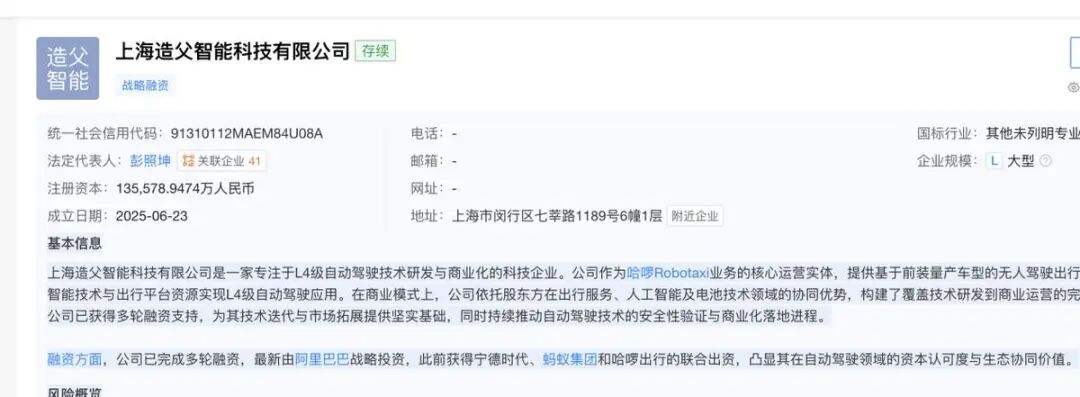
According to Tianyancha App, last year, Hello partnered with Alibaba and CATL to venture into Robotaxi, jointly establishing Zaofu Intelligence Co., Ltd., planning mass production this year and deploying 50,000 units next year.
On the ride-hailing platform front, Cao Cao Mobility announced its Hong Kong stock listing last year, betting on Robotaxi, and set key performance indicators this January, such as deploying 100,000 customized Robotaxis; even automakers are unwilling to cede this market, with XPENG Motors planning to collaborate with AutoNavi to launch three Robotaxi models this year...
Robotaxi is gaining momentum domestically, posing certain pressure on veterans like WeRide, Pony.ai, and Baidu.
For the Robotaxi industry, ultimate technologies will converge, and the slower the market expansion, the less the first-mover advantage for leading companies, with pursuers closing in rapidly.
Moreover, among the pursuers, many are backed by major corporations, like Hello supported by Alibaba, which provides not only funding but also algorithmic advantages; Cao Cao Mobility backed by Geely, manufacturing customized vehicles with differentiation advantages; XPENG Motors, starting as an automaker, can create synergies with its own car brands in Robotaxi operations, making it easier to establish a leading perception.
Therefore, with fewer cities available for overseas expansion, the conversion of first-mover advantages for leading companies will diminish, and the pressure from pursuers will intensify.
However, despite the uncertainty in the Middle East, Apollo Go, Pony.ai, and WeRide have accumulated cross-border operational experience, which remains a significant advantage, giving them time to exert efforts in other regions.
Meanwhile, the Middle East incident has provided some insights for future Robotaxi companies.
Now, overseas competition transcends mere technological and operational dimensions, testing companies' risk anticipation and control capabilities, as well as their agile response and resilient survival capabilities in the face of sudden crises.
Overseas expansion is necessary but must be approached cautiously.
In today's world of increasing decoupling, heavy overseas asset investments may not be advisable, as Amazon's data center in the Middle East was recently destroyed.
Although WeRide has been aggressive in overseas expansion, it has consistently pursued a light-asset approach, avoiding excessive investment without room for maneuver.
Moreover, what is concerning now is that in some regions of the Middle East, our autonomous driving peers have had to enter emergency mode—stockpiling supplies, staying indoors, and even guarding against flying debris during daily operations.
They set out for the future but first encountered the smoke of history.
This deeply illustrates that no matter how far a business's reach extends, it must ultimately take root in peaceful soil.
May the smoke of war disperse soon, and may our compatriots far away return home safely.
-
![]()
The Unstoppable Rise of 'Optical Progress and Copper Decline': Sunny Optical’s Strategic Vision for the Next Decade
-
![]()
AI + Going Global in the Second Half: No Intermission for Robot Vacuum Cleaners
-
![]()
The Suffering Endured in E-commerce, Walmart Doesn't Want to Repeat in AI
-
![]()
What Does the Doubling of New Energy Vehicle Exports Mean?
-
![]()
Ghosn: 'Only I Can Save Nissan'
-
![]()
Volkswagen Lays Off 100,000 Employees, The Elephant Sits Down
-
![]()
Expanding Production Capacity! Yutong Optics Acquires Approximately 1.5 Hectares of Industrial Land in Chang'an, Dongguan
-
![]()
Why Is Nokia Making a Comeback in the AI Era?