Chinese Automakers Face Challenges in 'Easily Winning' the 2026 Russian Market
 03/11 2026
 517
517
According to data compiled by the China Association of Automobile Manufacturers from General Administration of Customs figures: In 2025, China's automotive exports to Russia settle at 582,700 units.
This figure marks a significant decline from the near-million-unit peak in 2024. Consequently, Russia lost its status as China's top automotive export market in 2025, falling behind Mexico.
Such dramatic fluctuations directly reflect the growing pains of Russia's automotive market structural transformation: The 'exports to Russia' model relying solely on trade is losing effectiveness, while competition centered on local production and industrial integration is quietly emerging.
In February-March of this year, two events further deeply influenced Russia's automotive industry and market landscape. First, on February 2, Hyundai announced it would abandon its repurchase rights for its Russian factory, effectively ending the buffer arrangement some foreign automakers had maintained for 'temporary exit with potential return.' Shortly after, on March 1, the 'Taxi Localization Bill' took effect. Through a precisely designed localization points system with a 3,200-point 'threshold,' the Russian government established clear and specific market entry requirements for this massive rigidity (essential) demand sector.
These two events are not isolated occurrences but rather concentrated manifestations of years of evolution in Russia's automotive industrial policies. Together, they signal the formation of a more clearly divided, increasingly fortified 'dualized' market structure. In this market, competitive rules are shaped less by market forces and more by administrative power.
For Chinese automakers, 'easily winning' in the Russian market has become even more difficult.
Hyundai Abandons Russian Factory
To understand Hyundai's decision to ultimately abandon its repurchase rights, we must first revisit the exit path commonly adopted by Western automakers in Russia after the Russia-Ukraine conflict erupted in 2022. Under sanctions pressure, most foreign OEMs chose to transfer their Russian factory assets to local enterprises at symbolic prices while retaining repurchase windows of several years in their agreements. This arrangement was essentially a 'wait-and-see' strategy: maintaining compliant exits while preserving the possibility of low-cost returns if the situation eased.
However, Hyundai's formal confirmation that it would not exercise its repurchase rights indicates significant changes in Russia's automotive industry environment over the past two-plus years.
Its St. Petersburg factory did not enter a 'frozen state' after the transfer. The acquiring AGR Automotive Group swiftly advance (advanced) asset restructuring, transforming the plant into a production base for localized brands like Solaris. Key aspects such as the supply chain system, management team, and production qualifications have all undergone local adjustments. In this context, even if Hyundai chose to repurchase, what it would regain would likely be only the 'shell' of production facilities rather than the previously fully operational industrial chain system.
From a broader policy perspective, this change aligns with the long-term direction of Russia's automotive industrial policies. The localization points system established through Government Resolution No. 719, combined with Annual increase (annually increasing) scrappage tax regimes and points-based entry requirements for taxi and official vehicle markets, forms a cohesive industrial policy framework. These measures continuously strengthen requirements for local component usage rates, deep supply chain integration, and industrial stability, aiming to drive long-term accumulation of domestic manufacturing capabilities rather than short-term emergency arrangements.
Under such institutional conditions, Hyundai's cost of attempting to re-enter the Russian market would now be far higher than two years ago. It would not only face competition from Chinese brands like Great Wall and Chery, which have deeply established themselves in the Tula factory, but also compete head-on with policy-supported local new brands (such as Solaris and Tenet) under the localization points system.
Hyundai's ultimate abandonment of its repurchase rights, to some extent, sends a clear market signal: Under Russia's new automotive industrial policy framework, foreign automakers without deep localization foundations will find it difficult to re-establish firm footing.
Market 'Dualization': Points Curtain and Tax-and-Fee Big Stick
The 'Taxi Localization Bill' that took effect on March 1, 2026, appears to be a regulatory statute for taxi industry access, but its core is actually an industrial evaluation mechanism based on localization points. According to the regulations, vehicles must meet the localization points threshold (3,200 points in 2026) set by government procurement standards or comply with specific investment contract conditions to be included in regional taxi registries, thereby qualifying for policy support and operational qualification .
These '3,200 points' are not arbitrarily set but form an industrial capability evaluation system through itemized scoring of production processes and key components, aiming to measure automakers' actual industrial investment depth in Russia. In other words, only enterprises that truly establish local manufacturing systems and complete localization of key links can cross this entry threshold.
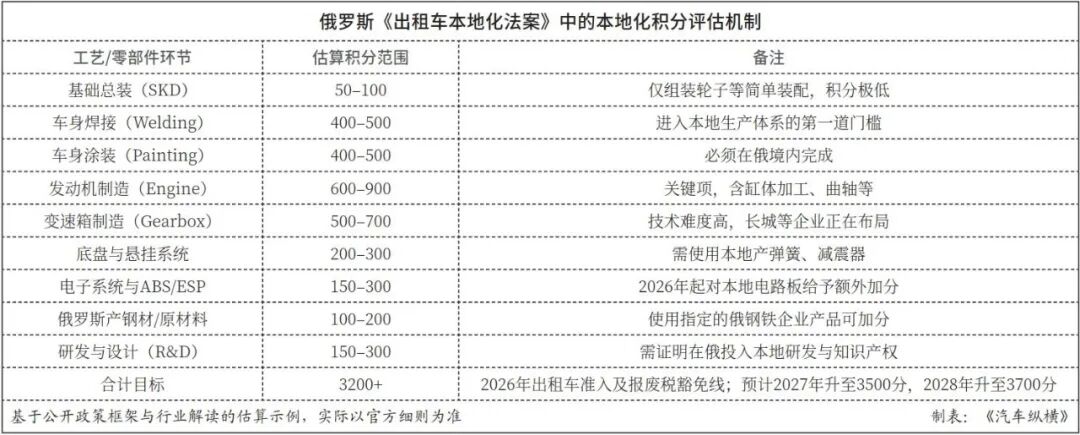
The points structure clearly favors enterprises that localize production of high-tech components like engines and transmissions, while showing extremely low recognition for models merely engaged in simple assembly. If an automaker only conducts SKD assembly, its points might remain in the hundreds, far below the entry threshold.
This also means that the taxi sector—a stable-sized, rigidity (essential) demand market segment—is being transformed into a 'test of localized industrial capabilities.' Who can enter this market largely depends on their degree of integration into Russia's domestic manufacturing system.
Meanwhile, continuous adjustments to the scrappage tax (Recycling Fee) form another complementary mechanism, further strengthening localization orientation through cost-side pressure. In recent years, Russia has repeatedly raised scrappage tax rates for imported vehicles. Especially after multiple rounds of adjustments from late 2025 to early 2026, the differences have become stark:
For mainstream models with 1.0–2.0L engine displacements, locally produced vehicles can typically offset these taxes through government subsidies or rebate mechanisms, resulting in near-zero actual burdens. In contrast, scrappage taxes for regularly commercially imported vehicles have risen to approximately 800,000–900,000 rubles, significantly increasing costs. Simultaneously, parallel imports or personal import channels previously used by some consumers are gradually tightening. Since December 2025, models with power exceeding 160 horsepower no longer qualify for the low personal import rate (originally about 3,400 rubles) and must pay the full commercial tax rate, amounting to over 750,000–1,000,000 rubles.
Under these policy changes, the cost structure of imported vehicles has risen markedly. Estimating based on a mid-size SUV with a Chinese factory price of about 150,000 RMB, the scrappage tax alone could add extra costs equivalent to 20–30% of the vehicle's price, significantly eroding its price competitiveness.

Additionally, the 'power-linked' algorithm introduced in 2026 and the 'full-amount top-up' customs clearance formula for Central Asian re-exports (such as to Kyrgyzstan) further compress space for gray trade channels. Models that previously saved thousands of dollars through re-export trade now see these cost advantages nearly eliminated under new rules, even experiencing cost reversals due to additional fees.
Taken together, the 'positive incentive' localization points system and 'negative pressure' tax policies jointly shape a market structure that emphasizes local manufacturing capabilities. For enterprises with deep local layout (presence), this means clear opportunities to enter policy-favored sectors like taxis. For participants relying on complete vehicle imports or low-level assembly, it means higher entry barriers and cost pressures.
Under this policy combination, an increasingly clear 'dualized' market structure is emerging: Deeply rooted players gain policy dividends and stable markets, while shallow participants are gradually marginalized, reshaping the competitive landscape.
Chinese Automakers' Positional Warfare
Within the gradually forming 'dualized' market structure, Chinese automakers show clear differentiation, forming three distinct survival paths. Each path reflects different strategic orientations and risk-reward trade-offs.
Among the three main paths, Great Wall Motors follows an independent deep-cultivation route. Its Tula plant represents one of the earliest cases where a Chinese brand established a complete manufacturing system in Russia. The factory covers the four core processes of stamping, welding, painting, and final assembly, and has gradually advanced localization of key components like engines and transmissions in recent years. According to public information, the plant has continuously improved its localization level under the framework of a Special Investment Contract (SPIC) signed in 2020. With projects like the engine factory progressing, its localization points are expected to approach or exceed 3,500 by 2026, placing it firmly in the top tier of the 'whitelist' for taxi market access.
This points advantage brings not only eligibility for policy-favored markets like taxis but also structural cost support through scrappage tax offsets and government subsidies. While many competitors are still striving to accumulate localization points, Great Wall can more fully leverage policy dividends from local manufacturing, forming relative advantages in pricing, delivery, and compliance capabilities.
Of course, this path also entails higher investment and risk exposure. Factory construction and supply chain localization require continuous capital input and are more sensitive to geopolitical and macroeconomic fluctuations in Russia. In a sense, this represents a long-term commitment deeply bound to Russia's industrial policies—both an opportunity and a test of risk tolerance.
Compared to Great Wall's independent deep cultivation, Chery adopts a more flexible cooperation path. Rather than building its own vehicle factory, it achieves market entry through technology output of its Tiggo series to local groups like AGR, realizing indirect access via Russian-branded models like 'Tenet.' This 'borrowing a boat to go to sea' model leverages industrial assets left behind after Western automakers' withdrawal, accumulating localization points with relatively low capital investment and participating in market allocation.
However, this model's potential vulnerabilities are also apparent: Localization points and operational voice depend to some extent on partners. If future cooperative relationships change or policy preferences and benefit distributions adjust, Chery's localization layout (presence) may face rapid adjustment pressures. This cooperation-network-centric model relies more on partner stability and long-term reliability of contractual arrangements.
Geely has chosen another path—relying on its BelGee joint venture factory in Belarus to seek tariff and policy synergies within the Eurasian Economic Union (EAEU) framework. By exporting complete vehicles from Belarus to Russia, it theoretically can reduce some tariff burdens through intra-union trade arrangements while retaining certain buffer spaces in supply chains and policies.
This layout (strategy) reflects more pronounced 'regionalization' thinking: dispersing single-market risks through the EAEU system and reserving possibilities for broader regional market expansion in the future. However, with the 2026 implementation of the 'full-amount top-up' customs clearance formula, the price arbitrage space previously created by re-export trade has been significantly compressed. BelGee's value as a 'springboard' now lies more in long-term policy buffering, supply chain diversification, and potential regional radiation capabilities rather than simple cost advantages. Its continued effectiveness depends heavily on Russia-Belarus relations and the stability of EAEU rules.
The differentiation among these three paths clearly reflects different strategic orientations of Chinese automakers in the Russian market: Great Wall emphasizes deep industrial integration, Chery focuses on cooperation networks and technology output, while Geely seeks flexible space through regional institutional frameworks. No single model can be seen as an absolutely safe 'universal solution.' Under current market logic emphasizing localization and administrative access, enterprises with deeper industrial chain investments and more stable industrial foundations generally demonstrate stronger resilience in policy dividend acquisition and risk resistance.
From a longer-term perspective, the 'dualization' process in the Russian market is driving Chinese automakers to gradually shift from pure export trade models toward a dual-track layout (strategy) combining 'deep rooting' and 'flexible curves.' Which path ultimately proves more sustainable remains to be seen through further policy evolution and market competition in the coming years.
From 'Gap-Filling' Dividends to 'Deep Cultivation' Existential Battle
Entering 2026, the Russian automotive market shows signals of phase transition. According to data from the Association of European Businesses (AEB) and Autostat, new vehicle sales in January-February this year declined slightly year-on-year, with the market's start described by some industry insiders as 'the weakest opening in 20 years.'
This to some extent indicates that the 'fill-in growth' formed after Western brands' withdrawal in recent years is gradually ending. The rapid rebound driven by supply gaps is shifting toward more normalized market competition. Future growth sustainability will depend more on natural replacement cycle recovery and long-term consumer recognition of product strength and brands.
Meanwhile, the orientation of Russia's automotive industrial policies has become increasingly clear: The core of competition is no longer 'who can sell cars into Russia' but 'who can take root in Russia's industrial system.' Localization process depth, points system accumulation, and alignment with policy frameworks are becoming key variables determining enterprises' long-term survival space.
Hyundai's ultimate decision to abandon repurchasing its Russian factory symbolizes this transformation to some extent. The Russian market is no longer a 'blank space' waiting for foreign capital's return but has evolved into a competition arena dominated by industrial policies and emphasizing local manufacturing depth. In this market landscape, middle ground is rapidly disappearing. Deeply rooted players may construct new moats, while those relying on shallow participation will likely become transient market players.
Image: From the Internet
Article: Auto Review China
Layout: Auto Review China
-
![]()
The Unstoppable Rise of 'Optical Progress and Copper Decline': Sunny Optical’s Strategic Vision for the Next Decade
-
![]()
AI + Going Global in the Second Half: No Intermission for Robot Vacuum Cleaners
-
![]()
The Suffering Endured in E-commerce, Walmart Doesn't Want to Repeat in AI
-
![]()
What Does the Doubling of New Energy Vehicle Exports Mean?
-
![]()
Ghosn: 'Only I Can Save Nissan'
-
![]()
Volkswagen Lays Off 100,000 Employees, The Elephant Sits Down
-
![]()
Expanding Production Capacity! Yutong Optics Acquires Approximately 1.5 Hectares of Industrial Land in Chang'an, Dongguan
-
![]()
Why Is Nokia Making a Comeback in the AI Era?