Xiaomi and Huawei Place Their Bets! OpenClaw Gains Traction in China, But Musk Stays Skeptical?
 03/12 2026
 517
517
Can Vehicles Finally Achieve True Autonomy?
The winds of change brought by OpenClaw have finally reached the automotive industry.
Recently, Xiaomi officially unveiled that its self-developed AI agent, MiclawAgent, has entered the internal testing phase. The goal is to integrate it into vehicles, endowing Xiaomi cars with more personalized and proactive intelligent interaction capabilities.
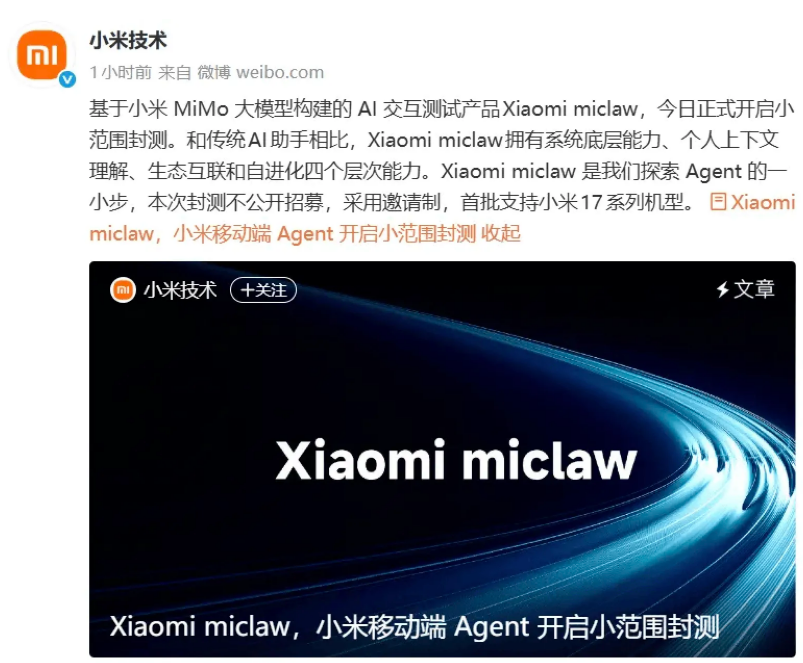
(Screenshot: Weibo)
Almost simultaneously, Huawei's Xiaoyi Open Platform introduced the OpenClaw mode, laying the groundwork for developing on-device agents for the HarmonyOS cockpit. NIO, XPeng, and Li Auto have also joined the race, quietly developing their own on-device agents.
After gaining widespread attention, OpenClaw quickly made waves in the automotive sector, becoming a buzzword in the industry. The new players are once again collectively advancing in the field of AI intelligence.
However, amid the excitement, a question looms: Will this wave of agent integration in vehicles represent a genuine technological revolution, or will it follow the path of the metaverse, becoming mere conceptual hype?
What Transformations Can OpenClaw Bring After Integration into Vehicles?
OpenClaw: Empowering AI Cars with 'Hands and Feet' to Get Things Done
Before delving into how OpenClaw can revolutionize the automotive industry, let's first clarify its essence.
OpenClaw is an open-source intelligent agent architecture. Unlike AI models such as DeepSeek and ChatGPT, which excel in conversation but lack execution capabilities, OpenClaw can both converse and perform tasks—effectively giving language models real 'hands and feet.'
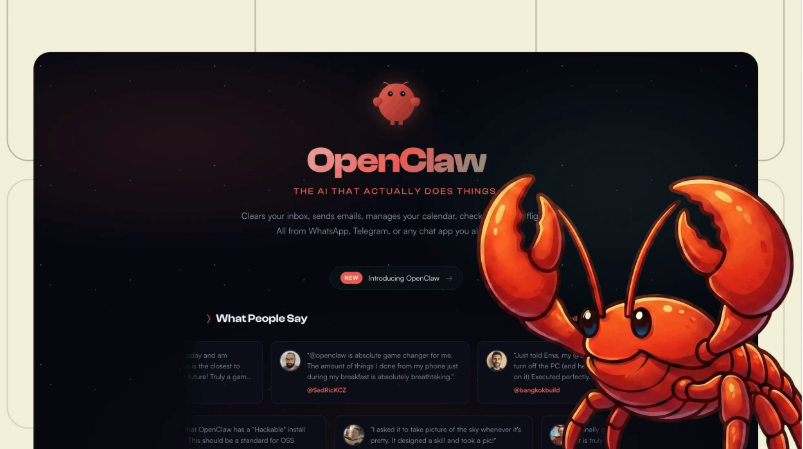
(Image Source: OpenClaw Official Website)
Integrating OpenClaw into a computer can already automate software-level tasks. When installed in vehicles or applied in the automotive industry, its capabilities become even more formidable. Automakers like Xiaomi, Huawei HarmonyOS, GAC Trumpchi, NIO, XPeng, and Li Auto are currently exploring how to leverage OpenClaw for groundbreaking technological innovations.
In essence, OpenClaw is likely a pivotal step towards enabling proactive automotive services.
The collective pursuit of OpenClaw by new automotive brands is not merely about following short-term trends but more about hoping to bring disruptive changes to smart vehicles with OpenClaw's empowerment.
Currently, AI interactions in vehicles are limited to 'question-and-answer' exchanges, such as 'XX Assistant, what's the weather today? It's sunny today' or 'XX Assistant, play music! Okay.' Slightly more intelligent automotive AI assistants can control hardware operations like opening the sunroof or turning on the air conditioning. Even the most advanced AI assistants can only achieve end-to-end intelligent driving and automatic parking.
Every operation requires explicit human instructions, falling far short of our vision of a 'truly intelligent car.'
Perhaps what we need is a smart car that, given a to-do list, can automatically take us to work, pick up documents from home, collect groceries from the mall, pick up the kids from school, park the vehicle and recharge it, and even seamlessly transition into work mode during the journey—all without requiring constant supervision or intervention.
These ideas are not far-fetched. Xiaomi, which boasts greater hardware development privileges, is attempting to use MiclawAgent to enable cross-device collaboration between Xiaomi cars, smart homes, phones, and PC terminals, creating a true 'human-vehicle-home' ecosystem.
Traditional automaker GAC Trumpchi is not far behind, having completed OpenClaw deployment and scenario validation on its all-electric M8 model, achieving efficient office scenarios.
Huawei, through the OpenClaw mode on its Xiaoyi Open Platform, enables multi-terminal collaboration, task handoffs, and vehicle control linkage with the infotainment system. This means users can issue commands on their phones or tablets, and the car will automatically execute them.
For example, issuing the command 'Plan tomorrow's business trip itinerary and navigate to the airport' on a phone will prompt timely reminders for departure time. Upon entering the vehicle, it will automatically initiate intelligent driving based on the navigation and park itself upon arrival—all without user intervention.
This is just the 'trial version' of OpenClaw on Huawei's Harmony Intelligent Mobility platform, with more features to be gradually released.
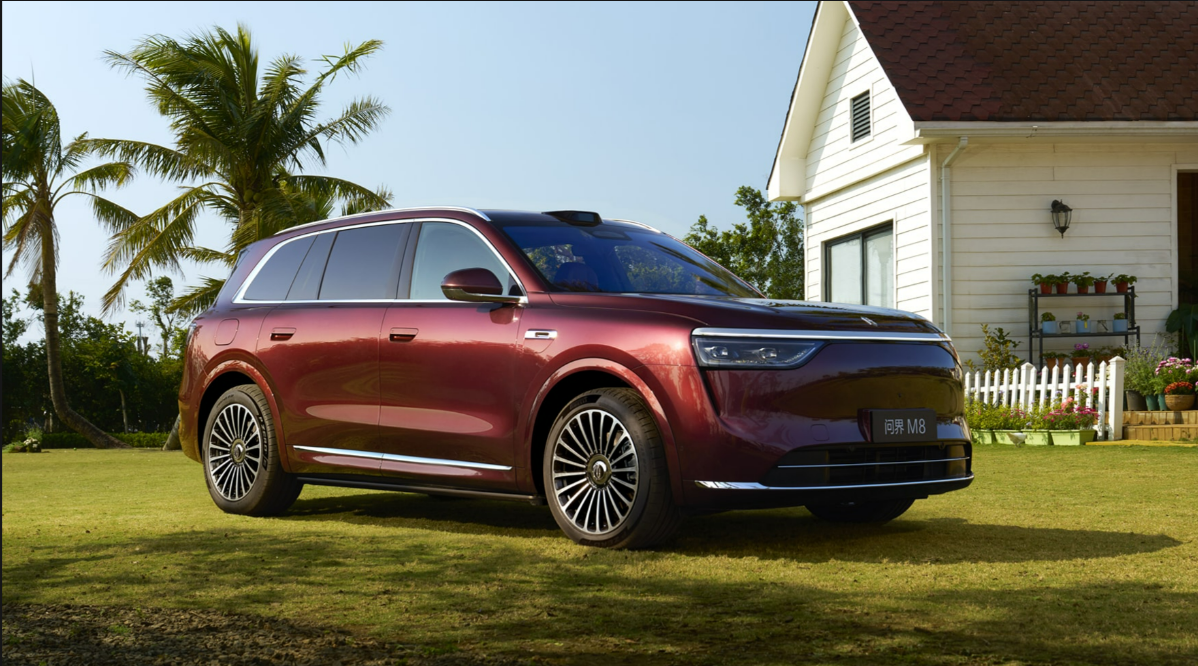
(Image Source: AITO Official Website)
Although NIO, XPeng, and Li Auto have not yet announced their OpenClaw-related strategies, it is possible that these three new forces will follow suit by integrating OpenClaw or developing their own agents.
In the future, surviving automakers will inevitably need to meet high product quality standards. The competition will then shift from 'who builds better cars' to who offers a smarter, more human-centric full-scenario ecosystem—and OpenClaw may be the key to winning this race.
OpenClaw Integration in Vehicles: Easy to Adopt, Hard to Implement
In fact, OpenClaw's impact on the automotive industry extends beyond mobility scenarios and could significantly empower industrial manufacturing.
From R&D to mass production, OpenClaw can deeply participate in the entire automotive manufacturing chain, such as replacing repetitive and mechanical labor with automation, driving decision-making with real-time data, enabling efficient collaboration across previously isolated systems, and accelerating integrated R&D, testing, and production—ultimately shortening new vehicle development cycles, reducing manufacturing costs, and improving overall vehicle quality and stability.
For automakers, this is not just about efficiency gains but also about rejuvenating the entire brand ecosystem.
Every coin has two sides, and the same applies to OpenClaw's application in the automotive industry. While its advantages are striking, potential risks cannot be ignored.
As we delegate more control permissions to AI, security issues arising from malicious intrusion, tampering, or manipulation of the system could be catastrophic and widespread.
In the movie 'The Fate of the Furious 8,' there is a scene where the villain remotely controls intelligent driving-enabled vehicles to disrupt traffic and cause accidents. While this is a fictional plot, for regulators and the industry, it represents a real security risk that must be proactively addressed in the future.
When it comes to policies and regulations, China has maintained a cautious and prudent stance toward intelligent driving. Currently, only a few automakers nationwide have obtained permits for Level 3 conditional autonomous driving. While this conservatism ensures safety, it may also somewhat constrain the rapid iteration of automotive intelligence.
However, many Chinese cities have shown a very positive attitude toward cutting-edge technologies like OpenClaw. Shenzhen, Wuxi, Hefei, Changshu, and others have explicitly expressed willingness to embrace and pilot such technologies, even offering special subsidies to support their implementation. This is a crucial and positive signal for the entire industry.
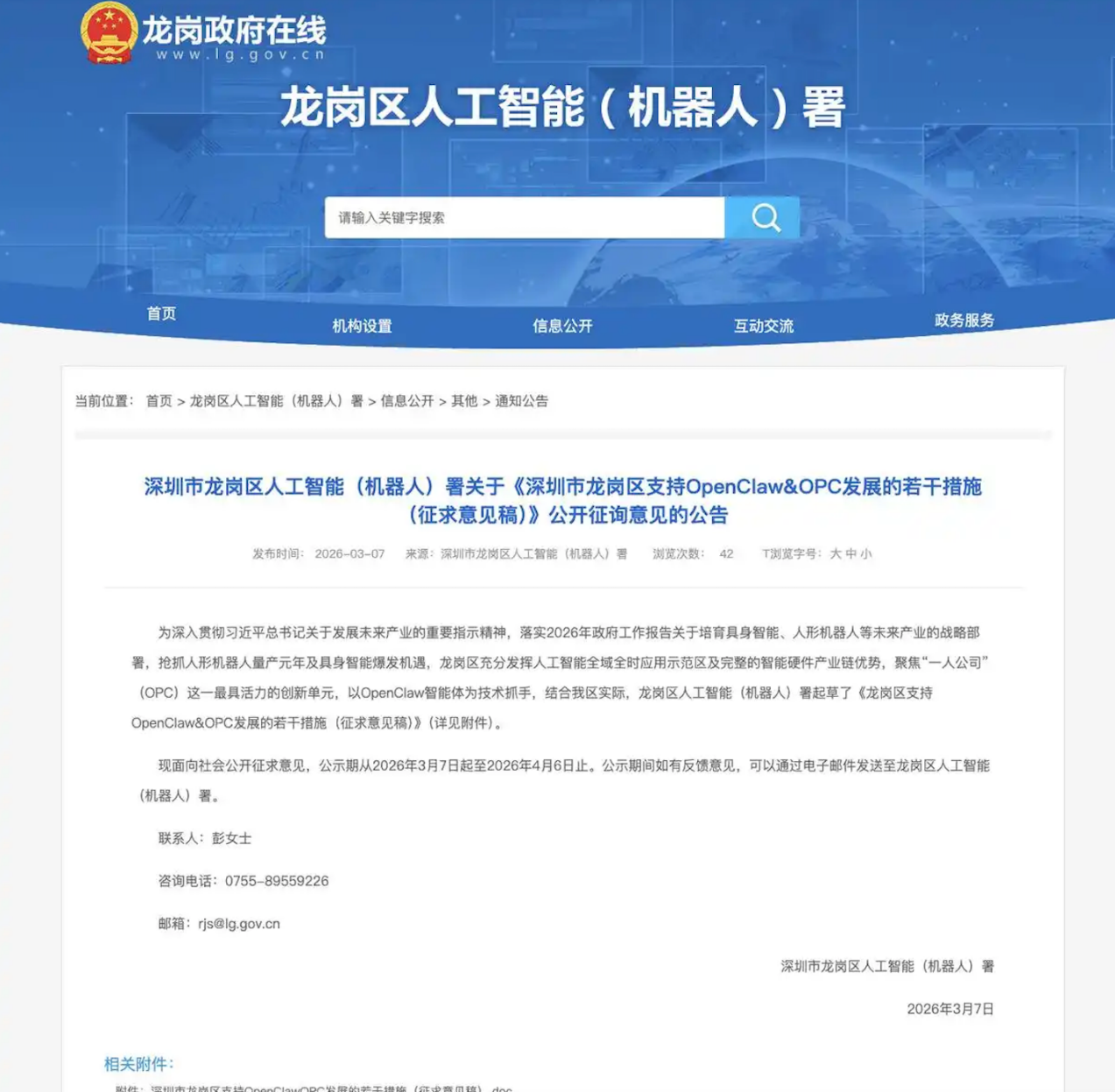
(Image Source: Longgang District Government Official Website)
Technological progress has never been a smooth journey.
The risks and controversies surrounding OpenClaw should not become stumbling blocks for industry advancement. Instead, they serve as a litmus test, compelling enterprises, regulators, and the supply chain to establish clearer safety boundaries and more robust regulatory frameworks, ensuring that smart vehicles can truly progress steadily and sustainably.
Final Thoughts
In contrast to the enthusiastic pursuit by domestic users and enterprises, Elon Musk, known for his bold innovations, holds a starkly different view of OpenClaw.
He bluntly stated that granting full root access to AI is akin to 'handing a loaded rifle to a monkey'—the risks are far greater than they appear on the surface.
The rise of any new technology has always been accompanied by controversy and disagreement. Support and opposition are normal aspects of technological advancement.
Whether OpenClaw is a fleeting concept or a new wave that can truly transform the automotive industry remains to be seen. There is no need to rush for an answer, but one thing is certain: this 'little lobster' has already made its way into the automotive sector and is destined to create ripples—either disrupting the status quo or serving as a wake-up call for the industry. That, perhaps, is the most captivating aspect of new technologies.
(Cover Image Source: AI-Generated)
Xiaomi, Huawei, Harmony Intelligent Mobility, NIO, OpenClaw
Source: Leikeji
Images in this article are from the 123RF licensed image library.
-
![]()
The Unstoppable Rise of 'Optical Progress and Copper Decline': Sunny Optical’s Strategic Vision for the Next Decade
-
![]()
AI + Going Global in the Second Half: No Intermission for Robot Vacuum Cleaners
-
![]()
The Suffering Endured in E-commerce, Walmart Doesn't Want to Repeat in AI
-
![]()
What Does the Doubling of New Energy Vehicle Exports Mean?
-
![]()
Ghosn: 'Only I Can Save Nissan'
-
![]()
Volkswagen Lays Off 100,000 Employees, The Elephant Sits Down
-
![]()
Expanding Production Capacity! Yutong Optics Acquires Approximately 1.5 Hectares of Industrial Land in Chang'an, Dongguan
-
![]()
Why Is Nokia Making a Comeback in the AI Era?