NIO Achieves Single-Quarter Profitability, But the Celebration Is Premature
 03/13 2026
 440
440

Among the new energy vehicle (NEV) startups, NIO is often perceived as both 'affluent' and 'a heavy spender'.
From the notion that 'even $15 billion from the Middle East couldn't sustain it for a year' to its current efforts to shed the 'heavy spender' label through sustainable business practices, NIO is undergoing a significant transformation.
On the evening of March 10, NIO released its financial results for the fourth quarter (Q4) and the full year of 2025. The data revealed that the company achieved an adjusted operating profit of approximately RMB 1.2513 billion in Q4 2025, with a net profit of RMB 283 million under general accounting standards. This marked NIO's first-ever single-quarter operating profit since its inception.
Meanwhile, the gross profit margin for automotive sales in Q4 reached 18.1%, and the overall gross profit margin climbed to 17.5%, up 5 percentage points and 5.8 percentage points year-on-year, respectively.
Qu Yu, NIO's CFO, attributed these achievements primarily to substantial growth in sales and revenue, optimization of the product mix, and the implementation of cost-reduction and efficiency-enhancement measures.
However, the challenge of survival and maintaining competitiveness continues to test the strategic acumen of William Li, NIO's CEO.
For the full year of 2025, NIO still reported a net loss of RMB 14.94 billion, with an adjusted net loss of RMB 12.41 billion.
As 2026 unfolds, market competition shows no signs of easing. In January 2026, NIO delivered 27,182 vehicles; in February, deliveries dropped to 20,797 units due to the Lunar New Year slowdown and product transitions, representing a month-on-month decline of about 23%.
This fluctuation in monthly deliveries underscores the pressure NIO faces in sustaining growth momentum in a fiercely competitive market.
1. Profitability Hangs by a Thread
In 2025, NIO's sales followed a 'decline-then-rise' trajectory.
For the full year, NIO delivered a cumulative total of 326,000 vehicles, up 46.9% year-on-year, setting a new record. Its three sub-brands—NIO, Onvo, and Firefly—delivered 178,800, 107,800, and 39,400 new vehicles, respectively, establishing a foothold in various market segments.
Specifically, sales were polarized between the first and second halves of the year.
The sluggish performance of the Onvo L60 led to a sales slump for NIO in Q1 2025, with losses hitting a record high.
After briefly exceeding 10,000 monthly deliveries in December 2024, Onvo L60 sales quickly declined in 2025. In Q1 2025, the Onvo brand delivered just 14,781 vehicles, far below the targeted monthly average of 10,000 units. In response, William Li reshuffled the leadership, replacing Ai Tiecheng with Shen Fei, head of NIO's energy business, as president of Onvo.
Financial data showed that NIO's adjusted net loss in Q1 2025 reached RMB 6.279 billion, up 28.1% year-on-year.
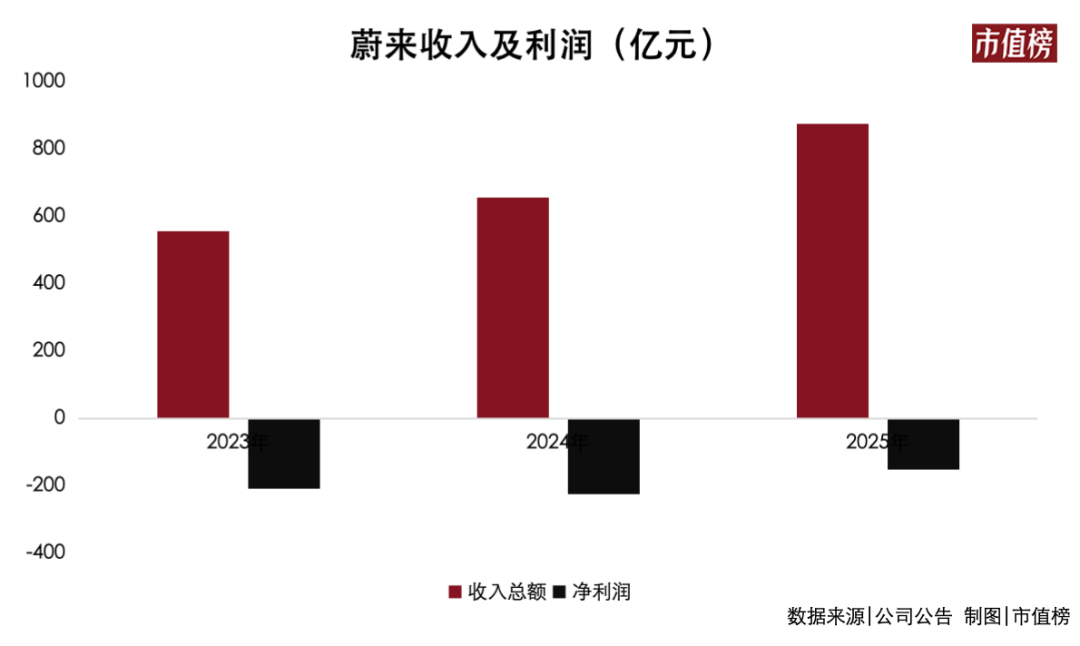
NIO's recovery in the second half was fueled by the success of its multi-brand strategy. The NIO ES8 set a record for monthly deliveries of vehicles priced above RMB 400,000, while the Onvo L90 became the best-selling pure electric large SUV in 2025.
Built on the NT 3.0 platform, NIO's next-generation products have seen comprehensive improvements in performance, efficiency, and cost control.
This allowed the Onvo L90 and third-generation ES8 to capture the mid-to-high-end market by offering 'high-spec features at competitive prices' in 2025.
Reduced R&D investment was one of the key drivers of Q4 profitability. In 2025, NIO's R&D expenses totaled RMB 10.61 billion, down 18.7% year-on-year. Q4 R&D spending was RMB 2.03 billion, a significant 44.3% decrease year-on-year.
NIO explained that this was primarily due to cost reductions in R&D personnel following organizational optimization and lower design and development expenses as new products and technologies progressed through different development stages.
This indicates that the NT 3.0 platform is delivering positive efficiency gains for NIO, with more mature platform capabilities leading to lower per-unit R&D costs.
However, this does not mean NIO is out of the woods.
From a balance sheet perspective, as of December 31, 2025, NIO's total assets stood at RMB 124.4 billion, with total liabilities at RMB 111.7 billion, resulting in an asset-liability ratio of approximately 89.8%. Meanwhile, current liabilities (RMB 78.58 billion) exceeded current assets (RMB 76.63 billion), with a current ratio below 1, indicating objective short-term debt repayment pressures. Cash and cash equivalents, restricted cash, short-term investments, and long-term time deposits totaled RMB 45.9 billion.
During the earnings call, William Li announced NIO's 2026 goals: achieving full-year Non-GAAP profitability and a vehicle gross profit margin of 20%. Additionally, NIO aims to grow sales by 40%–50% in 2026, equivalent to delivering between 456,000 and 489,000 vehicles for the year, averaging about 40,000 units per month.
Judging by NIO's sales performance in the first two months of 2026, the company seems to have reverted to its 'boom-and-bust' pattern.
2. 'Multi-Brand' Strategy Faces a 'Turbulent' 2026
Earlier this year, when NIO rolled off its one-millionth vehicle, Qin Lihong, NIO's president, stated that there were no groundbreaking plans for 2026—just execution in established directions to achieve higher-quality growth: selling cars well, providing excellent service, and improving infrastructure.
Qin's rationale was that NIO would fully transition to third-generation platform products in 2026, offering more models and smoother product iterations.
However, the automotive market continues to evolve rapidly.
First, in an era of intensified competition, blockbuster models are more critical than ever.
On the NEV leaderboard, AITO and Xiaomi dominated deliveries in January 2026, but both saw a 50% month-on-month decline in February.
NIO's 23% month-on-month delivery drop in February was influenced by the Lunar New Year slowdown and product transitions.
Critically, AITO and Xiaomi's dominance was driven by their super-blockbuster models, the M9 and YU7, which hold absolute advantages in their respective price segments.
Given NIO's reliance on the ES8 as its sole pillar, the company still needs blockbuster models like the ES8 for its upcoming ES9 and other vehicles to achieve significant market impact.
Second, under the blockbuster model dynamic, multi-brand strategies may create internal competition despite gaining visibility across dimensions.
NIO's multi-brand strategy has yet to achieve a 'flourishing' state. Since the launch of the Onvo brand, delivery data shows an inverse relationship between NIO's main brand and Onvo—when one surges, the other slumps.
At the start of 2026, NIO's deliveries still heavily rely on the ES8, while Onvo has been relatively quiet lately.
Third, the intelligent driving competition in 2026 poses a new challenge for NIO.
With the Ministry of Industry and Information Technology issuing the first batch of L3 autonomous driving permits, intelligent driving capabilities will be a focal point of competition among automakers in 2026.
NIO's approach to intelligent driving shares similarities with Huawei's. By leveraging the NT 3.0 platform to establish hardware thresholds and spread per-unit costs, NIO has also reserved multiple safety redundancies, including two Shenji chips. This not only helps reduce R&D costs but also creates a premium 'exclusive' experience for NIO owners.
Chips are not just significant for NIO's own brand; the company also aims to export its technology and seek opportunities to define industry standards in the chip sector.
On February 26, 2026, Anhui Shenji Technology Co., Ltd., NIO's subsidiary responsible for intelligent driving chip development, completed a new funding round. Investors, including Hefei State Investment and IDG Capital, subscribed to new shares in Shenji for RMB 2.257 billion. After the funding, NIO's subsidiary retained a 62.7% controlling stake, with external investors holding 27.3% and management receiving a 10.0% equity incentive.
According to previous media reports, NIO's self-developed high-end intelligent driving chip, the Shenji series, has begun technical licensing to an automotive chip company.
However, in the intelligent driving arena, this is not the only solution.
On March 2, XPENG unveiled its second-generation VLA large model, a native multimodal physical world model that does not rely on high-line LiDAR. By integrating visual, auditory, and semantic information, it enables human-like decision-making, such as identifying abnormal vehicles, navigating around accident scenes, and yielding to animals at night.
XPENG's approach focuses not solely on computational power but on joint optimization of chips, compilers, and models to maximize efficiency.
On the path to high-level intelligent driving, hardware self-research and algorithmic innovation are evolving in parallel. As these different technological paths mature and scale, the automotive market landscape will face new disruptions.
3. 'Flash Charging' Emerges Alongside Fifth-Generation Battery Swap Stations
In 2026, beyond the imperative to sell more vehicles, NIO will face challenges on two fronts.
The first is cost pressures from rising battery prices.
Recently, the price of lithium carbonate, a core raw material for power batteries, has surged continuously, climbing from a low of about RMB 60,000 per ton in June 2025 to over RMB 170,000 per ton in early 2026—a more than 180% increase in six months.
Around the same time as NIO's financial results, CATL was enjoying substantial profits. In 2025, its net profit attributable to shareholders reached RMB 72.2 billion, up 42.28% year-on-year, averaging nearly RMB 200 million in daily profits.
Rising battery costs pose additional difficulties for NIO, which aims to improve gross profit margins and achieve full-year Non-GAAP profitability in 2026.
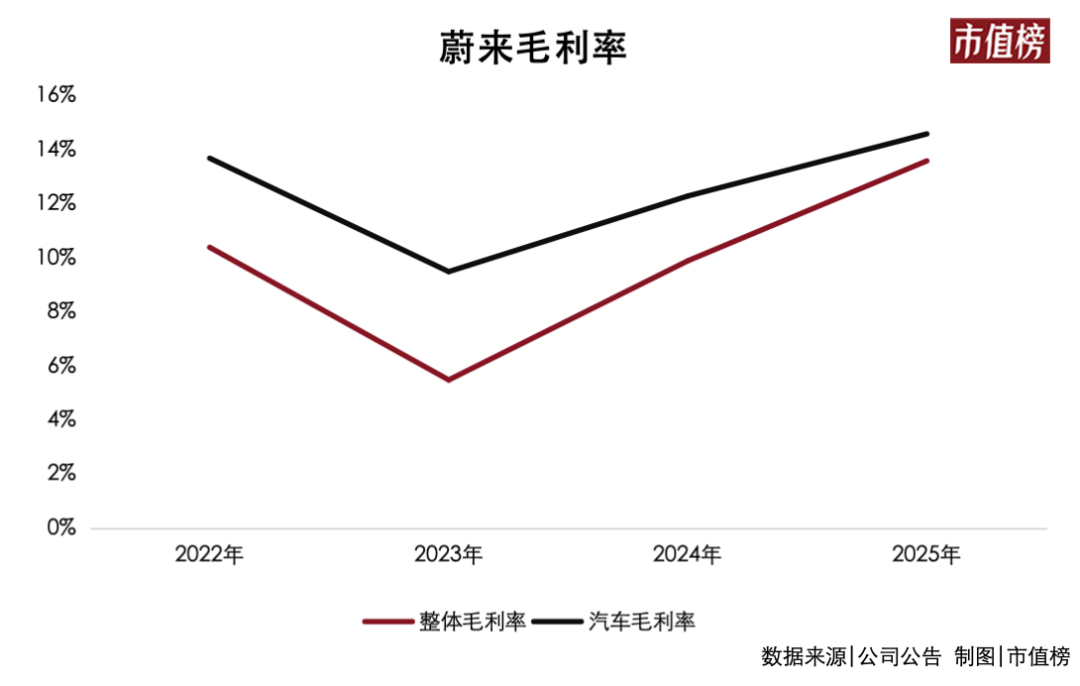
The second challenge is the offensive and defensive dynamics of NIO's battery swap strategy, which faces pressures from both internal and external sources.
Internally, deploying fifth-generation battery swap stations brings financial strain. Under NIO's 2026 plan, as the 'Battery Swap County-to-County Connectivity' initiative deepens, the company plans to add 1,000 new battery swap stations throughout the year and begin large-scale deployment of the more powerful but costlier fifth-generation stations (V5) in April.
This is both to establish the reliability of the 'Battery Swap Alliance' in the market and to resolve internal incompatibilities within NIO's brands.
Previously, NIO's three brands had significant fragmentation in their battery swap systems: existing third- and fourth-generation stations primarily served the NIO main brand, while Onvo models could only use a limited number of these stations due to battery specification differences. The core value of the fifth-generation stations is their compatibility with all three NIO brands—NIO, Onvo, and Firefly—fundamentally closing the loop for shared battery swap networks among the brands.
However, this requires substantial ongoing investment.
Externally, advancements in the charging ecosystem are posing new threats to NIO's battery swap model.
On March 5, 2026, BYD unveiled its second-generation Blade Battery and flash charging technology in Shenzhen, announcing plans to build 20,000 flash charging stations in 2026.
BYD Chairman Wang Chuanfu declared on-site, 'Under normal temperatures, charging takes 5 minutes to reach 80% and 9 minutes to full; in sub-zero temperatures (-30°C), it takes just 3 minutes longer.'
This is unwelcome news for NIO. As flash charging technology reduces charging times to the 10-minute range, the time advantage of battery swapping is diminishing. Proving the added service value of 'battery swapping' over 'flash charging' has become NIO's new challenge in maintaining its leadership in energy replenishment solutions.
William Li previously judged that the automotive market has entered the 'final round,' stating, 'We're still at the table, though not in the leading position. But we've found our rhythm.'
Maintaining relatively high yet stable growth is what matters most to NIO.
Ultimately, this remains a race against time for NIO to build brand recognition. Building on its Q4 2025 profitability, NIO aims to close the energy replenishment loop with fifth-generation battery swap stations, reduce costs through self-developed chips and platform capabilities, and secure a competitive moat through market expansion.
Maintaining its rhythm is no easy feat for NIO, which is still incurring losses.
-
![]()
The Unstoppable Rise of 'Optical Progress and Copper Decline': Sunny Optical’s Strategic Vision for the Next Decade
-
![]()
AI + Going Global in the Second Half: No Intermission for Robot Vacuum Cleaners
-
![]()
The Suffering Endured in E-commerce, Walmart Doesn't Want to Repeat in AI
-
![]()
What Does the Doubling of New Energy Vehicle Exports Mean?
-
![]()
Ghosn: 'Only I Can Save Nissan'
-
![]()
Volkswagen Lays Off 100,000 Employees, The Elephant Sits Down
-
![]()
Expanding Production Capacity! Yutong Optics Acquires Approximately 1.5 Hectares of Industrial Land in Chang'an, Dongguan
-
![]()
Why Is Nokia Making a Comeback in the AI Era?