BMW Group's 2025 Financial Review and 2026 'Neue Klasse' Product and Technology Strategy | In-Depth Analysis
 03/16 2026
 453
453
Amidst geopolitical challenges, tariff headwinds, and global pricing pressures in 2025, BMW Group (BMW Group) delivered a resilient performance. It will also unveil its 'Neue Klasse' (NEUE KLASSE) models in 2026, integrating the latest product and technology designs.
This article provides a neutral perspective, comprehensively reviewing BMW Group's core financial and sales performance in 2025, and offers an in-depth analysis of its 2026 product and technology market strategy centered around the 'Neue Klasse' (NEUE KLASSE).
I. 2025 Financial and Sales Summary: Global Balanced Layout Offsets China's Decline
In FY2025, BMW Group maintained overall performance stability amidst severe macroeconomic and currency headwinds through strict cost control and a globally balanced layout.
1. Core Financial Data: Revenue Declines Slightly
Group Revenue and Profit: In 2025, BMW Group's total annual revenue was €133.453 billion, down 6.3% year-on-year. Group earnings before tax (EBT) were €10.236 billion, a 6.7% decrease, but the EBT margin remained stable at 7.7%, unchanged from 2024.
Automotive Business Segment: The automotive division's annual revenue was €117.557 billion, down 5.9% year-on-year, primarily due to negative currency impacts and global pricing pressures. Automotive earnings before interest and tax (EBIT) were €6.259 billion, a 20.7% decrease, with an EBIT margin of 5.3% (or 6.4% excluding depreciation and amortization related to the Brilliance BMW acquisition). 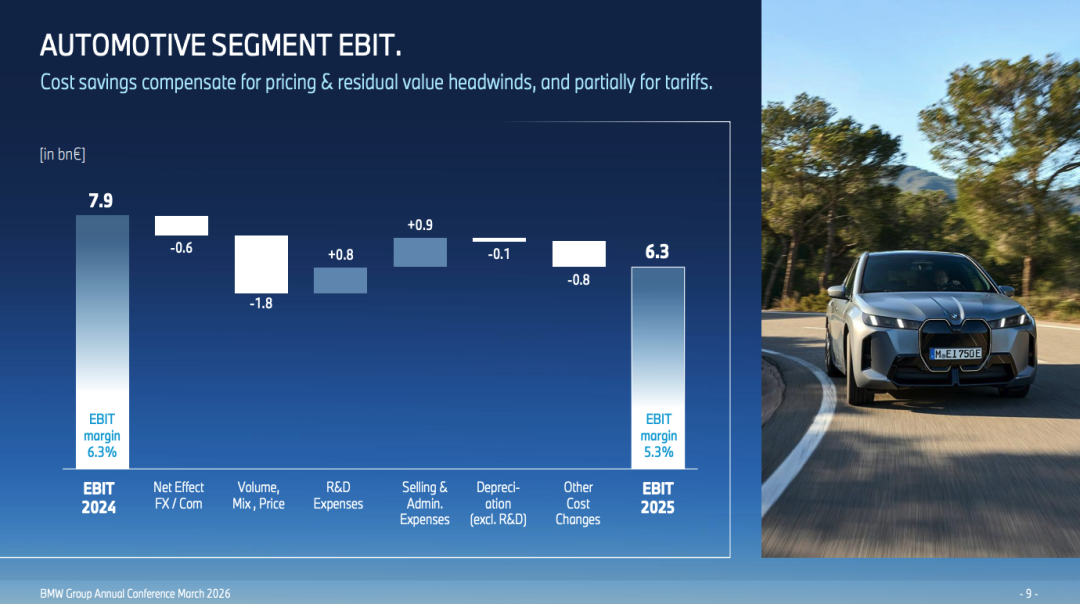
Quarterly Performance and Cost Control: BMW extended its positive trend from the first nine months into the fourth quarter, with earnings before tax from eliminations reflecting favorable developments, meeting full-year expectations. Additionally, through strict control over R&D, sales and administrative expenses, and manufacturing materials, BMW achieved cost reductions of approximately €2.5 billion for the year, effectively offsetting the negative impact of tariffs by about 1.5 percentage points.
2. Global Sales Comparison by Major Markets: European and U.S. Growth Fills China's Gap
In 2025, BMW Group's global vehicle deliveries reached 2.464 million units, up 0.5% year-on-year. The positive sales growth was primarily driven by strong performances in European and U.S. markets:
Europe: Annual deliveries reached 1.018 million units, up 7.3% year-on-year, marking the first time BMW surpassed one million sales in Europe since the COVID-19 pandemic.
United States: Annual deliveries were 419,000 units, up 5.0% year-on-year, achieving significant growth in a saturated market.
China: Affected by intense market competition, annual deliveries were 626,000 units, down 12.5% year-on-year. However, by consolidating dealer structures and stabilizing prices, BMW's average monthly sales in China stabilized at around 50,000 units.
Other Regions: Annual deliveries were 401,000 units, up 3.4% year-on-year. 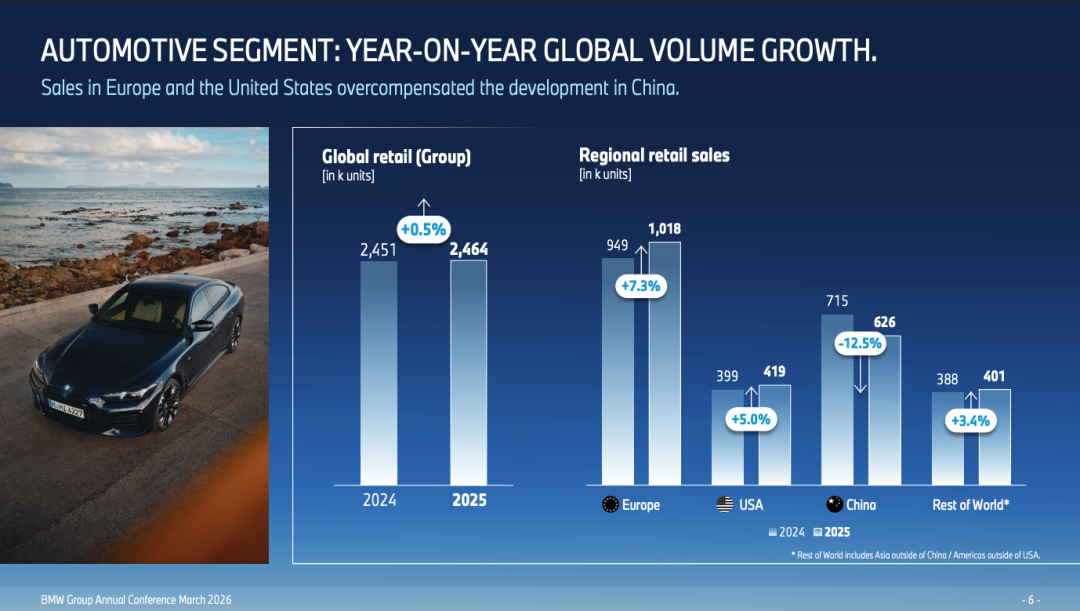
3. Progress in Electrification Transition
In 2025, BMW's total new energy vehicle (xEV) sales reached 642,000 units, up 8.2% year-on-year, accounting for 26.1% of total sales. Among them, battery electric vehicle (BEV) sales reached 442,000 units, representing approximately 17.9% of the group's total sales. In Europe, electrified models accounted for over 40% of sales. 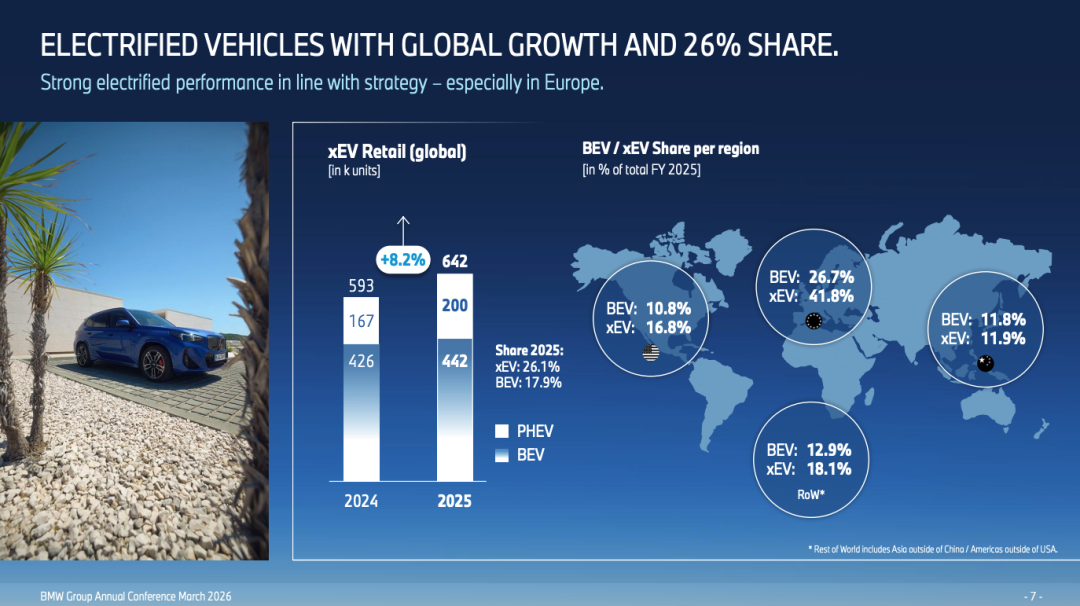
II. 2026 Product and Technology Market Strategy: Betting on the 'Neue Klasse'
For 2026 and beyond, BMW's strategic focus is on adhering to 'Technology Openness' and fully advancing the implementation of 'Neue Klasse' (NEUE KLASSE) architecture products while integrating with global technology ecosystems.
1. Accelerated Rollout of the 'Neue Klasse' Product Matrix
The 'Neue Klasse' models feature breakthrough technologies in powertrains, digitization, and design:
Sixth-Generation Battery and Drive Technology:
Enhanced Range and Efficiency: Adopting the sixth-generation eDrive system, battery cell energy density increases by 20%. Range extends by 30%, reaching up to 805 km (WLTP). Overall vehicle efficiency improves by 20%.
Charging Performance: Introducing 800-volt technology, charging speed increases by 30%. A 10-minute charge adds approximately 372 km of range, with bidirectional charging support.
Cost Reduction: Electric drive system costs are expected to decrease by 40% to 50%.
New Digital Nervous System (Software-Defined Vehicle):
'Four Superbrains': The vehicle is controlled by four high-performance computers (Superbrains), responsible for propulsion (BMW calls it the Heart of Joy), driving assistance, infotainment, and panoramic vision.
BMW Panoramic iDrive: Information is projected along the lower edge of the windshield, covering its entire width, combined with 3D head-up display and a multifunctional steering wheel with tactile feedback, enabling 'hands-on-wheel, eyes-on-road' operation. This feature was preempted by Xiaomi over a year ago, but BMW's implementation is superior and more stable.
Advanced AI Integration: For the first time, Amazon Alexa+ technology is integrated, providing natural voice interaction. In China, the intelligent personal assistant will incorporate DeepSeek functionality. 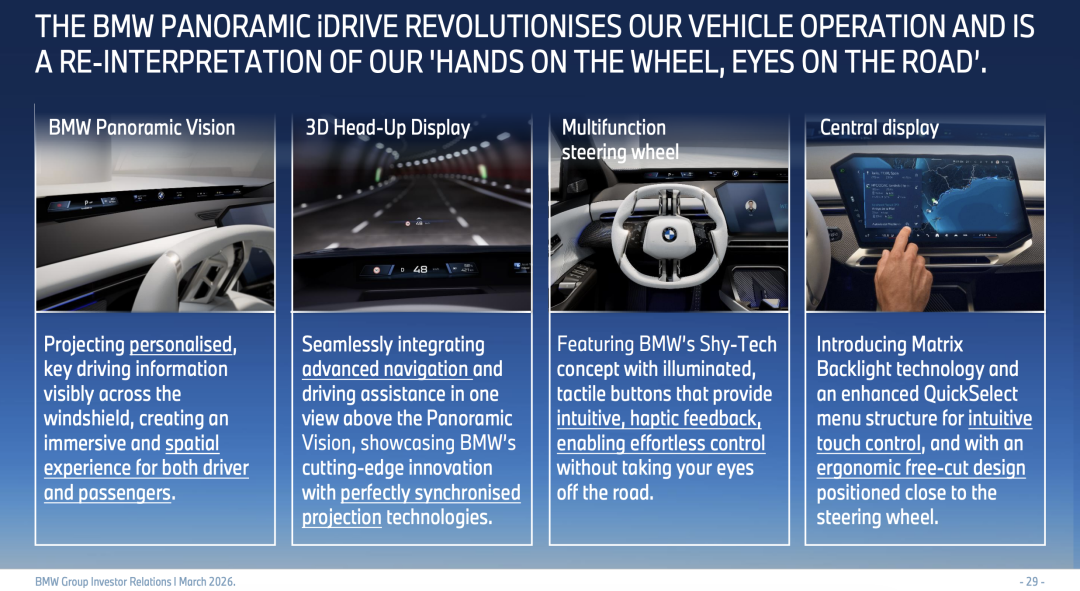
However, despite all these electrification and intelligent product technologies, these on-paper figures seem insufficient compared to China's intelligent electric vehicles.
New Design Language:
Combining progressive clarity with timeless elegance, embodying BMW's brand DNA.
Product Launch Plan (2025–2028)
In 2025, the BMW iX3 was successfully mass-produced at the Debrecen plant in Hungary and entered the European market, marking the official launch of 'Neue Klasse' models, with a strong order backlog. Entering 2026 and 2027, the product offensive will further accelerate:
BMW i3 and Next-Generation 3 Series: BMW will soon release the first variant of the next-generation 3 Series—the all-new BMW i3—bringing 'Neue Klasse' technology to the core of the BMW brand.
China-Exclusive iX3: At the upcoming Beijing Auto Show, BMW will unveil a China-version iX3 co-developed by its local R&D team, which BMW claims will be the 'most China-aware' model in its history.
Next-Generation BMW X5: This major model refresh will become the first to offer five powertrain options (efficient internal combustion engine, plug-in hybrid, pure electric, and hydrogen fuel cell launching in 2028), fully embodying its technology openness strategy.
BMW 7 Series and BMW M: The BMW 7 Series facelift featuring 'Neue Klasse' technology will debut at the Beijing Auto Show; the BMW M brand will also introduce its first high-performance pure electric model based on the 'Neue Klasse' architecture in 2027. 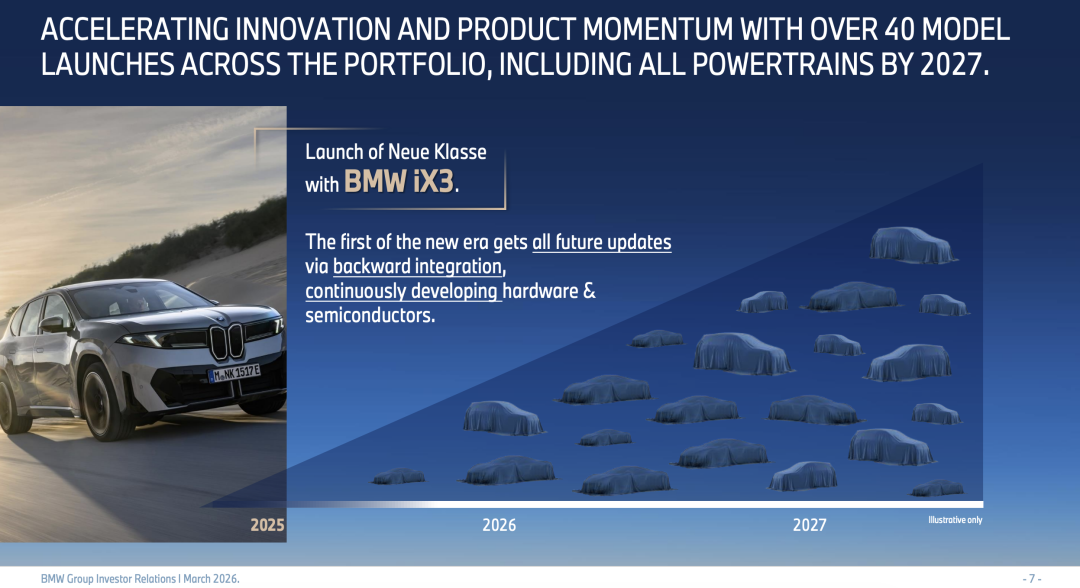
Overall, from now until 2027, BMW will launch over 40 new or refreshed models, fully applying 'Neue Klasse' technology.
2. Technology Cluster and 'Localized' AI Ecosystem
BMW's intelligent cockpit and autonomous driving technologies adopt a highly customized collaboration strategy: 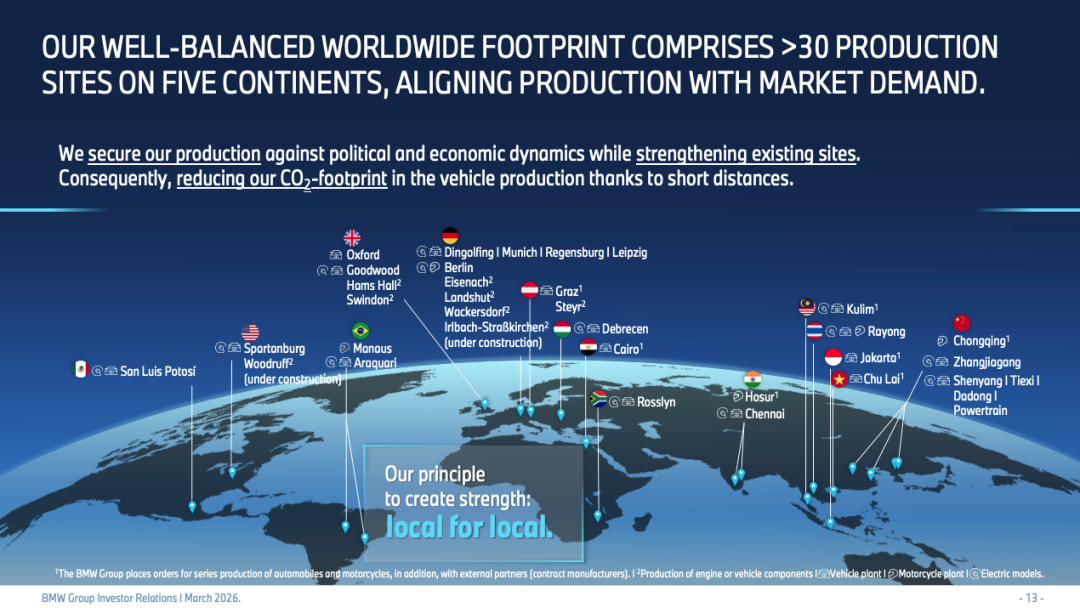
China Market Layout: Deeply integrating with China's tech ecosystem, BMW collaborates with Alibaba's Banma Network to develop next-generation voice control systems; introduces the DeepSeek large model to empower the BMW Intelligent Personal Assistant; in intelligent driving (ADAS), partners with Momenta to develop L2+ advanced driver-assistance systems tailored to Chinese road conditions, debuting on the locally produced iX3 in 2026.
Currently, China's intelligent driving leads in product and technology applications. For those interested in autonomous driving product technologies, refer to this article 'Who Should Read 'Autonomous Driving Product Manager'? What Value Does It Offer?' which discusses relevant books.
Global Market Layout: In most overseas markets (including Europe), the BMW Intelligent Personal Assistant will be powered by Amazon's Alexa+ large language model; for the ADAS chip and software stack, BMW collaborates deeply with U.S.-based Qualcomm. 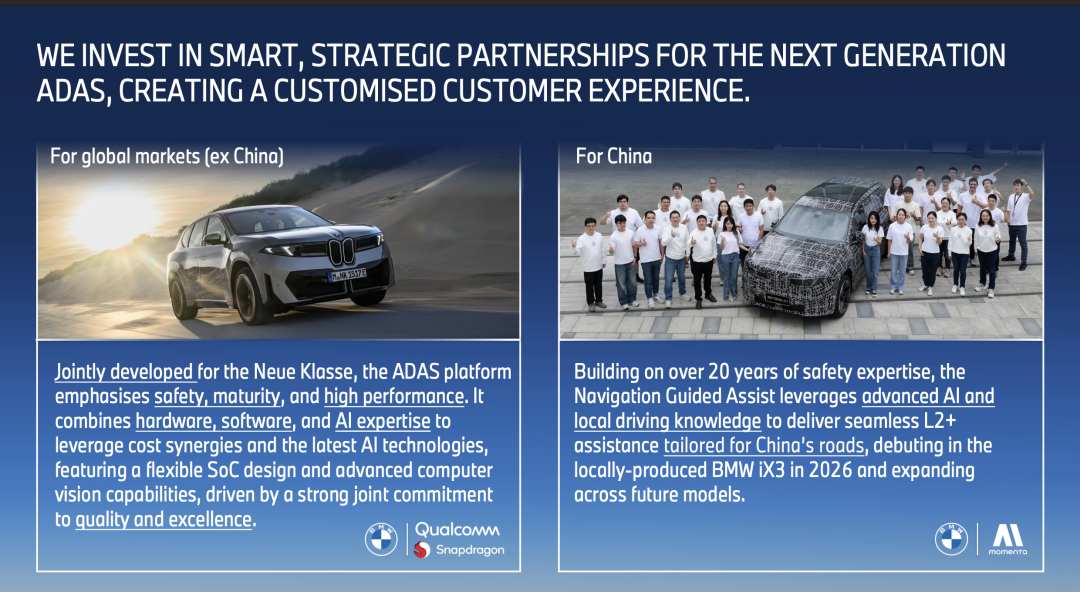
III. 2026 Market and Financial Outlook: Stability is Key
Based on rational predictions of geo-economic and tariff policies, BMW Group provides pragmatic guidance for 2026:
Sales and Revenue Expectations: Global vehicle deliveries in 2026 are expected to remain flat compared to 2025, with the BEV share also remaining flat due to model cycle impacts. After price stabilization measures in China, sales are expected to stabilize and reach 2025 levels.
Profit Guidance: Due to significant 'Neue Klasse' investments entering depreciation and amortization periods (estimated capitalization rate around 30%), coupled with an expected 1.25 percentage point negative tariff impact, the automotive division's EBIT margin target for 2026 is set at 4% to 6%.
Cash Flow: Despite heavy asset depreciation, the automotive division's free cash flow is expected to remain strong at over €4.5 billion by the end of 2026. 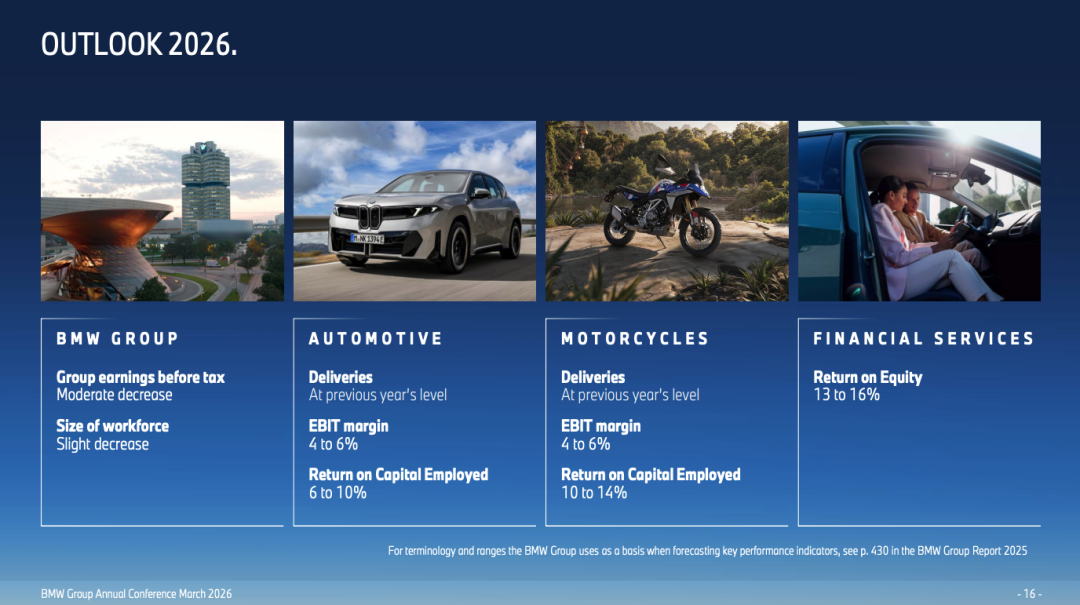
Conclusion: A glance at BMW Group's financials and strategy reveals a highly resilient automaker navigating volatile markets.
On one hand, growth in European and U.S. markets stabilized the 2025 baseline; on the other, through dense (intensive) 'Neue Klasse' product launches, sixth-generation electric drive cost reductions, and pragmatic collaborations with Chinese and foreign AI tech giants (e.g., DeepSeek, Alexa+), BMW is building a robust technological and market moat for 2026 and beyond.
However, overall, BMW's 'Neue Klasse' product technologies, based on on-paper figures, cannot compete with China's intelligent electric vehicles; Jack predicts that foreign brands' cars in China's market will follow a similar trajectory to the home appliance market, with luxury brands like BMW and Mercedes resembling Bosch and Siemens, focusing on niche services rather than cost-effectiveness, targeting high-end users.
What do you think? Welcome to leave a comment and discuss.
References and Images
BMW Automotive 2025 Fiscal Year PPT and Speech Manuscript
BMW Automotive Latest Investor PPT
*Unauthorized reproduction or excerpting is strictly prohibited-
-
![]()
The Unstoppable Rise of 'Optical Progress and Copper Decline': Sunny Optical’s Strategic Vision for the Next Decade
-
![]()
AI + Going Global in the Second Half: No Intermission for Robot Vacuum Cleaners
-
![]()
The Suffering Endured in E-commerce, Walmart Doesn't Want to Repeat in AI
-
![]()
What Does the Doubling of New Energy Vehicle Exports Mean?
-
![]()
Ghosn: 'Only I Can Save Nissan'
-
![]()
Volkswagen Lays Off 100,000 Employees, The Elephant Sits Down
-
![]()
Expanding Production Capacity! Yutong Optics Acquires Approximately 1.5 Hectares of Industrial Land in Chang'an, Dongguan
-
![]()
Why Is Nokia Making a Comeback in the AI Era?