In-depth Analysis of Honda's Major Strategic Shift: Withdrawing from EVs with a Massive Loss of 2.5 Trillion Yen and Refocusing on Hybrid Vehicles
 03/16 2026
 530
530
While recent earnings reports have been released by major automakers, Honda typically announces its fiscal year results (Q4 report) from late April to early May each year. Honda's fiscal year runs from April 1 to March 31 of the following year.
However, Honda recently held an urgent press conference to announce its first major financial deficit since adopting current accounting standards. The company expects to record a massive loss of up to 2.5 trillion yen (approximately RMB 108 billion to 110 billion).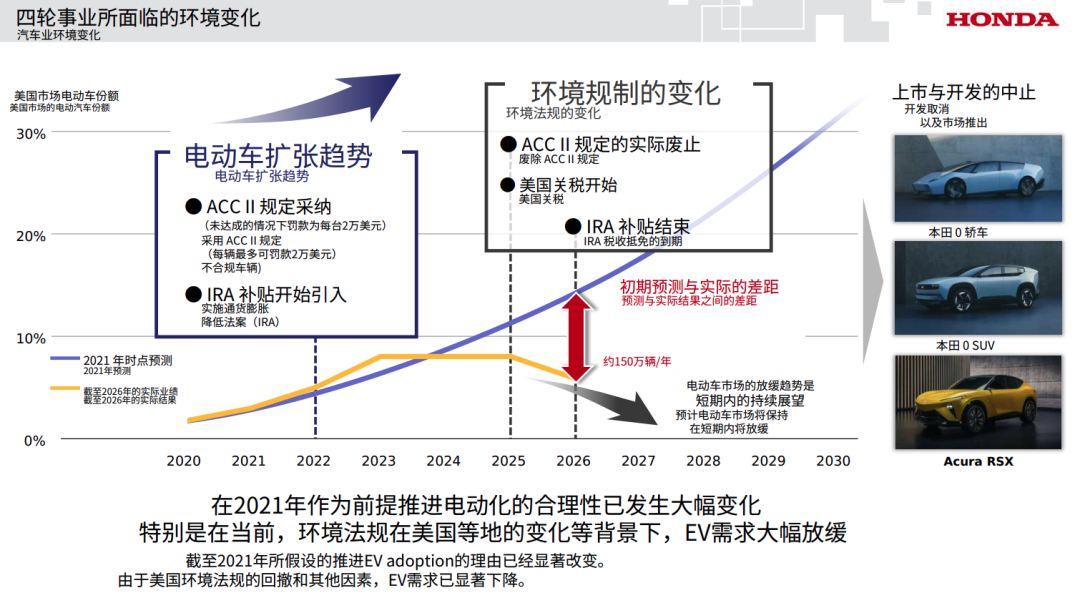
This is due to a difficult decision made by Honda's management to significantly adjust its long-term automotive business strategy.
What strategic changes has Honda made? What led to the abrupt halt of its once-ambitious electric vehicle (EV) plans? And where does this staggering 2.5 trillion yen loss come from? Today, we will provide an in-depth analysis of Honda's 'crisis of the century.'
I. Honda's Major Strategic Shift: From 'Full Embrace of EVs' to 'Refocusing on Hybrid Vehicles'
Honda's recent strategic adjustment can be described as a 'hard brake' and 'redirection,' primarily reflected in the following core areas:
Cancellation of Three Core EV Models in North America
Honda announced the formal cancellation of the launch and development of three major EV models in the North American market: the Honda Zero SUV, Honda Zero Saloon, and the Acura RSV/RSX.
Yes, the Honda Zero is the same model showcased several times at CES! To be honest, its competitiveness and cost are no match compared to Chinese EVs.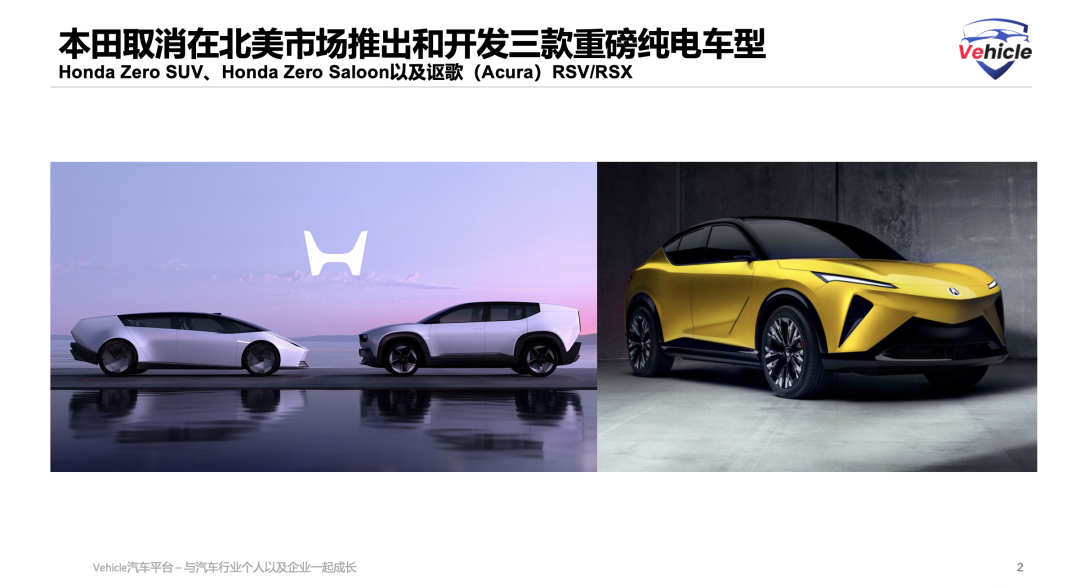
This marks a significant setback for Honda's EV expansion plans in the crucial North American market. However, the 'Honda Zero Alpha' model, primarily targeted at India, Japan, and select Asian markets, will continue development.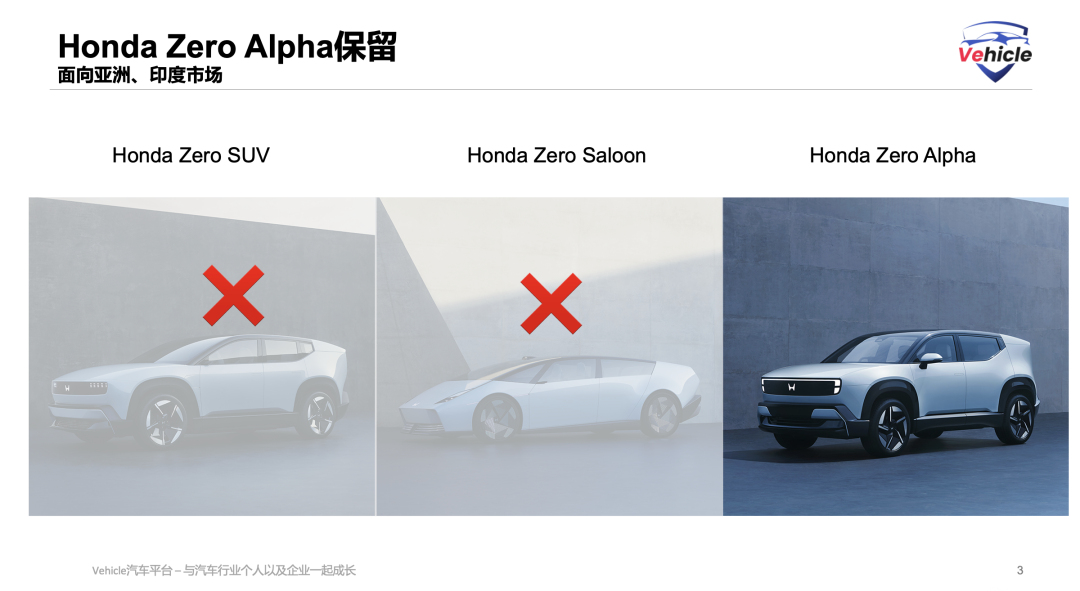
Refocusing on Hybrid Electric Vehicles (HEVs)
While reducing its EV investments, Honda is redirecting resources toward hybrid vehicles. The company plans to launch new hybrid models in the latter half of the 2020s. Starting in 2027, Honda will phase in next-generation hybrid systems across its core models. In the D-segment or larger markets, Honda will introduce newly developed large-scale hybrid systems.
Honda also stated that its next-generation advanced driver-assistance systems will be applied to its hybrid models.
On the supply chain front, Honda is advancing its joint venture with LG Energy Solution, planning to convert its U.S.-based EV battery production lines directly into hybrid battery production lines to achieve localized hybrid battery manufacturing.
Abandoning the '100% EVs by 2040' Goal
While reaffirming its long-term social responsibility goal of achieving carbon neutrality by 2050, Honda CEO Toshihiro Mibe admitted that the original target of '100% electrification by 2040' has become extremely difficult to achieve in reality due to market slowdowns. However, Honda still maintains that EVs are the future.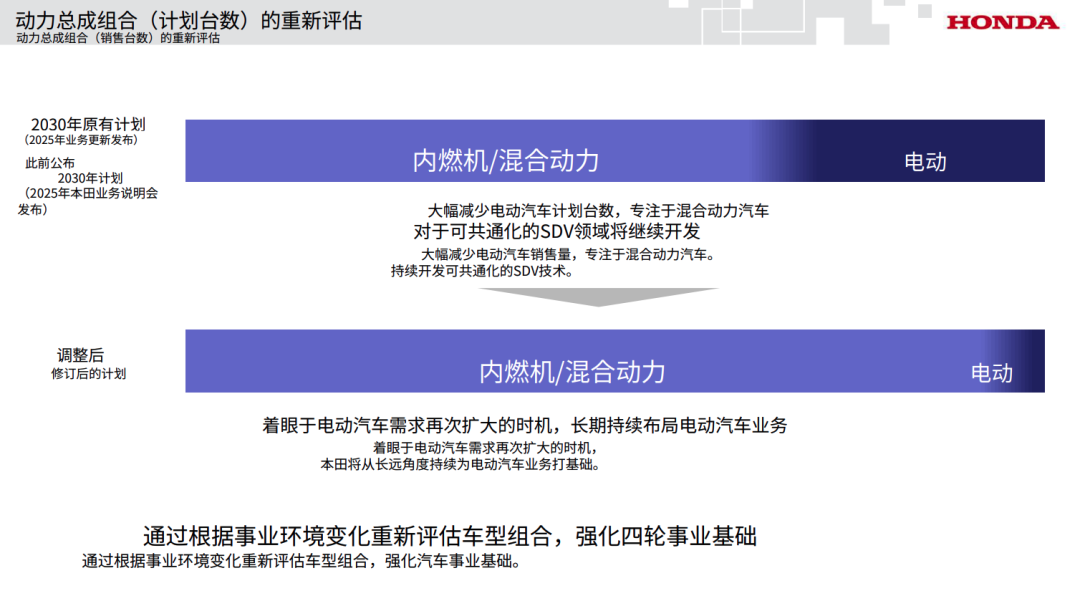
II. Why the Sudden Adjustment? Harsh Realities Halt the 'EV Dream'
Honda originally believed that pure electric vehicles were the best solution for long-term development and had invested heavily in preparation over the past few years. However, the pace of change in the business environment far exceeded Honda's expectations within just a few years:
Plummeting Demand and Policy Shifts in North America:
U.S. environmental regulations have been relaxed, and EV subsidies have been canceled, leading to a significant slowdown in EV market growth. Honda had originally predicted that EVs would account for 12% to 18% of the market by 2026, but in reality, U.S. consumer purchase intent dropped sharply in January and February this year, with EVs falling to about 5% of the market.
Mired in 'Selling One at a Loss':
Amid low demand, substantial subsidies were required to sell vehicles, compounded by the impact of newly imposed tariffs, resulting in severe negative gross margin growth for Honda, with losses far exceeding expectations. Management realized that forcing these three EV models into production and sales would not only make profitability extremely difficult but could also lead to premature production halts, further damaging Honda's brand image.
Intense Competition from Chinese and Emerging Brands:
In contrast to the U.S. market, the electrification and intelligentization (intelligentization) development in China has exceeded expectations. Emerging Chinese automakers (OEMs) are not only performing strongly domestically but are also exerting significant competitive pressure in other overseas markets like ASEAN. Under the current competitive environment, Honda has failed to offer products with sufficient cost-effectiveness and competitiveness. To address this, Honda urgently needs to shorten development cycles and improve production efficiency.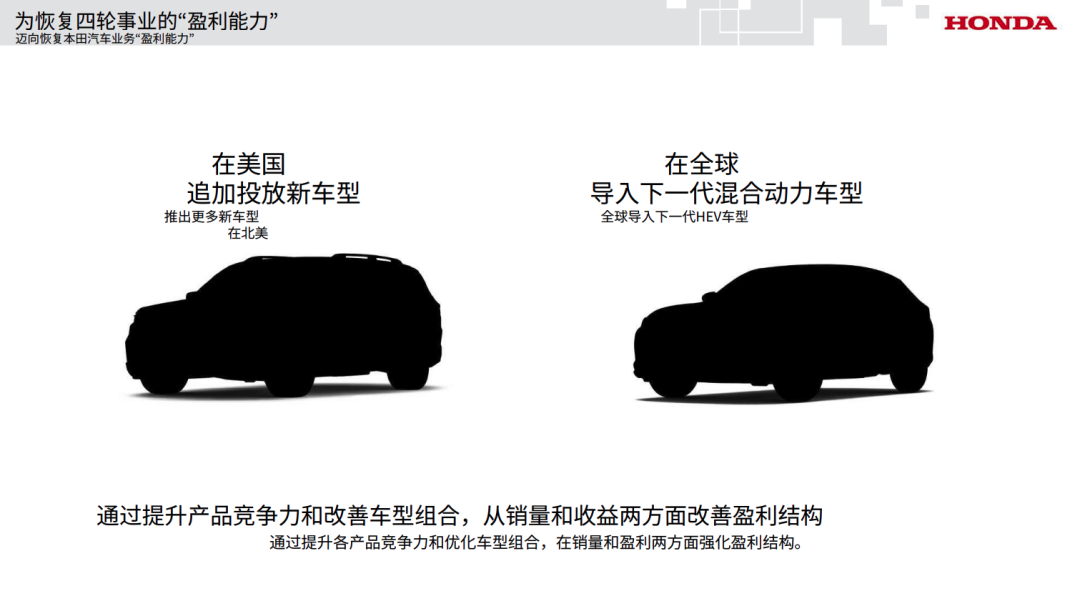
III. Where Does the Staggering 2.5 Trillion Yen Loss Come From?
According to Honda's disclosures, out of the maximum 2.5 trillion yen loss, approximately 1.3 trillion yen will be recorded in the current fiscal year (ending March 2026), with the remaining about 1.2 trillion yen to be accounted for in the next fiscal year (ending March 2027). This massive financial black hole primarily consists of the following components:
Asset Impairment and Sunk Development Costs (Core Non-Cash Losses)
Canceling the development of three core models means that significant research and development assets, customized production molds, and dedicated facilities—both tangible and intangible—must be impaired and written off.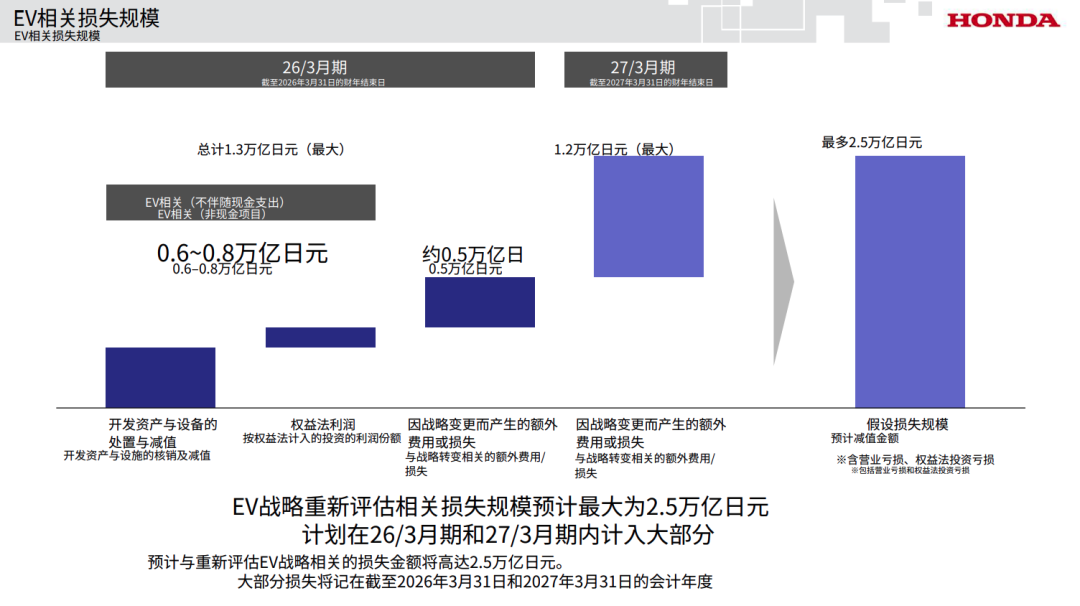
Hefty Supplier Compensation (Core Cash Expenditure)
Since many suppliers had already made substantial upfront preparations for the mass production of Honda's EV models, Honda had to engage in sincere negotiations with each supplier and pay significant breach-of-contract damages. According to financial officials, the majority of the 1.2 trillion yen loss to be recorded in the next fiscal year will be used for supplier compensation, resulting in actual cash outflows of up to 1.7 trillion yen.
One cannot help but admire the professionalism of these international giants, including Volkswagen, as discussed in our previous article 'Volkswagen Group's 2025 Operating Performance and 2026 Strategic Outlook Analysis.' They all face business with integrity and adhere to the spirit of contract.
'Compliance Costs' from Stringent Regulations
California's extremely strict ACC2 environmental regulations impose hefty fines of up to $20,000 per non-compliant vehicle. To meet these baseline requirements, Honda was forced to invest enormous sums in research, development, and compliance preparations upfront, investments that are now going to waste with the project cancellations.
Investment Setbacks in the Chinese Market
In addition to the EV projects in North America, Honda's business in the Chinese market has also struggled. This has resulted in equity-method investment losses of 110 billion to 150 billion yen for Honda in regions including China.
Conclusion: 'Stopping the Bleeding' to Ensure Survival
Honda CEO Toshihiro Mibe admitted at the press conference that the current priority is to 'stop the bleeding' and face harsh realities rather than defend past erroneous decisions. While the 2.5 trillion yen cost is extremely painful, Honda still possesses a massive cash reserve of 4 trillion yen, with a robust (robust) balance sheet.
By promptly canceling unprofitable EV projects and refocusing on hybrid vehicles, an area where it excels and where demand is currently strong, Honda hopes to return its automotive business to stable profit growth by fiscal year 2028 and beyond.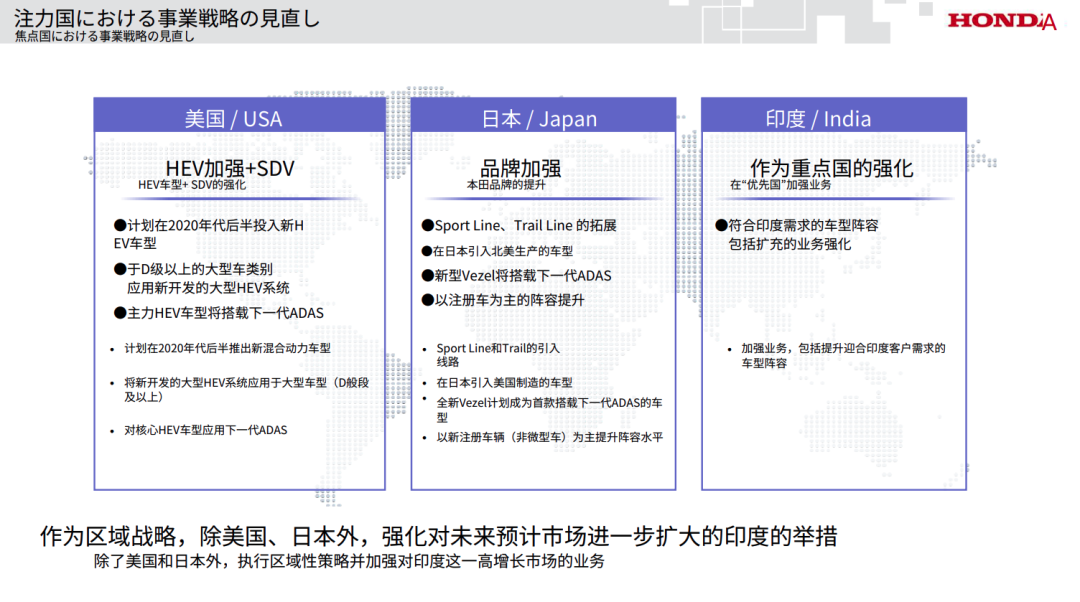
In the era of electrification transformation, Honda's 'drastic survival tactic' undoubtedly serves as a wake-up call for traditional automakers worldwide: amid policy shifts, market cooldowns, and the rise of Chinese automakers, maintaining flexibility and profitability will be key to survival.
References and Images
Honda Motor's special announcement PPT and speech
*Unauthorized reproduction or excerpting is strictly prohibited-
-
![]()
The Unstoppable Rise of 'Optical Progress and Copper Decline': Sunny Optical’s Strategic Vision for the Next Decade
-
![]()
AI + Going Global in the Second Half: No Intermission for Robot Vacuum Cleaners
-
![]()
The Suffering Endured in E-commerce, Walmart Doesn't Want to Repeat in AI
-
![]()
What Does the Doubling of New Energy Vehicle Exports Mean?
-
![]()
Ghosn: 'Only I Can Save Nissan'
-
![]()
Volkswagen Lays Off 100,000 Employees, The Elephant Sits Down
-
![]()
Expanding Production Capacity! Yutong Optics Acquires Approximately 1.5 Hectares of Industrial Land in Chang'an, Dongguan
-
![]()
Why Is Nokia Making a Comeback in the AI Era?