Jensen Huang Unveils Future Trends at GTC 2026: The Fate of SaaS and Token-Based Charging for Software-Defined Vehicles
 03/18 2026
 567
567
GTC 2026 commenced last night, China time, captivating tech enthusiasts and investors who stayed up late to watch Jensen Huang's keynote. As the CEO of NVIDIA, Huang once again made waves in the tech and automotive industries with his groundbreaking announcements.
Today's GTC has evolved beyond NVIDIA's traditional 'chip showcase' into a grand vision presented by Huang. He discussed how AI is entering its 'second phase,' transitioning from pure digital generation to fully actionable intelligent agents (Agentic AI) and ultimately achieving real-world applications in physical domains such as automobiles and robotics.
For professionals in the automotive and intelligent mobility sectors, this is not just a glimpse into cutting-edge technologies but a future roadmap that could dictate their survival.
While many have extensively covered Jensen Huang's keynote from various angles, none have interpreted it through the lens of Physical AI in automobiles and embodied intelligent robots. Therefore, this article will delve into NVIDIA's latest products and technical details from the automotive industry's perspective, exploring how they empower the sector and where the future of the automotive industry is headed.
1. Background and Trends: The 'Inference Inflection Point' of AI Has Arrived, with Computing Demand Soaring a Millionfold
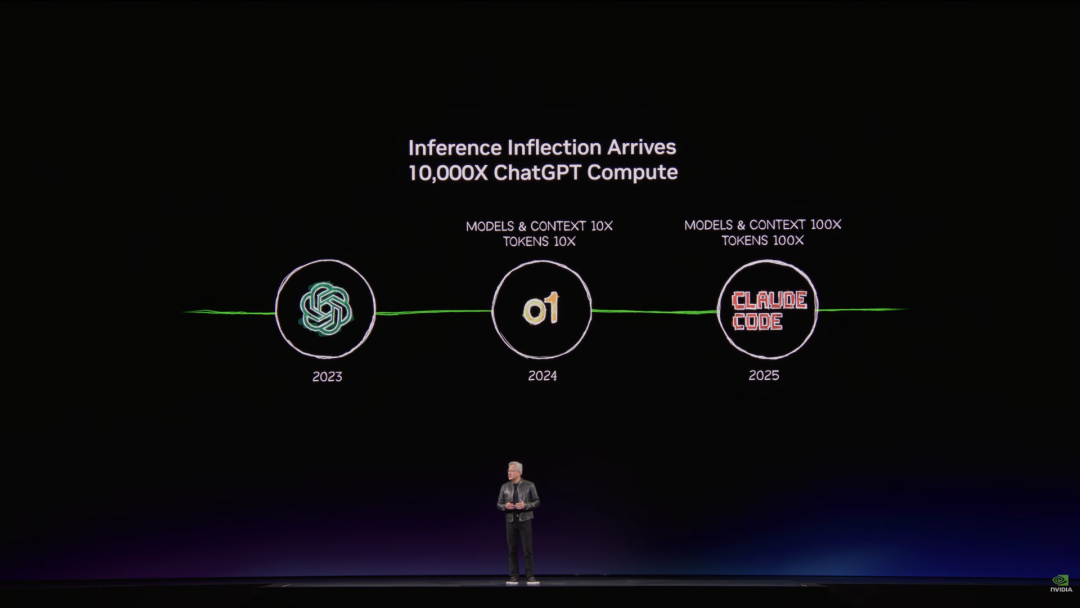
To comprehend NVIDIA's new releases, one must first understand the underlying logic of current AI evolution. Huang pointed out that AI has undergone three major leaps in the past two years:
Generative AI: Represented by ChatGPT, AI can now not only perceive but also generate content, shifting computation from 'retrieval-based' to fully 'generative.'
Reasoning AI: Represented by the o1 model, AI now possesses reflective, planning, and truth-based reasoning capabilities.
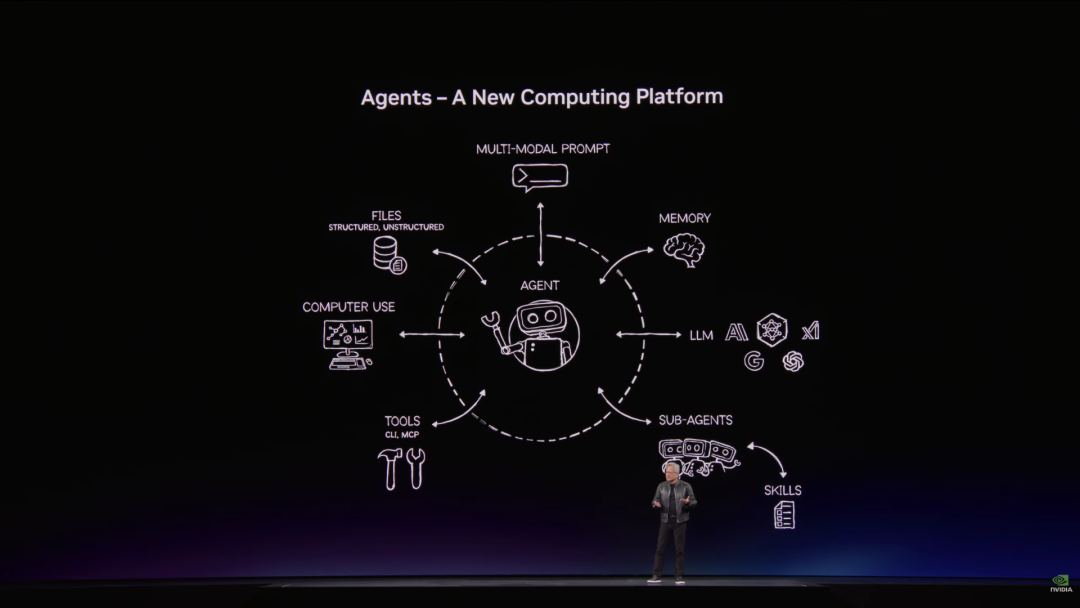
Agentic AI: Represented by Claude Code, AI can now read files, write code, use tools, and autonomously execute tasks.
As AI transitions from 'perception' to 'execution,' it is constantly performing inference. Based on this logic, Huang declared, 'The inflection point for inference has arrived.' With longer input contexts and surging output tokens, AI computing demand has skyrocketed nearly a millionfold in the past two years.
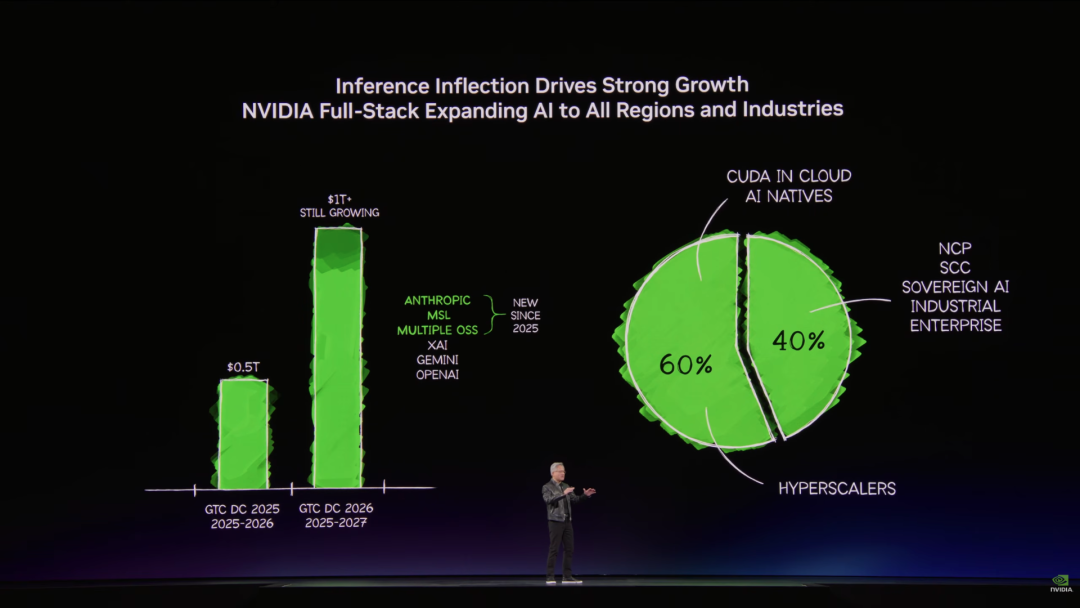
Here's a straightforward pitch: Jensen Huang stated that by 2027, global demand for AI computing infrastructure will exceed $1 trillion. The tech industry and investments can revolve around this AI computing infrastructure, with NVIDIA at the forefront.
2. Game-Changing Arsenal: NVIDIA's New Generation of 'Hardcore Weapons'
Facing massive inference demands, NVIDIA is no longer limited to selling chips but now offers a complete 'AI factory'-level hardware and software system.
At GTC 2026, NVIDIA highlighted the following products:
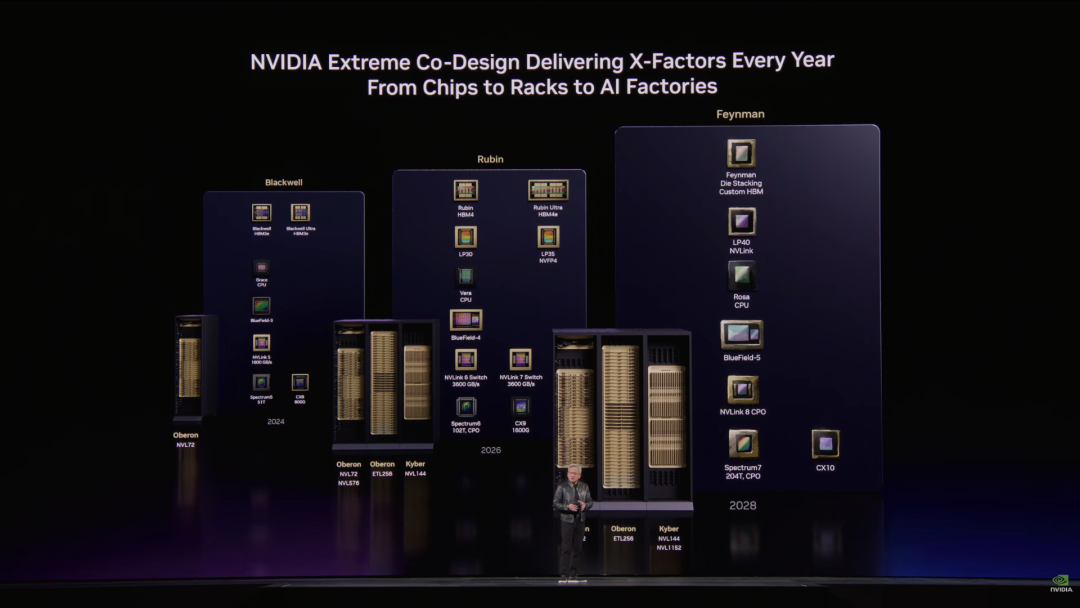
Vera Rubin Supercomputing Platform: Tailored for Intelligent Agents. This is a brand-new architecture designed specifically for Agentic AI. The Vera CPU is the world's only data center CPU using LPDDR5, delivering extremely high single-thread performance—perfectly meeting the rapid demands of AI agents frequently calling tools like browsers and virtual PCs.
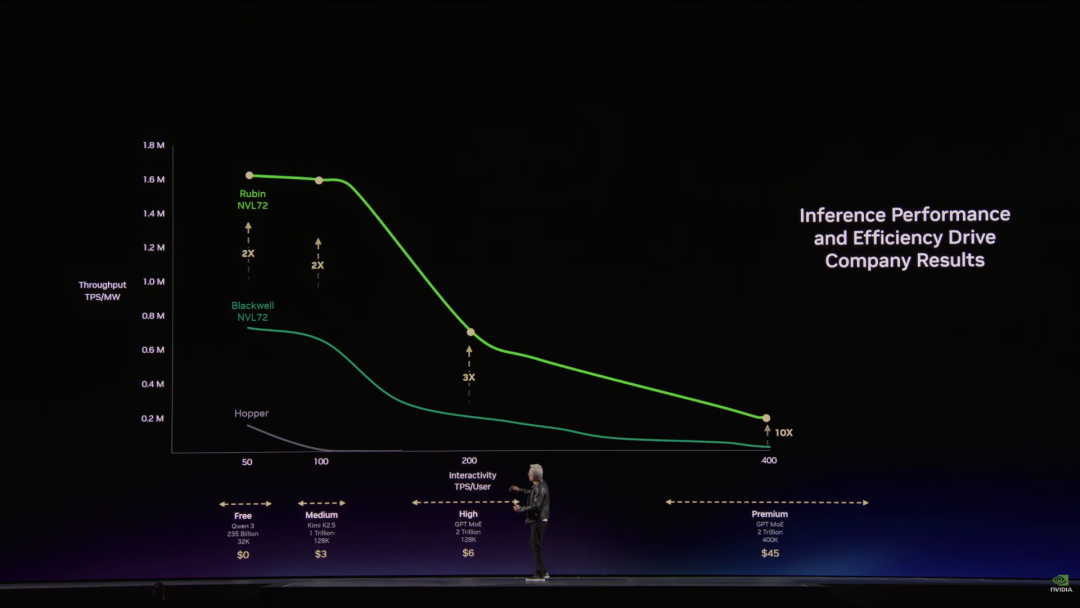
Combined with NVLink 72 networking, the Vera Rubin platform achieves astonishing performance leaps, generating 35 times more tokens per watt than the previous generation.
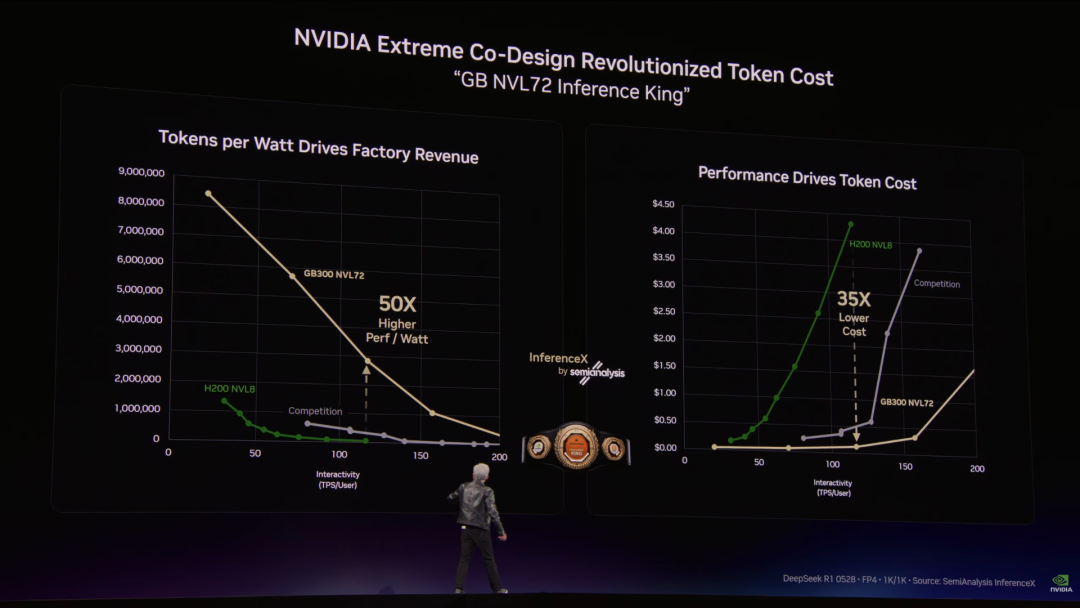
Integration with Groq Technology: Pioneering 'Decoupled Inference.' To overcome the physical contradiction between high throughput and ultra-low latency, NVIDIA introduced 'decoupled inference' through its Dynamo software system. The Vera Rubin supercomputing platform handles massive contexts (KV Cache) and complex attention mechanism computations.
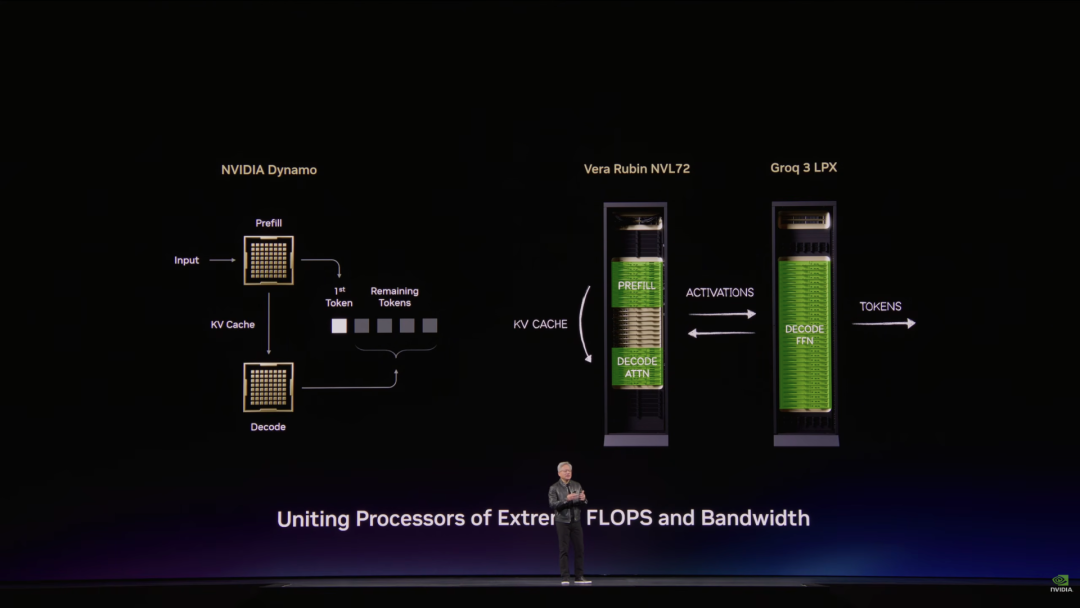
Another new chip, the LPU (Language Processing Unit), Groq LP30/LP40, leverages massive SRAM for ultra-fast token generation (decoding). This technology comes from the company NVIDIA acquired for $20 billion late last year.
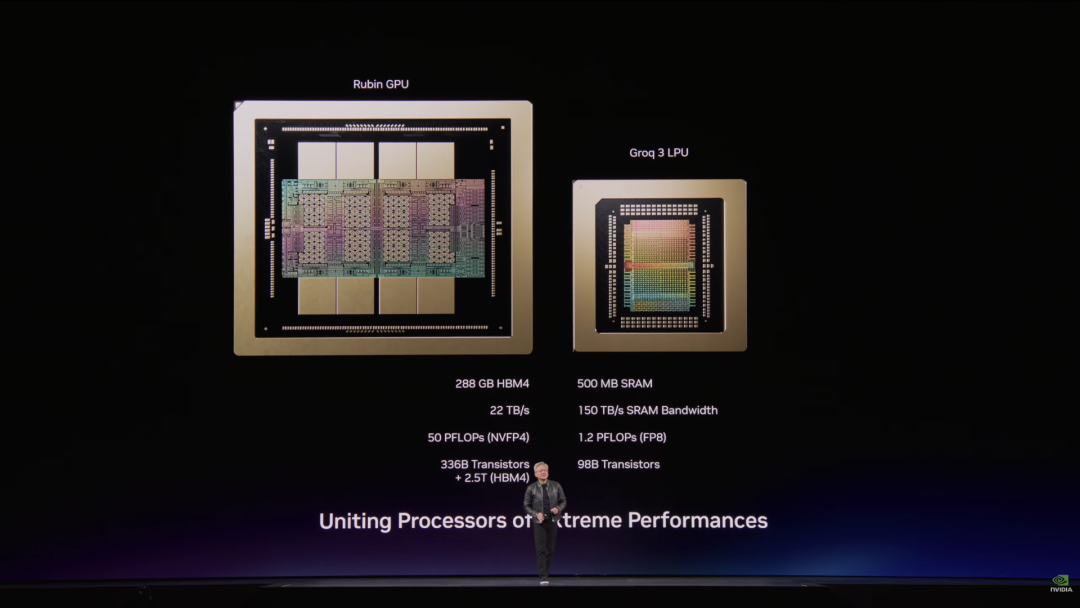
Now, these two distinct chips join forces, delivering unprecedented generation speeds at the core inference level. Could this speed-boosting approach bring hope to VLA technologies desperately needing performance improvements? Stay tuned to Vehicle for our subsequent analysis.
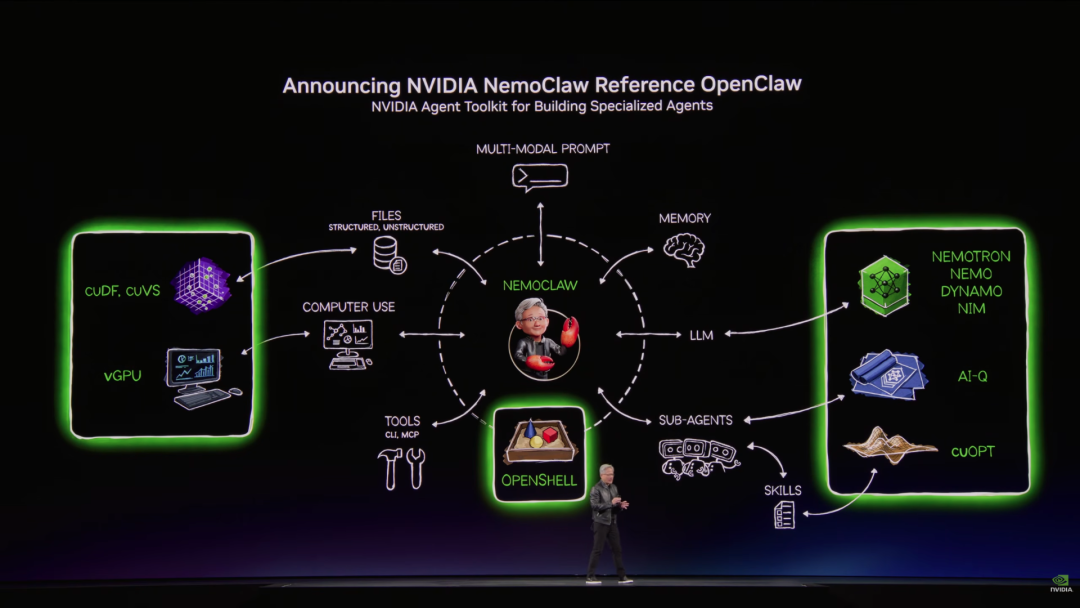
OpenClaw and NemoClaw: Even NVIDIA, a tech giant, is chasing hot trends. 'Claw,' the buzzing 'operating system' of the intelligent agent era, enables AI to autonomously schedule resources, execute code, and call tools. Recently, rumors circulated about a certain automaker's internal 'Claw' adoption leading to corporate 'poisoning,' making safe 'Claw' cultivation a corporate necessity. Thus, NVIDIA launched the enterprise-grade secure version NemoClaw, adding privacy routing and network guardrails to allow agents to securely and compliantly access confidential data within enterprises.
3. Physical AI Explosion: The 'ChatGPT Moment' for Autonomous Driving and Embodied Intelligence
While digital intelligent agents on the internet have already dazzled, attracting most talent and capital, what truly excites the automotive industry is the full-scale explosion of Physical AI. Huang formally declared at the conference, 'The ChatGPT moment for autonomous driving has arrived!'
Besides the hardware mentioned above, Jensen Huang also prepared various software tools, practically feeding the industry:
Alpamayo: The 'Thinking and Explaining' Autonomous Driving AI. Traditional autonomous driving relies heavily on rules and passive perception. NVIDIA's Alpamayo large model endows vehicles with 'reasoning' capabilities. For details on Alpamayo's structure and technology, refer to 'Wu Xinzhou Leads NVIDIA's Charge Toward L4 Autonomous Driving with VLA Large Model Algorithms.' Additionally, an updated Alpamayo 1.5 version will be shared later.
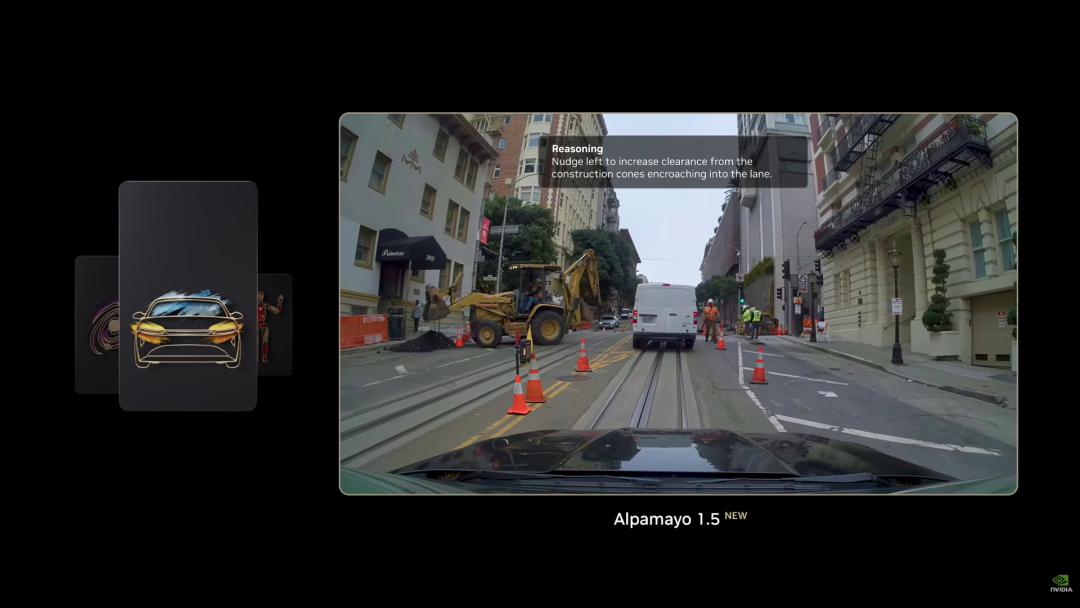
Vehicles equipped with this model can not only drive safely but also explain their decision-making logic in natural language like human drivers (e.g., 'There's a double-parked car in my lane; I'm maneuvering around it') and even directly follow passenger voice commands for acceleration and other operations.
Addressing Long-Tail Data: Real-world data is far from sufficient to handle countless 'edge cases.' NVIDIA provides the Cosmos world foundation model, Isaac Lab simulation platform, and Newton physics simulation engine to train AI using massive amounts of high-precision synthetic data.
The conference even showcased a robot named Olaf (from Disney), which learned to walk and interact in the physical world entirely within a virtual environment powered by NVIDIA Omniverse and Newton engines.
Finally, another pitch moment: Jensen Huang announced that NVIDIA's Robotaxi platform has welcomed heavyweight new partners. Following Mercedes-Benz, Toyota, and General Motors, BYD, Hyundai, Nissan, and Geely have officially joined NVIDIA's Robotaxi technology ecosystem. This will further intensify competition in the automotive industry—after all, we haven't even mass-produced L3 vehicles yet, and everyone's already charging ahead with L4.
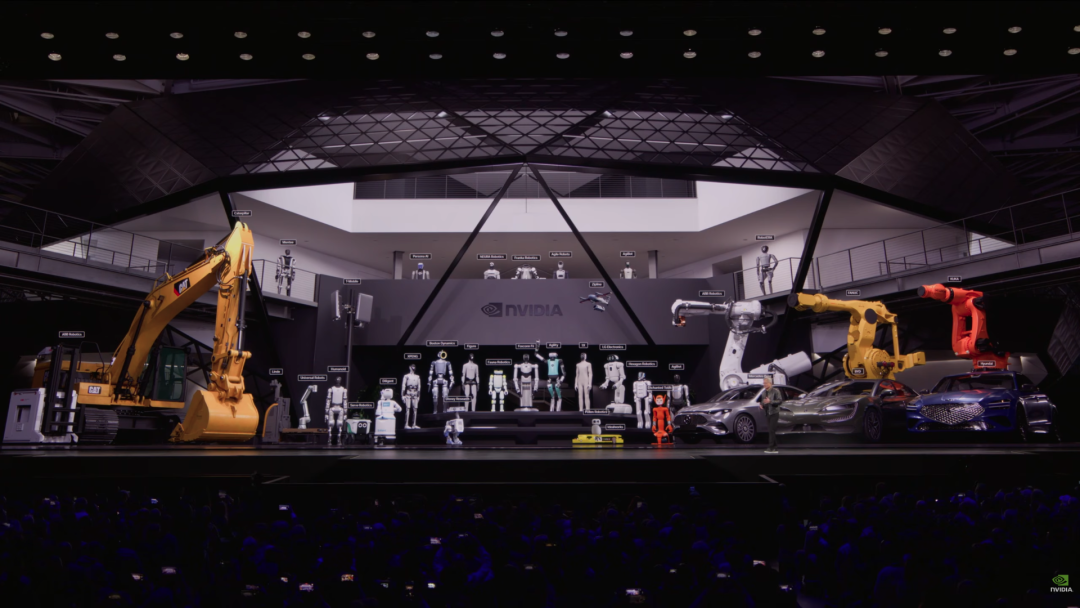
Indeed, intelligent assisted driving/autonomous driving represents the most valuable segment in the automotive industry today, both for investment and careers, offering high returns. Here's a plug: For enthusiasts and practitioners interested in autonomous driving products and technologies, check out the book mentioned in 'Who Should Read
4. Industry Forecast and Outlook: Where Is the Next Competitive Battleground for the Automotive Industry?
Now that Huang has covered so much, what implications and insights does this hold for our automotive industry? Based on the major announcements at GTC, we can derive three profound predictions for the automotive sector and the broader tech industry:
All Software and In-Vehicle Experiences (SaaS) Will Shift Toward 'AaaS (Agentic as a Service).' Huang predicts that all future SaaS (Software as a Service) companies will become AaaS (Agentic as a Service) providers.
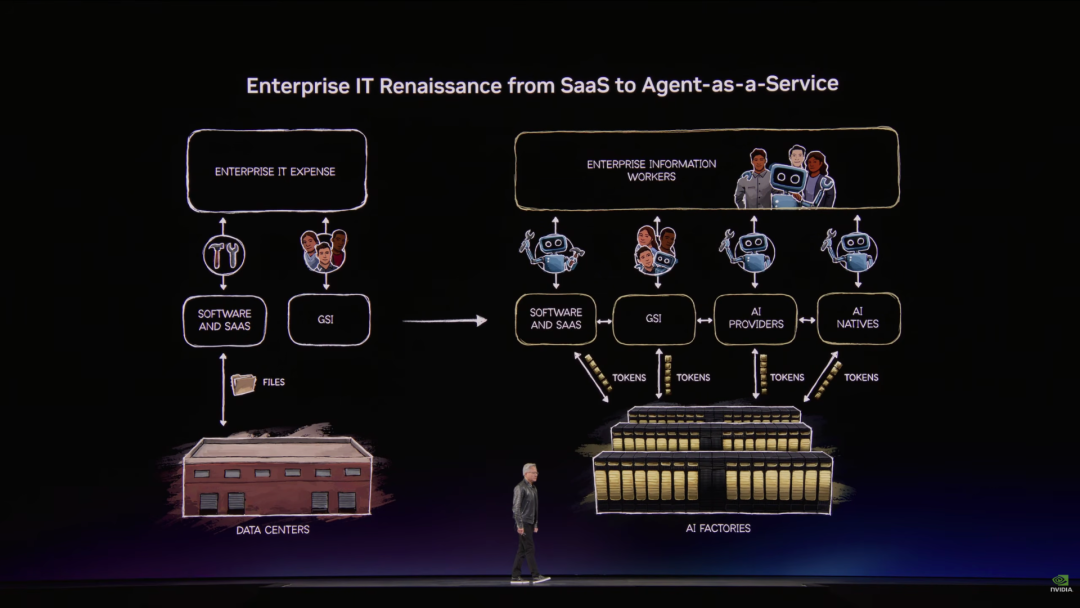
For automakers, future vehicles will no longer be mere hardware or traditional smart cockpits but mobile spaces equipped with multiple vertical-domain 'expert agents.' The core business model for automakers will shift toward continuously providing users with exclusive AI token services.
If you've read Vehicle's recent financial analyses of automakers, you'll see that traditional car manufacturers' transitions generally involve heavy losses, prompting them to slow down and reconsider future smart car profit models.
Indeed, with smart cars packing so much hardware and software, much of it given away for free, and users still complaining about features lagging behind competitors, the result is fierce competition without profit. After large models are integrated into vehicles, Geely's Zeekr 8x recently premiered a Tesla Grok-like experience (click the previous article 'Tesla Grok + FSD = VLA?' to learn about Grok's in-car experience). This cockpit experience, which doesn't control the vehicle, might experiment with token-based charging.
'Annual Token Budgets' Will Become Standard for Enterprises, Requiring Automakers to Establish OpenClaw Strategies. In the future, tokens will become a new commodity like electricity and water. Huang predicts that software engineers will not only receive base salaries but also 'annual token budgets' from companies to exponentially boost productivity.
Just as every company once needed an internet strategy and cloud strategy, future automakers must establish their own OpenClaw strategies, building enterprise-exclusive intelligent agent operating systems to gain an edge in internal R&D efficiency and external autonomous driving services.
This token system might burden current workplace newcomers and interns. While on-the-job training used to involve veterans mentoring rookies, now veterans plus tokens can boost efficiency. Conclusion: GTC 2026 showcases an AI era no longer confined to screens. As AI develops 'limbs' and 'brains,' entering the physical world through intelligent agents and autonomous vehicles, the automotive industry faces unprecedented transformation.
Whether in terms of workplace dynamics, organizational structures, product forms, or business models, the automotive industry is set for change.
Embracing AI will be the automotive sector's sole ticket to winning future battles. Finally, welcome friends interested in autonomous driving to explore Vehicle's book 'Who Should Read
-
![]()
The Unstoppable Rise of 'Optical Progress and Copper Decline': Sunny Optical’s Strategic Vision for the Next Decade
-
![]()
AI + Going Global in the Second Half: No Intermission for Robot Vacuum Cleaners
-
![]()
The Suffering Endured in E-commerce, Walmart Doesn't Want to Repeat in AI
-
![]()
What Does the Doubling of New Energy Vehicle Exports Mean?
-
![]()
Ghosn: 'Only I Can Save Nissan'
-
![]()
Volkswagen Lays Off 100,000 Employees, The Elephant Sits Down
-
![]()
Expanding Production Capacity! Yutong Optics Acquires Approximately 1.5 Hectares of Industrial Land in Chang'an, Dongguan
-
![]()
Why Is Nokia Making a Comeback in the AI Era?