NIO, Xpeng, and Li Auto All Achieve Profitability: A Milestone or a Prelude to Intensified Competition?
 03/23 2026
 442
442
In the 2025 financial reporting season, China's new energy vehicle (NEV) sector has finally reached a long-anticipated milestone.
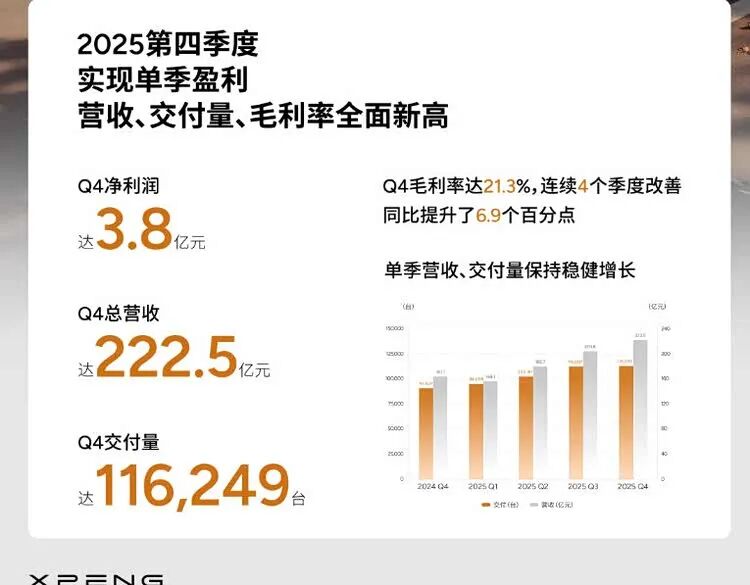
On March 19, Xpeng Motors unveiled its financial report, announcing a net profit of RMB 380 million in the fourth quarter, marking its first profitable quarter. With this achievement, NIO, Li Auto, and Xpeng—the 'Big Three' of China's NEV sector—have all crossed the profitability threshold simultaneously for the first time.
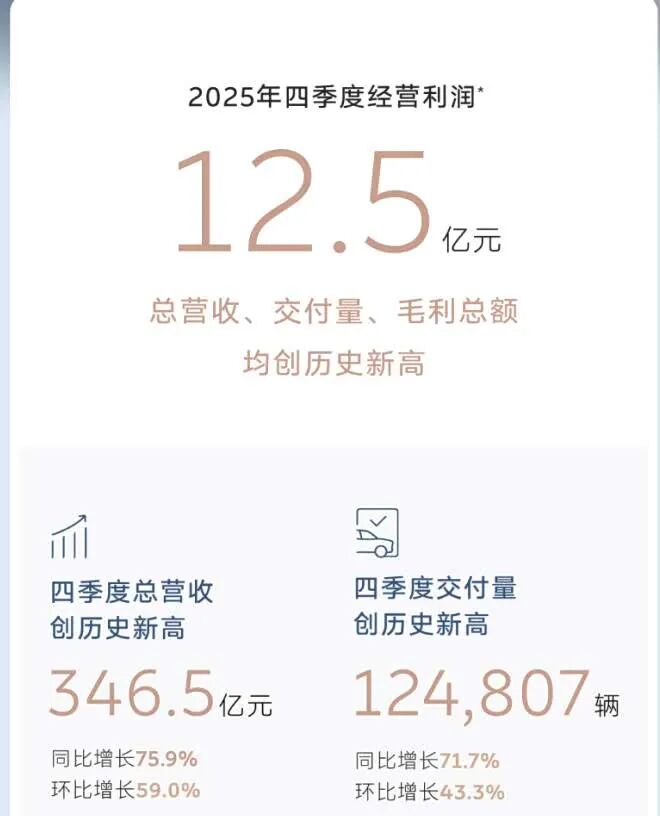
Li Auto's early profitability in 2023 was no longer a surprise. NIO also turned a profit in the fourth quarter of 2025, with a net profit of RMB 283 million. Xpeng's profitability report simply completed the final piece of the puzzle.
However, the significance of this achievement extends far beyond the financial statements of individual companies.
It signifies that China's leading NEV manufacturers have collectively crossed the 'survival threshold,' transitioning from a capital-driven expansion phase to a self-sustaining maturity phase. The question that has lingered in the capital markets for a decade—'Can you survive independently?'—has finally received a provisional answer.
Yet, profitability has never been the finish line. On the contrary, it serves as the starting gun for a new round of intense competition.
The First Year of Profitability: Three Reports, Three Paths
Let's delve into the numbers.
In 2025, Li Auto's annual revenue reached RMB 112.3 billion, maintaining its position as the 'revenue king' among the three, with cash reserves totaling RMB 101.2 billion, far exceeding its peers. However, Li Auto was also the only one among the three to experience a decline: annual deliveries fell by 18.8% year-on-year to 406,000 units, and net profit plummeted by 85.8% year-on-year to RMB 1.1 billion. The diminishing returns of the extended-range route and the growing pains of transitioning to pure electric vehicles reflect Li Auto's current challenges.
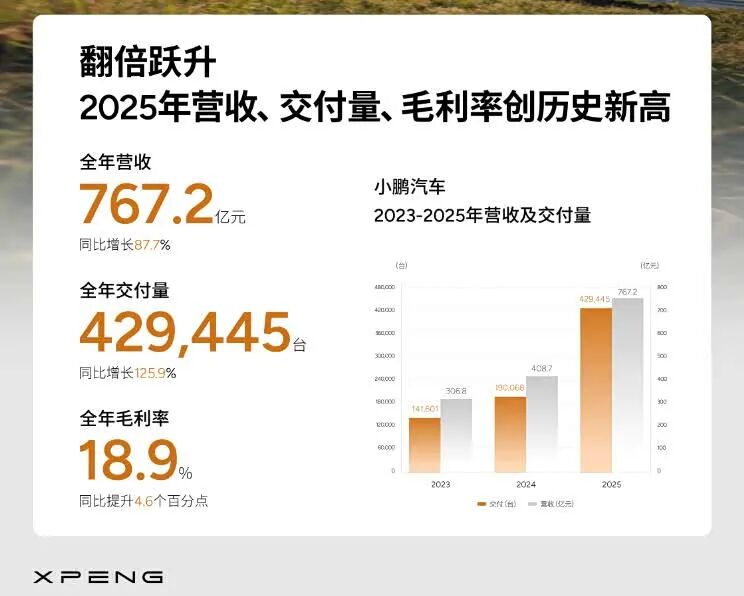
Xpeng Motors, on the other hand, emerged as the 'growth king.' Annual deliveries reached 429,000 units, a 125.9% year-on-year increase, securing the top spot among NEV manufacturers for the first time. Revenue grew by 87.7% year-on-year to RMB 76.72 billion, and the fourth-quarter gross margin stood at 21.3%, the highest among the three. Its first quarterly profit of RMB 380 million marked the success of a technology-driven profitability path.
NIO remained the most 'stable' of the three. Annual deliveries reached 326,000 units, a 46.9% year-on-year increase, with revenue growing by 33.1% year-on-year to RMB 87.488 billion. The fourth quarter marked its first profit of RMB 283 million, ending an 11-year streak of losses. However, the annual net loss still stood at RMB 14.943 billion, significantly narrowed year-on-year but still indicating the weakest 'self-sufficiency' capability among the three.
Three distinct paths, converging at the same destination:
- Li Auto achieved early profitability through precise product definition and extreme cost control, representing the 'efficiency-driven' approach.
- Xpeng achieved high-margin profitability through technological premiums and product matrix expansion, representing the 'technology-driven' approach.
- NIO managed to turn a profit through its high-end brand moat and organizational streamlining, representing the 'persistence-driven' approach.
Over the past decade, these three companies have proven in different ways that new energy vehicle manufacturers are not merely capital-induced bubbles but entities capable of independent survival.
Post-Profitability: The War Continues, Just on a Different Battlefield
The news of collective profitability might easily create an illusion: Has the elimination round for new forces ended?
The answer is no. On the contrary, competition post-profitability will only become more brutal.
The reason is simple: Profitability is merely the passing grade. In the automotive industry, profitability does not equate to safety; it only means you qualify for the next round.
What will the next round compare?
First, cash reserves.
Li Auto holds RMB 101.2 billion in cash, Xpeng has RMB 47.6 billion, and NIO has approximately RMB 60 billion. This gap determines the offensive and defensive postures of the three companies in the coming years.
Li Auto can use its ample ammunition to support the pain period of transitioning to pure electric vehicles, trading capital for time. Xpeng needs to be more prudent, ensuring every penny is spent wisely while maintaining R&D intensity. NIO falls in between, with sufficient funds to sustain long-term investments in battery swapping and chip self-research but without room for error.

Competition in the automotive industry is, in essence, a protracted war. Cash reserves serve as war funds, determining how long and how fiercely you can fight.
Second, growth quality.
Post-profitability, the valuation logic for the three companies will shift in the capital markets. In the past, the market focused on 'price-to-sales ratios,' emphasizing growth rates and imagination. Now, with profitability becoming the norm, the market will turn its attention to 'price-to-earnings ratios' and the sustainability of profitability.
This means the three companies must prove not just 'can they make money' but 'can they continue to make money.'
Can Xpeng maintain its high gross margin of 21.3%? Can Li Auto halt its decline and have its pure electric products take over from extended-range models? Can NIO reduce losses while preserving brand premium? These are the questions that must be answered in 2026.
Third, new battlegrounds.
As the domestic market enters a saturated phase, going global becomes a necessity. All three companies are accelerating their overseas expansion, but whoever can first establish a scalable sales network and brand recognition abroad will gain a new growth curve.
Meanwhile, intelligence remains the commanding height of long-term competition. Xpeng invested RMB 9.49 billion in R&D in 2025, Li Auto RMB 11.3 billion, and NIO also in the billions. While achieving profitability, none of the three have reduced R&D intensity—indicating a clear understanding that intelligence is the moat for the next decade.
Capital Markets: Profitability Achieved, What's Next?
What does the news of collective profitability mean for capital markets?
In the short term, it represents a significant emotional turning point. The profitability doubts that have plagued new forces for years have finally dissipated, allowing investors to establish more stable expectations for the fundamentals of these three companies.
However, in the long term, profitability brings new questions: With losses no longer the main narrative, what differentiated stories remain for the three companies?
Li Auto's extended-range story has been fully absorbed by the market, and the success of its pure electric transition will determine its valuation trajectory in the next phase. Xpeng's intelligence label remains distinct but requires continuous technological breakthroughs to sustain its premium capability. NIO's battery swapping model and high user stickiness serve as its moat, but sustained improvement in profitability remains the core focus for the market.
More critically, with all three companies now profitable, the market will begin to ask: Who can accelerate faster? Whose growth is more sustainable? Who can survive the elimination round to the end?
These questions cannot be answered by the 2025 financial reports.
The collective profitability of NIO, Xpeng, and Li Auto marks a symbolic milestone in the maturity of China's new energy vehicle industry. It proves that new forces are not capital-induced bubbles but entities capable of independent survival.
However, profitability is merely the passing grade—when 'losses' are no longer the common narrative, true differentiated competition has just begun. Li Auto, with its RMB 100 billion in cash, Xpeng, with its technological premiums, and NIO, with its hard-earned turnaround, will face a fresh round of competition in 2026.
The next suspense is: In the second half of the elimination round, who will evolve from a 'profitable new force' into a 'world-class automaker'?
Post-profitability, the war escalates.
-
![]()
The Unstoppable Rise of 'Optical Progress and Copper Decline': Sunny Optical’s Strategic Vision for the Next Decade
-
![]()
AI + Going Global in the Second Half: No Intermission for Robot Vacuum Cleaners
-
![]()
The Suffering Endured in E-commerce, Walmart Doesn't Want to Repeat in AI
-
![]()
What Does the Doubling of New Energy Vehicle Exports Mean?
-
![]()
Ghosn: 'Only I Can Save Nissan'
-
![]()
Volkswagen Lays Off 100,000 Employees, The Elephant Sits Down
-
![]()
Expanding Production Capacity! Yutong Optics Acquires Approximately 1.5 Hectares of Industrial Land in Chang'an, Dongguan
-
![]()
Why Is Nokia Making a Comeback in the AI Era?