NIO, XPeng, and Li Auto Each Have Their Own Strengths
 03/23 2026
 499
499

No idlers allowed here.
Author I Xue Xingxing
Editor I Zhang Wen
Cover I Let the Bullets Fly
In China's fiercely competitive automotive industry, where no idlers are tolerated, those who survive each have their own strengths.
By 2025, China's earliest batch of new automotive forces—NIO, XPeng, and Li Auto—have entered their second decade. They have proven they can build good cars, sell them in phases, and tell compelling stories about the future. However, when it comes to profitability, each has its own worry (challenges)—but also its own strategies.
Li Auto, the first to achieve profitability, has been trapped in the pure electric vehicle (EV) dilemma for the past two years. By the last quarter of 2025 (excluding the impact of the Q3 MEGA recall), Li Auto even shifted from profitability to operating losses. Had it not been for the 430 million yuan in investment income generated from over 100 billion yuan in cash on the company's books, net profit might not have been sustainable. This isn't the first time the company has relied on financial maneuvers to survive. Amid internal and external pressures, Li Xiang has finally turned his attention back to extended-range electric vehicles (EREVs), this time branding them as embodied intelligence.
NIO, which has teetered on the brink several times, finally realized in 2025 that the company needed to cut costs. It also realized that selling cars couldn't rely solely on 300-yuan hand sanitizers or flying in media personnel on chartered planes. Only price cuts would work. The redesigned ES8 saw a 100,000-yuan price drop last year, finally driving sales amid fierce competition. Even so, cost-cutting measures were necessary, starting with personnel reductions followed by R&D cuts. Even the annual NIO Day had to be moved to the third quarter (or perhaps canceled altogether) before the company finally achieved its first quarterly profit at the end of the year.
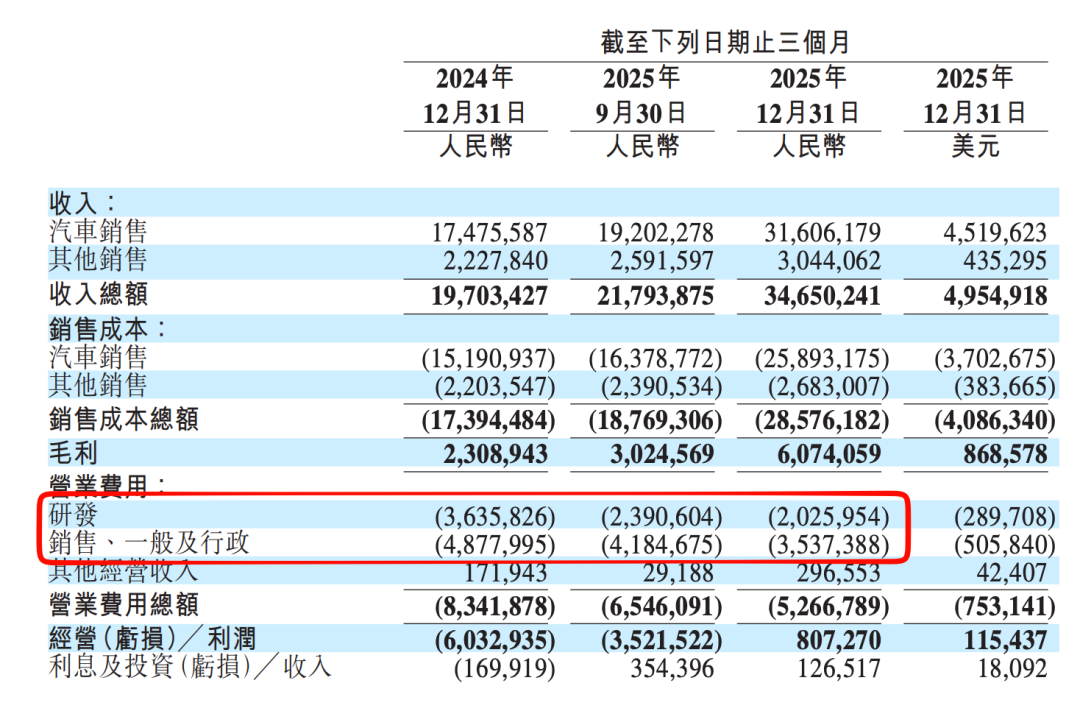
NIO's Q4 2025 Financial Report
Even before Wang Fengying joined, she could see issues with XPeng's steel procurement, but it took He Xiaopeng more than half a year to figure it out (his exact words: 'It took me nine fucking months'). The past two years have been a relearning process for the company. The low-cost MONA model paved the way, the new P7 became a bestseller, and heavy investments from Volkswagen added fuel to the fire. By year-end, the launch of humanoid robots further boosted XPeng's market value, which briefly surpassed its two peers. However, within months, all those gains had evaporated.
In the last three months of 2025, XPeng also achieved its first quarterly net profit turnaround. However, the bulk of it likely came not from car sales but from 840 million yuan in 'other income' that quarter—mostly government subsidies. This is nothing to be ashamed of; Tesla also relied on subsidies and carbon credit sales in its early years—a fitting comparison for the 'Chinese Tesla.'
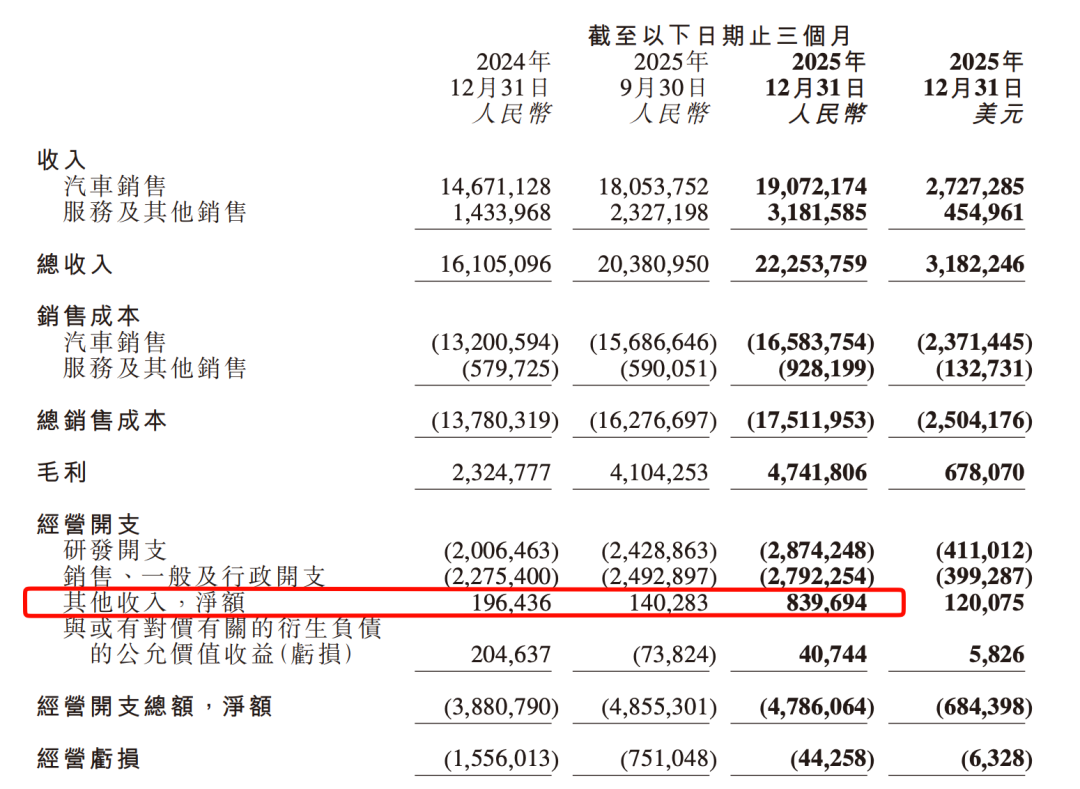
XPeng's Q4 2025 Financial Report
Now, all three have entered a new decade, each with a fresh narrative. Building cars is no longer sexy; it's always been a tough, labor-intensive business with limited imagination. Everyone says intelligence is the future, and AI is king.
Li Xiang, leveraging his extensive reading, quoted animated films like *Transformers* and *Cars* during the earnings call to convince analysts that cars are one of the core forms of robots. After XPeng's tearful public relations stunt to prove its robot credentials, He Xiaopeng declared that future physical AI sales rankings would resemble today's new energy vehicle (NEV) sales charts.
Even their descriptions of intelligence sound alike. Li Xiang described automotive robots as providing 'the care and attention a mother always gives us by our side,' while He Xiaopeng described his VLA second-generation system as 'the national intelligent driving system even mothers would love to use.' Chinese mothers have truly borne too much.
Li Bin may not have the luxury of considering such grand futures yet, as his team is still grappling with cost-cutting headaches. Every media report on NIO's adjustments seems to produce memorable moments. Last year, 36kr reported that Li Bin asked frontline salespeople about their work experience, and one replied that every day was fulfilling—just without time to sell cars. This year, LatePost revealed that NIO replaced bottled mineral water in office pantries with filtered tap water and swapped real plants for fake ones in NIO Houses.
The intelligent future feels so close, as if we're already living in it. Yet it seems so far away because reality never matches the promotional videos. Tech leaders love to paint vivid pictures of the future but rarely discuss the present.
Mr. Yu (likely referring to Yu Chengdong of Huawei) always drives with his hands off the wheel using intelligent driving, occasionally getting caught and fined by traffic cameras—whether this inspires imitation remains unclear. Lei Jun (of Xiaomi) used to talk about dreams and performance but now focuses on safety at every press conference, emphasizing how precious life is.
If we exclude the impact of low-cost EVs like the Geely Starry Wishes and Wuling Hongguang MINIEV, the Tesla Model Y remains the best-selling single model in the Chinese market, even six years after its launch.
Many may forget that Tesla's proud FSD (Full Self-Driving) system hasn't fully landed in China yet, making intelligence merely a nice-to-have feature. Nevertheless, it consistently appears in Xiaomi Auto's presentation slides, just like how Xiaomi phones annually benchmark themselves against the iPhone.
Last year, China's best-selling new automotive force by volume was Leapmotor, which media outlets still describe as a manufacturing company rather than an AI company. This unsexy automaker sold 596,000 vehicles last year, doubling its sales for the second consecutive year, with a target of 1 million units this year.
China's NEV market surged last year amid the tail end of purchase tax exemptions, with annual production and sales both exceeding 16 million units. NEVs accounted for over 50% of domestic new car sales. However, the first quarter of 2026 brought a sudden chill, much like Beijing's winter. Data from the China Passenger Car Association shows that NEV retail sales in China fell 20% year-on-year in January and 32% in February.
Industry insiders are discussing the intensified competition in the 2026 automotive market, with rising raw material costs, subsidy reductions, and a flood of new model launches. NIO, XPeng, and Li Auto all have major product years ahead. Li Auto is pinning its hopes on the L9 to save the market, NIO is betting big on the large SUV segment, and XPeng is cooling down MONA sales with a focus on intelligent driving and EREVs.
However, the year hasn't started well for any of them. Li Auto expects Q1 deliveries to fall 3.1% to 8.5% year-on-year. Even launching four new models in one day didn't comfort XPeng, which anticipates a 29.79% to 35.11% drop in Q1 deliveries. The ES8, still in high demand, is temporarily driving NIO's sales, but March sales guidance fell slightly short of market expectations.
During earnings calls, all three companies believe their performance will improve from Q2 onward with new model launches. He Xiaopeng said he is confident in achieving significant quarter-on-quarter sales growth with new model deliveries—perhaps because last year's sales were so strong that only quarter-on-quarter comparisons make sense now. Li Xiang claimed the L9 Livis represents their deep thinking on embodied intelligent flagship SUVs and will determine the market ceiling for their entire L series. Li Bin said the large three-row and large five-seat SUV markets have entered the golden age of pure electrification, and NIO is fully embracing the trend.
As for Elon Musk, who is also targeting embodied intelligence and AI futures, he no longer discusses cars during earnings calls. From this perspective, the master of drawing big pictures—Master Ma—is true to his word. After declaring that Tesla is no longer just a car company, he has lost interest in car manufacturing in recent years. No new models have been launched in years, relying solely on minor updates to the Model Y, occasional production halts, and failing to learn any essence (essence) from traditional automakers.
Cui Dongshu, secretary-general of the China Passenger Car Association, said China's automotive sales profit margin was just 4.1% last year, a five-year low.
In the first three quarters of last year, 10 out of 22 A-share automakers, including BYD, FAW Jiefang, Changan Automobile, and Great Wall Motor, saw net profit declines. GAC Group's decline reached 3,691.33%.
The China Association of Automobile Manufacturers predicts that China's total automotive sales will reach 34.75 million units in 2026, up 1% year-on-year, including 19 million NEVs, up 15.2%.
© All rights reserved by Shanshang. Unauthorized reproduction is prohibited.
-
![]()
The Unstoppable Rise of 'Optical Progress and Copper Decline': Sunny Optical’s Strategic Vision for the Next Decade
-
![]()
AI + Going Global in the Second Half: No Intermission for Robot Vacuum Cleaners
-
![]()
The Suffering Endured in E-commerce, Walmart Doesn't Want to Repeat in AI
-
![]()
What Does the Doubling of New Energy Vehicle Exports Mean?
-
![]()
Ghosn: 'Only I Can Save Nissan'
-
![]()
Volkswagen Lays Off 100,000 Employees, The Elephant Sits Down
-
![]()
Expanding Production Capacity! Yutong Optics Acquires Approximately 1.5 Hectares of Industrial Land in Chang'an, Dongguan
-
![]()
Why Is Nokia Making a Comeback in the AI Era?