New Energy Vehicle Newcomers, Once Struggling, Now Turning Profits
 03/25 2026
 597
597
The new energy vehicle sector has transitioned from a 'market share at any cost' approach to a model centered on sustainable growth.
Rewind to 2014, a year brimming with enthusiasm and innovation. The global new energy vehicle industry was just taking flight, buoyed by supportive domestic policies and a surge in 'electrification' interest among investors. Internet magnates ventured into the fray with their user-centric strategies, traditional automakers' tech experts pursued disruptive dreams by starting their own ventures, and even entrepreneurs with no manufacturing background bravely presented their plans on the financing stage.
Yet, reality soon tempered this fervor. As the capital tide receded, those who had been 'swimming naked' were left exposed.
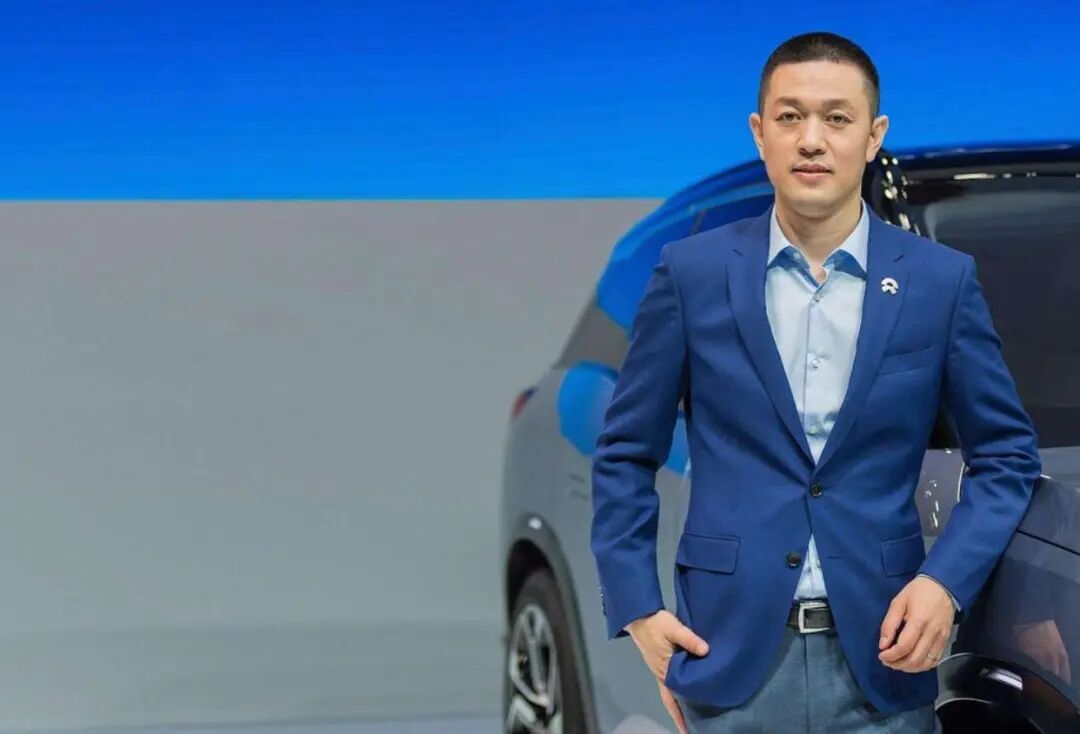
The industry's winter in 2023 proved to be the breaking point. With skyrocketing raw material costs, frequent supply chain disruptions, and intensified market competition, the weakly-rooted newcomers crumbled one by one, leaving only a select few like NIO, XPENG, Li Auto, and Leapmotor standing.
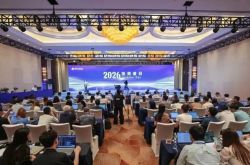
In early March, the remaining new forces in the automotive industry released their 2025 financial results.
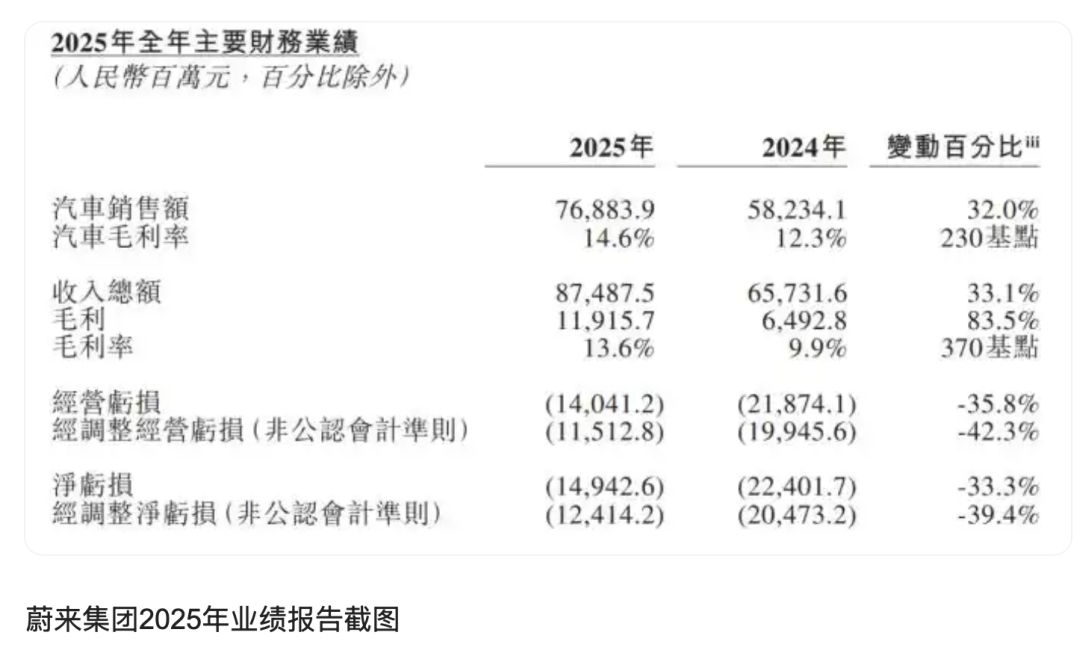
Data reveals that Li Auto has been profitable for three consecutive years, Leapmotor achieved its first annual profit, and NIO and XPENG both attained single-quarter profitability. This series of milestones signals that the new energy vehicle companies, long entangled in 'burning money for scale,' have now collectively reached the profitability threshold. The industry's development logic has shifted from 'scaling for survival' to 'profitability for sustained growth.'
Profitability Divergence Among Leaders, Each With Unique Strategies
In this profitability race, leading newcomers have displayed distinct development rhythms and breakthrough paths.
As the first to achieve profitability, Li Auto maintained its streak in 2025, with annual revenue reaching 112.3 billion yuan and net profit hitting 1.1 billion yuan. It became the only new force in China to surpass 100 billion yuan in revenue and sustain profitability for three consecutive years.
Despite a year-on-year decline in revenue and net profit due to product cycle transitions and intensified industry competition, its 101.2 billion yuan in cash reserves and sustained technological investments have laid a solid foundation for future growth.
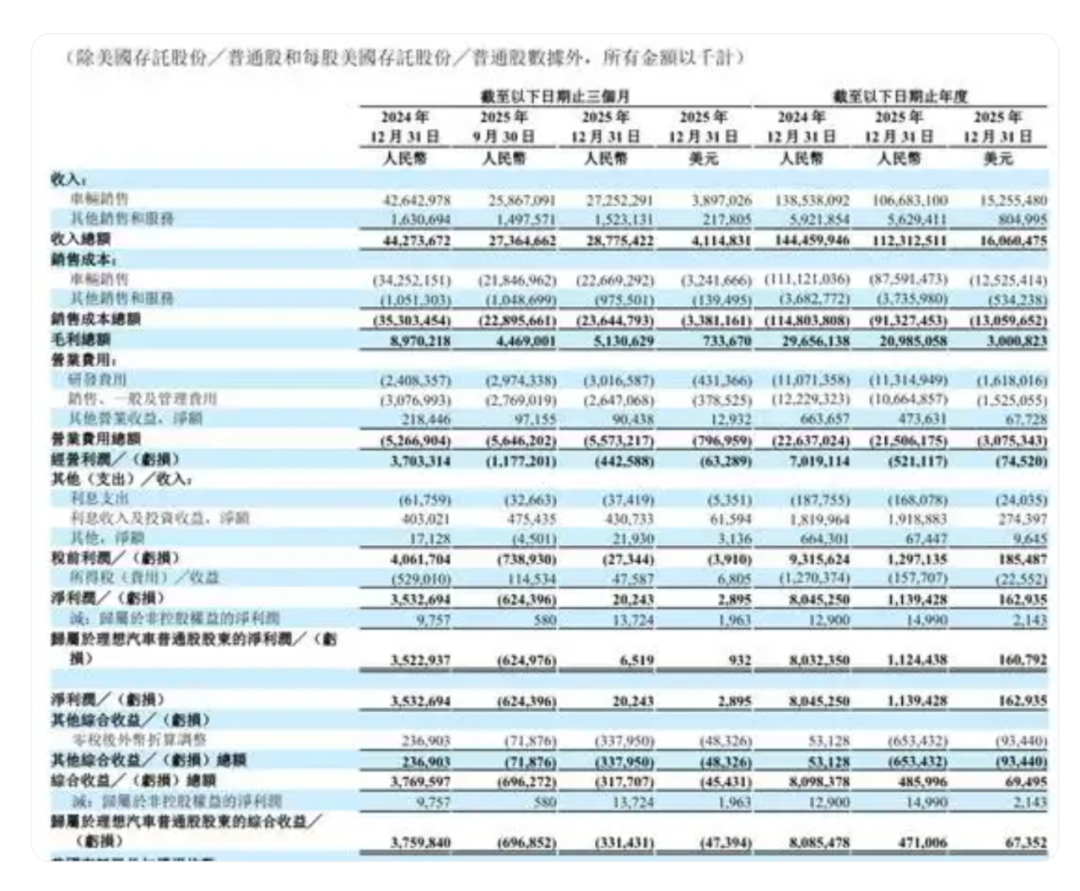
In 2025, Li Auto's R&D investment soared to 11.3 billion yuan, with AI-related investments accounting for 50%. Its self-developed chip, Mach 100, is set for mass production and vehicle installation in the second quarter of 2026. The all-new Li Auto L9 is also planned for launch during the same period, launching a new assault on the high-end new energy market.
Leapmotor, meanwhile, emerged as a 'dark horse.' In 2025, it delivered approximately 596,600 new vehicles, doubling its deliveries year-on-year for two consecutive years and ranking first in sales among Chinese new energy brands. Its annual net profit was 540 million yuan, achieving full-year profitability for the first time and becoming the second Chinese new energy vehicle manufacturer to do so.
Leapmotor's profitability stems from its precise market positioning and cost control capabilities. Focusing on the mass market segment of 100,000-200,000 yuan, it achieved autonomous control of core technologies through full-domain self-research, effectively reducing production costs. Simultaneously, it further diluted costs through economies of scale, ultimately achieving a dual harvest of sales and profitability.
NIO and XPENG, meanwhile, glimpsed the dawn of profitability in the fourth quarter of 2025.
NIO delivered 124,800 new vehicles in the fourth quarter, a year-on-year increase of 71.7% and a quarter-on-quarter increase of 43.3%. It achieved revenue of 34.65 billion yuan, a year-on-year increase of 75.9% and a quarter-on-quarter increase of 59.0%. Its net profit was 283 million yuan, marking its first single-quarter profitability.
NIO's profitability stems from the synergistic effects of product matrix expansion, technological self-research breakthroughs, and organizational efficiency improvements.
In 2025, NIO continued to advance its multi-brand strategy, launching and delivering models such as the ET9 and all-new ES8, and achieving market success with products like the LEAPMOTOR L90 and firefly. Its intelligent automotive 'new three major components,' including the world's first mass-produced 5nm intelligent driving chip, the Shenji NX9031, entered mass production and were installed in vehicles. Its steer-by-wire technology received dual certification from China and Europe. Its infrastructure construction continued to improve, with a total of 3,737 battery swap stations built globally, making the battery swap model the mainstream energy replenishment solution.
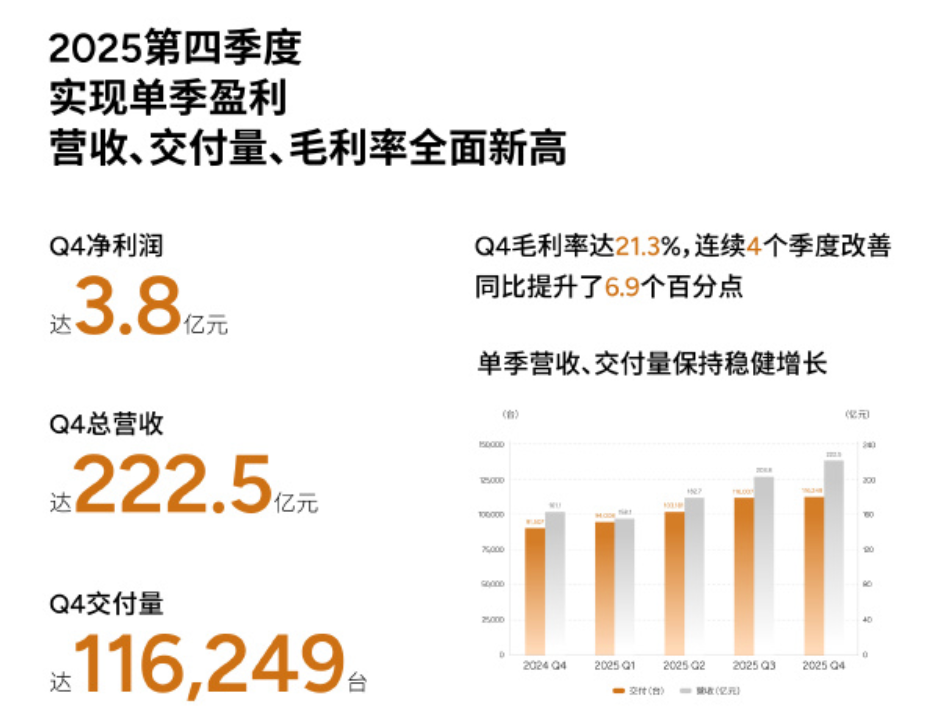
XPENG Motors achieved revenue of 22.25 billion yuan in the fourth quarter of 2025, a year-on-year increase of 38.2%. Its net profit was 380 million yuan, marking its first single-quarter profitability. Although it still incurred a full-year loss of 1.14 billion yuan, the loss narrowed by 80.3% year-on-year, bringing it one step closer to breaking even.
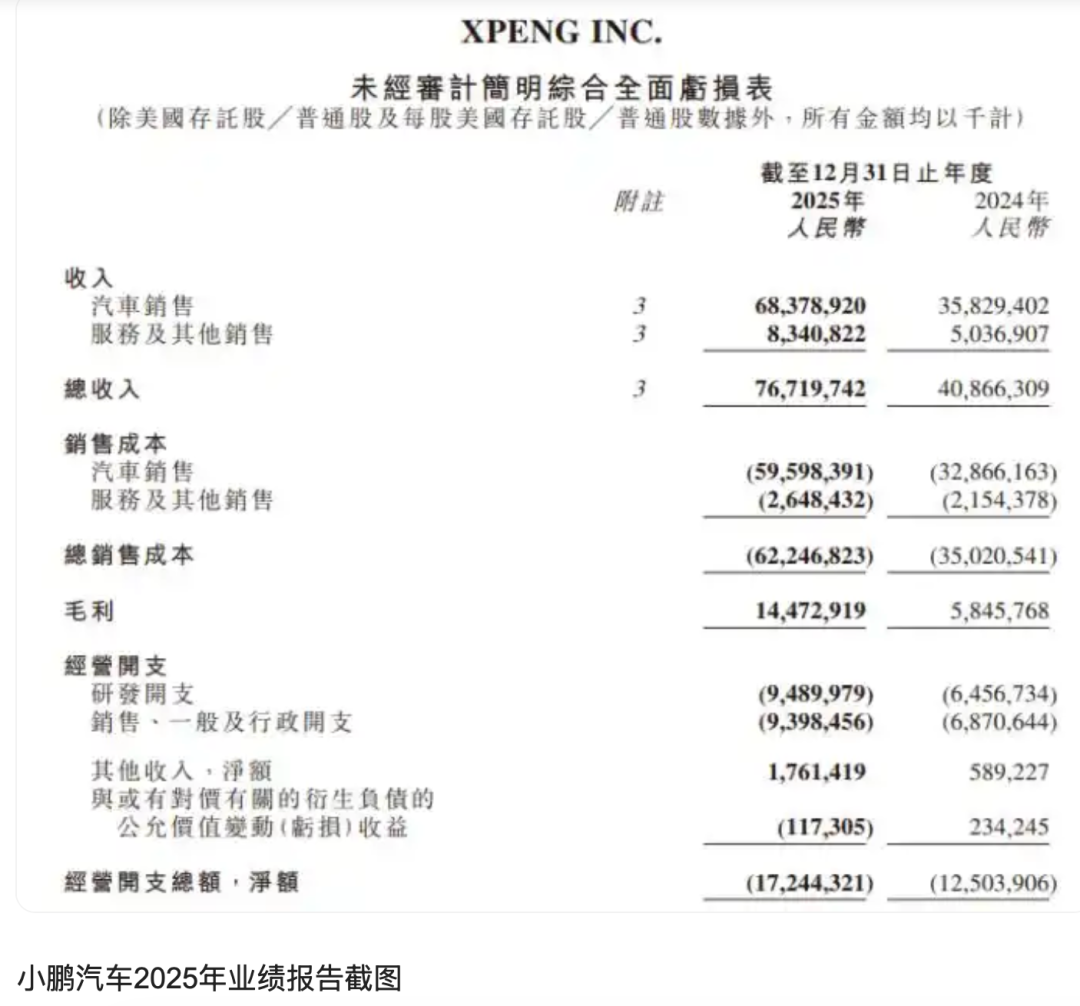
XPENG's profitability breakthrough was driven by both sales growth and cost optimization. In 2025, XPENG delivered 429,400 vehicles, a year-on-year increase of 125.9%, with blockbuster models such as the XPENG MONA M03 and P7+ becoming the pillars of sales. Its deep cooperation with Volkswagen also brought it dual benefits in terms of technology and cost.
Additionally, XPENG's sustained investments in AI intelligent driving began to bear fruit. The rollout of its second-generation VLA assisted driving system doubled the number of test drives at stores month-on-month, and the sales proportion of the Ultra and Ultra SE versions increased significantly.
A Profound Shift in Industry Development Logic
The collective profitability of new energy vehicle companies is no coincidence.
Firstly, market competition has shifted from 'incremental expansion' to 'stock competition,' compelling automakers to seek efficiency through management.

As the penetration rate of the new energy vehicle market continues to rise, industry growth gradually slows, and market competition intensifies. The extensive 'burning money for scale' model of the past is no longer sustainable. Automakers must optimize operations and management, reduce production costs, and improve product quality to survive in the fierce competition.
Li Auto reduces user vehicle usage costs through technological research and development, Leapmotor achieves cost control through full-domain self-research, NIO optimizes operational efficiency through organizational efficiency improvements, and XPENG shares R&D costs through cooperation with Volkswagen.
Secondly, technological innovation has shifted from 'showcasing technology' to 'implementation,' becoming the core driver of profitability.
In the early days, new energy vehicle companies often attracted attention with cool concepts and cutting-edge technologies. However, as the market matures, consumers pay more attention to the practicality and reliability of technologies. Nowadays, the technological innovations of new energy vehicle companies are more closely aligned with market demands, enhancing product competitiveness through technology implementation, thereby driving sales growth and profitability improvements.
It is worth mentioning that their business models have shifted from 'single vehicle sales' to 'ecosystem services,' opening up new profitability spaces.
In addition to vehicle sales, new energy vehicle companies have ventured into after-sales services, charging networks, intelligent cockpit software, and other value-added service areas, constructing diversified profitability models. NIO's service and community businesses contributed steady growth, XPENG's technology R&D service revenue became a new revenue pillar, and Li Auto continued to create value for users through OTA upgrades, all bringing stable cash flows and new profit growth points to automakers.
Although new energy vehicle companies have made breakthrough progress in profitability, the industry still faces numerous challenges.
In the short term, market competition remains fierce, and the pressure of price wars persists. Since 2025, Tesla has repeatedly lowered prices, and traditional automakers have also accelerated the launch of new energy models, intensifying market competition. Although new energy vehicle companies have achieved phased profitability, their profitability remains relatively fragile. Once the price war escalates, it may impact their profitability.
Additionally, XPENG expects its delivery volume in the first quarter of 2026 to decrease by approximately 29.79% to 35.11% year-on-year, and its total revenue to decrease by approximately 16.01% to 22.84% year-on-year. Li Auto also expects its delivery volume in the first quarter to decrease by 3.1% to 8.5% year-on-year, reflecting the continued existence of market demand uncertainties.
In the medium to long term, the pace of technological iteration is accelerating, and the pressure of R&D investment is enormous. The new energy vehicle industry is undergoing rapid technological changes, with increasingly fierce competition in areas such as intelligent driving, battery technology, and chip technology. Automakers must continuously increase R&D investment to keep up with the pace of technological iteration.
Data shows that Li Auto's R&D investment reached 11.3 billion yuan in 2025, and NIO also continued to increase its technological R&D investments. The huge R&D investments place higher requirements on the financial strength and profitability of automakers.
Furthermore, globalization expansion faces numerous challenges, and overseas market expansion is not smooth sailing.
Although XPENG, NIO, and other automakers have made certain progress in overseas markets, overseas markets face different policies and regulations, consumer habits, and competitive environments. Automakers need to invest a large amount of manpower, material resources, and financial resources in market research, channel construction, and brand promotion. At the same time, geopolitical risks, exchange rate fluctuations, and other factors may also impact their overseas businesses.
The collective profitability of new energy vehicle companies is an important milestone in the industry's development, marking the transition of the new energy vehicle industry from the extensive development of 'burning money for market share' to a new stage of sustainable development of 'seeking long-term growth through profitability.'
Facing fierce market competition, rapid technological iteration, and a complex global environment, new energy vehicle companies need to continuously deepen technological innovation, optimize operations and management, and expand business models to achieve true sustainable development and occupy a place in the global new energy vehicle market competition.
Profitability is just the starting point, not the endpoint.
Note: Some images are sourced from the internet. If there is any infringement, please contact us for deletion.
-END-
-
![]()
The Unstoppable Rise of 'Optical Progress and Copper Decline': Sunny Optical’s Strategic Vision for the Next Decade
-
![]()
AI + Going Global in the Second Half: No Intermission for Robot Vacuum Cleaners
-
![]()
The Suffering Endured in E-commerce, Walmart Doesn't Want to Repeat in AI
-
![]()
What Does the Doubling of New Energy Vehicle Exports Mean?
-
![]()
Ghosn: 'Only I Can Save Nissan'
-
![]()
Volkswagen Lays Off 100,000 Employees, The Elephant Sits Down
-
![]()
Expanding Production Capacity! Yutong Optics Acquires Approximately 1.5 Hectares of Industrial Land in Chang'an, Dongguan
-
![]()
Why Is Nokia Making a Comeback in the AI Era?