Xiaomi's Auto Business Soars While Smartphone Division Faces Challenges, Lei Jun Pledges Over 60 Billion Yuan for AI
 03/27 2026
 439
439

Produced by Leadar Finance. Text by Ding Yu. Edited by Meng Shuai.
On the evening of March 24, Xiaomi Group released its financial results for the fourth quarter and full year of 2025. Despite achieving record-high annual performance, the company experienced a revenue increase without corresponding profit growth in the fourth quarter.
Financial reports revealed that Xiaomi's total revenue reached 457.29 billion yuan in 2025, up 25% year-on-year, with net profit hitting 41.57 billion yuan, a 76.3% increase.
Notably, the smart electric vehicle business emerged as the primary growth engine, with revenue skyrocketing 221.8% year-on-year to 103.3 billion yuan.
However, due to rising storage costs and intensifying industry competition, Xiaomi's overall revenue in the fourth quarter of last year grew 7.3% year-on-year to 116.92 billion yuan, while net profit fell 27.3% to 6.54 billion yuan.
The company's smartphone × AIoT business saw a significant decline, generating 79.7 billion yuan in revenue for the quarter, a 13.7% year-on-year decrease.
At Xiaomi's 2025 financial results briefing, President Lu Weibing expressed helplessness over rising storage costs, stating that price hikes for the company's products were inevitable. "The pressure on Xiaomi is immense, but we will strive to absorb costs for consumers as long as possible. If we can no longer hold out, prices will rise," he said.
According to Tianyancha, Xiaomi Group went public in Hong Kong in 2018. As of market close on March 26, Xiaomi's share price stood at HK$32.44, with a total market capitalization of HK$841.3 billion, nearly halved from last year's peak.
Declining Sales and Average Selling Prices: Is Xiaomi Losing Its Smartphone Foothold?
In terms of revenue composition, the share of smartphone × AIoT business in Xiaomi's total revenue is rapidly declining, while the contribution from smart electric vehicles and AI-driven innovative businesses is growing significantly.
In 2025, the smartphone × AIoT business contributed 351.22 billion yuan in revenue, up 5.4% year-on-year and accounting for 76.8% of total revenue, a 14.2 percentage point decrease from 2024.
During the same period, revenue from smart electric vehicles and AI-driven innovative businesses surged 223.8% year-on-year to 106.07 billion yuan, representing 23.2% of total revenue, a 14.2 percentage point increase.
Xiaomi's smartphone × AIoT business comprises smartphones, IoT and consumer lifestyle products, internet services, and other related operations.
Notably, Xiaomi's core smartphone business experienced negative revenue growth last year. In 2025, the segment generated 186.44 billion yuan in revenue, down 2.8% year-on-year and accounting for 40.8% of total revenue, an 11.6 percentage point decrease.
Xiaomi attributed this to a decline in smartphone shipments and average selling prices (ASP).
Financial reports showed that while Xiaomi's domestic smartphone shipments increased by 4.1% last year, global shipments fell 2% year-on-year to 165 million units.
This decline was primarily due to reduced shipments in India, partially offset by increases in mainland China and other international regions, such as Latin America and Africa.
Meanwhile, Xiaomi's smartphone ASP dipped slightly by 0.8%, from 1,138.2 yuan per unit in 2024 to 1,128.7 yuan per unit in 2025. This was driven by increased shipments in emerging markets with lower ASPs, partially offset by a higher proportion of smartphone shipments in mainland China, where ASPs are higher.
Throughout 2025, Xiaomi generated 151.06 billion yuan in revenue from other global regions, down approximately 1.5% year-on-year.
Notably, the gross profit margin for Xiaomi's smartphone × AIoT segment reached 21.7% last year, up 0.5 percentage points year-on-year and hitting a record high.
However, the gross profit margin for the smartphone business within this segment declined more significantly, falling from 12.6% in 2024 to 10.9% last year. This was attributed to reduced government subsidies in mainland China in the second half of the year, rising core component prices, and intensified global market competition.
Focusing on the fourth quarter of last year, Xiaomi's smartphone, IoT, and consumer lifestyle product businesses showed signs of weakness.
In the fourth quarter, smartphone business revenue fell 13.6% year-on-year to 44.34 billion yuan, primarily due to a 11.6% year-on-year decline in smartphone shipments to 38 million units and a drop in ASP.
Meanwhile, IoT and consumer lifestyle product revenue declined 20.3% year-on-year to 24.6 billion yuan in the fourth quarter, as reduced government subsidies and increased competition led to lower revenue from certain lifestyle products, smart large appliances, and smart TVs in mainland China.
Auto Business Surpasses 100 Billion Yuan in Revenue, Though Gross Margin Declines Quarter-on-Quarter
In stark contrast to the sluggish growth of traditional smartphone businesses, Xiaomi's auto business demonstrated robust expansion.
In 2025, revenue from Xiaomi's smart electric vehicles surged 221.8% year-on-year to 103.3 billion yuan, accounting for over 97% of total revenue from smart electric vehicles and AI-driven innovative businesses. This growth was driven by increased vehicle deliveries and higher ASPs.
According to Leadar Finance, Xiaomi delivered approximately 411,000 vehicles in 2025, a 200.4% year-on-year increase.
During the same period, the ASP of Xiaomi's smart electric vehicles rose 7.1% year-on-year to 251,000 yuan per unit, primarily due to deliveries of the higher-ASP Xiaomi SU7 Ultra and Xiaomi YU7 series.
The gross profit margin for the smart electric vehicles and AI-driven innovative businesses segment increased from 18.5% in 2024 to 24.3% in 2025.
More encouragingly, Xiaomi's auto business segment achieved positive operating income for the first time in 2025, with annual operating income reaching 900 million yuan.
Focusing on the fourth quarter of last year, the segment generated 37.2 billion yuan in revenue, up 123.4% year-on-year, with a gross profit margin of 22.7%, a 2.3 percentage point increase.
Within this, smart electric vehicle revenue reached 36.3 billion yuan, with other related businesses contributing nearly 1 billion yuan in revenue. The segment's operating income totaled 1.1 billion yuan.
However, on a quarter-on-quarter basis, while revenue from Xiaomi's smart electric vehicles and AI-driven innovative businesses segment grew 28.3% in the fourth quarter, the gross profit margin declined from 25.5% in the third quarter to 22.7%.
Xiaomi explained that this was due to a lower proportion of Xiaomi SU7 Ultra deliveries and the sale of existing and display vehicles in the fourth quarter of 2025.
As Xiaomi's ambitious entry into the luxury automotive market, the SU7 Ultra was highly anticipated by Lei Jun. However, by the end of last year, monthly sales of the SU7 Ultra had plummeted from a peak of over 3,000 units during its initial launch to double digits.
Additionally, in December last year, Xiaomi officially launched a "ready-stock vehicle purchase" channel, offering "ready-stock" vehicles that included brand-new units, official display vehicles, and near-new vehicles.
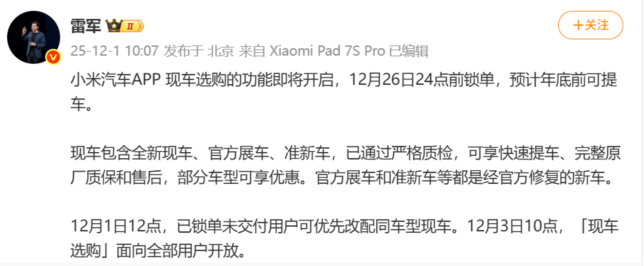
According to sources close to Xiaomi Auto, this move was likely aimed at achieving higher annual sales targets as the year-end approached. Selling ready-stock vehicles could accelerate transactions for customers who were hesitant or planning to cancel orders due to prolonged delivery times.
This strategy indeed stimulated Xiaomi's auto sales to some extent. In December last year, Xiaomi delivered over 50,000 vehicles, setting a new monthly delivery record since the brand's inception.
Doubling Down on AI: 60 Billion Yuan Investment Over Three Years
After successfully establishing smart electric vehicles as a new growth driver, Xiaomi is now setting its sights on the booming AI sector.
According to financial disclosures, Xiaomi's existing AI business remains relatively small, with other related businesses under the smart electric vehicles and AI-driven innovative businesses segment generating 2.8 billion yuan in revenue last year.
While this marked a significant increase from 700 million yuan in 2024, the growth was primarily driven by higher revenue from after-sales services, accessory sales, and automotive financial services.
Nevertheless, Xiaomi devoted considerable space in its financial report to outlining its AI strategy.
Compared to industry leaders like ByteDance and Alibaba, Xiaomi's AI large language model (LLM) development started later. On April 30 last year, Xiaomi open-sourced its first inference-focused LLM, Xiaomi MiMo.
Subsequently, in November of the same year, Luo Fuli, an "AI prodigy" who had previously pursued graduate studies at Peking University, published articles in top conferences and journals, joined Alibaba's DAMO Academy, and later worked on AI research at DeepSeek, announced her joining Xiaomi to lead the Xiaomi MiMo LLM team.
In terms of foundational models, Xiaomi MiMo-V2-Flash was officially released and open-sourced in December last year. According to Xiaomi, this highly "cost-effective" model is a self-developed MoE model with a total of 309 billion parameters (15 billion activated) designed for ultimate inference efficiency.
On March 19 this year, Xiaomi claimed ownership of the mysterious LLM "Hunter Alpha," which had recently sparked widespread discussion, and simultaneously introduced the Xiaomi MiMoV2-Pro, a flagship foundational model for the Agent era; Xiaomi MiMo-V2-Omni, a full-modality foundational model; and Xiaomi MiMo-V2-TTS, a text-to-speech model.
At the time, Luo Fuli stated that this marked the first full-stack model family truly built for the Agent era. She even Speak frankly (bluntly stated) that to persuade the team to embrace the "complex agent-based architecture," she demanded that "anyone in the MiMo team who had engaged in fewer than 100 dialogues could resign tomorrow."
Xiaomi's ambitious AI push aims to fully empower its "human-vehicle-home ecosystem" with AI capabilities. In March this year, Xiaomi launched a small-scale closed beta test for Xiaomi miclaw, a mobile Agent.
This AI interaction test product, built on the Xiaomi MiMo foundational LLM, focuses on verifying the model's execution capabilities within Xiaomi's "human-vehicle-home ecosystem" and explores the path from "dialogue capabilities" to "system-level execution capabilities."
To support this grand vision, Lei Jun recently announced that Xiaomi is actively embracing the AI era and plans to invest over 60 billion yuan in AI over the next three years.
Notably, financial reports showed that Xiaomi's cumulative R&D expenditure over the past five years has reached 105.5 billion yuan. In 2025 alone, R&D spending soared to 33.1 billion yuan, up 37.8% year-on-year.
Furthermore, Xiaomi estimates that its cumulative R&D expenditure will exceed 200 billion yuan over the next five years starting from 2026.
Going forward, can Xiaomi maintain sustained business growth while successfully commercializing its AI initiatives? Leadar Finance will continue to monitor developments.
-
![]()
The Unstoppable Rise of 'Optical Progress and Copper Decline': Sunny Optical’s Strategic Vision for the Next Decade
-
![]()
AI + Going Global in the Second Half: No Intermission for Robot Vacuum Cleaners
-
![]()
The Suffering Endured in E-commerce, Walmart Doesn't Want to Repeat in AI
-
![]()
What Does the Doubling of New Energy Vehicle Exports Mean?
-
![]()
Ghosn: 'Only I Can Save Nissan'
-
![]()
Volkswagen Lays Off 100,000 Employees, The Elephant Sits Down
-
![]()
Expanding Production Capacity! Yutong Optics Acquires Approximately 1.5 Hectares of Industrial Land in Chang'an, Dongguan
-
![]()
Why Is Nokia Making a Comeback in the AI Era?