Has NIO Stepped Out of Others' Shadows and Embraced Its HALO Moment?
 04/14 2026
 576
576
In 2026, Wall Street's long-standing perception of the value of 'asset-heavy' models is being challenged.
On April 9, amid discussions of a $200 billion AI capital expenditure, Amazon reassured the market with a shareholder letter: AI infrastructure, though asset-heavy, features high barriers to entry, slow iteration, and clear monetization paths. Once established, it becomes an insurmountable moat for competitors.
On the same day, NIO unveiled the ES9 in Hangzhou, revealing a similar perspective. Supported by systemic innovations across six domains—full-stack R&D of products and technologies, innovative supply chain collaborations, advanced manufacturing, lifecycle quality management, smart energy services, and full-scenario vehicle usage services—the ES9 represents the culmination of NIO's 11-year systemic innovation.
These two events converge on a single business proposition: how should asset-heavy models in the technology sector be valued in today's capital markets?
Optimistic expectations for AWS AI and its in-house chip business have sent Amazon's stock price soaring. NIO's first quarterly profit validates the sustainability of its business model, accelerates product deployment and delivery, and increasingly embodies the logic of infrastructure, similarly stepping into an upward trajectory for its stock price.
In an era of rapid technological change, Chinese and U.S. tech companies are forging a new value language, addressing where valuation benchmarks should lie for companies with low-obsolescence heavy assets, in-house chips, and service ecosystems.
The ES9 Sounds the Horn for NIO's 'Systemic Capabilities' Revaluation
The traditional logic of value discovery in capital markets is becoming increasingly ineffective in asset-heavy industries with strong technological attributes.
Assets like data centers, custom chips, and energy networks require massive upfront investments, with return curves lagging exponentially. Measuring them by quarterly revenue recognized under GAAP standards would likely conclude that 'this company offers mediocre value for money.'
However, Amazon has demonstrated to the market with its $200 billion AI infrastructure that the value of some assets does not lie in current financial statements.
The ES9 is also NIO's first opportunity to comprehensively showcase its 'systemic capabilities' to the capital markets, serving as evidence that 'the market has underestimated certain assets.'
Over the past 11 years, NIO has invested over 67 billion yuan in R&D, establishing 12 full-stack positive (forward-looking) R&D systems centered on core technologies for intelligent electric vehicles. These investments, dispersed across R&D systems, supply chains, manufacturing, energy replenishment networks, and service systems, have often been broken down into expenses, capital expenditures, or low-turnover assets in financial statements, remaining 'undervalued' for an extended period.
Now, the ES9 integrates these dispersed capabilities into a product form that users can perceive and that capital can price.
NIO has packaged its 'new three major components'—the Thor chip, Skypilot system, and Skyride chassis—into an executive flagship SUV. Consumers are not just paying for a chip or a chassis but for the complete delivery of NIO's entire technological system, marking NIO's achievement of closure in its underlying technology stack.
Of course, following automotive market rules, buying a car is just the beginning of the value chain. Strong product capabilities fully unlock the value of the service system.
NIO boasts a nationwide battery swap network, over 8,700 charging and swapping stations, and a lifecycle service system. This positions NIO as a company that has already laid down a national energy infrastructure.
What is the asset nature of battery swap stations? Low obsolescence.
A battery swap station will not be replaced by next-generation technology within three to five years; its utilization rate will only increase with the growing user base.
Therefore, these 'difficult-to-value' assets will gain clearer pricing anchors driven by better-than-expected sales guidance and high-value product innovations. Coupled with NIO's arrival at a turning point for profitability—achieving its first quarterly profit of 283 million yuan in Q4 2025, with vehicle gross margins hitting an 18.1% three-year high—
NIO is telling the market a fact: the underlying logic of the company's valuation has changed.
The ES9's launch is essentially a signal for valuation reset. Capital markets need to reconsider: what standards should be used to value this infrastructure-type technology platform?
Reimagining the Future: From Manufacturing Logic to HALO Asset Pricing
In the long run, it has become a fact that Chinese new energy vehicles are collectively undervalued, as market valuations continue to use outdated yardsticks.
Focusing on capacity utilization, vehicle gross margins, and inventory turnover, with production lines as core assets, reflects traditional manufacturing thinking.
However, the asset structure of EVs is undergoing fundamental changes, shifting from 'production lines' to 'infrastructure + technology platforms' as core assets.
Battery management systems, intelligent driving, operating systems, and energy replenishment networks, once established, not only offer strong reusability but also have iteration cycles far longer than traditional hardware.
This aligns with a narrative gaining traction in capital markets in 2026: HALO assets (Heavy Asset, Low Obsolescence).
First proposed by Josh Brown of investment firm Ritholtz in early February 2026 and widely adopted by Wall Street banks like Morgan Stanley and Goldman Sachs, Goldman Sachs stated that asset intensity has become a core driver of valuation and returns.
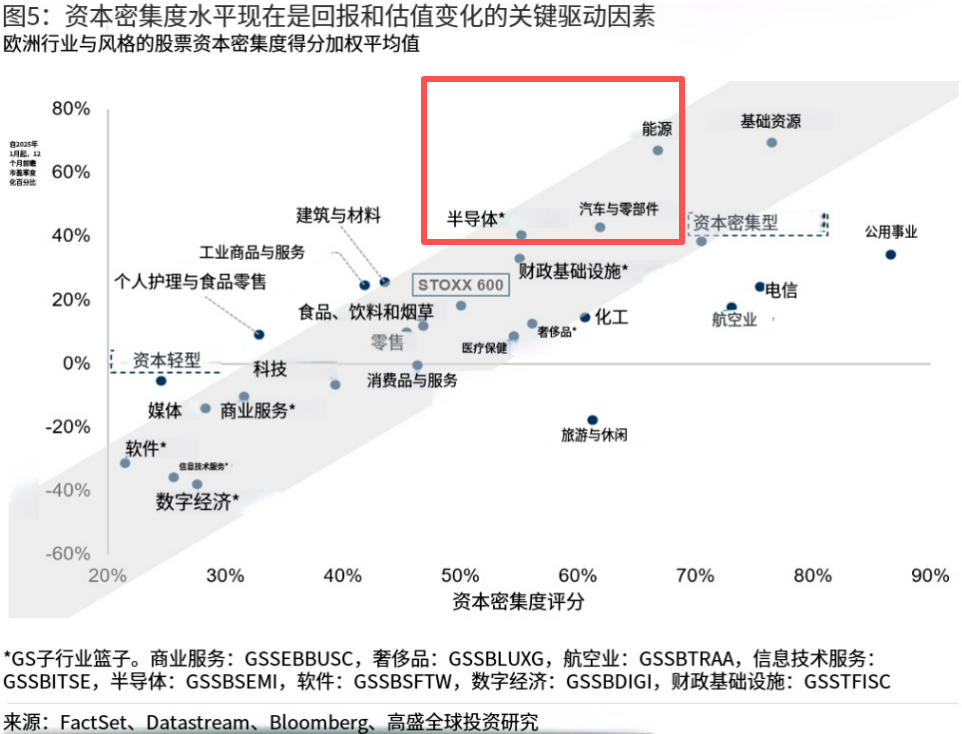
Behind the shift in value anchors lies a simple logic.
In an era of accelerated technological iteration, while asset-light models offer flexibility, they also imply low entry barriers and vulnerability to disruption. In contrast, asset-heavy models, though cumbersome, constitute natural competitive barriers.
For instance, replicating NIO's battery swap network requires 20 billion yuan in capital and eight years. Calculating the costs, competitors have few options left.
NIO's layout (strategic layout ) is accelerating the positive flywheel effect of these asset values. Plans to build 1,000 more battery swap stations in 2026, aiming for over 4,600 by year-end, with fifth-generation stations featuring retractable robotic arms expected to launch as pilot sites in May-June, targeting industry-shared energy replenishment facilities.
Once established, these assets will have far longer lifespans than traditional manufacturing equipment, with network effects amplifying as the user base grows.
So, how should NIO's valuation be reset?
Amazon's latest shareholder letter has already guided the market on valuing such companies. It introduced a key valuation tool—annualized run rate—to encourage analysts to view Amazon through an SOTP (sum-of-the-parts) valuation lens.
The market quickly understood: Amazon is not just an e-commerce company but a portfolio of 'AWS + chips + retail.'
NIO founder, chairman, and CEO William Li sent a similar signal at the High-Level Forum on Intelligent Electric Vehicle Development.
During a group interview, he explicitly stated that NIO is transitioning from 'heavy investment' to 'heavy operations.' The in-house chip Thor NX9031 and the vehicle-wide operating system SkyOS·Skypilot will accelerate their introduction into the 200,000-300,000 yuan price range, while battery swapping evolves from an energy replenishment solution into a full-lifecycle battery management capability.
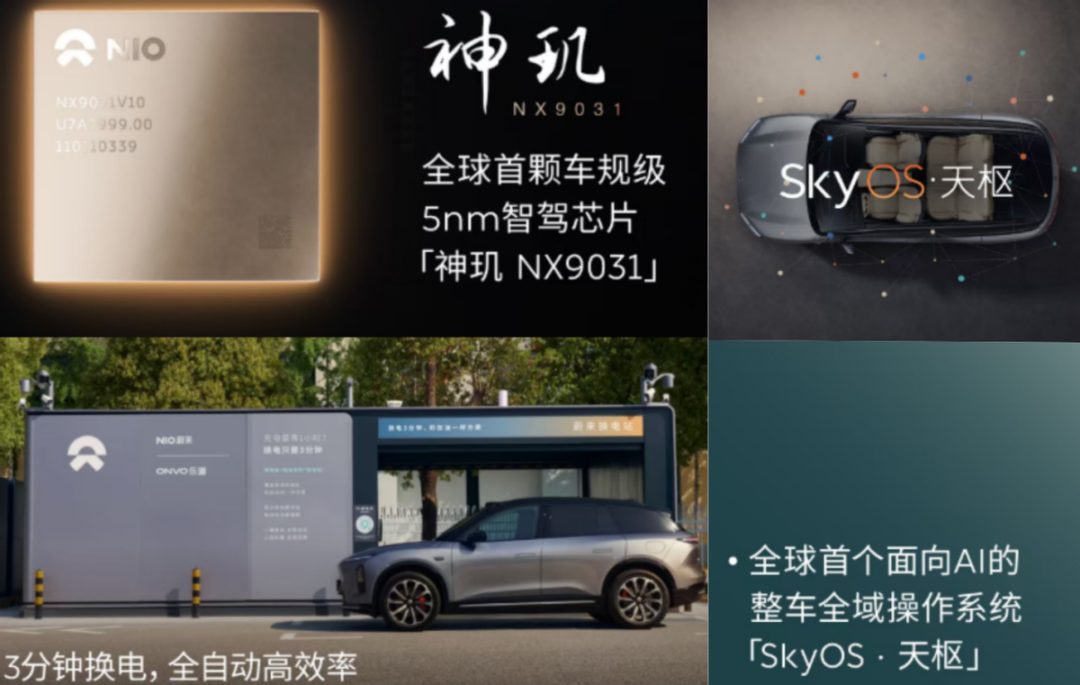
Source: NIO's official WeChat account. Chart by: American Stock Research Society (U.S. Stock Research Society)
These signals collectively point to the same conclusion: NIO's asset structure will be a low-obsolescence, high-growth infrastructure asset portfolio.
Previously, NIO's price anchor was 'vehicle profit × sales volume.' Now, the market should view it as a composite model of 'infrastructure platform × asset reuse rate.'
This also foreshadows a divergence and restructuring of the underlying valuation logic in the EV industry.
The EV Valuation Divide Arrives: The ES9 Shapes NIO's New Industrial Role
For years, the core debate in the EV industry has persisted: Is it manufacturing or technology?
Behind these answers lie vastly different valuation logics. If valued as manufacturing, the ceiling for valuation multiples aligns with traditional manufacturing leaders. If valued as a tech company, firms must prove technological barriers, network effects, and long-term cash flows, with valuation ceilings potentially several times higher.
Over the past few years, industry leaders have each provided their answers.
Tesla chose to break free from the automotive framework, using narratives of autonomous driving and robotics to achieve tech company valuations. BYD, relying on vertical integration and scale manufacturing advantages, anchored its valuation ceiling as a 'manufacturing leader' through predictable profitability.
Now, NIO offers a new approach: restructuring valuations through 'systemic capabilities + infrastructure attributes.'
Breaking it down, NIO's asset value can be divided into at least four layers:
First, the value of the vehicle. The Vehicle business (vehicle business) can be valued using EV/EBITDA multiples common in the automotive industry.
Second, energy nodes. The value of the energy network under the HALO framework depends not only on service frequency and user stickiness but also, against the backdrop of exploding AI computing demand and mounting grid peak-shaving pressures, unlocks the value of distributed energy storage assets.
Third, computing nodes. In-house chips and operating systems shift from cost centers to revenue sources, inherently possessing the potential for independent valuation. The ES9's Thor NX9031 chip, the world's first automotive-grade 5nm intelligent driving chip with computing power equivalent to four NVIDIA Orin X chips, establishes the logic of 'autonomous driving + vehicles = computing centers.' The broader the distribution of vehicle-end computing power, the stronger the network effects of edge computing.
Fourth, the service system. From NIO Houses to the NIO App, user stickiness and full-lifecycle value keep NIO's owner recommendation rates among the highest among Chinese automakers. In an era of rising customer acquisition costs, a user network capable of spontaneous viral growth and sustained repeat purchases is itself a valuable traffic entry point.
Combining these four asset layers forms a complete infrastructure profile. The battery swap network serves as the energy layer, in-house chips as the computing layer, and the service system as the entry layer. The vehicle, akin to computers and smartphones, acts as the terminal carrier for these three layers of capabilities.
Over the longer term, akin to Apple's role in smartphones, NIO is poised to evolve into an infrastructure platform capable of coordinating multiple assets and continuously generating value. This represents the core narrative of tech company evolution in the AI era.
As a new flagship, the ES9 will serve as NIO's window to showcase its 'platform capabilities.' Through this window, the company will complete its transition from an EV manufacturer to an intelligent electric infrastructure platform.
The true divide in China's EV industry has arrived. With institutions increasingly listing HALO assets as a core annual topic, it is only a matter of time before a company establishes this valuation language accepted by global capital markets, triggering a revaluation.
Source: U.S. Stock Research Society
-
![]()
Jitian Xingzhou: A Pioneer in Optical Payloads Secures Hundreds of Millions in Series B Funding!
-
![]()
Orders Secured Through to the Second Half of the Year! The Rationale Behind the 'Surge' in Demand for This Company’s Optical-Grade Base Films
-
![]()
Beyond Patents: The Retail Rivalry of Insta360 and DJI Unfolds
-
![]()
180 Billion Market Cap Vanished! How Did Seres Fall So Far?
-
![]()
Blockbuster! Domestic storage takes the global double crown for the first time, from an AI company
-
![]()
China Spearheads Formulation! World's Pioneering Global Technical Regulation for Automated Driving Systems Greenlit and Unveiled
-
![]()
Farewell to Pulsed Support Policies: Three Major Auto Policy Directions from Multiple Departments Take Effect on the Same Day
-
![]()
Embercore AI’s Accelerated Funding: The Robot Industry’s Shift Toward ‘Learning Systems’