Is XPENG Merely a Stopgap Solution? Volkswagen’s Secret Weapon in China’s Autonomous Driving Race: CARIZON’s Advanced R&D Strategy
 05/14 2026
 434
434
At the Beijing Auto Show, I had the privilege of an insightful, albeit brief, conversation with Han Sanchu, Executive Vice President of Volkswagen Group China and CEO of CARIAD China. Between the lines of our dialogue, I sensed a pivotal turning point in Volkswagen’s autonomous driving strategy in China.
There’s a common misconception in the industry that Volkswagen has fully entrusted its autonomous driving ambitions in China to XPENG. However, the reality is that models utilizing XPENG’s solutions, such as the Volkswagen ID. UNYX 08/09, represent only a “temporary boost.” Volkswagen’s true strategic move—its Chinese subsidiary CARIZON—is poised to take center stage as the primary force.
Recently, an internal report titled “High-Level Intelligent Driving R&D Strategy” by CARIZON CEO Marcus Hafkemeyer (Han Hongming) caught my attention. This significant presentation not only unveils Volkswagen’s ace in the hole for achieving L3 autonomy but also drops a bombshell that has sent shockwaves throughout the industry: the imminent launch of a Volkswagen full-stack in-house intelligent driving chip with computing power of up to 2400 TOPS!
Understanding CARIZON’s strategy reveals the true trajectory and secret weapon of this automotive giant as it transitions in the second half of the intelligent driving era. From “full value chain in-house R&D” to “cutting-edge chip manufacturing,” today, we’ll delve deep into this report to gauge the extent of Volkswagen’s autonomous driving ambitions and how it will disrupt the current landscape.
1. Progress and Introduction to CARIZON
Strong R&D Team Foundation:
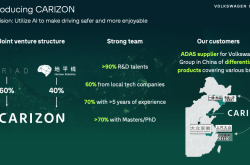
CARIZON is Volkswagen Group’s core ADAS supplier in China. Over 70% of its team members hold master’s or doctoral degrees, and more than 90% are R&D personnel. Additionally, 60% of its key members hail from local tech companies, bringing robust end-to-end software and hardware development capabilities. 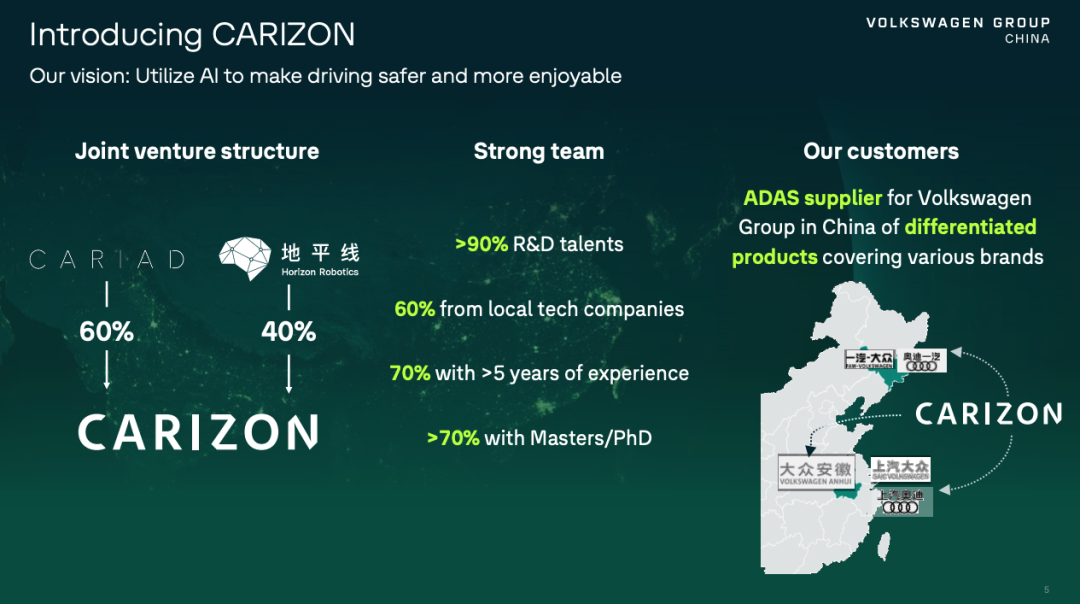
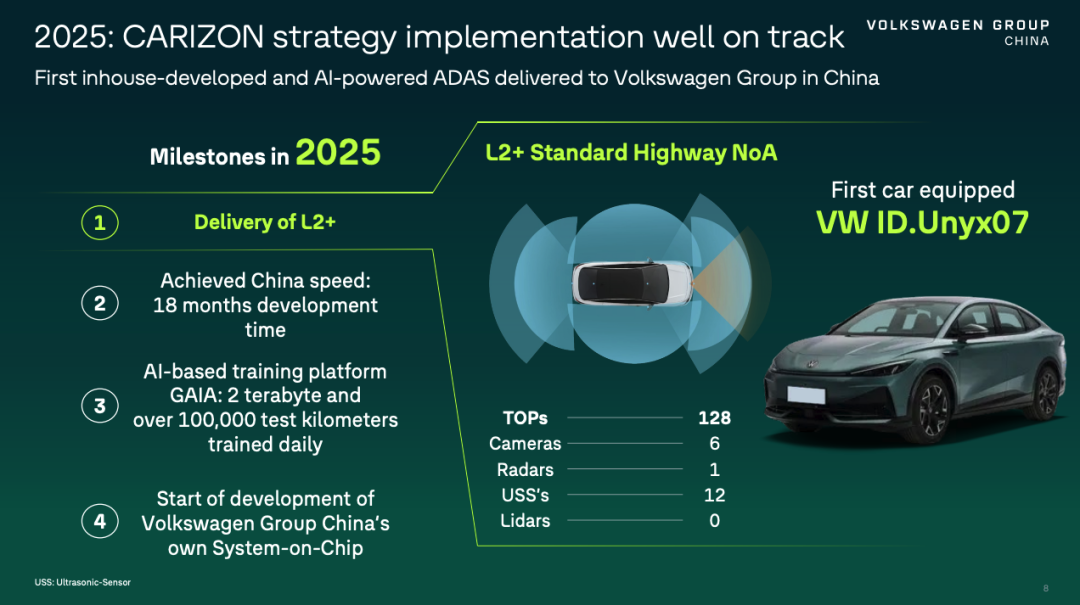
Achieving ‘China Speed’ by 2025: In just 18 months of development, CARIZON successfully delivered an L2+ standard Highway NoA (Highway Pilot Assist) system to Volkswagen Group. Consider this an impressive feat.
2. Full Value Chain Development and Software-Hardware Integration Capabilities
Full-Stack In-House R&D Capabilities:
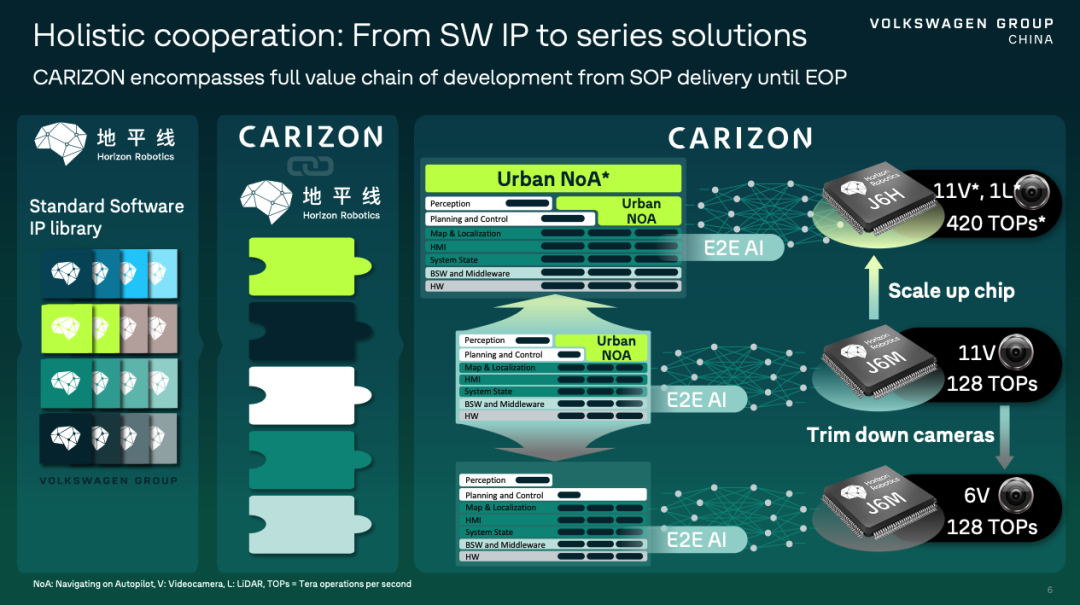
CARIZON’s focus extends beyond software; it encompasses the entire value chain development from SOP (Start of Production) to EOP (End of Production).
Deep Hardware Integration:
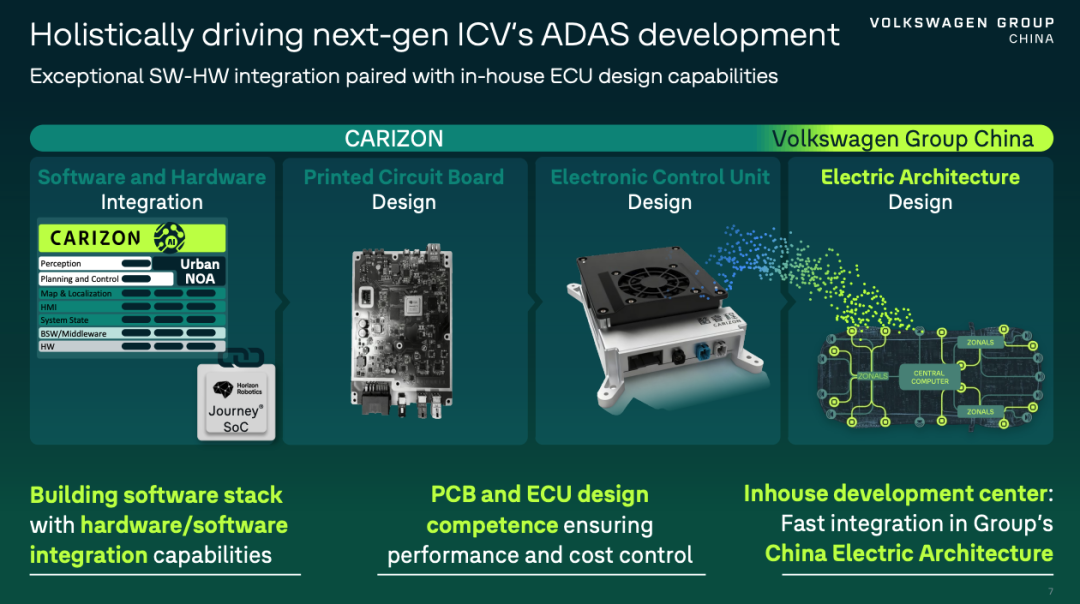
CARIZON boasts strong software-hardware collaborative optimization capabilities, enabling independent design of printed circuit boards (PCBs) and electronic control units (ECUs). This ensures rapid system integration into Volkswagen’s China Electrical Architecture (CEA) and achieves ultimate cost and performance control.
It turns out that this subsidiary of Volkswagen China is also proficient in both software and hardware, resembling a formidable new player in China’s ADAS T1 landscape.
3. 2025 Milestones and ‘China Speed’
The 18-Month Miracle:
CARIZON announced a significant milestone for 2025—in just 18 months of development, it successfully delivered to Volkswagen its first self-developed AI-driven L2+ standard Highway NoA (Highway Pilot Assist) system. Secretly, I must say, this would be a miracle in Europe or the Americas, but in China, OEMs require suppliers to go from designation to SOP in just 6 months.
Debut Model and Infrastructure:
The system made its debut on the Volkswagen ID. UNYX 07 model. Meanwhile, the backend supporting this speed is the GAIA AI training platform (to be introduced later), capable of processing 2TB of data daily and completing over 100,000 kilometers of virtual training.
4. ADAS Market Insights and Evolution Trends
Market Demand:
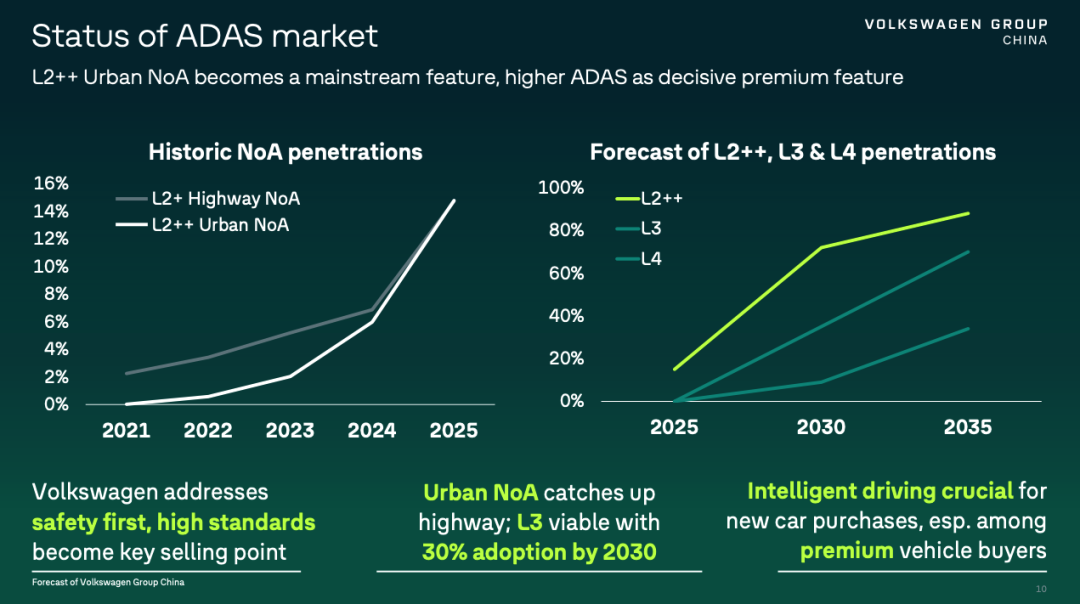
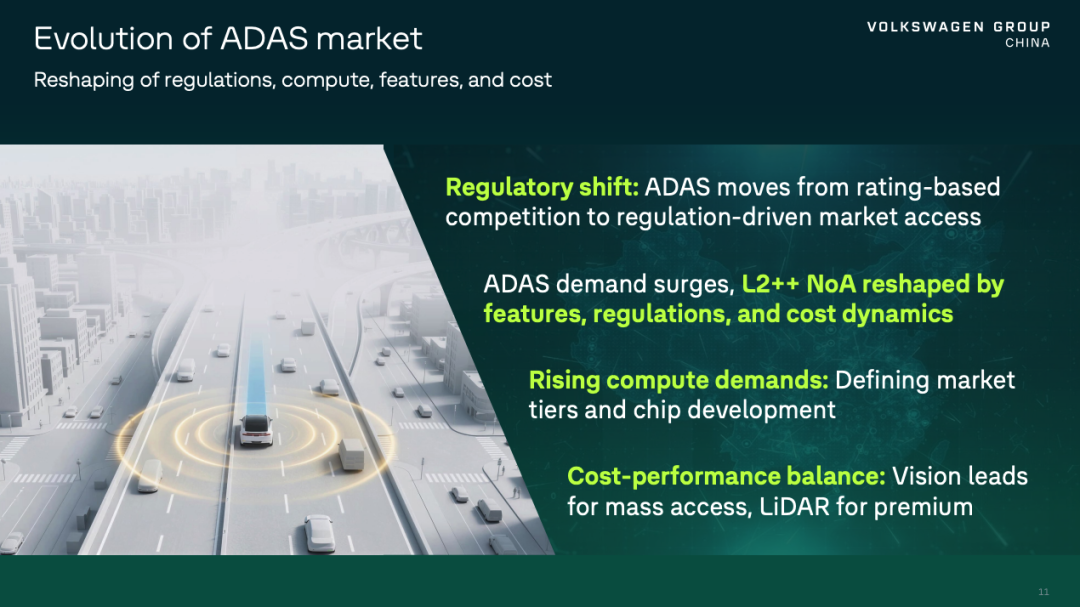
According to CARIZON’s research data, high-level intelligent driving has become a “decisive feature” for Chinese consumers (especially high-end car buyers) when purchasing a vehicle. Therefore, it is imperative to develop in-house capabilities, especially for giants selling millions of units annually.
Technology Roadmap Prediction:
L2++ urban pilot assist is becoming mainstream; pure vision solutions will dominate the mass market, while LiDAR will be used in the high-end market. It is predicted that by 2030, the market penetration rate of L3 autonomous driving will reach 30%.
This prediction—the former part is currently unfolding, while the latter part is the current focus of industry debate, whether it will be L3 or directly L4. Some experts predict that the market penetration rate for L3/L4 autonomous driving might reach 30%, not just L3.
5. High-Level Intelligent Driving Delivery Roadmap (2026-2027+)
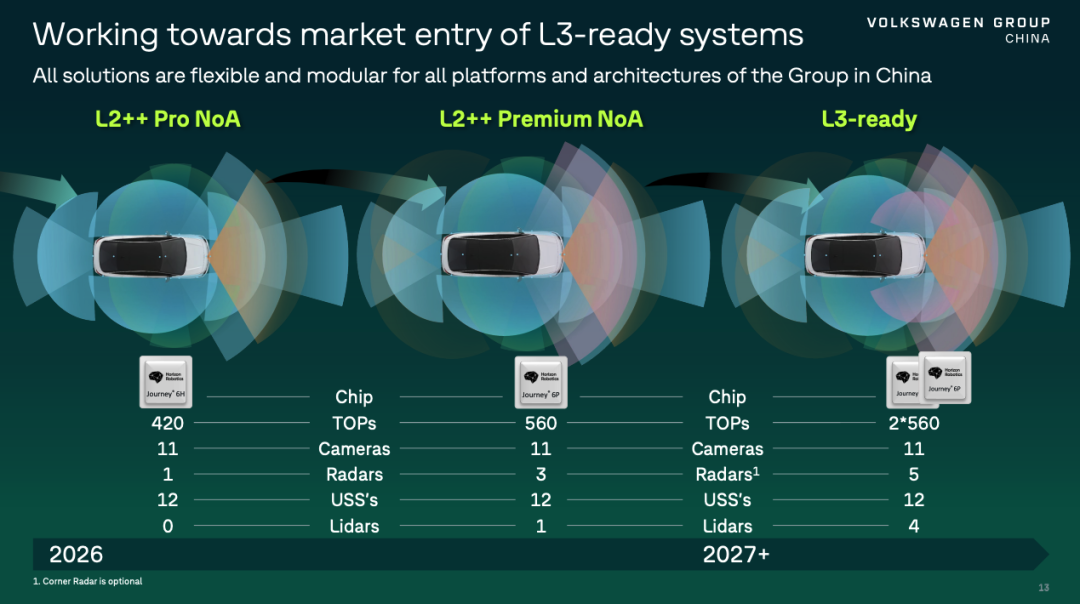
This high-level intelligent driving delivery roadmap from Volkswagen CARIZON details the hardware evolution path for the coming years:
2026 (L2++ Level):
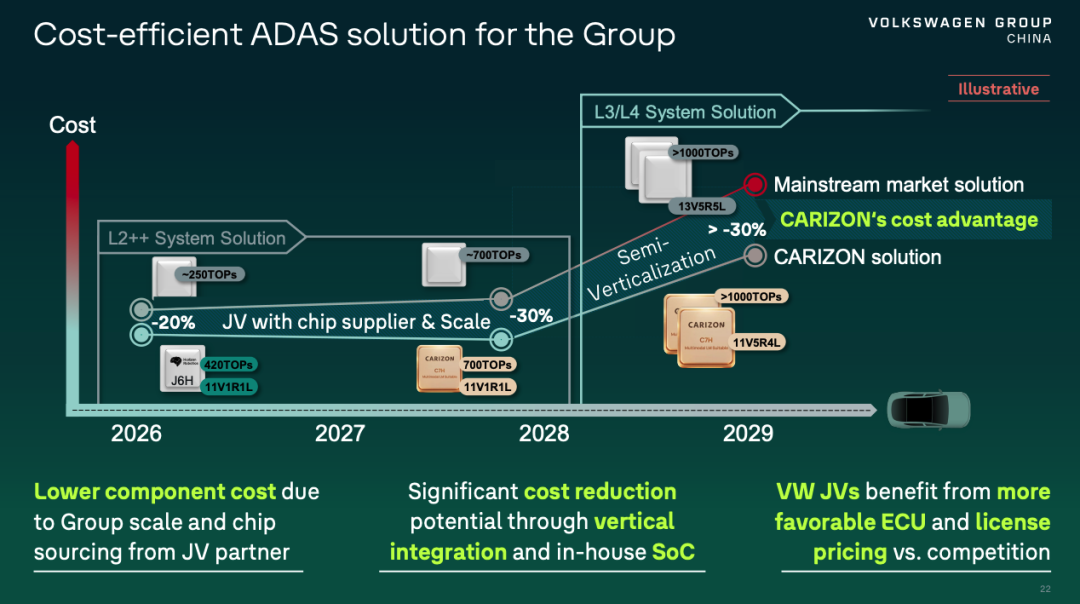
It will introduce a Pro version (based on a single Journey 6H chip with 420 TOPS computing power, 11V plus LiDAR) and a Premium version (based on a single Journey 6P chip with 560 TOPS computing power, plus LiDAR).
2027 and Beyond (Quasi-L3 Level):
Evolving to an L3-ready system with doubled computing power (using two 560 TOPS chips) and equipped with a luxurious sensor suite including four LiDARs.
This L2++ positioning is still relatively high-end, with 420-560 TOPS computing power, possibly slightly higher or comparable to the future Thor Z. Is there a flagship missing? Don’t worry; continue reading for Volkswagen CARIZON’s heavyweight product.
6. Immense Challenges in Transitioning to L3 and the ‘AI Simulation’ Solution
Exponential Difficulty:
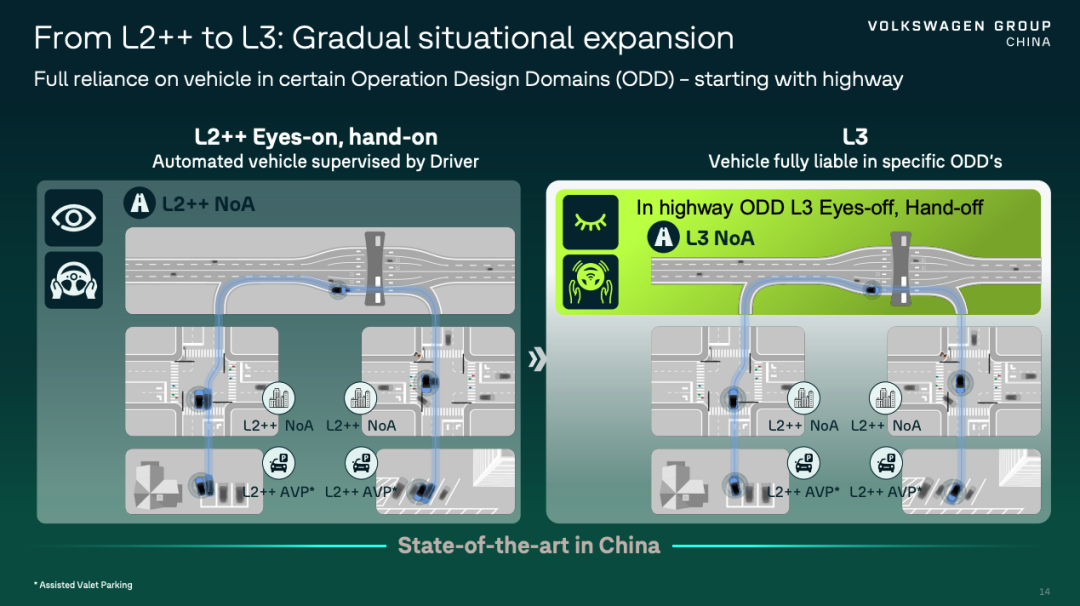
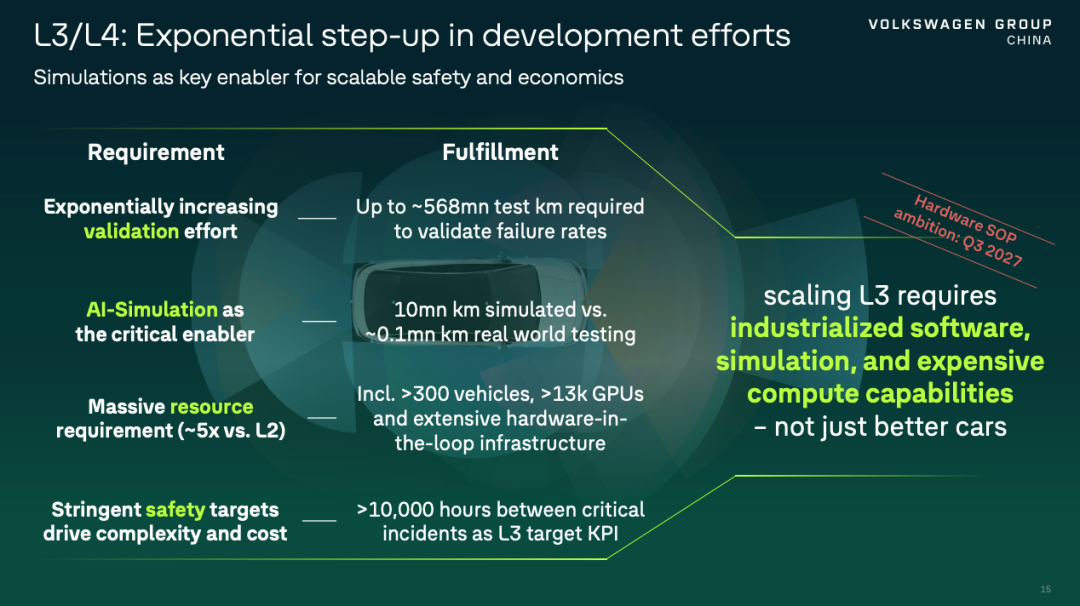
Volkswagen believes that transitioning from L2++ (driver responsible) to L3 (vehicle fully responsible) increases R&D resource requirements by about fivefold. The L3 goal is to achieve a critical accident interval time of over 10,000 hours.
Simulation Testing as Key:
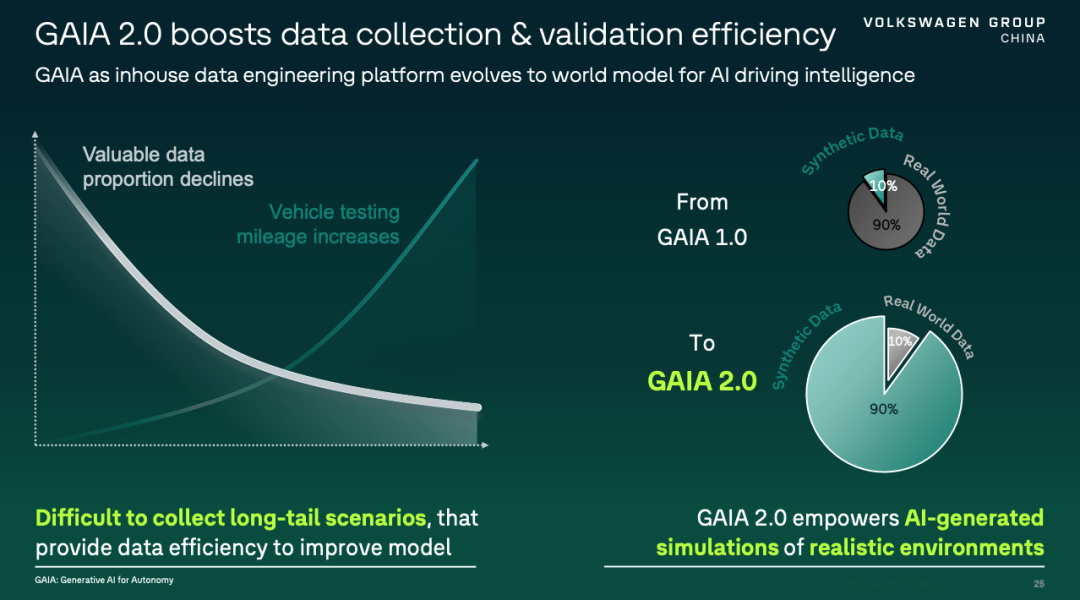
Relying solely on real-world road testing cannot verify L3 safety (requiring approximately 568 million kilometers of testing). Therefore, CARIZON will heavily rely on AI virtual simulation technology, aiming to increase the ratio of virtual simulation test miles to real-world test miles to 10 million kilometers vs. 100,000 kilometers.
7. Three Major Bottlenecks in Technological Breakthroughs and the ‘Winning Iron Triangle’
Three Major Bottlenecks:
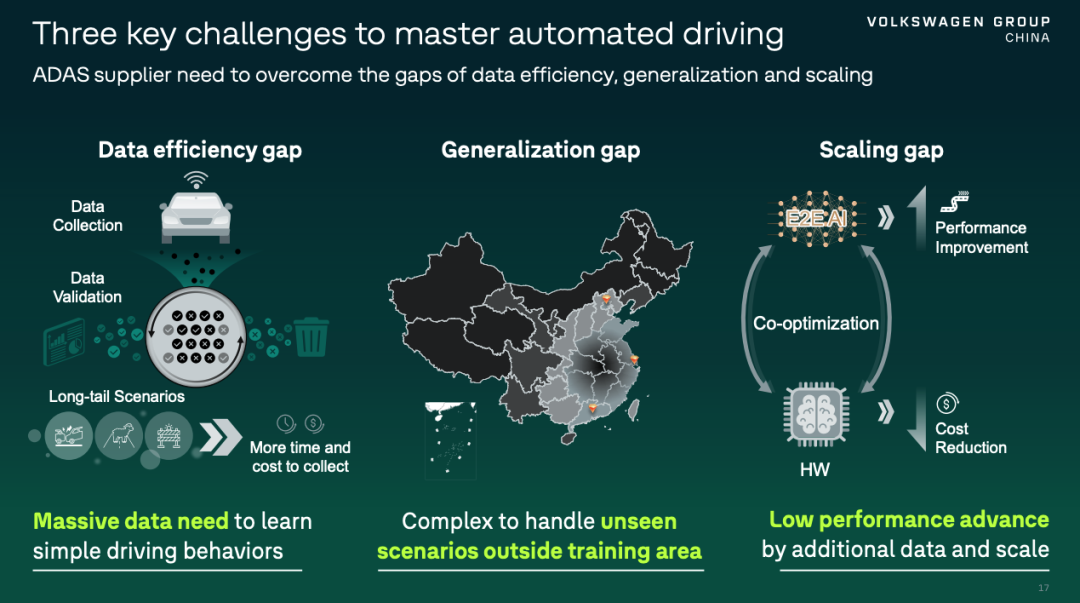
Volkswagen CARIZON identifies data efficiency gaps, generalization capability gaps, and scalability gaps as challenges facing the autonomous/assisted driving industry.
CARIZON’s Three Major Solutions:
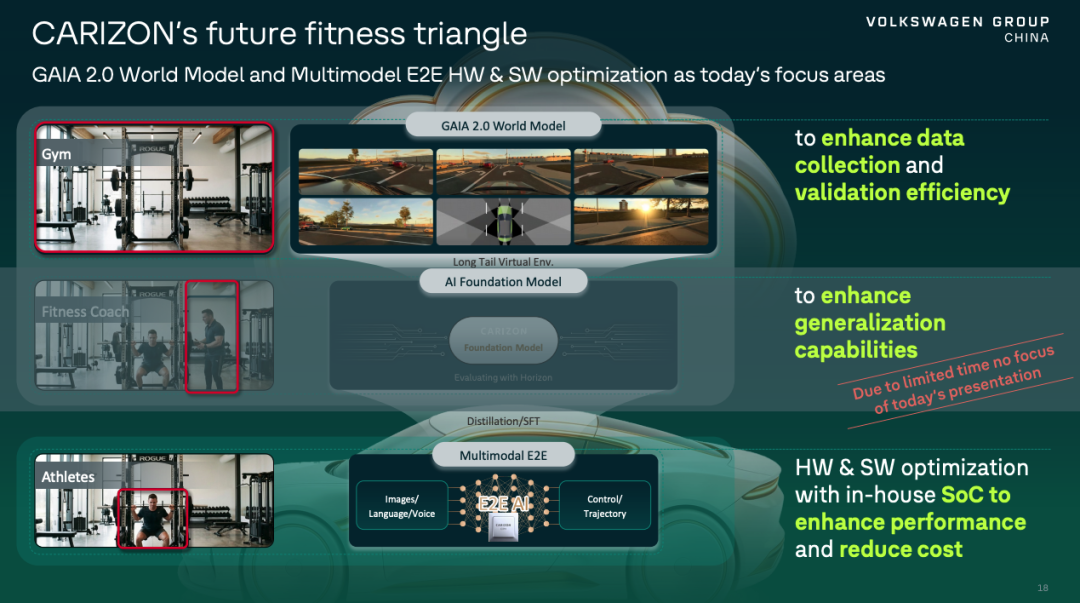
1. GAIA 2.0 World Model (enhances data collection and verification efficiency); Volkswagen’s world model should primarily generate various simulation cases and verifications on the simulation end.
2. AI Foundation Large Model (enhances generalization capability); a foundational model with multiple uses, essentially characteristic of large model tech companies.
3. In-House SoC Chip (enhances performance and reduces costs).
8. Underlying Logic of Comprehensive In-House SoC Chip Development
The Inevitable Path to Cost Reduction and Efficiency Enhancement:
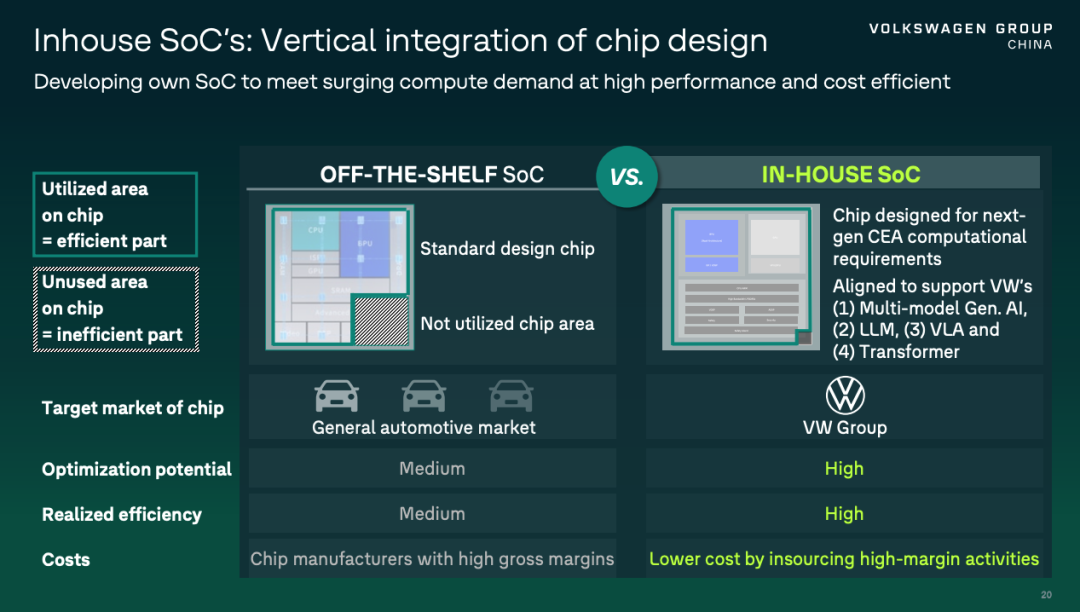
Volkswagen CARIZON believes that generic chips on the market often contain many unused redundant areas, and chip manufacturers enjoy extremely high gross margins. Through vertical integration, Volkswagen designs its own dedicated ADAS chips, precisely adapting to its AI large language models and Transformer architectures, not only achieving higher performance but also retaining high-profit links internally, resulting in significant cost reductions.
9. Ultimate Game-Changer—CARIZON C7H Intelligent Driving Chip
Hardcore Parameters:
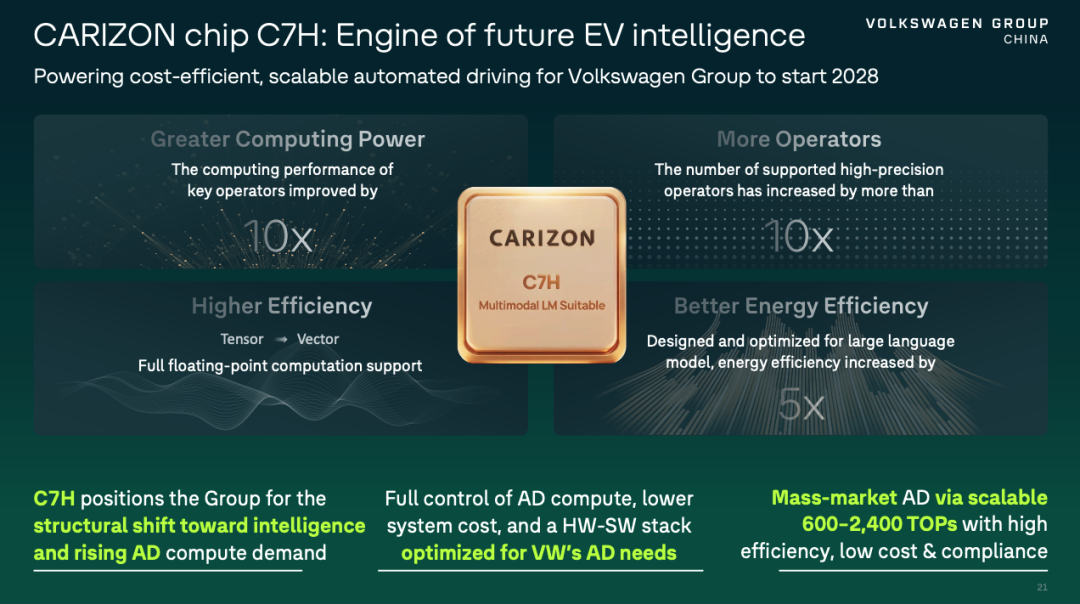
The flagship missing from the above roadmap is here—Volkswagen’s intelligent AI chip boasts a computing power of up to 2400 TOPS, extending Volkswagen’s excellent platform expansion concept from the mechanical era to chips.
Volkswagen CARIZON is developing an in-house chip codenamed C7H, with computing power flexibly scalable between 600 and 2400 TOPS, optimized for multimodal large models, and expected to begin mass installation in vehicles by 2028.
Overwhelming Cost Advantage:
Leveraging Volkswagen Group’s scale effect, L2++ and L3/L4 systems equipped with the C7H chip can reduce costs by over 20% to 30% compared to current mainstream solutions.
10. Backend Optimization and Final Strategic Summary
Astonishing Efficiency of GAIA 2.0:
The daily virtual test miles on the training platform will surge tenfold to 1 million kilometers, reducing verification costs by 70%.
Core Summary:
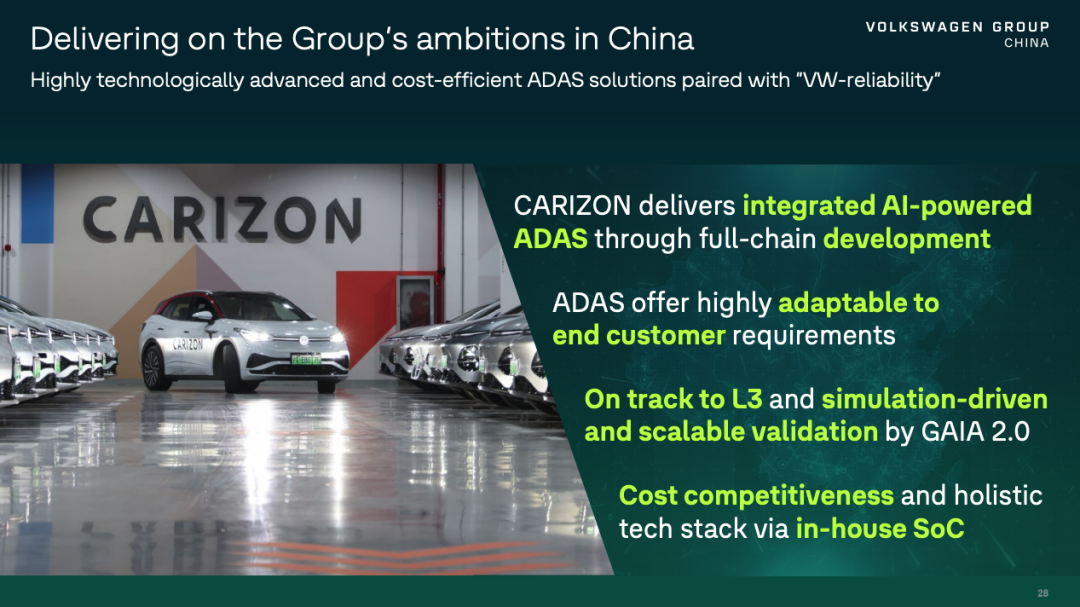
CARIZON is ensuring cost competitiveness through in-house chip development, steadily advancing toward L3 autonomy with the help of the GAIA 2.0 simulation platform, and fully realizing Volkswagen’s intelligent driving ambitions in China.
After examining Volkswagen’s ultimate game-changer of “full-stack in-house R&D + in-house chips,” what are your thoughts on this joint venture giant’s position in the second half of the intelligent driving battle?
Share your views in the comments: Do you think Volkswagen’s “asset-heavy” self-developed intelligent driving model can stage a comeback in the Chinese market? Welcome to share your sharp insights in the comments!
▍Please follow, like, and share—your every ‘view’ motivates us to continuously produce in-depth content.
References and Images
CARIZON Utilizing AI to make driving safer and more enjoyable PDF - Volkswagen CARIZON
*Unauthorized reproduction and excerpting are strictly prohibited-
-
![]()
Is XPENG Merely a Stopgap Solution? Volkswagen’s Secret Weapon in China’s Autonomous Driving Race: CARIZON’s Advanced R&D Strategy
-
![]()
Google Launch Event: The Largest Android Update in History; AI-Powered Notebook Tailored for Gemini
-
![]()
Chinese EVs: Challenging the U.S. Market
-
How Does the Occupancy Perception Network Detect Dynamic Objects?
-
![]()
Is Android 17 Underdeveloped? Android 17 Beta First Impressions: None of Google's Touted AI Features Have Come to Fruition
-
![]()
While the Entire Industry Fixates on Tokens, Baidu Advocates for a New Standard
-
![]()
Paradigm Shift Unleashed: OpenClaw Sparks China’s AI ‘Era of Action’ — Decoding the ‘Report’ (Part 1)
-
![]()
Can Kuaishou 'Gain Honor Through Its Offspring' by Listing Its 'Prized Asset' Kling?