ByteDance's Heavy Investment in the Automotive Industry: What Are Volcano Engine's Chances of Success?
 05/19 2026
 530
530
Volcano Engine is Making Waves in the Automotive Industry.
If AI is the primary keyword for Volcano Engine's rise in the past two years, then 'automotive' is the second.
At the 2026 Beijing Auto Show, Volcano Engine finally secured its own dedicated booth, while Alibaba Cloud was tucked away within the Zebra Smart Travel exhibit.
Investing heavily in a prime auto show location underscores Volcano Engine's commitment to the automotive sector.
In fact, when Volcano Engine, ByteDance's cloud service brand, was established in 2020, it immediately set up a dedicated automotive division. 'We were the first among all cloud providers to prioritize the automotive industry,' Tan Dai, President of Volcano Engine, previously told Guangzhui Intelligence.
This reveals Volcano Engine's long-standing ambition in the automotive sector. However, for several years, it did not stand out in the industry.
It wasn't until 2024, with the explosion of AI large models and the demand for AI integration in vehicles, that Volcano Engine truly made its mark in the automotive industry.
In May of the same year, Volcano Engine officially released the ByteDance Doubao large model family, Volcano Ark 2.0, AI applications, and AI cloud infrastructure. In August, Mercedes-Benz announced a strategic partnership with Volcano Engine.
Two years later, at the Beijing Auto Show, Tan Dai announced that over 7 million intelligent vehicles were equipped with the Doubao large model, covering more than 50 automotive brands and 145 models. The Doubao large model completed over 30 million daily cockpit interactions and service closures.
More critically, Volcano Engine has established AI innovation partnerships with 100% of mainstream automakers. This means that in the Chinese automotive market, it is nearly impossible to find a mainstream automaker that has not collaborated with this ByteDance-owned cloud service provider.
'Automobiles are crucial for us because they reach a vast audience and occupy a significant amount of their time,' Tan Dai's statement reveals the underlying logic behind Volcano Engine's foray into the automotive sector, with the goal of acquiring more C-end traffic and increasing token consumption.
However, at the same time, Yang Liwei, Vice President of Volcano Engine, tempered this aggressive stance with a more measured approach: 'Every business must have profitability goals, which is inevitable. However, we are taking a longer-term view and are not pursuing immediate profits.'
Not building cars but deeply integrating with every vehicle; not focusing on short-term profits but heavily investing in the automotive industry. So, what exactly is Volcano Engine aiming to achieve in the automotive sector, and how does it plan to do so?
A Five-Year Strategic Layout in the Automotive Industry: Volcano Engine's Three-Stage Evolution
Volcano Engine's foray into the automotive industry is not a spur-of-the-moment decision but a five-year strategic endeavor.
The story begins in 2020 when Volcano Engine started introducing ByteDance's recommendation algorithms to the automotive market, with its first automotive client being a new energy vehicle brand from a U.S. automaker.
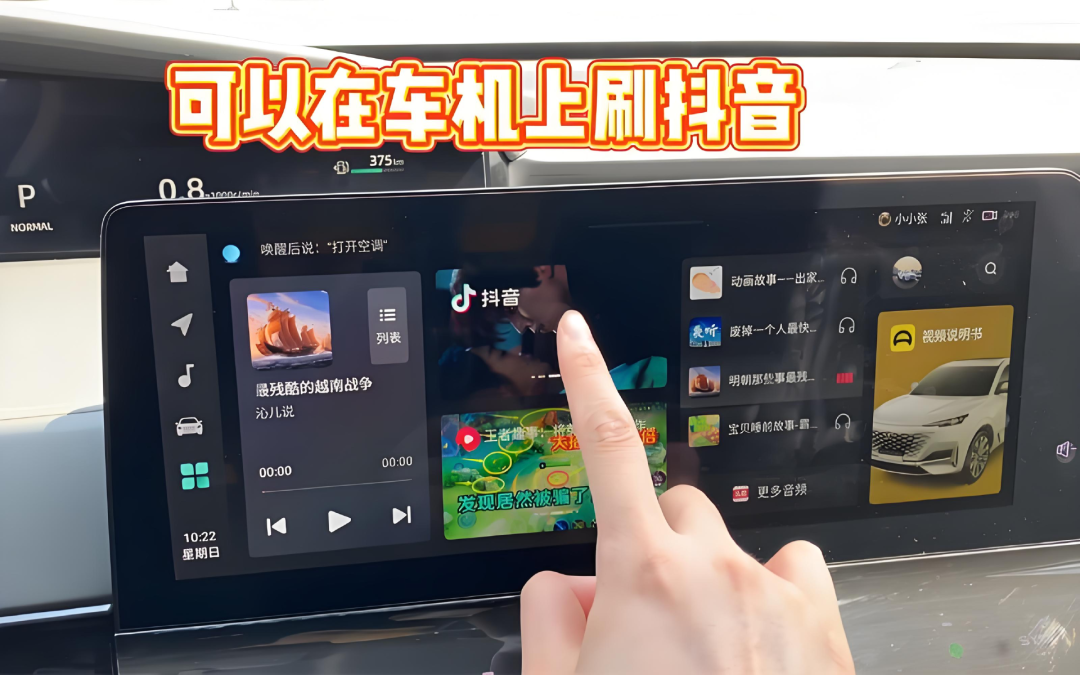
In September of the same year, Volcano Engine partnered with ECARX to integrate content from Toutiao, Douyin, Xigua Video, and Dongchedi, viewed by hundreds of millions daily, along with recommendation algorithms, into automotive cockpits.
This marked the inception of Volcano Auto Entertainment. Initially, the focus was on promoting ByteDance's content ecosystem in vehicles.
It wasn't until March 2021 that ByteDance announced its participation in the Series A1 financing of QCraft, marking its entry into the autonomous driving sector.
In December of the same year, Volcano Engine officially launched its cloud products, entering the automotive cloud market with an initial strategy focused on providing connected vehicle cloud services and cloud infrastructure to support autonomous driving research and development.
Over the next few years, Volcano Engine successively partnered with Himo Auto and Li Auto in intelligent computing.
In 2023, Volcano Engine introduced three 'clouds' in the automotive sector: intelligent driving cloud, intelligent cockpit cloud, and intelligent marketing cloud. Among these, the intelligent marketing cloud became one of Volcano Engine's core selling points in the automotive industry in recent years.
According to Yang Liwei, even before Volcano Engine's official debut, they had already secured partnerships with automakers, providing them with 'data analysis and growth tools' similar to those used in core ByteDance products like Douyin to assist in marketing efforts.
Over the next few years, Volcano Engine developed a series of products along these lines, ranging from basic App development for automakers to integrating data from various channels—phone customer service, Apps, offline sales—to establish data analysis systems. They also refined automotive consumption trends across the internet based on applications like Douyin, Toutiao, and Dongchedi, enabling targeted marketing information and ad placements for specific customer segments.
Take Lynk & Co as an example. Volcano Engine built a CDP platform for them, integrating data from 15 system sources to address data silos and implementing differentiated and automated user operations through MA. After the solution's deployment, Lynk & Co saw a significant boost in overall event operation efficiency, saving over 70% in operational labor costs through CDP and MA.
Initially, Volcano Engine's approach to the automotive industry was not significantly different from other internet cloud providers, progressing steadily from intelligent cockpits to intelligent driving cloud services and then to automotive digital marketing, without standing out notably.
However, the explosion of AI large models and the release of the Doubao series provided Volcano Engine with an opportunity.
The first stop for AI large models in vehicles was the intelligent cockpit.
After the surge in popularity of ChatGPT in early 2023, Baidu's ERNIE Bot led the way in integrating AI into vehicles. By early 2024, the focus shifted from ERNIE Bot to the popular and open-source DeepSeek.
However, the automotive industry is highly customized. Despite automakers announcing integrations with DeepSeek, they had to develop relevant technologies themselves and fine-tune models for in-car cockpit experiences, posing a significant challenge for automakers without large model development experience.
'One key reason automakers choose us is our superior model services,' Tan Dai stated. This implies that Volcano Engine is willing to invest substantial human and material resources to meet automakers' customized needs.
This became the key to Volcano Engine's deep penetration into the automotive sector.
Thus, at the Shanghai Auto Show in late 2024 and early 2025, Doubao capitalized on the trend of integrating large models into vehicles.
During the 2025 Shanghai Auto Show, Volcano Engine announced that its Doubao large model had been integrated by 80% of participating automakers and had established partnerships with over 60 companies in intelligent driving computing, intelligent cockpit large models, and AI marketing.
By the 2026 Beijing Auto Show, this figure had grown to 100% cooperation with mainstream automakers and over 7 million vehicles equipped with the model.
Meanwhile, at this year's Beijing Auto Show, Volcano Engine unveiled its 'Automotive Brain' strategy, aiming to deeply integrate with vehicles through a single AI brain, connecting key functional domains like vehicle control, navigation, and intelligent driving to achieve a closed-loop system of 'perception-reasoning-execution-memory-learning.'
From initial content integration to marketing empowerment and now the 'Automotive Brain,' Volcano Engine has completed a three-stage evolution in its automotive industry strategy. In just five years, it has transformed from a newcomer to a prominent player in the industry.
So, what exactly has Volcano Engine done in the AI era, and how can it sustain its momentum in the fiercely competitive automotive industry amidst the AI large model boom?
Intelligent Agents in Vehicles: The Next Wave of Intelligent Cockpit Competition
In late 2025, Tesla integrated its large model Grok into vehicles, linking it with FSD. This move completely transformed the automotive industry's perception of cockpit large model voice assistants.
Amidst the trend of integrating cockpit and driving functions, this appears to be a technological integration on the surface. However, it conceals a new wave of technological architectural innovation.
Subsequently, China witnessed a new surge in integrating AI large models into vehicles.
Earlier this year, a wave of integrating 'lobster' (a metaphor for advanced AI agents) into vehicles further accelerated the trend of 'cockpit-driving integration.'
The intelligent cockpit industry has evolved for decades but has been limited by scenarios and technologies. Voice assistants' human-vehicle interaction experiences often remain at a basic Q&A level. Although recent years have seen some vehicle control capabilities through voice commands, such as opening windows, these are essentially still instructional operations.
The surge in integrating intelligent agents into vehicles brings about more than just recognizing and executing user voice commands. More importantly, these agents can make autonomous judgments and learn, accumulating and precipitate (Note: ' precipitate ' is retained as is for its specific meaning in Chinese, which may not have a direct English equivalent but conveys the idea of accumulation and refinement) experiences, truly capable of 'getting things done.'
Therefore, no company wants to miss out on this new market space created by this wave, which adds incremental value to the automotive industry's second half competition.
Horizon Robotics unveiled its in-vehicle 'lobster' KakaClaw before the auto show, building an in-vehicle intelligent agent operating system with capabilities, personality, and memory. Qianli Technology and Jueyue Xingchen jointly developed Super Eva, centered around intelligent agents, for vehicle integration. Additionally, companies like Minieye, Zebra Smart Travel, and SenseTime also launched in-vehicle cockpit intelligent agents.
At this year's Beijing Auto Show, Volcano Engine introduced a new generation of automotive intelligent solutions based on the Agentic AI architecture, replacing the previous voice assistant architecture that relied on intent segmentation and multi-agent collaboration.
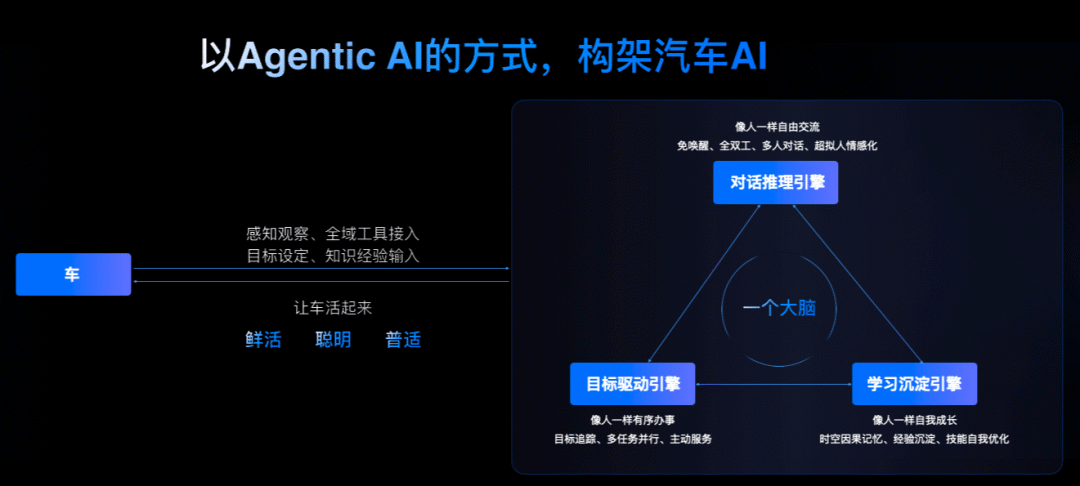
This architecture, 'One AI,' uses a unified main model to replace the previously scattered models and modules within the cockpit, connecting interaction, thinking, and execution.
In recent years, many AI-controlled vehicle functions have matured. According to Yang Liwei's disclosed in-vehicle scenario data, among user behaviors involving the Doubao large model in vehicles, vehicle control accounts for 53%, navigation 29%, and media entertainment 10%.
This data confirms the core demand logic of in-vehicle users: AI intelligent agents in vehicles must first excel in basic high-frequency functions like vehicle control, navigation, and multimedia. Emotional companionship and casual chat experiences are value-added features. The industry should prioritize ensuring smooth interaction and complete execution of essential functions.
Currently, in the intelligent cockpit sector, Volcano Engine offers two distinct collaboration paths:
1. AI Cockpit All-in-One Package (Capability Output): This is a 'toolbox' prepared for automakers with strong self-research and integration capabilities.
Volcano Engine provides full-stack capabilities, ranging from underlying MaaS model services and the Doubao large model to the core 'main intelligent agent' engine, as well as upper-layer tool connections, interaction design, and operation management platforms. Automakers can use these components as needed and deeply customize them based on their ecosystems and brand identities.
2. Doubao Cockpit Assistant (Application Output): This is an end-to-end user experience benchmark created by Volcano Engine itself.
It deeply integrates Volcano Engine's AI capabilities with ByteDance's C-end ecosystem (such as Douyin and Toutiao's local life and content services).
This serves as a 'showroom' to demonstrate the upper limits of user experience, with plans for mass production and vehicle integration in 2026.
'Automakers with strong self-research capabilities can directly call our APIs. Chip manufacturers, software Tier 1 suppliers, and voice providers can all leverage large models to enhance spatial interaction experiences. Meanwhile, during our development process, we discovered some excellent experiences that we hope to set as benchmarks,' Yang Liwei said.
Regardless of the chosen path, deep collaboration with automakers is crucial for success. After all, for an intelligent agent to truly 'understand' a vehicle, it requires injecting substantial vehicle-specific 'knowledge.'
'We need to work with automakers to clearly define all atomic capabilities, describe each function in natural language, and understand what each signal means... including how to cool down faster without blowing on the legs and what temperature is comfortable. This requires the automaker's know-how,' Volcano Engine emphasized, highlighting the deep integration process from vehicle engineering to AI models.
Having products is not enough; channel construction is also vital in B-end business. According to Guangzhui Intelligence, in Volcano Engine's service offerings to automakers, especially in the intelligent cockpit sector, it heavily relies on the capabilities of channel partners.
'Currently, nearly 80% of our intelligent cockpit projects are handled by us,' a Volcano Engine automotive industry channel partner told Guangzhui Intelligence, citing previous collaborations with models like Roewe.
As of April 2026, Volcano Engine has established partnerships with 100% of China's mainstream automakers, covering over 50 automotive brands and 145 models. The installed base of intelligent vehicles equipped with Volcano Engine's Doubao large model has exceeded 7 million.
However, despite the large number of partnered automakers, most collaborations are based on rapid mass production and cost-effective API solutions.
Currently, the only automaker that Volcano Engine has publicly achieved CPP (joint hardware definition, customized systems, AI-native architecture) level deep collaboration with is SAIC Roewe.
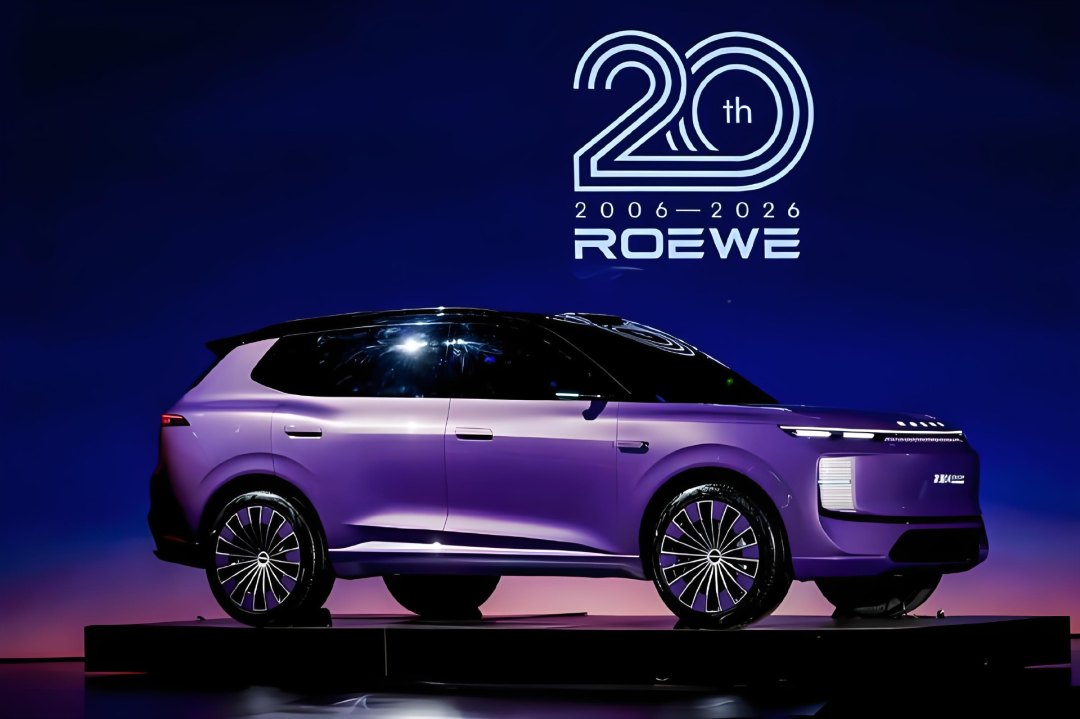
(Volcano Engine's Jiayue series concept car co-created with Roewe)
This results in a bustling intelligent cockpit sector that struggles to generate profits.
Take Zebra Smart Travel as an example. According to its prospectus data, its comprehensive income in 2025 was approximately 861 million yuan, with an annual installation volume of 2.487 million units, translating to roughly 346.2 yuan in revenue per vehicle (calculation: 861 million yuan / 2.487 million units ≈ 346.2).
Additionally, while its emerging AI business shows promise, it is currently too small in scale. For instance, its fastest-growing in-vehicle service platform (+83.7%) generated only 151 million yuan, and its AI full-stack solution brought in a mere 66 million yuan.
However, the intelligent cockpit industry is typically technology-intensive, requiring substantial upfront R&D investment. Zebra Smart Travel's R&D investment in 2025 remained high at 725 million yuan, accounting for 84.2% of its total annual revenue.
This 'high investment, low output' model directly leads to significant losses. In 2025, Zebra Smart Travel incurred a loss of 1.896 billion yuan, with its operating cash flow experiencing substantial net outflows for three consecutive years. In other words, for every yuan of revenue earned, the company spent nearly 84 cents on R&D, making profitability extremely challenging when factoring in daily operational costs.
Although Volcano Engine's intelligent cockpit business differs from Zebra Smart Travel's, their underlying business logic is similar.
Overall, compared to the vast automotive intelligence market, cockpit-related revenue is relatively limited. It serves more as an entry point for Volcano Engine to penetrate automakers and sell its cloud services, which constitute the bulk of cloud providers' revenue.
Can Volcano Engine Break Through?
As a cloud provider, Volcano Engine has indeed put considerable effort into the automotive industry.
One of the reasons is that during the years when Volcano Engine has been preparing to deeply engage in industry scenarios, the wave of AI integration in vehicles has presented a new opportunity in automotive intelligence. Almost all cloud providers are starting from roughly the same point, which is already a rare advantage for Volcano Engine, which still has a relatively shallow foundation.
Therefore, Volcano Engine does not miss any opportunity for small businesses and continuously seeks opportunities in automotive scenarios.
As a result, from the initial Volcano Car Entertainment to automotive marketing, and then to the integration of intelligent agents into vehicles, Volcano Engine's products in the smart cockpit sector have been constantly iterating.
However, this sector is also relatively crowded. After the wave of intelligent agents in vehicles, four major camps have formed: tech giants, self-developed solutions by automakers, professional AI companies, and supply chain vendors. Among them, the current major players among tech giants include Volcano Engine, Alibaba Cloud, Tencent Cloud, Huawei Cloud, and Baidu Cloud.
Comparatively speaking, what these tech giants do is not just the output of technical capabilities; more importantly, it is the integration of ecological capabilities behind them. For example, behind Volcano Engine are ByteDance's ecosystems such as Douyin, Dongchedi, and Toutiao; behind Alibaba are Didi, e-commerce, Alipay, Gaode, etc.; behind Tencent are WeChat Pay, Mini Programs, etc.
It can be seen that compared to other cloud providers, Volcano Engine has indeed carved out its own path in the automotive industry: rapidly cut into with the Doubao large model as the foundation and integrating the ecological content behind ByteDance to quickly seize the smart cockpit sector in the automotive industry.
However, this does not mean that Volcano Engine can rest easy; its competitors may not all come from cloud providers.
First, Volcano Engine's intelligent driving business is primarily focused on intelligent driving cloud services and does not directly involve itself in the research and development of intelligent driving technologies. The lack of this 'killer app' will limit the integration of cockpit and driving functions.
At the level of cockpit-driving integration, Yang Liwei believes that forcibly integrating at the model layer at this stage would have a 'very poor ROI.' The core reason lies in the huge difference in inference frequencies—intelligent driving models require processing speeds ranging from 10 Hz to 48 Hz (Tesla's is 48 Hz), while cockpit models are sufficient at 1-2 Hz. 'Different frequencies represent exponentially increasing demands for computing power and memory, so there's no need to combine the two.'
Volcano Engine's current approach is to achieve data and task connectivity at the model layer rather than insisting on physical integration of chips or models.
Yang Liwei drew a vivid analogy: Volcano Engine is more like the brain, while intelligent driving is more like the cerebellum for vehicle motion control. 'We will summarize and refine the user's intentions towards the driver agent and transmit them to the intelligent driving system to complete the closed loop (closed loop).'
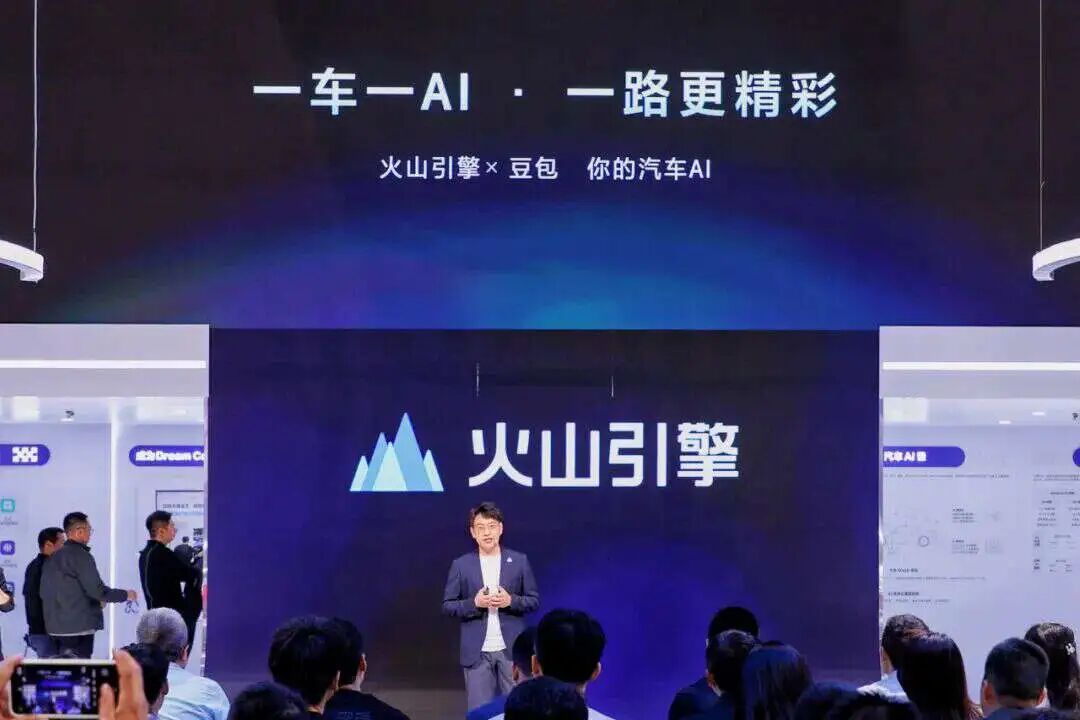
(Yang Liwei, Vice President of Volcano Engine)
He revealed that Volcano Engine has already collaborated with a leading domestic intelligent driving Tier 1 supplier and expects to achieve real-world implementation before the end of this year.
At the same time, Volcano Engine also made it clear: 'We have always been providing the underlying cloud and infrastructure for intelligent driving to help improve training efficiency. So whether it's L3 or L4, as long as they continue to develop, we are willing to support them.'
It can be seen that in the intelligent driving business, Volcano Engine has not delved too deeply into the industry and mainly provides cloud and infrastructure services. However, looking ahead, the integration of cockpit and driving functions is the general trend. For example, Tesla's FSD+Grok and Huawei's Qiankun+Harmony Cockpit can offer a deeper cockpit-driving integration experience.
Volcano Engine's solution is to 'transmit the cockpit's understanding of intentions to the intelligent driving Tier 1 supplier' rather than a true unified cockpit-driving model. If cockpit-driving integration becomes the industry's mainstream standard, suppliers with only cockpit AI capabilities may gradually be marginalized.
Overall, the development of the automotive intelligence sector has undoubtedly created equal opportunities for late-entering cloud providers like Volcano Engine. Relying on the computing power foundation of the Doubao large model and the advantages of ByteDance's ecosystem, Volcano Engine has steadily completed its business iteration from automotive marketing to smart cockpit AI services, gradually gaining a foothold in the field of in-vehicle intelligent agents and carving out a differentiated path for industry penetration.
However, in the long run, for Volcano Engine, as in-vehicle intelligence industry standards gradually unify and the cockpit-driving integration experience becomes a core user demand, a development route that only focuses on cockpit AI ecosystems and emphasizes cloud services may also face industry adaptation pressures.
Ultimately, whether Volcano Engine can break through in the automotive intelligence sector is also worth watching.
-
![]()
After an 8 Billion Yuan Investment in Wuhan, Will French Automobiles Outperform Japanese Ones?
-
![]()
"Charging Industry Set to Move Beyond 'Cutthroat Low-Price Competition'", "Charging sector, profitability, structural enhancement, high-quality growth, the 15th Five-Year Plan era"
-
![]()
No Shortcut to the 'Final Circle' of the Autonomous Delivery Van (Robovan) Era
-
![]()
Yann LeCun's Retweet Declares Meta AI 'Dead'
-
![]()
Token Package Plans Launch: The 'Traffic War' in the AI Era Now Involves Doubao and Peers
-
![]()
Which enterprises have incorporated world models into their autonomous driving solutions, and what are the differences in their implementations?
-
Alibaba's AI Revenues Made Transparent, Tencent's AI Strategies Remain Hidden
-
![]()
Hands-On App Creation is Now a Reality! Tencent's TuSi vs. Ant Group's LingGuang: One Offers Installability, the Other, Speed