Japanese Automakers Experience Collective Downturn, Financial Performance of Top Three Plummets
 06/01 2026
 448
448
For years, Toyota, Honda, and Nissan have held sway over the family car market, largely due to their reputation for fuel efficiency, durability, high resale value, and minimal issues. These attributes have made them the preferred choice for countless families and a reliable source of revenue for 4S dealerships worldwide.
However, in just a few short years, the landscape has shifted dramatically. Visiting multiple Japanese brand 4S stores today, one is greeted not by the bustling crowds and high-demand vehicles of yesteryear, but by deserted showrooms, idle display cars, and the resigned sighs of sales staff.
A seasoned sales manager at a Japanese car 4S store, with over a decade of experience in the industry, bluntly described the seismic shift: "It's glaringly obvious now. Previously, at least seven or eight out of every ten customers who came specifically to buy Japanese cars would end up considering BYD or AITO, and we struggled to retain many of them."
More alarmingly, following Japan's fall from the top spot in global automotive sales, the financial reports of the big three Japanese automakers have also taken a significant hit.
Toyota saw its revenue rise, but profits stagnated, with net profit attributable to the parent company falling nearly 20%. Honda incurred its first loss since going public in 1957, while Nissan suffered massive losses for two consecutive fiscal years, totaling 1.2 trillion yen (approximately RMB 51 billion).
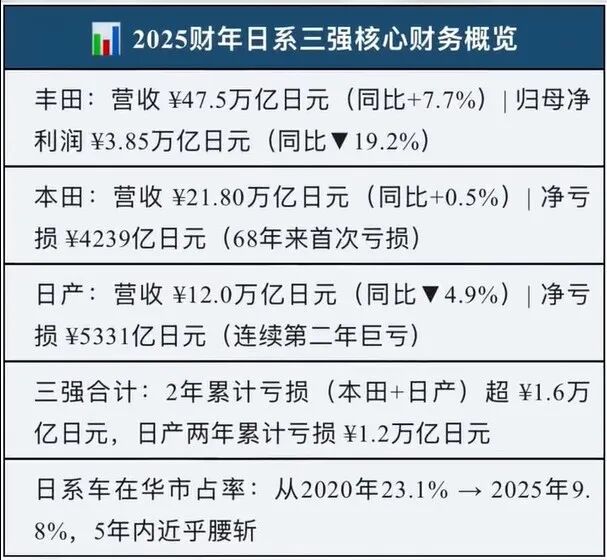
Beyond the top three, Subaru also experienced a revenue increase but stagnant profits, with operating profit plummeting by 90%. Japanese media reported that by fiscal year 2025, profits in the Japanese automotive manufacturing industry could be nearly halved. Geopolitical conflicts, tariff pressures, and lagging electrification efforts are ensnaring the former sales leaders.
The outlook for 2026 remains grim. Japan's 'Nikkei Asian Review' reported that due to factors such as geopolitical conflicts, tariff pressures, and supply chain risks, profits in the Japanese automotive manufacturing industry could shrink significantly in fiscal year 2026. The once highly profitable Japanese cars have suddenly become unprofitable. Behind this collective slowdown, the primary pressure comes from U.S. tariffs. 
"Despite significant changes in the external environment, the downward trend in per-vehicle profitability has not been curbed," said Toyota Motor President Kenta Kon at the financial results briefing. In the lucrative U.S. market, Japanese automakers face continuous threats. Although the tariff rate on Japanese cars exported to the U.S. was reduced from 27.5% to 15% in September 2025, it still resulted in a significant reduction in operating profits for automakers. For Toyota alone, the operating profit loss due to tariffs in fiscal year 2025 reached a staggering 1.38 trillion yen (approximately RMB 58.7 billion), with its North American operations recording their first operating loss since 2008.
If tariffs and geopolitical conflicts have inflicted severe 'external injuries' on Japanese cars, then their defeat in the Chinese market reveals fatal 'internal injuries.'
During the era of fuel-powered vehicles, Japanese cars held their ground with mature "three major components" (engine, transmission, chassis), stable quality control, extremely low failure rates, and decent fuel economy. They dominated the market for over a decade with a mature product lineup.
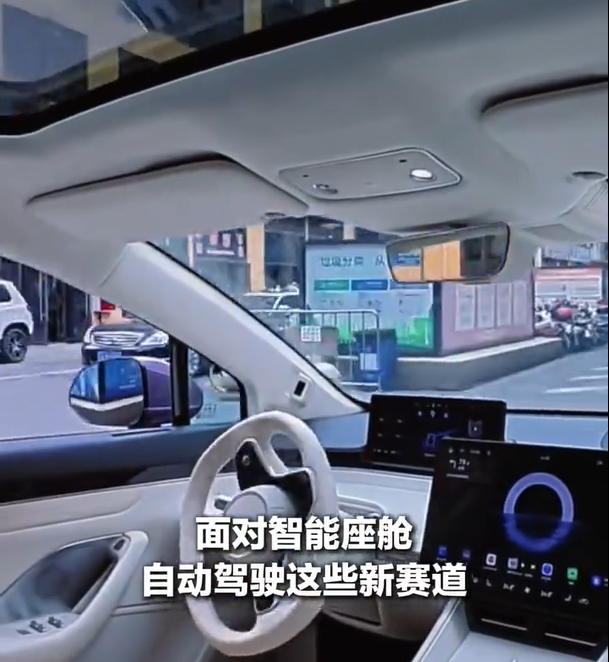
However, with the advent of the new energy vehicle (NEV) wave, the shortcomings of Japanese automakers have been magnified. Intelligence lags significantly behind. Today, when consumers purchase cars, intelligent infotainment systems, voice control, autonomous driving, and connected car technologies have become essential. Yet, Japanese cars still cling to a 'mechanical transportation' mindset. Laggy infotainment systems, simplistic functions, and almost no intelligent assistance configurations stand in stark contrast to BYD and AITO's seamless intelligent cockpits and comprehensive assisted driving features, highlighting a significant generational gap.
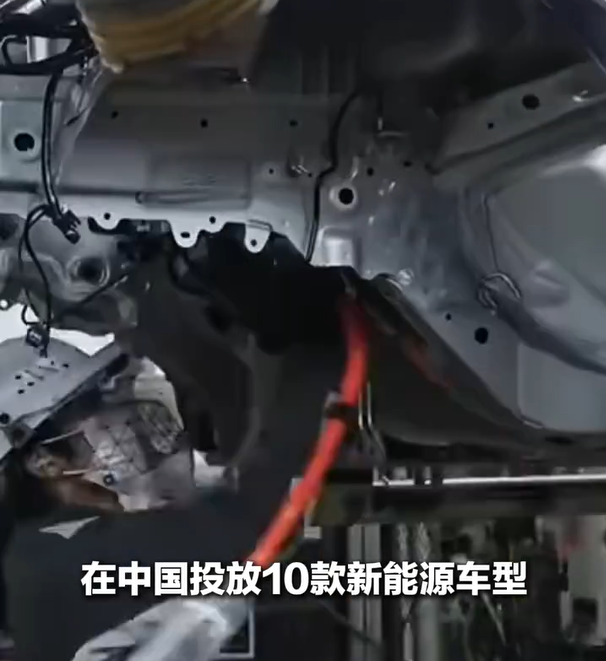
Product configurations are extremely stingy. For models in the same price range, domestic NEVs offer full configurations, including sound insulation, interior design, and comfort features. In contrast, Japanese cars still adhere to a 'configuration reduction is king' approach, with plastic interiors, basic features, simplistic infotainment systems, yet high premiums, completely losing their cost-effectiveness. The transition to new energy is sluggish and hesitant. While BYD delves deep into hybrid and pure electric sectors, and AITO focuses on high-end intelligent NEVs, Japanese automakers are reluctant to disrupt their fuel-powered vehicle base. Most of their new energy models are simply converted from fuel-powered ones, with weak competitiveness, high prices, and outdated technology, completely unable to participate in market competition.
More critically, consumer perceptions have undergone a complete transformation.
"Previously, customers compared Toyota, Honda, and Nissan. Now, after a brief chat in the store, they mention BYD Han, Tang, AITO M5, M7. In the past, everyone assumed 'joint ventures are better than domestic,' but now domestic NEVs have surpassed joint ventures in technology, quality, experience, and cost-effectiveness. Consumers no longer blindly believe in the joint venture halo; pragmatic car selection has become the mainstream,"
Leapmotor President's Media Briefing 'Makes Waves,' Shen Fei Directly States Ideal Owes 'Us an Apology.' Second Trial Awards 2 Million in Damages, Dragon Brother Discusses Electric Cars and 'Tearfully' Apologizes. BYD's Tenure Ends Two Years Early, Guangqi Group Vice President Suddenly Resigns. Jeep 'Once Again' Makes a Comeback, Netizens Question If It Will 'Rebadge.' Thirteen Years Later, Lei Jun Takes a Photo with Elon Musk, Sparking Internet Frenzy. Shareholding Exceeds 70%, Parent Company Continues to 'Support' VOYAH Automobile. April Sales Reach 5,100, What Can Guangqi Honda Rely On to Recapture the Market?
-
![]()
618 'Silent Mode': Algorithms Speak Louder Than Words
-
![]()
The New Battle for 'AI Workstations' Among Tencent, Google, and Others: Can Marvis and Its Peers Replace Human Workers?
-
![]()
Bestune Finally Wakes Up! Yueyi 08 Launches Pre-sale, Can the Independent Brand Make a Splash?
-
![]()
A Hackathon Reveals How AI Reshapes a Company with Ten Thousand Employees
-
![]()
Musk Hurriedly Promotes 'American Coding Version of DeepSeek,' Comment Section: 'Not Even as Good as Free Alternatives...'
-
![]()
Dissecting the Satellite Architecture of Assisted Driving: It's Not Just Performance Upgrades, but a Shift in Industrial Chain Dominance!
-
![]()
AI Image Generation Finally Stops Guessing! GenEvolve Transforms Open-Ended Image Generation into a Trainable, Self-Evolving Agent!
-
![]()
Another Way to Thrive for Large Models: MiniMax Has Found the Path