Trunk Technology Joins Forces with Two National Teams: Can Autonomous Driving Tackle the 'North-South Grain Transport' Challenge?
 06/03 2026
 539
539
Introduction
On May 28 in Harbin, Trunk Technology, Beidahuang Logistics Group, and China Railway Modern Logistics—a "tech pioneer" in autonomous driving trucks, a "national team" in agricultural logistics, and a "national team" in integrated logistics under China Logistics Group, respectively—gathered at the same signing table. The agreement was concise but carried immense weight with every word.
The focus is on enhancing multimodal transport systems, implementing autonomous driving for mainline transport, and transitioning logistics heavy trucks from diesel to electric, all with the singular aim of transforming the "north-south grain transport" corridor—a vital channel for national food security—into an intelligent and low-carbon benchmark.
The WeChat public account "Self-Driving Vehicle Insights" notes that this is not the first attempt to use technology to revolutionize bulk logistics. However, this time, the approach is different.
(For further reading, click: 'Trunk Technology Partners with Guanghui Logistics and Jiuzhou Hengchang Logistics to Build China's First Autonomous Driving Energy Transport Line')
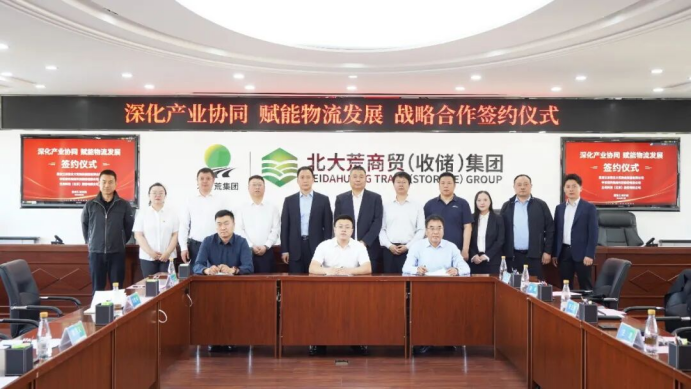
Image Source: Trunk Technology
I. Who is Trunk Technology? An Autonomous Driving Veteran from Tianjin Port
Before delving into the collaboration, it's crucial to understand why Trunk Technology was chosen by two "national teams."
A look at the company's background reveals a unique approach.
Founded in 2017 by Zhang Tianlei, a PhD from Tsinghua University's Computer Science Department and a protégé of Li Deyi, a leading figure in Chinese artificial intelligence, Trunk Technology stands out.
Zhang Tianlei is also one of the "founding 30" members of Baidu's autonomous driving team. While many autonomous driving entrepreneurs emerged from Baidu, Trunk Technology took a "tougher" path—while others focused on passenger vehicle autonomy, they dove headfirst into ports.
In 2018, Trunk Technology launched the world's first autonomous electric truck for trial operations at Tianjin Port and secured the nation's first road test license for commercial vehicle intelligent connected vehicles the same year.
At the time, few recognized the significance, but subsequent data tells the story:
As of December 2025, Trunk Technology has delivered a cumulative 830 intelligent trucks, completed nearly 100 million kilometers of intelligent transport mileage, and deployed over 400 autonomous trucks across dozens of ports, including Tianjin Port, Ningbo Zhoushan Port, Guangzhou Port, and Yantai Port, leading the industry in port autonomous driving deployment scale.
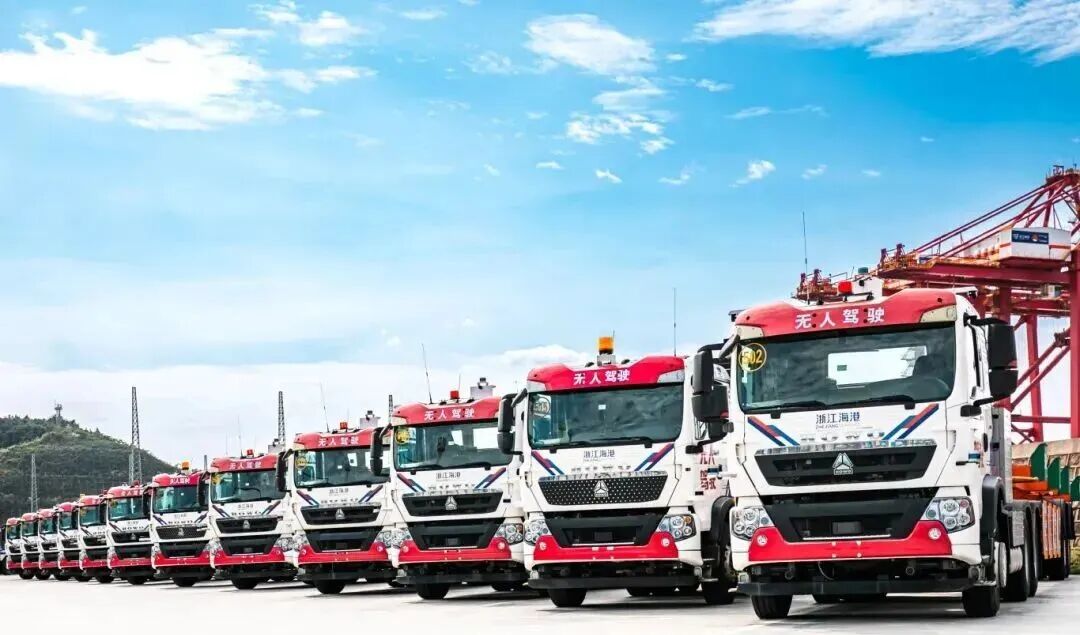
Autonomous container trucks at Ningbo Zhoushan Port. Image Source: Official Website of the National AI Application Scenario Innovation Challenge Organizing Committee
At Tianjin Port's Section C, the world's first "smart zero-carbon terminal," Trunk Technology's ART (AI Transport Robot) has achieved regular unmanned operations, boosting single-bridge operational efficiency by over 40% and completing over 8 million TEU in total operations.
Had Trunk Technology focused solely on ports, it might remain just a "port autonomous driving company" today.
But Zhang Tianlei's vision has always extended beyond ports—as he puts it, "Port autonomous driving is just a starting point; the real goal is to build a nationwide autonomous driving transport network."
By 2025, this vision is beginning to materialize rapidly.
II. Autonomous Driving Technology Foundation: From 'Single-Vehicle Intelligence' to 'Highways as Railways'
Trunk Technology's success is not built on burning cash or storytelling but on a technology system "hammered out" by real-world scenarios.
At its core are two pillars: the AiTrucker autonomous driving system and the Trunk CAFC intelligent platooning technology.
AiTrucker can be understood as an evolving "AI virtual driver." It adopts an end-to-end large model architecture, integrating perception, prediction, planning, and control for rapid reactions and precise decision-making.
More critically, Trunk Technology has built a data closed-loop platform, T-Yoga, continuously mining "long-tail scenarios" from nearly 100 million kilometers of real-world driving data, compressing algorithm iteration cycles from "monthly" to "weekly."
However, what truly anchors Trunk Technology in bulk logistics is Trunk CAFC—the "1+N" hybrid platooning model.
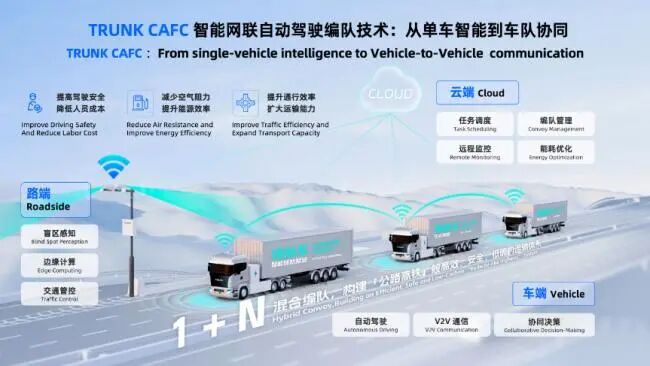
Image Source: KanChai Network
Simply put: a manned lead vehicle guides the way, followed by N L4-level autonomous trucks in coordinated formation, creating a "highway railway."
The brilliance of this design lies in its pragmatism—rather than chasing a "fully unmanned" dream, it finds the most commercially viable path under current regulations and technology.
The lead operator handles complex decisions and compliance, while the unmanned vehicles behind share perception data in real-time via V2V communication, synchronizing acceleration and braking.
Even if communication briefly cuts out, each vehicle can operate independently and safely, avoiding a total system failure.
How effective is it?
Real-vehicle validations on multiple highways, including Jingjintang, Jinshi, and Jingha, show over 99.99% accuracy in detecting traffic participants within 100 meters; at 60 km/h, lateral errors stay below 15 cm on straight roads and 25 cm on curves.
The cost benefits are clear: one driver manages a fleet, slashing labor costs; tight vehicle following reduces wind resistance, cutting fuel costs; and without new road construction, throughput rises.
III. Why 'Grain Transport from North to South'?
No matter how advanced the technology, without the right scenarios, it's meaningless.
What makes Beidahuang Logistics Group significant? As China's "national team" in agricultural logistics, it dominates the Northeast's core grain-producing regions. China Railway Modern Logistics, a subsidiary of China Logistics Group, needs no introduction for its integrated logistics capabilities.
The pain points of the "north-south grain transport" corridor are severe:
- Northeast winters are brutally cold, with temperatures regularly dropping below -30°C;
- Long transport distances, spanning 2,000–3,000 km from Heilongjiang to the south, with complex road conditions, including icy sections, raising driver fatigue risks;
- A severe driver shortage—young people shun long-haul freight, while veteran drivers retire yearly, making recruitment increasingly difficult.
Trunk Technology's solution involves "three moves":
- Move 1: Mainline intelligent driving. L4 autonomous trucks handle high-frequency, long-distance heavy-haul tasks, transforming "sweat logistics" into "smart logistics."
- Move 2: Yard unmanned loading/unloading. Upon arrival at logistics parks, vehicles automatically park and load/unload without human waiting.
- Move 3: Container multimodal transport. Boosting "bulk-to-container" ratios reduces inefficient handling, enabling "single-bill, single-container" end-to-end transport.
This combo addresses both the "no one to drive" and "time-wasting cargo transfers" issues while cutting emissions—logistics heavy trucks' transition from diesel to electric is explicitly written into the cooperation agreement.
IV. Not the First, Nor the Last
"Grain Transport from North to South" is just the latest addition to Trunk Technology's "national team collaboration list."
In April 2026, Trunk Technology partnered with Guanghui Logistics and Jiuzhou Hengchang to build China's first large-scale autonomous driving energy transport line in Hami's Naomao Lake region, Xinjiang, targeting the heart of "Xinjiang coal to the east" transport capacity.
The division of labor is clear: Jiuzhou Hengchang provides multi-million-ton annual transport scenarios and local operational experience, Guanghui Logistics controls key resources like the Hongnao Railway, and Trunk Technology supplies L4 intelligent heavy trucks and cloud-based dispatch platforms.
Autonomous driving test vehicles began trials on the Naoliu Highway in March this year, with the first batch of new energy heavy trucks expected to operate this year.
From Xinjiang's coal to Northeast's grain, Trunk Technology's autonomous trucks are moving deeper from "ports" to "national territory."
The company's ambition has never been limited to a single self-driving truck.
At the 2026 Sino-German (European) Hidden Champions Forum, Zhang Tianlei made it clear: Trunk Technology aims to build the Next-Generation AI Logistics Network (NATS), optimizing vehicle utilization, road efficiency, and cargo flow, connecting ports, logistics parks, and urban distribution centers into a single network.
In the Beijing-Tianjin-Hebei region, this network is taking shape: an autonomous driving freight corridor linking Tianjin Port, bonded warehouses, and Beijing logistics parks enables cross-provincial, cross-scenario commercial transport.
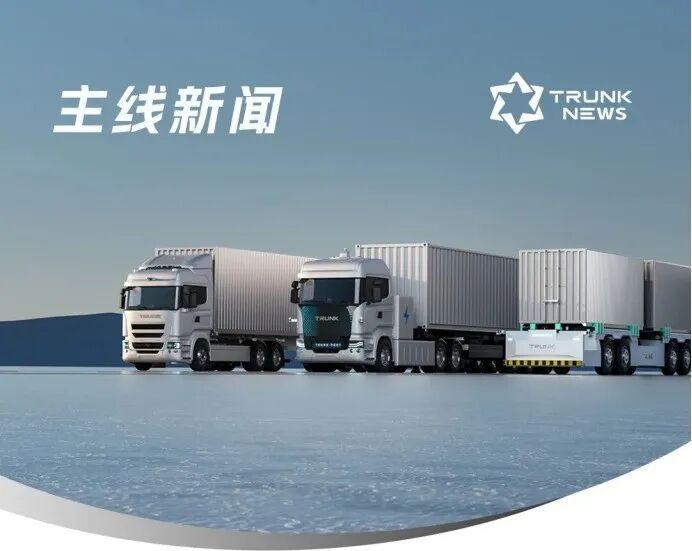
Image Source: Trunk Technology Official WeChat Account
In summary, "Self-Driving Vehicle Insights" (WeChat public account) believes:
From a single autonomous container truck at Tianjin Port to Xinjiang's "Xinjiang coal to the east" energy line and now the Northeast's "north-south grain transport" logistics corridor, Trunk Technology has spent nine years proving one thing:
The value of autonomous driving trucks lies not in replacing a single driver but in restructuring the entire logistics value chain.
As autonomous driving's "steel camels" begin traversing snowfields in herds, they carry not just grain but a smarter, greener, and more efficient logistics future.
What do you think? References: Reports from Dute & Shenzhen Evening News, NetEase, iResearch, Sina Finance, Economic Observer, and other media outlets.
#SelfDrivingVehicleInsights #AutonomousDriving #SelfDrivingCars #SelfDrivingVehicles
We look forward to your follows, likes, shares, and reposts!
-
![]()
From 'Hardware Price Comparison' to 'Endurance Race': Who Will Lead the Heavy-Duty Truck Sector?
-
![]()
Sales of Six Major Chinese Automakers in May: BYD Reclaims Top Spot, Domestic Market Under Pressure While Exports Drive Growth | Mirror Pro
-
![]()
Search Will Enter the Third Phase of Its Lifecycle: Search as Code
-
![]()
Computex 2026 | Qualcomm’s Visionary Outlook: In the Age of Agents, Devices Take Center Stage in Computing
-
![]()
Computex 2026 | Marvell: How to Connect Data Centers in the AI Era?
-
![]()
【Intelligent】Tianjin Launches Its First L4 Autonomous Bus Route
-
![]()
BYD’s Monthly Overseas Sales Soar Past 160,000 Units: Elevated Gross Margins Drive Profitability!
-
![]()
Tencent's Trump Card Has Never Been Large Models