BYD’s Monthly Overseas Sales Soar Past 160,000 Units: Elevated Gross Margins Drive Profitability!
 06/03 2026
 528
528
On June 2 (Beijing Time), BYD released its sales data for May.
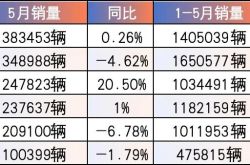
In May, BYD recorded total sales of 383,500 units, comprising 222,800 units in the domestic market and 160,200 units overseas, with overseas sales accounting for 41.8%.
Leading BYD is Chery. In April 2026, Chery's combined sales of fuel and new energy vehicles reached 177,600 units, climbing to 181,900 units in May. Moving forward, we anticipate a competitive showdown between BYD and Chery to determine who will be the first to surpass 200,000 monthly overseas sales.
It's noteworthy that the gap between BYD and Chery is closing rapidly. In April, the difference was 43,100 units, but by May, it had narrowed to 21,700 units. There's a possibility that BYD could overtake Chery in the coming month.
In terms of absolute sales figures, BYD's sales have yet to return to their peak. In November 2024, BYD achieved its highest monthly sales to date, with 506,800 units sold. However, since then, monthly sales have not exceeded the 500,000-unit mark.
The primary reason for this is the decline in domestic sales. In 2025, BYD's domestic sales decreased by 303,000 units compared to 2024.
Nevertheless, due to a significant surge in overseas sales, which increased by 633,300 units year-on-year—a 151% rise—BYD's total sales in 2025 still reached 4.6024 million units, surpassing the 4.2721 million units recorded in 2024.
As we enter 2026, BYD's dependence on overseas sales has further intensified.
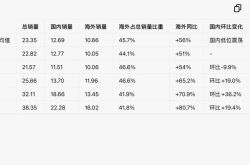
Below is BYD's sales breakdown from January to May 2026:
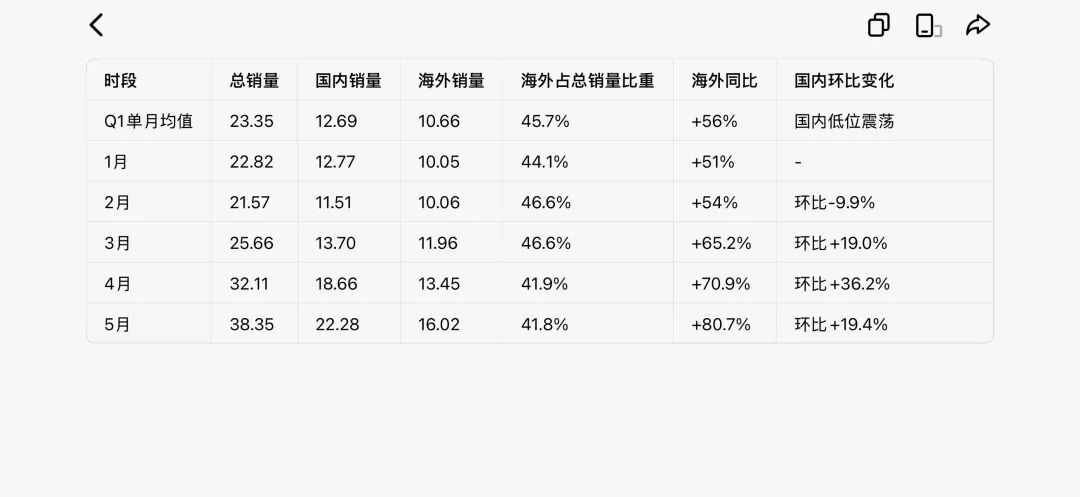
It is clear that in the first quarter, BYD's performance was largely buoyed by overseas sales.
Given that BYD's cumulative domestic sales in Q1 were only 379,800 units—a figure even lower than its peak monthly sales—it's evident that BYD's domestic operations are facing challenges, prompting the company to provide support to its dealers.
However, in Q1 2026, BYD's overseas sales experienced a notable upswing.
Sales in January and February were 105,000 and 106,000 units, respectively, likely influenced by the Spring Festival holidays. In March, overseas sales jumped to 119,600 units, then to 134,500 units in April, and further to 160,200 units in May. Previously, BYD set a record for overseas sales in December 2025, with 128,400 units sold.
Earlier reports indicated that BYD raised its 2026 overseas sales target from 1.3 million to 1.5 million units. With 614,500 units sold from January to May, BYD has achieved 43.8% of its target, while only 41.67% of the year has elapsed. At this rate, BYD is on track to meet and potentially surpass its annual overseas sales target of 1.5 million units.
The question remains: In which month will BYD's overseas monthly sales breach the 200,000-unit mark, or even reach higher levels?
To achieve its overseas sales objectives, BYD has established three major factories abroad—in Brazil, Hungary, and Thailand—covering South America, the EU, and Southeast Asia, respectively. Currently, the Brazilian factory has commenced full CKD production, assembling vehicles locally instead of relying on imports. Thai production is ramping up, and the Hungarian factory is set to commence operations to supply the EU market. Concurrently, BYD is expanding its self-owned ro-ro fleet, with eight ro-ro ships currently in operation and seven more on the way, aiming for an annual transport capacity of 2 million units.
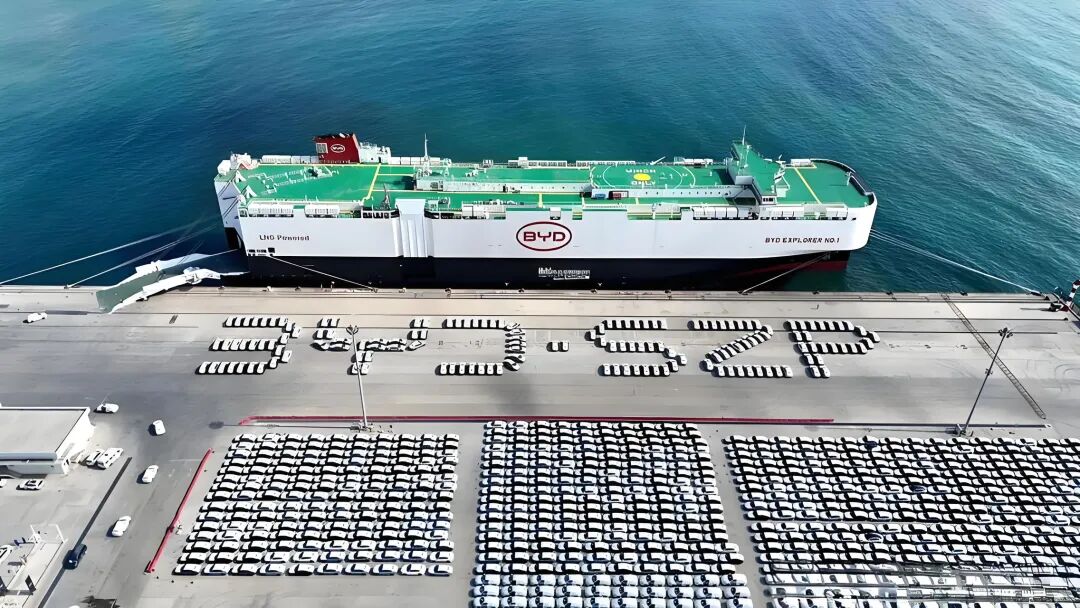
Both the establishment of local factories and the expansion of the self-owned ro-ro fleet contribute to cost reductions, including tariffs and transportation, thereby positively impacting gross margin improvements.
According to financial reports, BYD's overall overseas gross margin in 2025 was 19.46%, compared to 16.66% domestically, with overseas margins 2.8 percentage points higher. In 2024, the overseas gross margin was 19.82%, while the domestic margin was 16.97%.
Delving deeper, according to securities firms, excluding batteries and parts:
In the first half of 2025, overseas vehicle gross margins ranged from 22%-23%, compared to 18%-19% domestically. In the second half, overseas vehicle gross margins rose to 27.5%-28.1%, while domestic margins slipped to 17%-17.2%, widening the gap to 10-11 percentage points.
Due to higher overseas pricing, the average selling price (ASP) per vehicle overseas was RMB 186,000, compared to RMB 127,000 domestically. Gross profit per vehicle domestically was RMB 22,000, while overseas it was RMB 52,000. The disparity in net profit per vehicle was even more pronounced, with overseas net profit per vehicle ranging from RMB 18,000-22,000, compared to RMB 6,000-7,000 domestically, nearly three times higher.
Wang Chuanfu noted that, in addition to higher overseas pricing (with the same model priced 1.5-2.5 times higher overseas than domestically), overseas sales focus on mid-to-high-end models, and local factory construction reduces tariffs. Meanwhile, the intense domestic price war has also impacted BYD's domestic vehicle sales' gross and net profit margins.
From the overseas sales share in the first five months, despite a slight decline due to the recovery in domestic sales, the overseas sales share still exceeded 40% in the first five months. The annual overseas sales share is expected to rise from 22.7% in 2025 to over 30%, with overseas vehicle gross margins likely stabilizing above 28%, further boosting BYD's overall gross margin.
So, Chinese automakers, take the plunge and venture overseas boldly! However, exercise caution to avoid engaging in malicious competition, lest we repeat the painful history of the motorcycle industry's collapse in Southeast Asia due to cutthroat competition.
-
![]()
From 'Hardware Price Comparison' to 'Endurance Race': Who Will Lead the Heavy-Duty Truck Sector?
-
![]()
Sales of Six Major Chinese Automakers in May: BYD Reclaims Top Spot, Domestic Market Under Pressure While Exports Drive Growth | Mirror Pro
-
![]()
Search Will Enter the Third Phase of Its Lifecycle: Search as Code
-
![]()
Computex 2026 | Qualcomm’s Visionary Outlook: In the Age of Agents, Devices Take Center Stage in Computing
-
![]()
Computex 2026 | Marvell: How to Connect Data Centers in the AI Era?
-
![]()
【Intelligent】Tianjin Launches Its First L4 Autonomous Bus Route
-
![]()
BYD’s Monthly Overseas Sales Soar Past 160,000 Units: Elevated Gross Margins Drive Profitability!
-
![]()
Tencent's Trump Card Has Never Been Large Models