Five Brands Team Up with Huawei: Will Dongfeng Still Pursue Independent R&D?
 06/08 2026
 514
514
Lead-in
Introduction
No automotive group has dared to take such a bold step.
As electrification and intelligence rapidly advance, only a handful of well-known names have emerged in recent years, predominantly cross-border automakers with inherent internet DNA, firmly establishing themselves in consumers' minds as leaders in intelligence. What about traditional automakers? They often seem to be reduced to mere sellers of electric vehicles.
Fortunately, Huawei's foray into the automotive sector has given some traditional automakers hope to turn the tide. From Seres' AITO to Chery, BAIC, JAC, and SAIC's five 'Harmony Intelligent Mobility' brands, and now with the emergence of 'One Fierce, One Tower, Two Realms,' Changan, Dongfeng, and GAC are also vying to integrate Huawei's intelligent technologies.
Previously, the 'Huawei content' was a battleground for these automotive brands. But the story doesn't end there. If the aforementioned brands are merely standalone entities under their parent groups, then Dongfeng's collaboration with Huawei is truly comprehensive. From Mengshi to VOYAH, then to ETRUN, and from Dongfeng eπ to Dongfeng Fengxing, all five major in-house brands of Dongfeng are on board.
Moreover, on May 19th this year, Dongfeng Motor's Mengshi and ETRUN brands initiated a comprehensive deepening of strategic cooperation 2.0 with Yinwang Intelligent Technology Company. What kind of determination does this reflect? Only by acknowledging the gap and facing objective realities can one possess such resolute courage.
Many may ask: since Dongfeng's major in-house brands are so embracing of Huawei, is there still a need for their own R&D institute? The answer is a resounding yes. Earlier at the Beijing Auto Show, 13 full-stack independent R&D technologies, including Tianyuan Intelligent Driving, Quantum Architecture, solid-state batteries, Mach Zero-Carbon Hybrid, and Dongfeng Hydrogen Vessel, were unveiled, showcasing a series of self-developed achievements.
On one hand, leveraging external strengths; on the other, striving internally. At this critical juncture, Dongfeng is embarking on a dual-track approach, attempting to maintain its position amidst the tides of the era.
01 Full Leverage of Huawei
In fact, as early as 2018, Dongfeng signed its first strategic agreement with Huawei, focusing on forward-looking technological reserves for electrification and connectivity, laying out next-generation intelligent connected electric vehicle technologies. Subsequently, models under VOYAH were launched, and the integration between the two sides deepened continuously.
'VOYAH and Huawei were among the earliest to reach a deep strategic cooperation, probably the first outside the Harmony series,' noted an industry observer. 'Taught by the same teacher, but the exam results are all different.' These classic quotes illustrate that both Dongfeng and VOYAH are striving to forge a deep connection with Huawei.
Of course, Dongfeng has made thorough preparations in terms of both depth and breadth. Last May, Dongfeng signed a comprehensive deepening of strategic cooperation agreement with Huawei, covering all-round cooperation in automotive intelligence, enterprise digital transformation, and ecological co-construction. Just a month later, the world's first full-stack Huawei intelligent off-road SUV, the Mengshi M817, made its debut.
An interesting episode is that Dongfeng not only had its in-house brands embrace Huawei but also brought along Dongfeng Nissan, a joint venture brand. The launch of the world's first Harmony cockpit fuel vehicle, the Dongfeng Nissan Teana Harmony Cockpit, further demonstrated Dongfeng's commitment to intelligent deep cultivation.
Subsequently, the birth of the 'Jing' series brand, ETRUN, and Huawei's creation of the 'Five Realms and Three Realms' also reflect Huawei's expansion in the automotive industry, while ETRUN's landing shows Dongfeng's decisiveness. Coupled with the debut model, the ETRUN X9, a '9-series' product, it's clear that Dongfeng is adopting a top-down strategy.
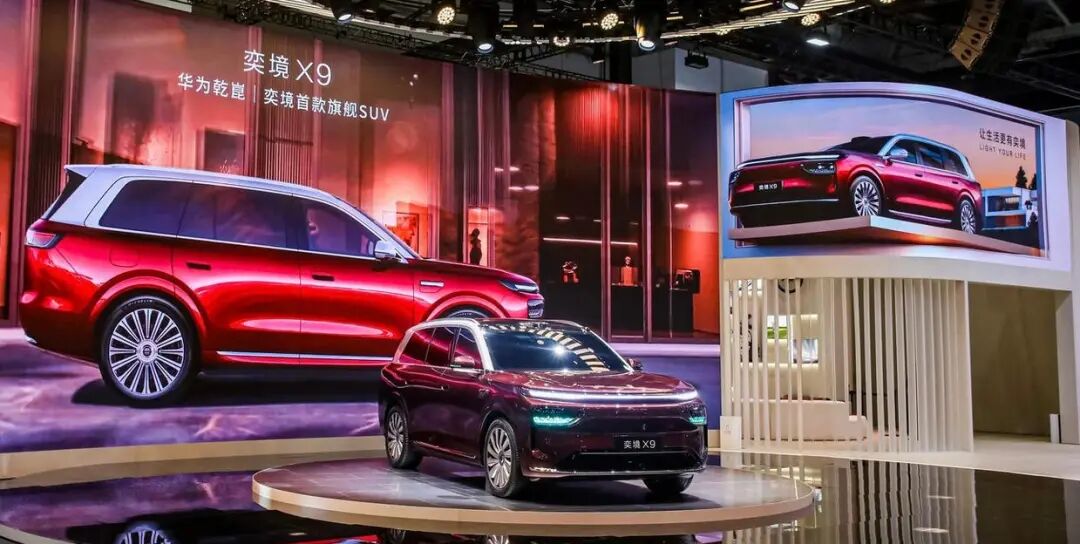
What many didn't expect is that at this year's Beijing Auto Show, Dongfeng Fengxing, a brand on the verge of marginalization, had its Xinghai new energy passenger vehicle lineup incorporated into Dongfeng's major in-house brands. The Xinghai V6, a large six-seater MPV, will also be equipped with Huawei's Qiankun Intelligent Driving System, with a pre-heated positioning as a 100,000-yuan-level product.
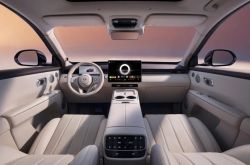
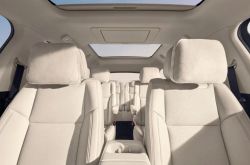
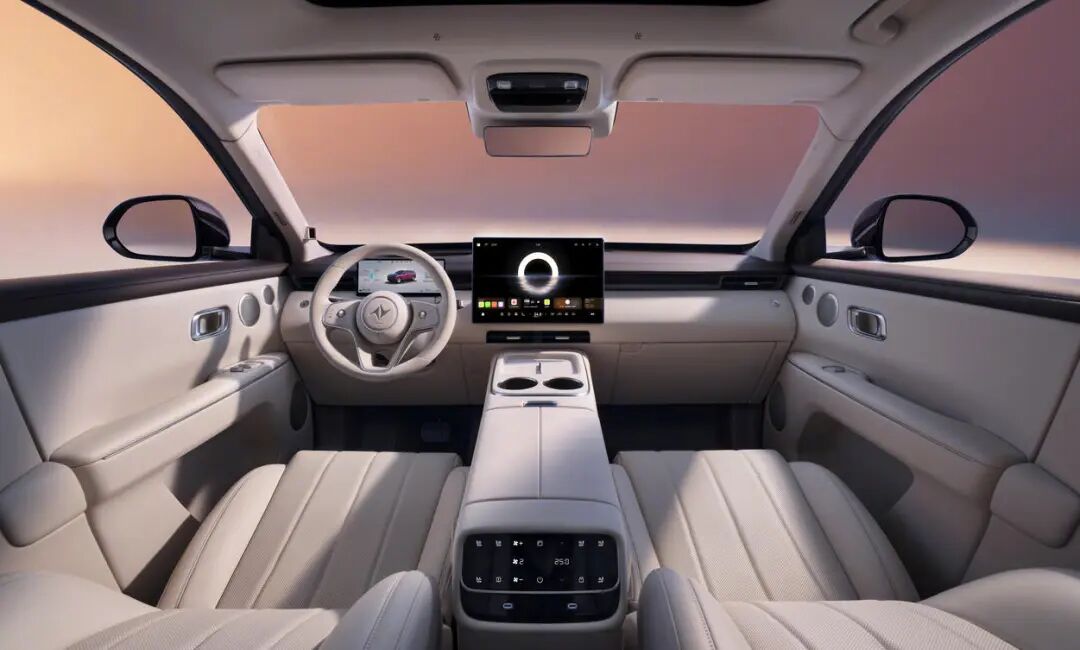
Simultaneously unveiled with the Xinghai V6 was the eπ M8, a golden large six-seater SUV equipped with Huawei's '6-piece suite.' Thus, all five major in-house passenger vehicle brands of Dongfeng fully embrace Huawei, extending from luxury high-end to mainstream mass-market. This is unique among all automotive groups in China.
Huawei's visit on May 19th this year pushed the cooperation between the two sides to a new climax. Xu Zhijin personally awarded the 'Full-Stack Native Co-Creation Gold Medal Team' title to the Huawei Qiankun and ETRUN joint innovation team, and the Mengshi and ETRUN brands simultaneously signed a comprehensive deepening of strategic cooperation 2.0 agreement. From technology integration to joint definition, the cooperation between the two sides has undergone a qualitative leap.
In simple terms, their relationship can be understood as not merely selling in Huawei stores but deeply co-creating within Huawei's ecosystem. Moreover, these brands are not just differentiated by hierarchy but also stratified across a full matrix of brand segments, from luxury off-road, high-end new energy, mid-to-high-end family sedans, to mainstream multifunctional travel.
Faced with the aggressive advances of new forces and the rapid transformation of two central state-owned enterprises, FAW and Changan, Dongfeng's urgency is understandable. How to fill the gap in intelligence? Dongfeng has given its answer: Huawei is the best partner. After all, time waits for no one, and actions must be swift.
02 Independent R&D Cannot Be Neglected
As mentioned at the beginning of the article, many may wonder: since Dongfeng is fully embracing Huawei, what should Dongfeng's R&D institute do? This is actually a short-term versus long-term issue. In the short term, Dongfeng needs to leverage Huawei to quickly narrow the gap with competitors.
However, in the long run, an independent R&D system is the foundation and bedrock of an automaker. Moreover, Huawei also has shortcomings in going global. Therefore, independent R&D technology becomes even more crucial; it is Dongfeng's anchor. Cooperation ultimately has its limits, and true core competitiveness can only be rooted in the deep soil of independent innovation.
However, constrained by Dongfeng's less-than-stellar communication, the outside world is not well-informed about Dongfeng's independent R&D technologies. As mentioned earlier, Dongfeng has many representatives of independent R&D technologies, such as the DF30 chip, Tianyuan architecture, Quantum architecture, Mach power, solid-state batteries, and Dongfeng Hydrogen Vessel, all of which require time to refine.
Take the DF30, China's first domestically developed high-performance automotive-grade MCU chip led by Dongfeng Motor, as an example. For a long time, automotive-grade MCU chips, as the core hub of automotive power control, have been almost monopolized by international giants like Bosch, NXP, and Renesas. Once the supply chain is disrupted, domestic automakers may face a systemic risk of 'no chips available.'
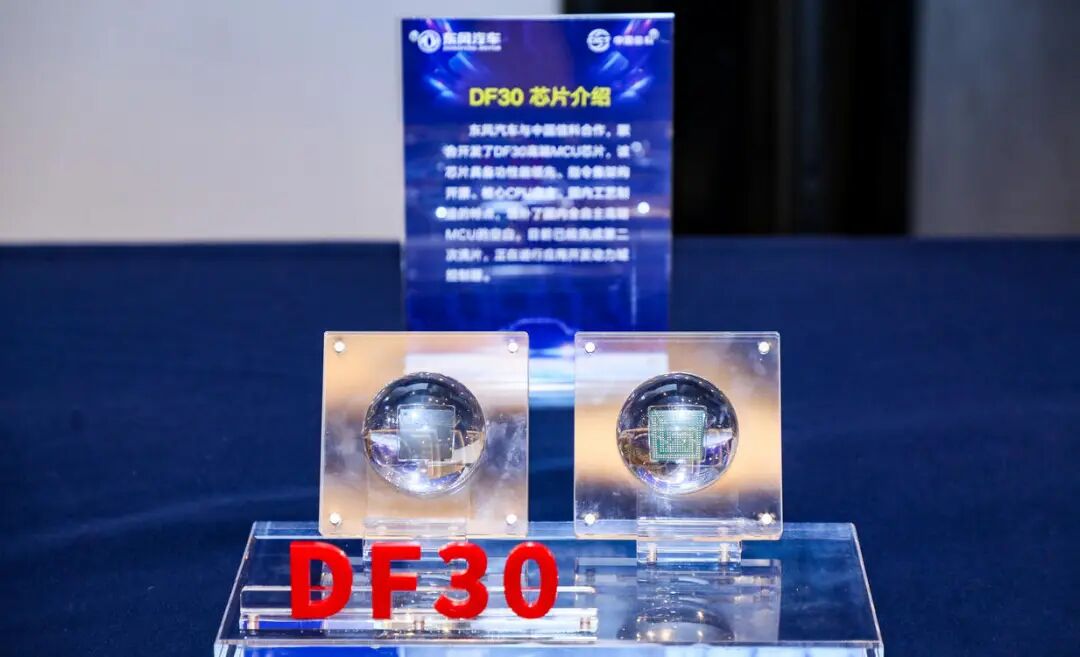
Faced with this industry bottleneck, Dongfeng took the lead in establishing the Hubei Provincial Automotive-Grade Chip Industry Technology Innovation Consortium, dominating the entire chain from demand definition, technological breakthroughs, to supply chain collaboration, blazing a trail from 0 to 1 for domestically produced high-end automotive-grade chips to break through independently, with comprehensive performance on par with international counterparts of the same period.
Currently, the DF30 chip has completed onboard verification in multiple models, including the Dongfeng eπ 007, Mengshi M817, and Dongfeng Fengshen Haohan, and is steadily progressing towards mass production introduction. Dongfeng's models are about to achieve 100% autonomous and controllable coverage with 'Chinese chips.'
Another example is Dongfeng's independently developed 'Tianyuan Intelligent Cockpit Plus' platform, the first domestically produced cockpit-driving integrated solution soon to be mass-produced. Built on the self-developed domestic chip 'Wudang C1296,' it integrates two intelligent systems into one, bringing high-level intelligent experiences to the mass market.
The thermal efficiency of the new generation Mach hybrid engine has exceeded 48%, setting an industry record. The industry's largest-tonnage 16,000T integrated die-casting production line has been built and put into operation, achieving the goals of a lighter, sturdier body and higher manufacturing efficiency.
And in the hydrogen energy track, which ordinary consumers may not pay much attention to, Dongfeng has not fallen behind either. Its independently developed 400kW hydrogen fuel cell stack has successfully passed the new national standard 10,000-hour durability verification, with an average single-cell voltage decay rate of only 3.29%, becoming the first metal bipolar plate stack in China to receive the 'Durability Star' certification.
It is reported that Dongfeng Motor's R&D investment intensity will reach 7.9% in 2025. 2026 will be 'the year of technological fulfillment' for Dongfeng Motor. The new generation Mach power system and DF30 chip will achieve large-scale onboard integration, 'Tianyuan Intelligent' will accelerate its landing, the T200 intelligent driving system will be massively deployed, the T500 intelligent driving system will enter mass production application, and the 'Tianyuan Intelligent Cockpit' intelligent agent will be put into use simultaneously.
It can be said that by holding hands with Huawei on one side and grasping independent R&D on the other, Dongfeng has embarked on a unique self-rescue path. Of course, the road ahead remains bumpy, especially for these five major in-house brands walking on 'two legs.' Whether their endogenous growth momentum can be fulfilled through sales remains to be tested within this year.
But one thing cannot be denied: Dongfeng's strategy highlights its most precious posture as a central state-owned enterprise amidst transformation.
Editor: Li Sijia Editor: He Zengrong
THE END
-
![]()
"3D Vision Pioneer" Grapples with Internal Strife: $120 Million in Share Reductions Offset by $147 Million Private Placement
-
![]()
The domestic auto sales have declined so much that dealers who can't hold on have started closing stores en masse
-
![]()
Five Brands Team Up with Huawei: Will Dongfeng Still Pursue Independent R&D?
-
![]()
The Large Six-Seater SUV Market: Overhyped and Overrated
-
![]()
The Smart Driving Blue Light: Urgent Need for Rectification
-
![]()
Would OpenAI Be Fascinated by Anthropic’s Concepts?
-
![]()
Tencent: Few Great Queries, Yet Possessing the Ultimate One
-
Does DingTalk Need Revolutionaries or Reformers?