BBA Struggles to Keep Pace with Domestic Car Competitors
 06/15 2026
 515
515
Lead
Introduction
Domestic cars are making significant inroads in the SUV and MPV markets, leaving sedans as the final stronghold for BBA.
When discussing luxury brands like BBA, the immediate association is invariably with high prices. Traditionally, premium passenger cars priced over 200,000 yuan have been the domain of foreign luxury brands such as BBA. This price bracket, as described by netizens, is where true market strength lies, serving as a critical indicator of a carmaker's brand prestige and industry clout.
However, in the era of new energy vehicles (NEVs), particularly with NEV penetration surpassing 60%, BBA's hold on the market for cars priced above 200,000 yuan has somewhat diminished.
According to May 2026 retail data released by the China Passenger Car Association (excluding imported vehicles), over 160 high-end models sold a total of 385,800 units that month. Chinese brands accounted for 221,000 units, while foreign brands managed only 165,000 units, marking a significant shift in sales dominance.
Of course, gaining an edge in overall high-end vehicle sales represents a notable achievement for domestic cars and signifies that China's auto market has entered a new phase. However, this does not imply that BBA is completely out of contention.
A closer examination of market segments—specifically, SUVs, sedans, and MPVs, the three core areas—reveals that domestic high-end passenger cars have secured dominance in the SUV and MPV markets above 200,000 yuan. Meanwhile, BBA relies on decades of brand perception to defend its position in the traditional high-end sedan market, making it their last bastion.
01 Domestic Cars Dominate High-end SUV and MPV Markets
Domestic consumers have always shown a strong preference for SUVs, regardless of whether they are budget or premium models. Had this not been the case, there wouldn't have been a market boom two decades ago where "building an SUV guaranteed big sales," nor would a wave of domestic brands have taken flight.
During that period, accelerated urbanization, changing family structures, and relaxed road regulations led to SUV annual growth rates often exceeding 20%. We witnessed times when domestic models like the Haval H6, Bo Yue L, and Changan CS75 PLUS dominated SUV sales charts. Of course, this also allowed some companies to thrive without significant R&D efforts for a while.
Later, with industrial upgrading, various vehicle types, including SUVs, underwent enhancements in product strength and automotive philosophies, enabling domestic SUVs to successfully enter the market above 200,000 yuan and compete with luxury brands like BBA.
This transition was not without challenges. Initially, due to the lingering perception of domestic cars as "low-end," consumer attitudes were largely divided: either buy a domestic SUV below 200,000 yuan or spend 300,000 yuan or more on a luxury brand model. Even as domestic SUV product strength significantly improved, this consumer mindset persisted for years.
The rapid development of the NEV sector accelerated the decline of this mindset. As domestic cars achieved widespread superiority in design, intelligence, and driving experience, consumers became more willing to try domestic options.
Today, as the largest segment in the high-end market above 200,000 yuan, the SUV sector has seen a domestic takeover, with BBA losing its mainstream voice under the pressure of the times. Data shows that domestic brands now hold over 70% market share in this price range, with the market landscape almost entirely one-sided. Only the Tesla Model Y remains as the sole representative of foreign brands.
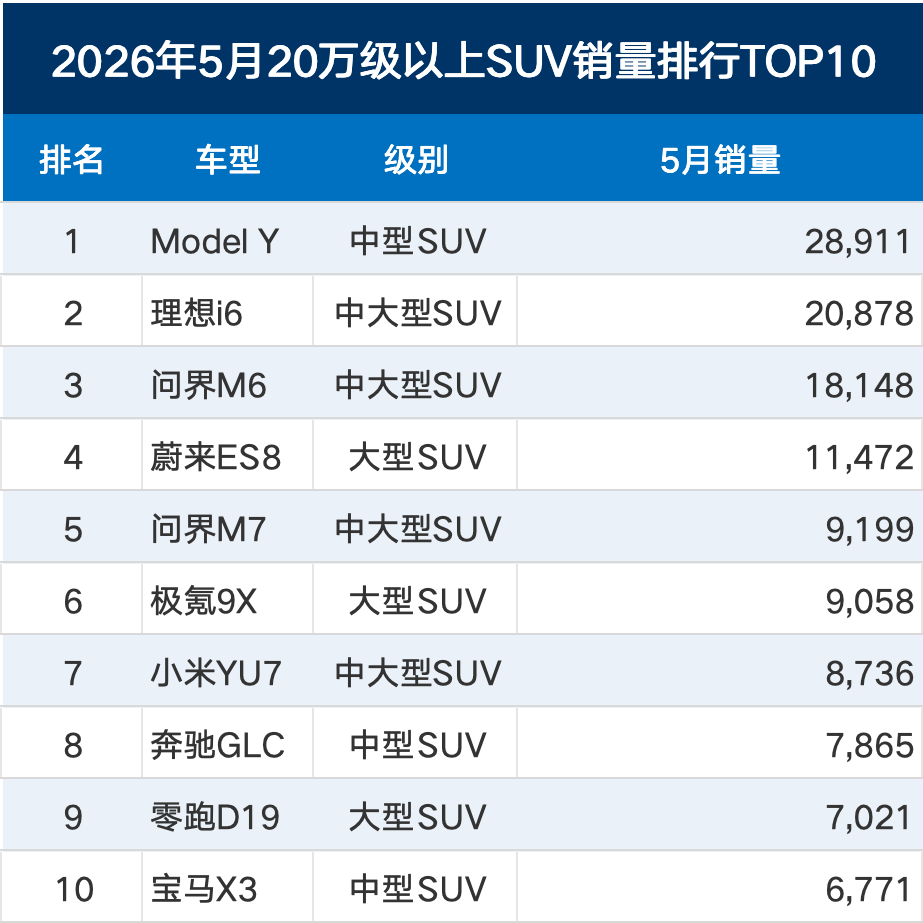
Specifically, the Model Y topped the category with 28,911 units sold, while the second to seventh places were all claimed by six Chinese brands: Li Auto, Seres, NIO, Zeekr, and Xiaomi.
Among them, the Li Auto i6 sold over 20,000 units in a single month, outperforming German competitors. In contrast, BBA's core SUV models—the Mercedes-Benz GLC, BMW X3, and Audi Q5L—all saw monthly sales drop below 8,000 units, with their combined sales totaling 20,908 units, even falling short of the Li Auto i6's individual sales.
Beyond single-model fluctuations, the industry trend is irreversible. Currently, all SUVs priced above 200,000 yuan and selling over 5,000 units monthly are NEVs. Six domestic brands, including Li Auto, Seres, Xiaomi, and Leapmotor, have simultaneously achieved monthly sales of over 7,000 units in the 200,000–400,000 yuan price range, collectively squeezing BBA's market space.
Even if BBA's overall SUV sales remain substantial, when sedan sales are excluded, the SUV segment's market volume and share have significantly shrunk.
Similar to the SUV sector, the MPV market has also undergone a domestic-led transformation, with domestic brands now holding over 60% market share. In contrast, traditional foreign MPV brands other than BBA have seen a collective decline.
Among the current top five high-end MPV models, four are Chinese brands: the Voyah Dreamer, Denza D9, Trumpchi M8, and GAC High Mountain, all ranking highly, while sales of the entire Buick GL8 lineup have been surpassed by domestic high-end MPVs.
This breakthrough began in 2022–2023, when the Denza D9 first broke foreign monopolies, validating the market feasibility of high-end plug-in hybrid MPVs priced between 300,000 and 500,000 yuan. A wave of domestic automakers quickly followed, expanding their product lineups, improving after-sales systems, and decisively reshaping the duopoly previously held by Buick and Toyota.
Currently, only the Toyota Sienna holds the top sales position in the MPV sector.
02 BBA's Sedans Remain Formidable
With the SUV and MPV sectors experiencing successive defeats, the high-end sedan market has become BBA's last bastion in defending its luxury position.
Data shows that the localization rate for sedans priced above 200,000 yuan is only around 40%, with German luxury brands firmly holding the influence in this segment, presenting a market logic entirely opposite to that of SUVs and MPVs.
In terms of specific model performance, in the May high-end sedan TOP 10 list, the Xiaomi SU7 and Tesla Model 3 took the top two spots, becoming the only breakthroughs for domestic and new-force brands. The third to seventh places were all occupied by five BBA fuel-powered sedans: the BMW 3 Series, Mercedes-Benz E-Class, and Audi A6L. These five models collectively sold over 40,000 units, monopolizing the traditional high-end fuel-powered sedan market.
More strikingly, when NEV models are excluded, BBA faces almost no competition in the traditional fuel-powered high-end sedan sector.
Of course, the real gap between domestic sedans and BBA is no longer about product hardware but rather a brand perception gap spanning two decades. SUV consumers prioritize functional values like space, intelligence, and ownership costs, making their decisions rationally. In contrast, the core demand of the 250,000–350,000 yuan mainstream high-end sedan audience is identity and business social attributes. Models like the Mercedes-Benz E-Class and Audi A6L have deeply cultivated the domestic market for over two decades, firmly associating themselves with administrative and business vehicle usage scenarios and building an identity that is hard to shake in the short term.
Meanwhile, the sedan market presents a clear three-tier structure. In the 200,000–250,000 yuan entry-level high-end segment, the Xiaomi SU7 and Model 3 have already dominated the market. In the 250,000–350,000 yuan core business segment, BBA's defenses are rock-solid. Above 350,000 yuan, domestic high-end sedans have yet to form significant scale. Even the Zenith S800, priced at 700,000 yuan and selling only a thousand units monthly, cannot alter the overall landscape.
From a broader perspective, BBA's current dilemma is not about the loss of a single model or short-term price competition but rather a structural shift in the market.
Leveraging electrification and intelligence, domestic cars have captured the home and travel markets, achieving a triple reversal in product strength, reputation, and scale in the SUV and MPV sectors. Meanwhile, BBA clings to its brand advantages from the fuel era, with slow product iteration and high ownership costs, losing its mainstream home user base.
In the short term, brand endorsement in business scenarios and consumer inertia will continue to support BBA's sedan position, preserving their luxury brand premium for now. In the long run, however, the upward advance of domestic high-end brands, the younger demographic of business users, and the arrival of NEV business models are gradually erasing the brand generational gap in the sedan sector.
In other words, the era where BBA could dominate all vehicle categories through brand strength alone has ended. They have lost ground in SUVs and MPVs, with only their sedan stronghold remaining. And even this last luxury bastion is now facing a new wave of assault from domestic cars.
Editor-in-Chief: Cao Jiadong Editor: Wang Yue

THE END

-
![]()
Auto Market News: Relief from Vehicle and Vessel Tax! MIIT Announcement
-
![]()
Haiqing Zhiyuan Gears Up for HKEX Debut: Revenue Growth Amid Profit Challenges, Operating Cash Flow Worsens
-
![]()
Haiqing Zhiyuan Prepares for HKEX Debut: Revenue Jumps Despite Profit Challenges and Worsening Cash Flow
-
![]()
The Big Three Telecom Giants Face Accusations of Overcharging Loyal Customers: Why Do Costs Rise with Tenure?
-
![]()
Competitor’s CTO Criticizes Extended-Range Tech; Seres’ Zhang Xinghai Fires Back: It’s Far From “Pointless”
-
![]()
"Football Unites the World," But Not the North American Auto Industry
-
![]()
Electric vehicles are indeed cheaper, but who says gasoline cars are doomed?
-
![]()
The Consensus Between Li Shufu and Li Bin Indicates the Obsolescence of Blockbuster Logic