These new policies have taken away the livelihoods of scalpers, and car owners say they finally don't have to waste money
 06/30 2026
 394
394

Lead
Introduction
From 'users paying extra to seek scalpers' to 'scalpers lowering prices to seek car owners.'
'When I entered the business in 2013, the vehicle inspection fee was 320 yuan. If people wanted our services, they had to pay 400 or 450 yuan, earning us over 100 yuan per vehicle. Back then, competition wasn't so fierce; it was the common people pleading, 'Please inspect my car quickly,' and some even slipped us 200 yuan to jump the queue.'
'Now, things are different. The industry has become extremely competitive. Scalpers have to actively seek out customers. It's me pleading now: 'Please, sir, come to me for your inspection; it's 100 yuan cheaper here.''
The interviewed 'scalper' claimed that even though industry profits have bottomed out, with vehicle inspection fees as low as 100 yuan, they can still secure a 50% profit margin. Factoring in over twenty services, including vehicle transfers and certificate replacements, their monthly income can still reach around 20,000 yuan.
Recently, two departments jointly issued the 'Notice on Using Motor Vehicle Manufacturer's Certificate of Conformity Information for Motor Vehicle Registration,' promoting pre-inspection of domestically produced passenger vehicles nationwide and making 'same-day purchase, same-day tax payment, and same-day license plate registration' the norm.
Media tests show that after the new regulations' implementation, consumers can complete the online license plate registration process within minutes, eliminating the need for long queues at the DMV. With simplified processes and transparent information, the 'gray space' that scalpers rely on has been significantly compressed, accelerating a new round of crackdowns.
01 Hiring Scalpers for License Plate Registration and Vehicle Inspections Was Once an Unspoken Rule
In the past, it was almost an unspoken rule for car owners to hire scalpers for license plate registration, transfers, and vehicle inspections.
For car owners unfamiliar with the process, bothered by the hassle, or unable to take time off, paying a few hundred yuan more to entrust their vehicles to scalpers or 4S dealerships saved time, effort, and peace of mind.
'I initially planned to wait in line myself, but when I asked, the fastest it could be done was two days. Since I didn't have time the next day, I found a scalper through a acquaintance. For 500 yuan, the 'big shot' scalper got everything done in an hour.'
Under a 2017 social media post, a netizen shared that what would normally take two days was expedited by a scalper who skillfully guided them to cut in line from the back door, securing the first spot. As soon as the window staff arrived, the entire process was completed in an hour.
Also in 2017, a modest new car owner in Guangxi encountered a 'cheap scalper' offering license plate registration for 20 yuan but demanded 600 yuan for the vehicle purchase tax. When the owner casually asked, 'Can we negotiate the price?' the scalper readily reduced it to 500 yuan. Suspecting something was amiss, the owner stubbornly followed the scalper to the tax hall and only then realized the purchase tax was merely 243 yuan. 'The scalper was embarrassed, his face turning red.'
Such tactics of information opacity and price discrimination are not relics of a decade ago. Even in recent years, after the market for license plate registration scalpers became severely saturated, the industry remained a mix of competent and incompetent players.
Some new car owners completed the entire process with online signatures from their offices, waiting for their new cars to be delivered, while others had to accompany scalpers to the DMV and even missed out on subsidies due to delayed processing.
On Black Cat Complaints, a car owner in Inner Mongolia, eager to claim a local new car subsidy, paid 405 yuan to a 4S dealership for license plate registration, with a promise of completion within the month. However, they were only contacted on the first day of the following month, causing them to miss the subsidy and leading to a complaint on the platform.
Even after the implementation of online license plate registration regulations, some scalpers continue to exploit information gaps to solicit clients on social media.
In late June, the author contacted several 'agents' still posting online, posing as a car owner. Although their quotes had decreased, their sales pitches remained familiar. A Zhejiang agent offered a 300 yuan package, claiming to complete the license plate registration within half a day. '300 yuan includes processing fees; I only earn 100 yuan in hard-earned money. If you do it yourself, you'll have to run around and ask questions.'

Upon further inquiry, it was revealed that scalpers still required the car owner's presence at the DMV. 'Just sign some papers and pick a number; you can sit most of the time.' They conveniently omitted mentioning the option for online processing.
When asked about the online license plate registration policy, the scalper seemed at a loss for words: 'You can't get the green book and driving license online; you'll have to pay extra for shipping. It's not that much more.' The scalper claimed the biggest difference between online and offline processing was that online DMVs didn't collect certificates of conformity, leaving no one to store them for the car owner, but scalpers had archives to help preserve the documents.
Faced with the author's inquiries, several agent scalpers were extremely enthusiastic, readily providing their contact information in hopes of quickly establishing connections and securing business. It's not hard to see that after the online license plate registration policy was introduced, scalpers' advantages have dwindled, and their customer base has shrunk.
02 With Information Public and Processes Simplified, Scalpers Struggle to Find 'Suckers' Even with Lower Prices
The underlying logic of scalpers' existence boils down to two factors: information asymmetry and cumbersome business processes.
In the past, new car license plate registration involved multiple steps, such as vehicle inspection, review, and license plate selection. Each step didn't take much time individually, but significant time was wasted queuing and traveling between different departments. Car owners, unfamiliar with the process, didn't know which window to visit first, which documents to submit, or how to efficiently connect the steps. Coupled with scalpers 'cutting in line,' owners handling the process themselves often waited an entire day at a single department.
'I went to the DMV for license plate registration early in the morning, waiting patiently in line. But as soon as the scalpers arrived, they started cutting in crazy ly. I was next in line, just six or seven people away, but they squeezed in twenty or thirty people ahead of me. The place was filled with scalpers. When I asked about it, one even scolded me, 'What's your rush?''
During vehicle inspections, many car owners lacked professional judgment about their vehicle's condition, fearing it wouldn't meet inspection standards. With a 'spend a little to save trouble' mentality, they tried to pass the review through scalpers' gray channels. Some scalpers exploited this mindset, either raising prices arbitrarily or fabricating vehicle non-compliance to charge exorbitant fees.
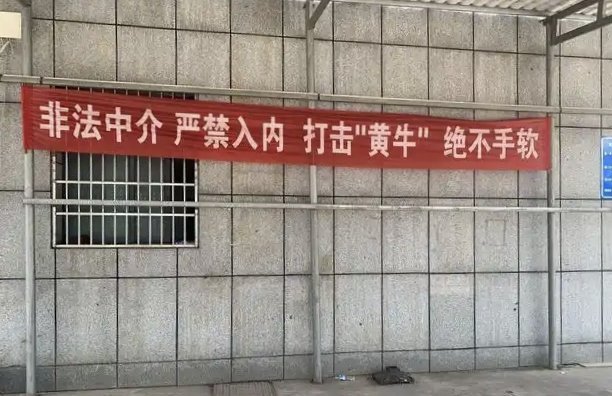
'The scalper drove my car for the emissions test. After finishing, he told his partner outside that the emissions were fine, but then he sent me a WeChat message and voice note saying the emissions exceeded standards and the engine needed work. I followed him the whole time and didn't think he noticed me. I saw him drive to the roadside outside the testing station without re-entering for further testing. Later, when the annual inspection passed, he charged me 1,450 yuan. I said, 'You know I watched the whole time, right?' He still claimed he needed to pay someone inside to adjust the data and tried to charge me an extra 500 yuan.' Guangdong truck driver Master Huang was scammed by a scalper in 2025.
'Cutting in line' and 'fabricating faults' are essentially exploits made possible by information asymmetry and opaque processes.
The situation is changing. Take the online license plate registration policy as an example. Through deep-level governmental reforms, data barriers between multiple departments, such as the Ministry of Public Security and the Ministry of Industry and Information Technology, have been broken down. The vehicle pre-inspection process has been shifted to the automotive manufacturer's end, with manufacturers uniformly completing information verification and uploading. Consumers only need to confirm information and select a license plate number on their phones, completing the entire process within minutes. Tasks that once took half a day or even several days of queuing have been compressed to under an hour.
With simplified processes and transparent information, the 'gray space' that scalpers rely on has been significantly compressed.
Not only do consumers save time and effort, but businesses also benefit. A new energy vehicle executive revealed that after the new regulations' implementation, the monthly workload for license plate registration services could be reduced by 1,200 work hours, and 15 full-time staff members could be cut, significantly lowering operational costs.
From 'users pleading with scalpers' to 'scalpers pleading with car owners,' the continuous streamlining of governmental processes and the breaking down of information barriers are forcing various gray intermediary businesses to exit the market.
Of course, no reform can be accomplished overnight. Online license plate registration currently mainly covers new car registration for domestically produced passenger vehicles. Scalpers still have room to maneuver in areas like used car transfers, out-of-town inspections, and imported vehicles. Completely eradicating this 'scourge' still requires joint efforts from the industry.
However, there's no doubt that transparency, convenience, and standardization are irreversible trends in motor vehicle governmental services. When every vehicle-related process becomes simple and transparent enough, the scalpers' business, which relies on information gaps, will soon reach its end.
 ",
",
-
![]()
Luxury Lineup, Highly Anticipated! The Pioneer of Physical AI Gears Up for Hong Kong Stock Exchange Debut!
-
![]()
Mercedes-Benz Withholds Year-End Bonuses for 90,000 Staff: Germany's Industry 4.0 Aspirations in Tatters
-
![]()
Can the Hong Kong Stock Market Pay for World Models? Dissecting Momenta's Prospectus
-
![]()
Set for Secondary Listing in Hong Kong with Market Cap Exceeding 500 Billion: How Luxshare Precision Regains Investor Trust?
-
![]()
Approaching its Secondary Listing in Hong Kong with a Market Cap Exceeding 500 Billion: How Has Luxshare Precision Regained Investor Trust?
-
![]()
Real Insights from New Energy Vehicle Owners in China’s Top 30 Cities by Ownership
-
![]()
Real Thoughts of New Energy Vehicle Owners in Top 30 Cities by Car Ownership
-
![]()
Truth Revealed: Memory Prices Soar, Apple Profits Surge, Yet Memory Makers Bear the Blame