In-Depth Analysis of Volkswagen CARIZON’s Proprietary Intelligent Driving Technology
 08/12 2026
 475
475
On August 10th, following the typhoon’s departure from Shanghai, Volkswagen China unveiled its first externally disclosed proprietary intelligent driving technology at the CARIZON office in Qingpu, Shanghai.
At this briefing, Volkswagen brought together, for the first time, the three key leaders spearheading its China-based intelligent driving initiatives: Han Sanchu, Executive Vice President and CEO of CARIAD China; Marcus Hafkemeyer, CEO of CARIZON; and Huang Chang, CTO of CARIZON. They provided insights into Volkswagen Group’s proprietary intelligent driving development in China. Following their presentations, the executives spent over two hours addressing media inquiries, thoroughly outlining the strategic vision and rationale behind Volkswagen Group’s self-developed intelligent driving endeavors in China.
Three months ago, I authored an article titled “Is XPENG Just a Stopgap? Volkswagen’s Hidden Ace for Intelligent Driving in China: CARIZON’s Advanced Intelligent Driving R&D Strategy.” Based on a leaked internal strategic document, the article posited that Volkswagen’s true strength lies not in XPENG but in CARIZON, which possesses a self-developed chip boasting 2400 TOPS.
At this briefing, Volkswagen began to unveil its self-developed achievements. It not only provided a comprehensive demonstration of the performance and design philosophy behind its Volkswagen intelligent driving products based on J6M but also disclosed two previously unanticipated aspects: a concrete timeline for L3 implementation and the actual computing power of the self-developed chip.
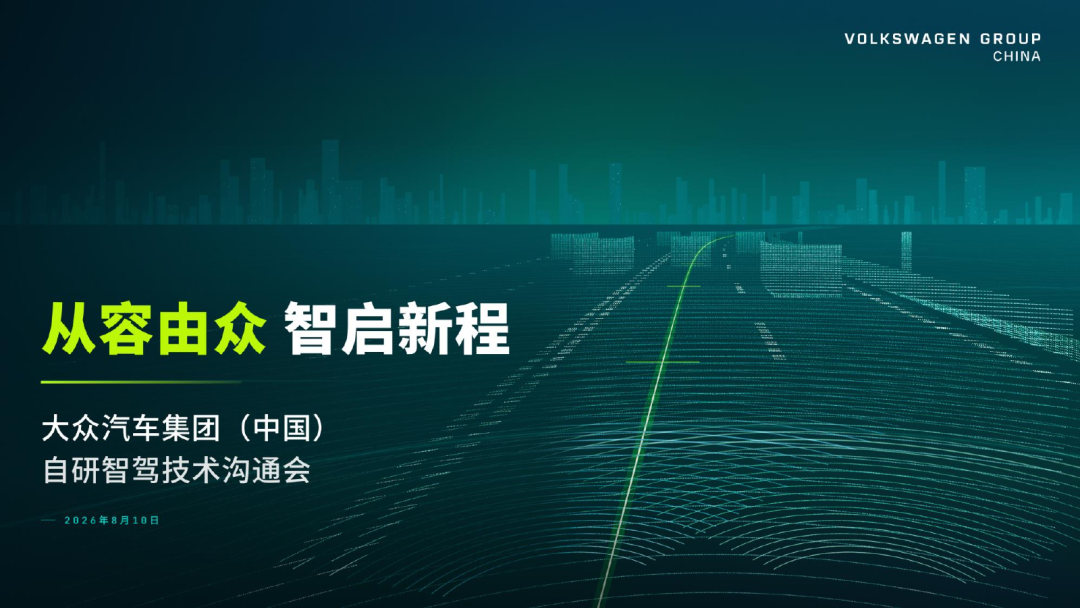
“On the Cusp of Innovation: Volkswagen Group (China) Reveals Proprietary Intelligent Driving Technology” Briefing, August 10, 2026, Qingpu, Shanghai
Today, we will delve into this PPT presentation, along with the executives’ speeches and the extensive Q&A session that followed, to explore Volkswagen’s core strategies, philosophies, methodologies, and accomplishments in proprietary intelligent driving.
01 Starting with the Cutting-Edge: When Will Volkswagen’s L3 Be Ready?
Volkswagen’s press release indicates availability as early as 2027, aligning with the timeline we previously shared in our article “China’s L3/L4 Standards Have Arrived: An Industry Insider’s Layman’s Guide.”
Huang Chang offered a more pragmatic and path-oriented response at the event:
“Firstly, that’s the optimistic timeline. Realistically, I anticipate L3 on highways and expressways by early 2028, with urban deployment by 2029. L3 development is no trivial matter. The system demands not only high performance but also safety standards that are 2-3 orders of magnitude higher than L2.” - Huang Chang, CTO of CARIZON
Han Sanchu subsequently clarified the technical foundations underlying the 2027 projection:
“When we mentioned 2027, we were referring to the ‘technical readiness’ of CEA, meaning preparing for L3 capability integration into vehicles... Mass production of L3 necessitates comprehensive work on the entire architecture, communication, network, computing, power supply, braking, chassis, and steering systems. Key components or pathways must achieve redundancy, so the architecture will be ready first. Commercialization... will gradually commence after we gain confidence from real-world simulation data and scenarios.” - Han Sanchu, Executive Vice President of Volkswagen Group (China)
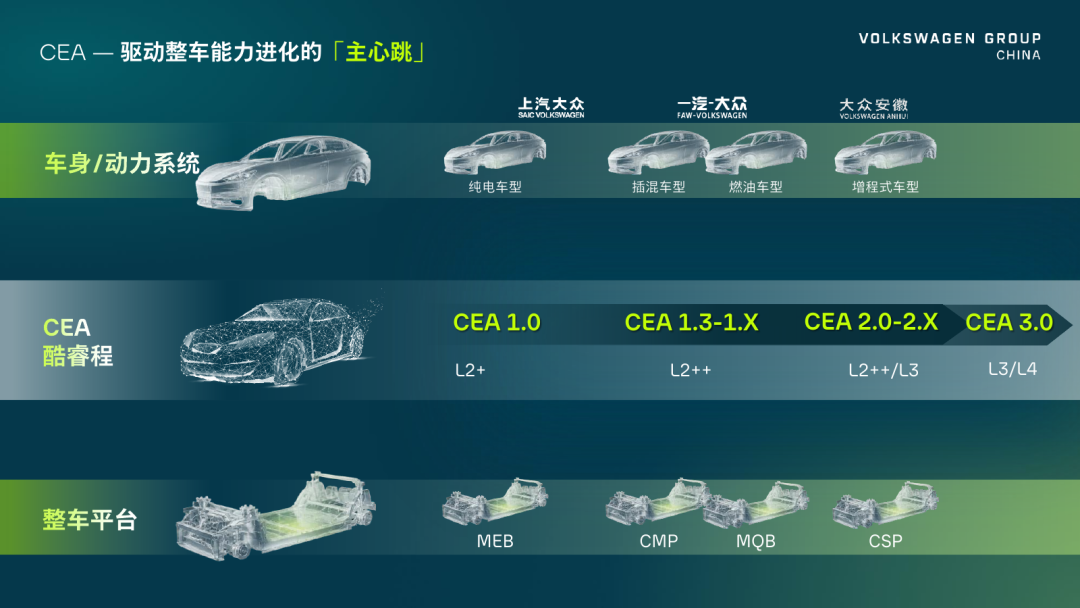
CEA serves as the ‘core engine’ driving vehicle capability evolution: 1.0 corresponds to L2+, 1.3-1.X to L2++, 2.0-2.X to L2++/L3, and 3.0 to L3/L4.
▍Jack's Insights
In simpler terms, the executives’ statements imply that by 2027, you may not purchase a Volkswagen vehicle capable of immediate L3 operation but rather one that is ‘architecturally prepared for L3 activation at any time.’ True hands-free highway L3 may arrive in early 2028, with urban L3 expected by 2029. This approach underscores Volkswagen’s pragmatism. The L3/L4 autonomous driving sector has been overly hyped in the past year, but Volkswagen has highlighted the essence of L3/L4 advancement: architectural readiness ≠ functional delivery ≠ responsibility transfer. Domestically, claims of ‘L3/L4 rollout by year-end’ typically refer to the initial phase.
02 Proprietary Chip C7H: 500~700 TOPS per Chip, Up to 2800 TOPS in Combination
In my previous article, based on a leaked report, I mentioned ‘flexible computing power expansion between 600 and 2400 TOPS.’ This PPT provides more precise specifications.
Key C7H specifications:
· AI computing power per chip: 500~700 TOPS
· NPU: BPU 4.0, compatible with large model applications
· Process technology: 3-5 nanometers
· Reliability: AEC-Q100 Grade 2
· Functional safety: Compliant with ASIL B/D
· Functional coverage: Full-scenario assisted driving and L3+ (including APA/RPA/TPA/AVP)
· Positioning: Customized design for future CEA architecture
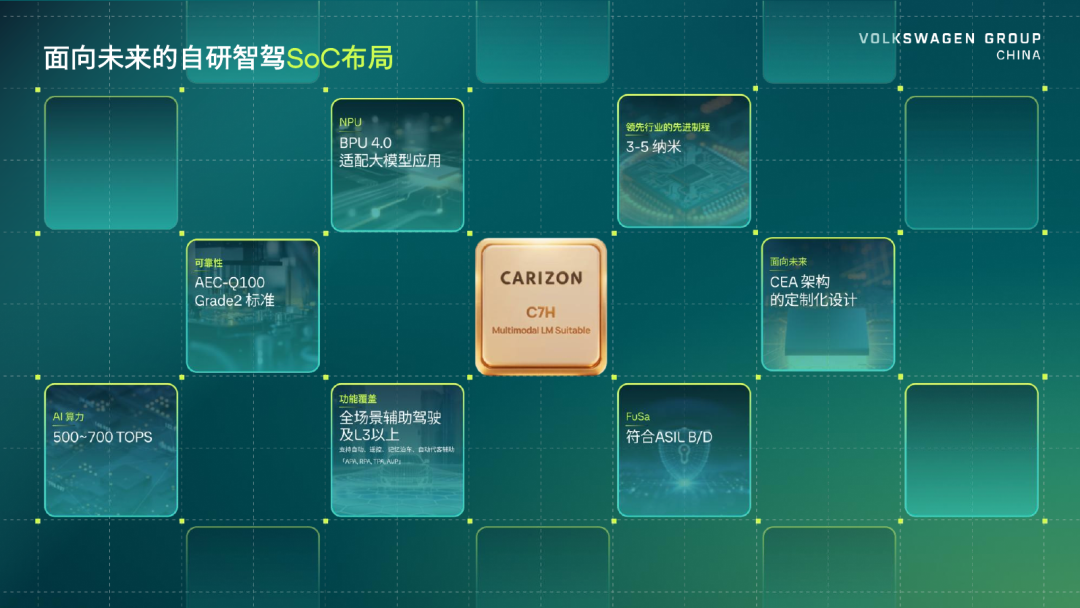
First public disclosure of the complete parameter diagram of the self-developed SoC “CARIZON C7H” in the PPT
How does the 2400 TOPS figure arise? Marcus Hafkemeyer explained on-site:
“A single chip can achieve 600~700 TOPS, but by employing chip series connection technology, theoretically, four chips can reach 2800 TOPS. This is CARIZON’s strategy for customizing chip computing power based on vehicle models and positions, highlighting our flexibility and the chip’s significance.” - Marcus Hafkemeyer, CEO of CARIZON
▍Jack's Insights
The computing power of this single chip and its combination into high-performance configurations resemble those previously announced by BYD. However, this chip embodies Volkswagen’s most ‘Volkswagen-esque’ heritage: Volkswagen has directly applied its platformization strategy, a hallmark of its mechanical era for decades, to the silicon level. One chip, through series connection, caters to models ranging from entry-level to flagship, eliminating the need for redesigns for each price segment. This approach echoes MQB.
Many may wonder about the relationship between Volkswagen’s C7H and Horizon Robotics’ J7. Huang Chang responded candidly:
“There is a definite connection. Many core technologies are shared, including those in chip and hardware design, reducing overall development costs. However, in terms of the entire SoC’s product definition, including interface design, we have incorporated our insights into the Volkswagen system, particularly the CEA platform.” - Huang Chang
▍Jack's Insights
This statement conveys more information than the 2800 TOPS figure. The accurate description of ‘Volkswagen’s self-developed chip’ should be: a dedicated SoC based on shared core IP, customized and defined by CARIZON according to demand and the CEA architecture. This is how chip development operates in the Chinese automotive industry. NIO’s Shenji and XPENG’s Turing also heavily rely on mature design firms and combined IP. For more on automotive chip development, refer to our previous article “The Automotive Industry’s Chip Development Race: A 101 Guide to Chip Design and Manufacturing Supply Chains.” This also reflects Volkswagen’s pragmatism, rather than vaguely allowing the media to speculate about ‘full-stack self-development from silicon sand.’
Regarding integration into vehicles, Huang Chang stated frankly: “We will integrate the technology into vehicles as soon as it is ready. Currently, we are still working with the Journey 6 chip.” The PPT describes C7H with four words: “Progressing as planned.”
03 Equity Structure: 60/40 CARIZON
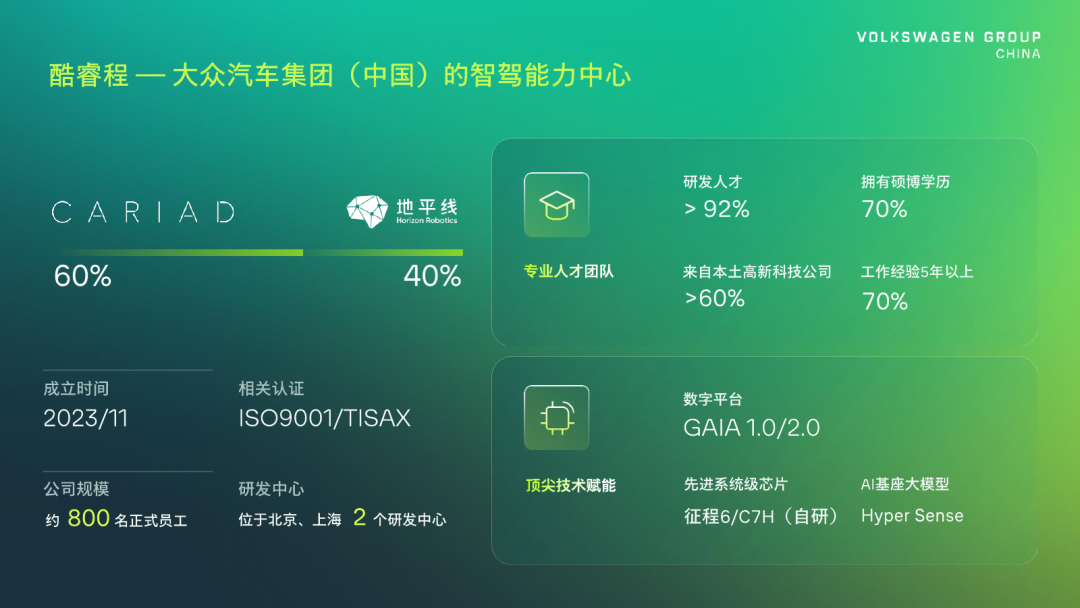
CARIZON’s equity and background: CARIAD 60% + Horizon Robotics 40%, established in November 2023, with approximately 800 full-time employees
CARIZON’s strength is reflected in its progress: CARIAD holds 60%, and Horizon Robotics holds 40%.
· Establishment date: November 2023 | Company size: Approximately 800 full-time employees
· R&D centers: 2 in Beijing and Shanghai | Relevant certifications: ISO9001/TISAX
· R&D talent ratio >92%, with 70% holding master's or doctoral degrees, >60% from local high-tech companies, and 70% with over 5 years of experience
· Digital platforms: GAIA 1.0/2.0 | Chips: Journey 6/C7H (self-developed) | AI foundation model: Hyper Sense
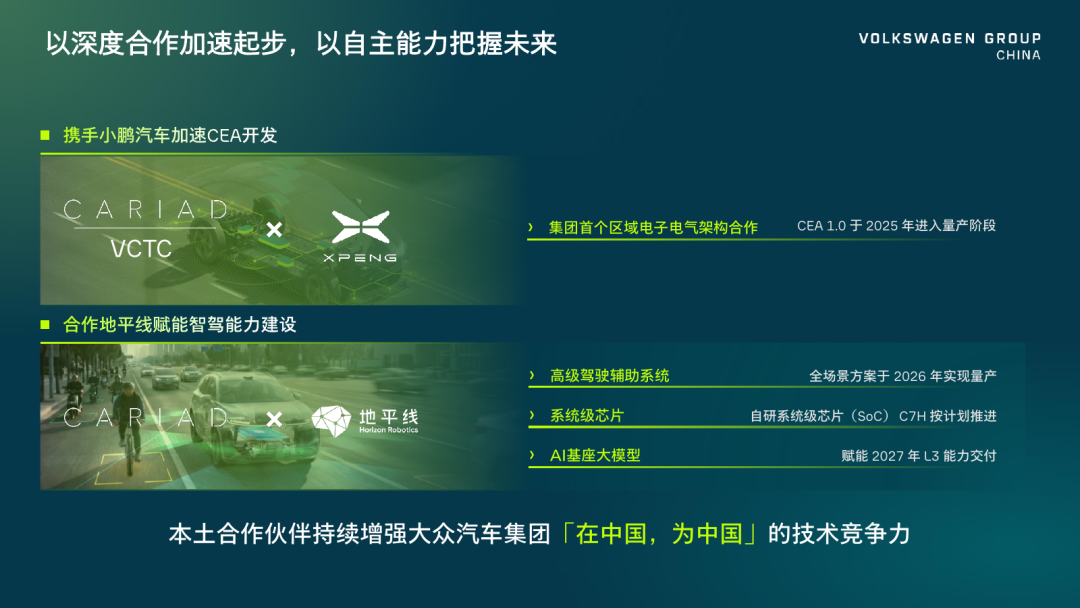
The PPT juxtaposes two cooperation lines: XPENG is responsible for ‘accelerating CEA development,’ while Horizon Robotics is responsible for ‘empowering intelligent driving capability building.’
▍Jack's Insights
Pay attention to this 60/40 equity split. Horizon Robotics is not merely a supplier here; it is a shareholder. This determines the logical consistency of all subsequent developments: why the foundation model can be licensed; why C7H can share core technologies with J7; why costs can be controlled; why Huang Chang, co-founder and CTO of Horizon Robotics, can serve as CTO of CARIZON and deliver this presentation. By the way, on this PPT slide, XPENG and Horizon Robotics are listed as two separate entities: XPENG’s role is ‘collaborating to accelerate CEA development,’ with CEA 1.0 entering mass production in 2025; Horizon Robotics’ role encompasses advanced driving assistance, system-level chips, and the AI foundation model. One entity is responsible for establishing the architecture, while the other installs the ‘brain.’ In my previous article, I referred to XPENG as a ‘transition booster,’ and this time, Volkswagen’s own PPT layout has illustrated this point.
04 What Will Be Delivered This Year: 2 J6M Models + 5 J6H Models, Seven Vehicles in Total
This diagram represents what Volkswagen and CARIZON are most proud of, as evident from the expressions of the three executives at the event. After all, these are the fruits of their three-year labor.
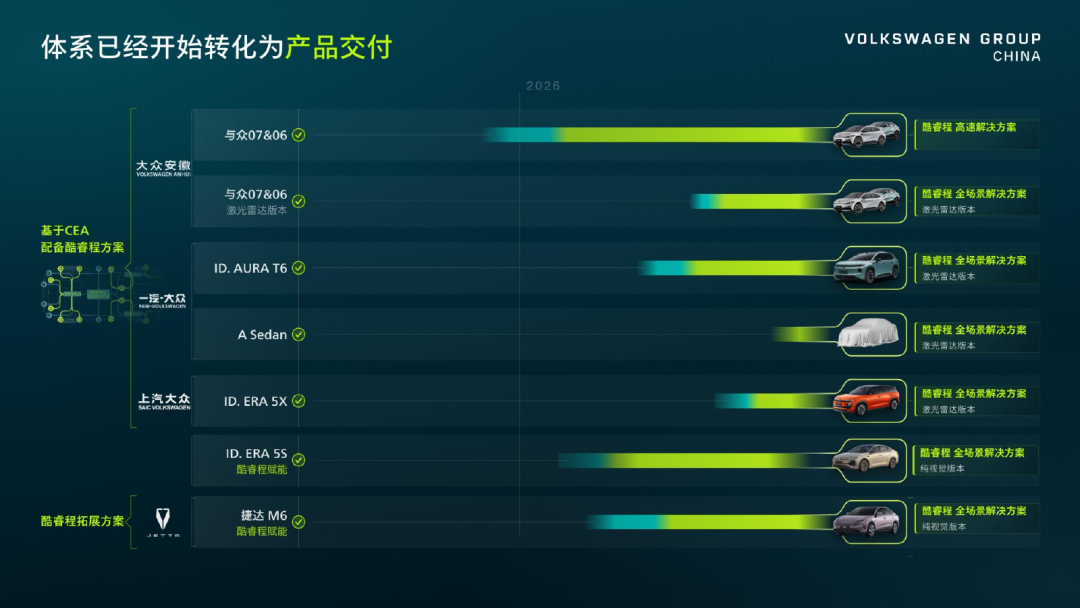
“The system has begun to translate into product delivery” - Seven vehicles, three joint ventures, all built on one CEA + one CARIZON solution
Vehicle integration plans: ZONY 07 & 06 with CARIZON highway solution; ZONY 07 & 06 with CARIZON full-scenario solution (LiDAR version); ID. AURA T6 full-scenario solution (LiDAR version); A Sedan full-scenario solution (LiDAR version); ID. ERA 5X full-scenario solution (LiDAR version); ID. ERA 5S full-scenario solution (pure vision version); Jetta M6 full-scenario solution (pure vision version)
Huang Chang provided this year’s delivery timeline:
“We will first deliver two models equipped with the J6M solution (HS8 pure vision version), followed by five models equipped with the J6H solution (HS8 LiDAR version).” - Huang Chang
Han Sanchu added a more definitive statement:
“Our CEA 1.3 version, paired with the J6H single-chip, one LiDAR, and 11 cameras delivered by CARIZON at the end of August, aims to achieve the highest level of full-scenario assisted driving in China. It will be delivered this year.” - Han Sanchu
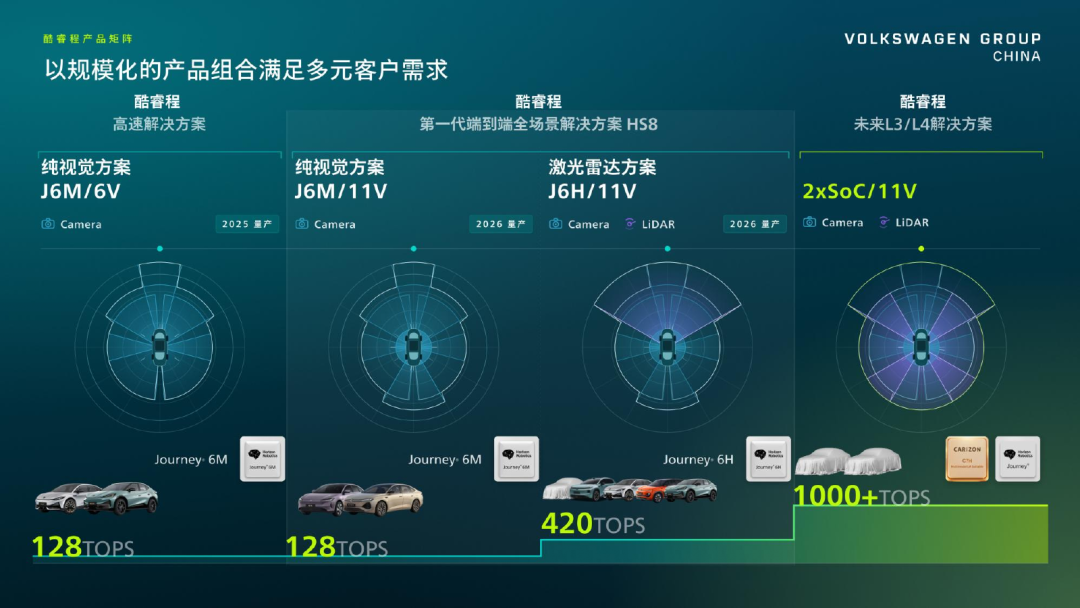
Computing power tiers in the product matrix: 128 → 128 → 420 → 1000+ TOPS, with the last tier being a future L3/L4 solution featuring “2×SoC/11V”
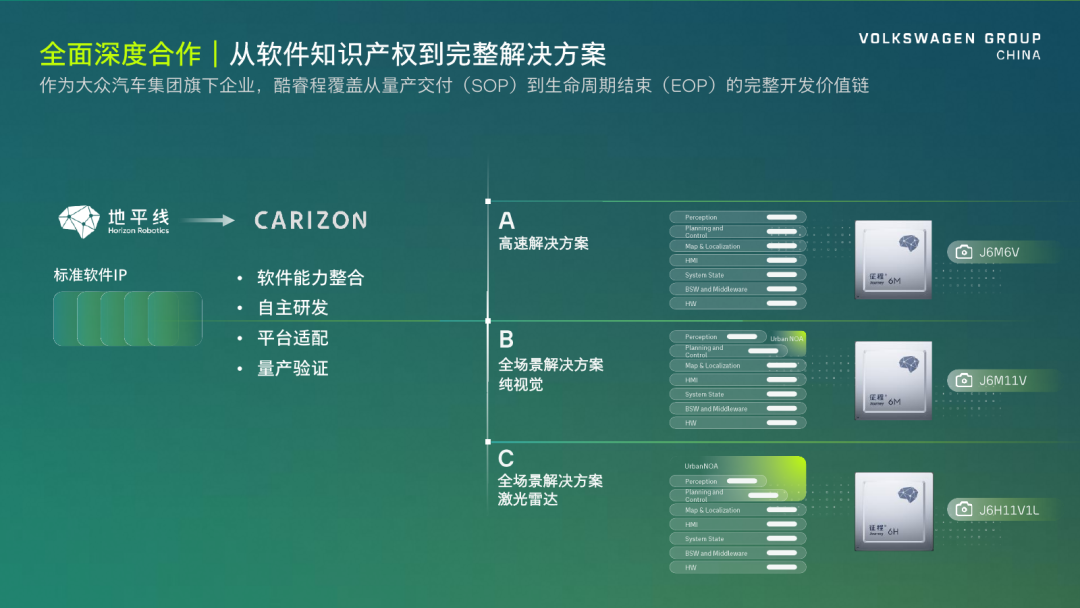
From Horizon Robotics’ standard software IP to three complete solution tiers: J6M6V, J6M11V, J6H11V1L
▍Jack's Insights
One architecture, four powertrain forms (pure electric, plug-in hybrid, fuel, extended range), four platforms (MEB, CMP, MQB, CSP), and seven models launching simultaneously - this is the true essence of ‘platformization’ and what all new forces aspire to but struggle to achieve. New forces can develop a robust intelligent driving system in three years but find it challenging to ensure ‘wherever there is CEA, there will be a CARIZON solution.’ Han Sanchu emphasized this point. This remains very Volkswagen. Early intelligent driving users often found their systems outdated after a year, as new forces shifted to new platforms and abandoned the old ones. Now, Volkswagen, through a universal underlying platform solution, can not only expand rapidly but also continue to update.
05 Taking a Reverse Approach: While Others Start from High-End, They Start from Entry-Level Models
From the above, it is evident that Volkswagen’s self-developed intelligent driving products are initially being integrated into Volkswagen vehicles. However, in the automotive industry, intelligent driving is typically developed for high-end models first, where cost pressure is low. But Volkswagen’s self-development in China starts from entry-level models. Is there a rationale behind this?
Marcus Hafkemeyer’s on-site response was straightforward:
“It’s not a top-down approach; we’re starting from entry-level models and moving upwards. Our intelligent driving system has another advantage: we can collect more data. If we only rolled it out on luxury or a few high-end models, the data would be scarce. But by doing it this way, we can gather more data.” - Marcus Hafkemeyer
Huang Chang added eight insightful words:
“It is easier to transition from frugality to extravagance than vice versa. Excelling in high-end solutions does not guarantee success in mid-range ones, but if you excel in mid-range solutions, high-end ones should not be too difficult. Whether it's mid-level L2, high-level L2, or L3, the technology for models in the AI field is unified, not fragmented. It's similar to how those large
Achieving urban Navigation on Autopilot (NOA) with a 128 Tera Operations Per Second (TOPS) pure vision system represents the most formidable challenge, not the simplest task. Furthermore, Volkswagen has come to a realization: the cornerstone of intelligent driving is data, which is derived from sales volume, particularly within the 100,000-200,000 yuan price range. Even if you attain perfection in a luxury car priced at a million yuan, the annual data volume generated pales in comparison to that produced by a mass-market A-class vehicle in a single month. Tesla grasped this concept long ago, and Volkswagen appears to be following a similar trajectory.
06 The Iron Triangle Revisited: Gym, Coach, Athlete
In my previous article, I referred to GAIA, the foundational large model, and self-developed chips as the 'Winning Iron Triangle.' This time, Volkswagen itself has crafted a more relatable metaphor, which Han Sanchu inadvertently revealed while answering questions:
'We have not only constructed a training ground (GAIA 2.0 world model) but also appointed a coach (HS base large model) and, finally, deployed an in-car model (delivery solution)... This in-car solution transcends being merely an in-car model; it also encompasses our core chip—currently the Journey 6 series, with our self-developed C7H on the horizon.' — Han Sanchu
On the presentation slides, another set of terms was introduced: Gym (GAIA 2.0), Fitness Coach (Hyper Sense), Athlete (vehicle-end multimodal end-to-end model).
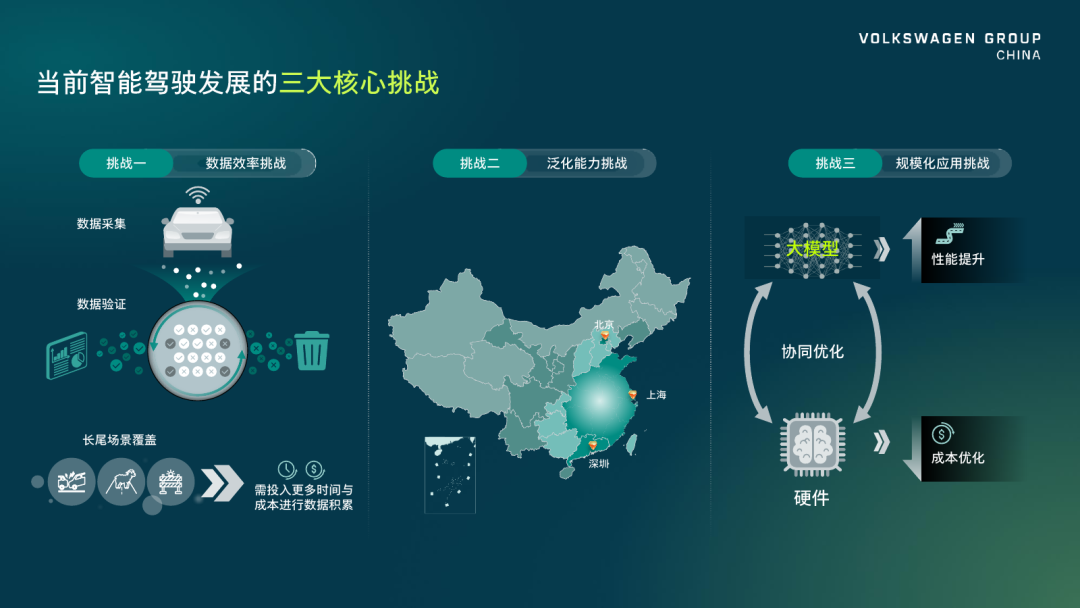
The Three Critical Challenges: Data Efficiency, Generalization Ability, Scalability—Fully Aligned with the Internal Report from a Year Ago
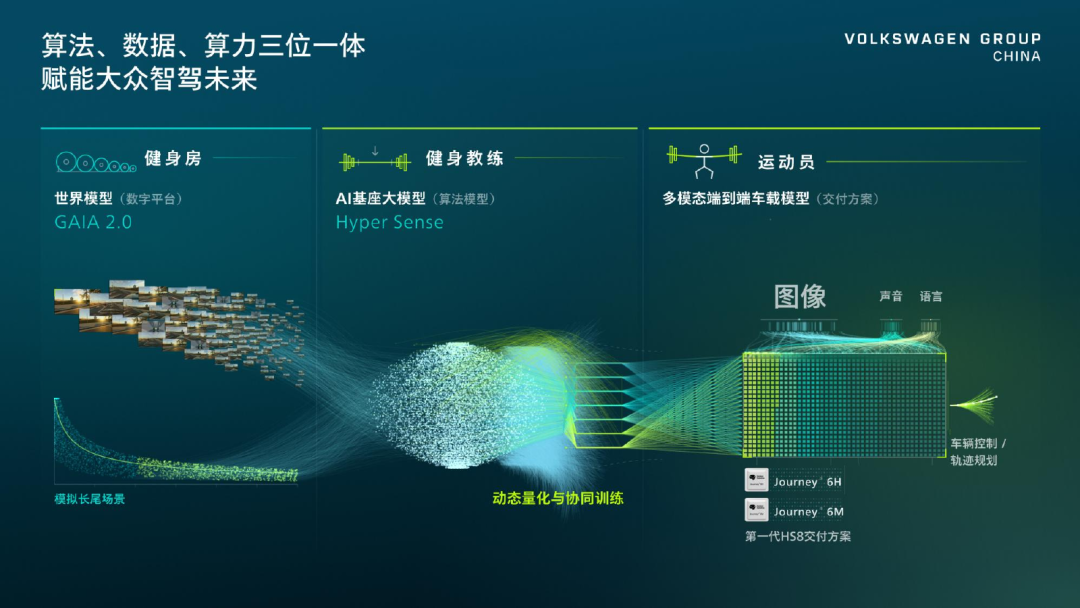
Algorithm, Data, and Computing Power as a Trinity: Gym GAIA 2.0 → Fitness Coach Hyper Sense → Athlete HS8 Vehicle-End Model
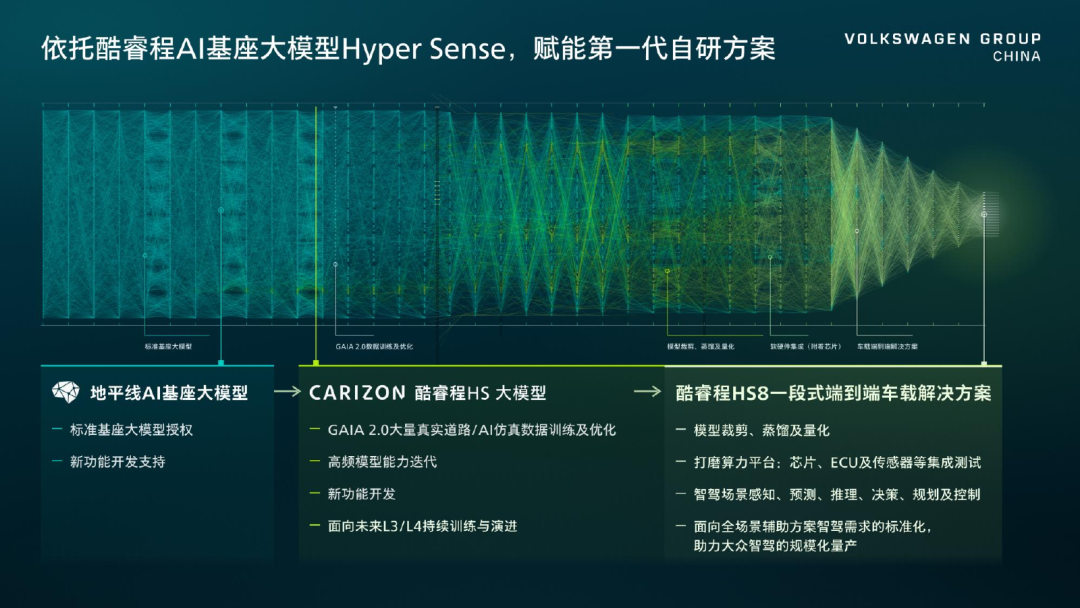
Complete Ecosystem: Horizon Base Large Model → CARIZON HyperSense HS Large Model → HyperSense HS8 One-Stage End-to-End In-Car Solution
Huang Chang drew a clear demarcation:
'Our collaboration with Horizon centers on the foundational model operating in the cloud, which is vast in scale and boasts an enormous number of parameters... a fully pre-trained base large model. In essence, all subsequent work is accomplished internally within HyperSense.' — Huang Chang
Han Hongming added: 'All distillation and customization are entirely handled by HyperSense itself.'
Han Sanchu emphasized more forcefully:
'The HyperSense team is unequivocally not just a model integration team... To truly integrate this model into vehicles, achieving automotive-grade safety and controllability standards, and seamlessly blending it with the vehicle and CEA architecture, entails far more than just model fine-tuning.' — Han Sanchu
▍Jack's Insights
These three individuals addressed the same question—Are you merely wrapping Horizon in a shell?—in three distinct ways, all with a resounding 'no,' and they are well-prepared. However, what is even more noteworthy is the metaphor itself—labeling the data generation capability as a 'gym' suggests that Volkswagen internally views it as an engineering asset that can be independently established and budgeted, rather than a mere byproduct of R&D. This could signal a paradigm shift in future autonomous driving algorithms, where only a select few develop foundational models, and everyone else distills and trains edge algorithms based on these foundational models, tailored to their own product characteristics.
07 90% of the Data Is 'Synthesized.' Is This Trustworthy?
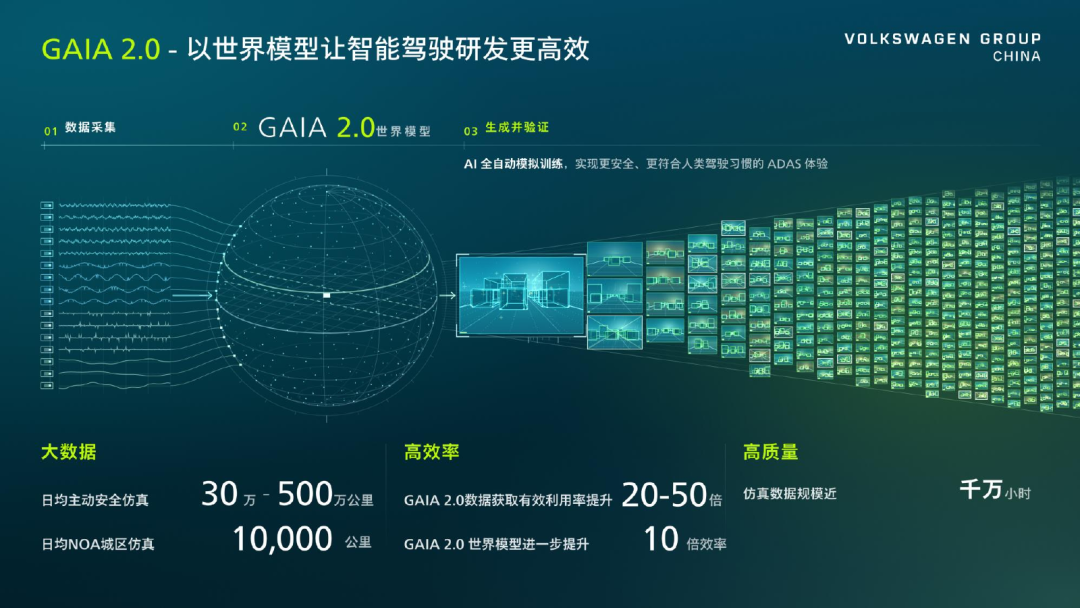
GAIA 2.0 World Model: Daily active safety simulation spanning 300,000-5 million kilometers, daily urban NOA simulation of 10,000 kilometers.
· Daily active safety simulation: 300,000-5 million kilometers
· Daily NOA urban simulation: 10,000 kilometers
· Enhancement in effective data utilization rate: 20-50 times; further improvement in world model efficiency: 10 times
· Scale of simulation data: nearly 10 million hours
Huang Chang provided a more illuminating comparison:
'Currently, the effective data utilization rate of GAIA 2.0 has been verified to exceed 60%. In contrast, traditional methods relying solely on real-world data collection often have an effective utilization rate of less than 5%.' — Huang Chang
But if all training is conducted with simulated data, how is its reliability ultimately verified?
Huang Chang's response was the most insightful part of the discussion:
'The requirements weren't as stringent in the L2 era... We now have about 5%-10% of our training data starting to incorporate simulations.' 'But for L3, the testing mileage equivalent is about 1-2 orders of magnitude greater than L2, roughly 100 times... So over 90% of the data is simulated, but we still retain... some targeted real-world data. And this real-world data, in turn, can verify whether the simulations are adequate.' — Huang Chang
Han Sanchu added a crucial piece of information:
'90% of the simulated data is actually generalized from the 10% real-world data. Because without this 10% real-world data as an anchor, it's difficult to envision which direction to generate data or what kind of data to generate.' — Han Sanchu
Huang Chang shared Volkswagen's approach and understanding of simulation technology in self-developed intelligent driving:
1. Application Scenarios: Transitioning from 'testing and verification' to 'auxiliary training.' Last year, it was for verification; this year, it has entered the training phase.
2. Operational Modality: Initially open-loop, then closed-loop (unidirectional verification → bidirectional interactive verification).
3. Deployment Location: Initially in the cloud, then in the vehicle: 'The vehicle can not only achieve closed-loop control but also predict future road condition changes 10 to 20 seconds ahead while driving.'
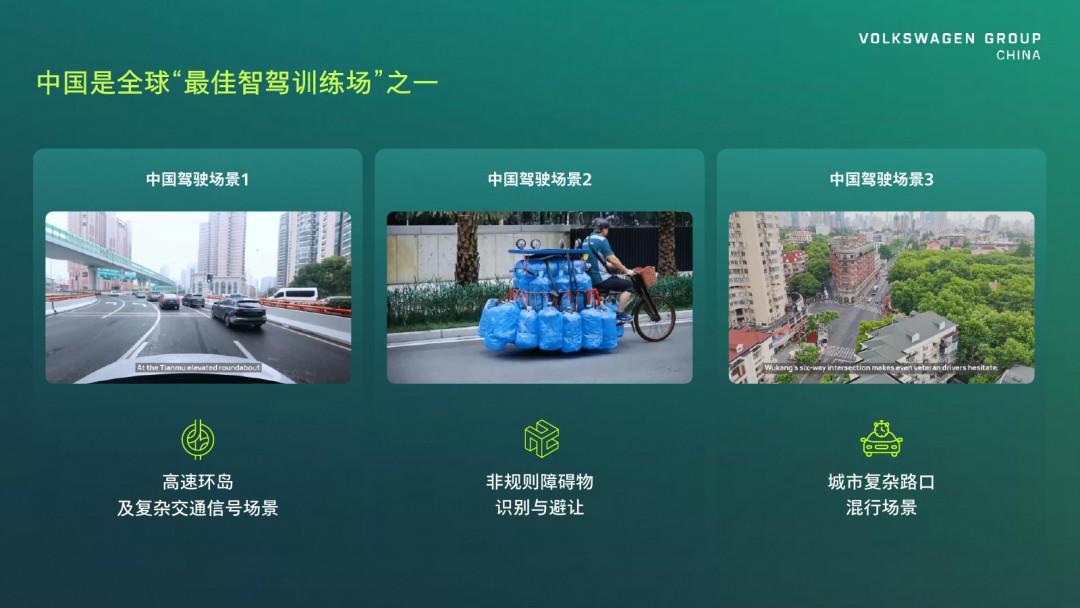
China stands as one of the global 'premier intelligent driving training grounds': highway roundabouts, irregular obstacles, and complex urban intersections.
▍Jack's Insights
Predicting 10 to 20 seconds ahead—isn't that a hallmark of a world model? Now, all end-to-end solutions in the industry are advancing from the stage of 'reacting to what is seen' to 'anticipating what will happen and acting preemptively.'
Additionally, Han Sanchu mentioned a particularly easily overlooked structural advantage: Many automakers have multiple solutions and architectures internally, leading to severe data fragmentation—'even though there are many vehicles, the data is hard to utilize.' However, the platformization of CEA and the uniformity of chips ensure that 'my data is not lost but continuously accumulated.' This point is more crucial than 2800 TOPS. This is also Volkswagen's way of bringing the advantages of physical architecture into the software-defined vehicle era.
08 'Ten Times Safer Than Human Drivers,' He Calculated It On the Spot
Long-time readers of our previous articles are aware that the hidden standard in the mandatory national standards for L3/L4 is 'no less safe than a sober standard driver.' Huang Chang stated on-site that Volkswagen CARIZON aims to be ten times safer. How was this figure derived? Huang Chang calculated it on-site with a calculator:
'An average driver typically drives 1,000 hours a year and may drive for 40 years in their lifetime, totaling 40,000 hours... Half on highways and half in urban areas, with an average speed of 80 kilometers per hour. 80 × 40,000 equals several million kilometers overall.' 'Then, amplifying this by 10 times within the statistical range of a lifetime of driving brings us to the billion-kilometer level, which we use as our target to build our evaluation system. Over 90% of this is completed through simulations, and 10% is done with real vehicles.' 'Additionally, to achieve a statistical confidence level of over 96%, we multiply all mileage by another 3 times.' 'This allows us to plan what we need to do... How many machines to stack today, how much simulation resources to plan... We break it down into clear goals and then convert them into our budget and R&D plan.' — Huang Chang
▍Jack's Insights
This is a more intellectually demanding logic, but self-development allows this logic and these requirements to be clearly articulated. When others talk about L3, they discuss 'how smooth the experience is.' Huang Chang discusses L3 in terms of 'how much money I need to spend, how many machines to buy, and how many hours to run.' Translating a marketing slogan ('ten times safer than humans') into a decomposable budget table—this is the language of engineers and the only language that can be trusted. By the way, he also honestly explained why the 10% real vehicles are necessary: 'Because simulations cannot perfectly mimic natural scenes or some physical characteristics of sensors and actuators.'
09 A Pertinent Question: J6M Is Ubiquitous. Where Is Your Differentiation?
Individuals in the industry have likely observed a trend: L2++ assisted driving configurations with J6M chips will soon be ubiquitous. So, where does Volkswagen CARIZON's differentiation lie in its self-developed solution based on this chip?
'Today, I noticed that our chip platforms are all J6M, but there are many others utilizing J6M in the market, such as Changan with its Changxian Technology, as well as Qingzhou and Zhijia Dalu. With the same chip platform, how do we differentiate ourselves? Whether in terms of product or cost—this might be the ultimate question for self-reflection today.' — Vehicle Jack
Huang Chang responded promptly:
'Last Thursday and Friday, I had a discussion meeting with colleagues from Jetta, and a crucial part was competitive benchmarking. There were J6M-based competitors and others. Afterward, they were very pleased, and the results spoke for themselves.' 'What computing platform, what sensors, what features—everyone lists them the same, but after driving for a while, you can discern a good product within half an hour and will increasingly enjoy driving it, while a poor product will make you not want to drive it after ten minutes.' 'The true point of differentiation is not in the computing power numbers or the number of sensors but in whether you can fully leverage the computing power, optimizing software, algorithms, models, and all safety-related algorithms to their fullest.' — Huang Chang
Han Sanchu added another dimension and proposed a concept that I believe the industry should remember—'engineering effective computing power':
'Technical parameters are just a baseline... You'll find that the same feature performs differently on different vehicles. It's particularly crucial to have efficient integration and synergy with the vehicle's architecture and chassis.' 'When people talk about 'computing power,' they often use the same term to tell different stories... This involves not just model quantization and distillation but even Mixture of Experts (MOE) and a series of technologies, as well as underlying hardware like chip bandwidth. So computing power is not just a simple numerical label.' — Han Sanchu
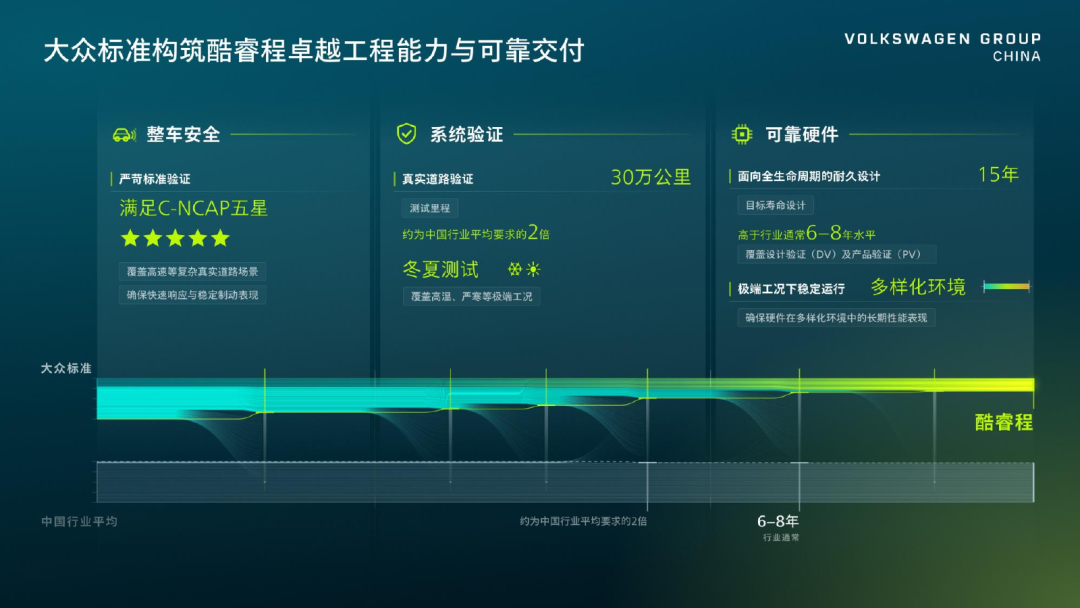
This is the confidence behind their claim of differentiation: C-NCAP five-star rating, 300,000 kilometers on real roads (about twice the industry average requirement), and hardware durability for 15 years.
▍Jack's Insights
I give this answer a 70. 'You'll know after driving for half an hour'—this is correct, but it's not falsifiable. And on that day, due to the typhoon, the test ride was canceled. Han Hongming himself was also disappointed, saying on-site, 'If we had the opportunity to test drive today, no one would ask that question about where the differentiation lies... Because only by sitting in and experiencing it would you know where the differentiation lies.' If we get a chance to take the Jetta M6 and ID. ERA 5S for a full ride, we can discuss differentiation then. Or, if anyone has driven them, feel free to leave a comment.
10 The Most Challenging Aspect: Cabin-Driving Interaction
Anyone who has worked on intelligent driving knows that cabin-driving interaction is probably the most challenging facet of intelligent driving products. Many companies experience some degree of fragmentation in the cabin-driving experience due to differences in organizational structure, chip platforms, etc. However, Volkswagen CARIZON faces an even greater challenge with two powerful joint ventures—FAW-Volkswagen, SAIC Volkswagen, and likely Anhui Volkswagen factored in.
Two leaders at the scene also offered some perspectives:
'Frankly, Volkswagen's organizational and operational methods could be pushed forward a bit more. Actually, many issues are not due to HyperSense but ultimately arise from upstream component problems. However, we will fix them as soon as possible, and we are already working on it.' 'By my standards, I don't think HyperSense's intelligent driving is a perfect 100 yet, but we will accelerate optimizations, including in subsequent OTA versions and new models. There is even more room for improvement in cabin-driving interaction.' — Huang Chang, CTO of HyperSense
Han Sanchu did not mince words but spoke honestly:
'We will also collaborate with our partners, such as FAW-Volkswagen and SAIC Volkswagen, to review whether our previous excessive customization was necessary. I also hope that from your evaluation perspective and the media's perspective, you can openly communicate these points to our partners.' 'We never set overly ambitious goals... We never hype up our products; we deliver on our promises. The perfect 100 that Dr. Huang mentioned is currently unattainable by anyone; that is the goal of the Volkswagen Group. We do not measure ourselves against others; everything is based on our own products.' — Han Sanchu
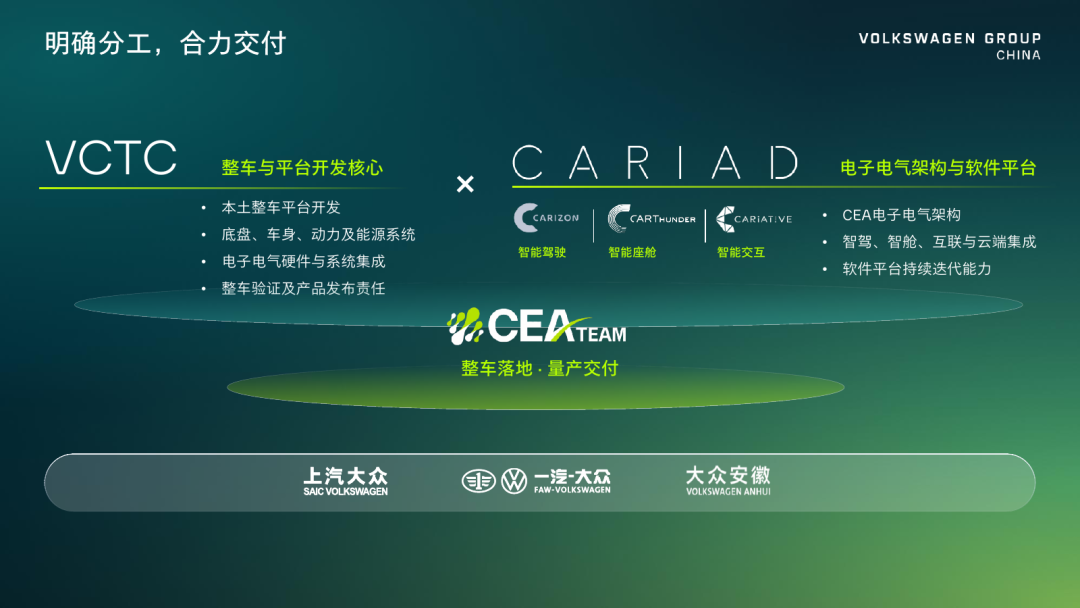
The division of labor between VCTC and CARIAD: Corethum handles intelligent driving, CARTHUNDER manages intelligent cockpit, and CARIATIVE oversees intelligent interaction.
While answering questions, Mr. Han shared two new pieces of information:
1. Product and Engineering Team: Following Han Sanchu's appointment, a dedicated product engineering team was formed. Prior to this, Volkswagen China lacked such a team, which focuses on the collaborative optimization of intelligent cockpits and intelligent driving systems from a user-centric perspective. This approach effectively integrates the user viewpoint into the engineering process.
2. HMI → HAI: As the capabilities of AI Agents continue to evolve, it may be necessary to redefine human-machine interaction as Human Agent Interaction (HAI), emphasizing the interaction between humans and AI Agents.
▍Jack's Comments
It's remarkable to think that just three years ago, a major joint venture player would, at a technical briefing held on its home turf, have its CTO openly admit to over twenty media outlets, "We haven't achieved perfection yet," and "There's significant room for improvement in cockpit-driving integration." Even more surprising, its executive vice president would appeal to the media to exert pressure on their joint venture partners. While some might view this as a sophisticated PR strategy, I prefer to see it as a triumph of engineer culture over PR spin. Zhang Wei, Vice President of Public Relations and Communications at Volkswagen Group China, provided a refreshingly candid summary: "They all exhibit very typical engineer characteristics... We never exaggerate, we never make claims we're not confident about, we prefer to let the media, and more importantly, Chinese users, be the judges." This statement may not be groundbreaking, but what's truly rare is that they consistently adhered to this approach throughout the entire event.
Volkswagen's commitment to honesty and sincerity in this regard is truly commendable.
◆ ◆ ◆
11 Finally: The Giant Has Laid Its Foundation
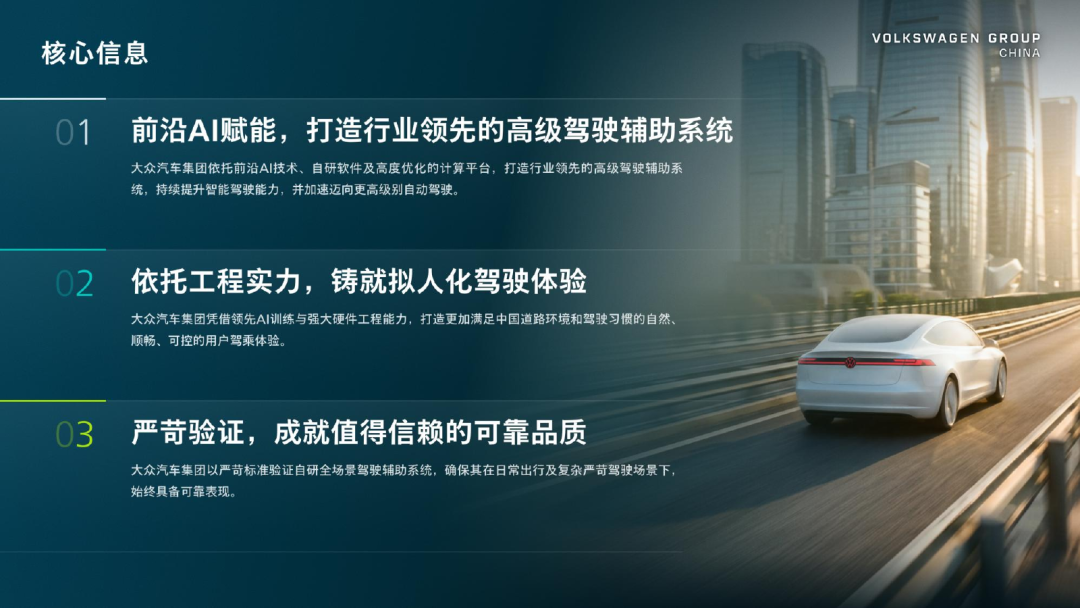
Three key takeaways from the communication event: cutting-edge AI empowerment, engineering excellence in crafting human-like experiences, and rigorous validation ensuring reliable quality.
Summarizing this morning's event in one sentence: Three years ago, Volkswagen in China was still grappling with concerns about its "soul." Today, it has at least laid the foundation for its soul:
- A self-developed CEA architecture (1.0 already in mass production, 2.0 slated for 2027, 3.0 corresponding to L3/L4 autonomy)
- A 60%-owned intelligent driving company (employing approximately 800 people, with R&D centers in Beijing and Shanghai)
- A custom SoC in development (C7H, offering 500~700 TOPS, serializable)
- A self-generated world model for data (GAIA 2.0, achieving over 60% effective utilization)
- Seven new models to be launched this year
The only remaining question is whether the highway L3 autonomy, expected in early 2028, will be delivered on schedule.
After witnessing Volkswagen's strategy of "architecture first, progressing from low to high, and self-generated data," what are your thoughts on this joint venture giant's transformation in the latter half of the intelligentization race?
Let's engage in a discussion in the comments: Do you view Volkswagen's clarification of L3 autonomy from "2027 delivery" to "2027 architecture ready, 2028 on highways" as a sign of honesty or conservatism? Share your insightful perspectives in the comments!
▍We invite you to follow, like, and repost—your every "like" fuels our motivation to continuously produce in-depth content.
◆ ◆ ◆
References and Images
PPT from "Composure from the Crowd, Intelligence Initiates a New Journey—Volkswagen Group China's Self-Developed Intelligent Driving Technology Communication Event"—Volkswagen Group China, August 10, 2026
"Composure from the Crowd, Intelligence Initiates a New Journey—Volkswagen Group China's Self-Developed Intelligent Driving Technology Communication Event"—August 10, 2026, Qingpu, Shanghai
*Reproduction and excerpts are strictly prohibited without permission. To access references for this article, join our Knowledge Planet to download a wealth of reference materials from our official account, including the aforementioned references.
-
![]()
Voice Input: Opening the AI Gateway?
-
![]()
This Year’s Chengdu Motor Show: A Subdued Affair
-
![]()
Can a Small Car Priced at 63,900 Yuan Help Leapmotor Achieve Its Goal of 60% Overseas Sales?
-
![]()
Behind Two Renewed Agreements: Joint Venture Automakers Choose Long-Term Presence in China's New Energy Sector
-
![]()
Will Zunjie’s Launch of Two L3-Ready MPVs Spell the End of the ‘Price Markup Era’ for Alphard and Its Peers?
-
![]()
17 Strategies, 1.8 Billion Parcels, 12.5 Billion Yuan: Huizhou, Guangdong, Paves the Way for Autonomous Vehicle and Drone Delivery
-
![]()
Manus to Regain Independence, Former Shareholders Including Tencent to Repurchase Shares from Meta for $2 Billion
-
![]()
Starting at 99,900 yuan, the Updated Seal 06 Hits the Market. How Should Family Buyers Decide?