Xiaomi Faces a Stacked Deck of Challenges
 08/20 2026
 517
517
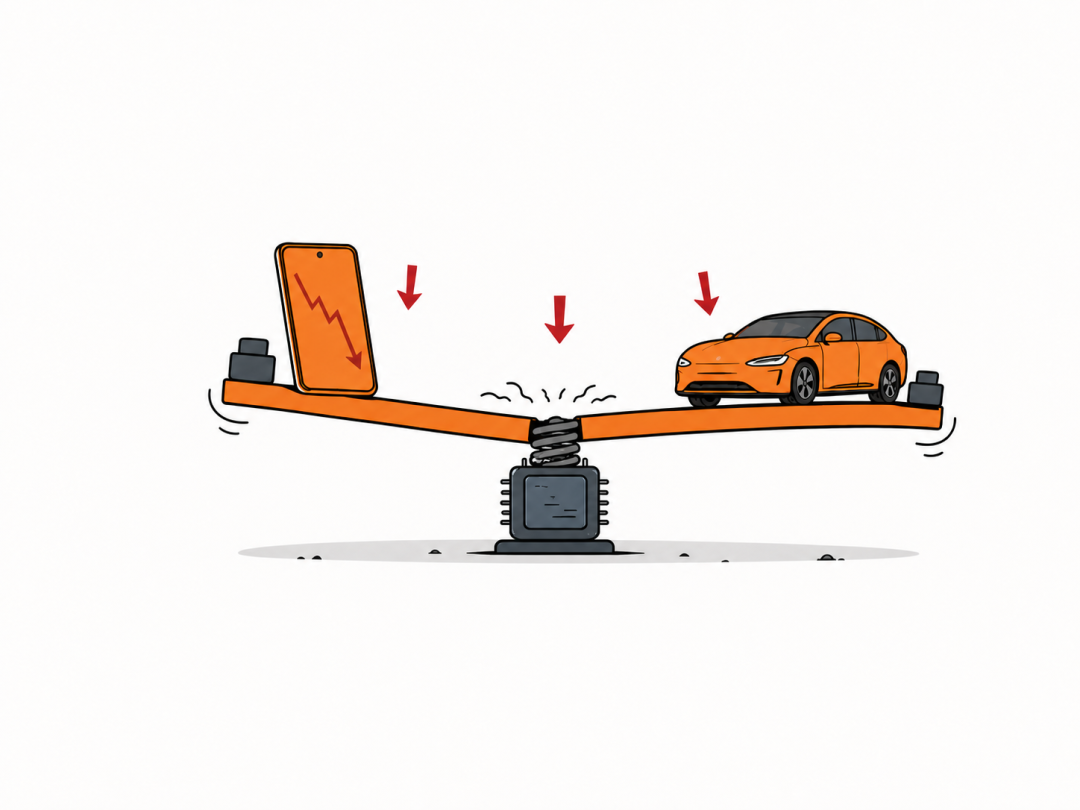
All because the market is proving to be exceedingly tough.
Author: He Jian
Editor: Zhang Wen
Cover: AI Generated
Challenges abound. At the commencement of Xiaomi's Q2 2026 earnings call last night, Lu Weibing began by airing his grievances.
"The external environment in the second quarter of this year remained highly challenging, with core component costs—such as those for storage—continuing to soar, consumer market demand still sluggishly recovering, and intense competition persisting in the industry..."
Throughout the first half of 2026, Xiaomi faced a rocky road. Revenue dipped below 100 billion yuan in the first quarter but rebounded in the second, growing 9.9% sequentially to reach 108.9 billion yuan. However, profits remained stagnant, with Xiaomi's adjusted net profit plummeting by 43.1% in the first quarter and an additional 42.6% in the second. The company's gross profit margin, which averaged 22% last quarter, dropped to 19.8% this quarter.
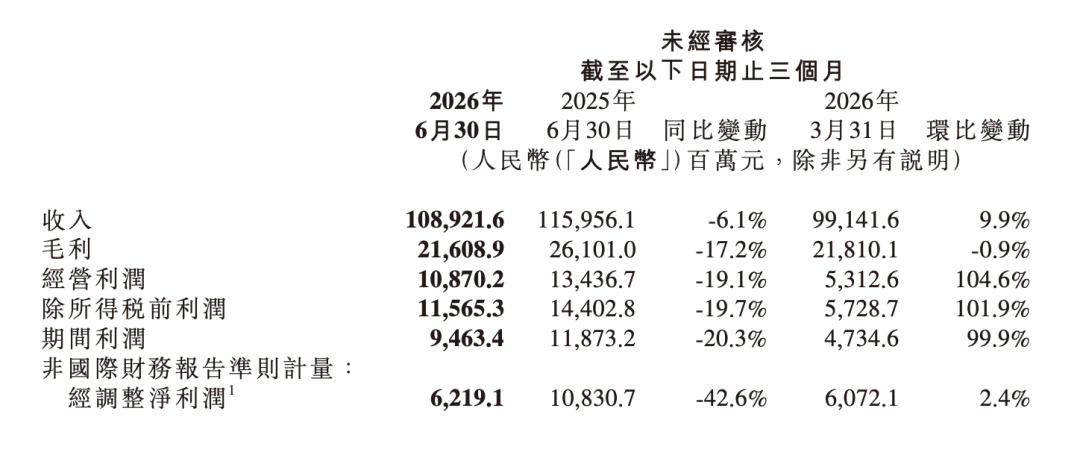
Xiaomi's Q2 2026 Financial Report
If the previous quarter was merely a downturn for the automotive business, this quarter Xiaomi is struggling to maintain its foothold. Pressured by escalating storage costs, Xiaomi's smartphone shipments plummeted 26.5% year-on-year, and the gross profit margin for smartphones tumbled to 8.5%. Revenue from Xiaomi's smartphone and AIoT division declined 11.3% year-on-year to 84 billion yuan.
The automotive business provided little solace. Revenue from Xiaomi's automotive and AI-related new ventures reached 24.9 billion yuan, up 17.1% year-on-year, but operating losses soared to 2.6 billion yuan. The division's gross profit margin dipped to 19.2%, down 7.2 percentage points year-on-year, marking its lowest level in seven quarters.
Xiaomi CFO Lin Shiwei explained that high-priced models like the Xiaomi SU7 Ultra contributed more significantly last year, while this quarter's delivery growth stemmed primarily from the new-generation SU7, causing fluctuations. Escalating costs for core components and AI business expenses further strained the division's gross profit margin.
Based on rough revenue calculations, Xiaomi's automotive revenue per vehicle this quarter was approximately 229,000 yuan, down 9.6% year-on-year, hitting a two-year low and only marginally higher than the first full delivery quarter of Xiaomi's automotive business.
In any case, the initial luster of Xiaomi's automotive venture seems to have dimmed. Facing the dual pressures of rising storage costs and a challenging automotive market, Xiaomi finds itself ensnared in a predicament, burdened with multiple challenges for 2026. Eight years after its listing, Xiaomi's stock price has fluctuated and now hovers around a low of HK$25—Mr. Lei might want to skip breakfast.
During the earnings call, management offered little reassurance for the upcoming quarter. Lu Weibing stated that factors exerting pressure on short-term operations persist in the third quarter. He reiterated his opening remarks, "Storage costs remain high, consumer demand recovery still takes time, and competition remains fierce..."
The only glimmer of confidence came from the slogan-like assertion at the end: "Xiaomi will ultimately prevail through adversity."
Xiaomi's High-End Smartphones Finally Gain Traction
Xiaomi is well-positioned to comment on the tough times facing smartphone makers. In the first quarter of this year, as storage pressures mounted, Xiaomi's smartphone shipments fell 19.2% year-on-year. By the second quarter, when even Apple faced difficulties, Xiaomi's smartphone shipments dropped 26.5%, with quarterly shipments falling to 31.2 million, reverting to levels seen three years ago.
Even within the broader smartphone market, Xiaomi's decline was notable. Omida statistics reveal that Xiaomi was the most affected among the world's top five smartphone makers by rising storage costs, as over half of its shipments were priced below $200. In contrast, domestic Android rivals OPPO and Vivo saw quarterly shipments decline by 17% and 18%, respectively.
The steeper decline is linked to Xiaomi's strategy of prioritizing profits over sales. Lu Weibing said during the earnings call that the surge in memory costs in the first half of the year far exceeded expectations, hitting low-end and entry-level models the hardest. According to previous media reports, Xiaomi raised smartphone prices three times in the first half of this year alone. The newly released REDMI K100 Pro series, launched in August, has pushed price segments up to the 4,000-yuan range.
After intentionally abandoning the entry-level market, Xiaomi's smartphone revenue fell only 7.5% year-on-year despite a sharp drop in shipments. The average selling price (ASP) for Xiaomi's smartphones reached 1,351 yuan this quarter, up 25.9% year-on-year, hitting a record high. Compared to a year ago, Xiaomi sold nearly 278 yuan more per smartphone on average.
There were benefits. After continuous price hikes, Xiaomi finally managed to penetrate the high-end market. The company emphasized in its financial report that Xiaomi's smartphone sales in the 3,000-yuan-and-above market in mainland China reached a record high of 32.1%.
But Xiaomi failed to sustain profits. Gross profit for Xiaomi's smartphones was only 3.6 billion yuan this quarter, down 31.1% year-on-year and 19.6% sequentially. The gross profit margin for smartphones fell from 11.5% a year ago to 8.5%.
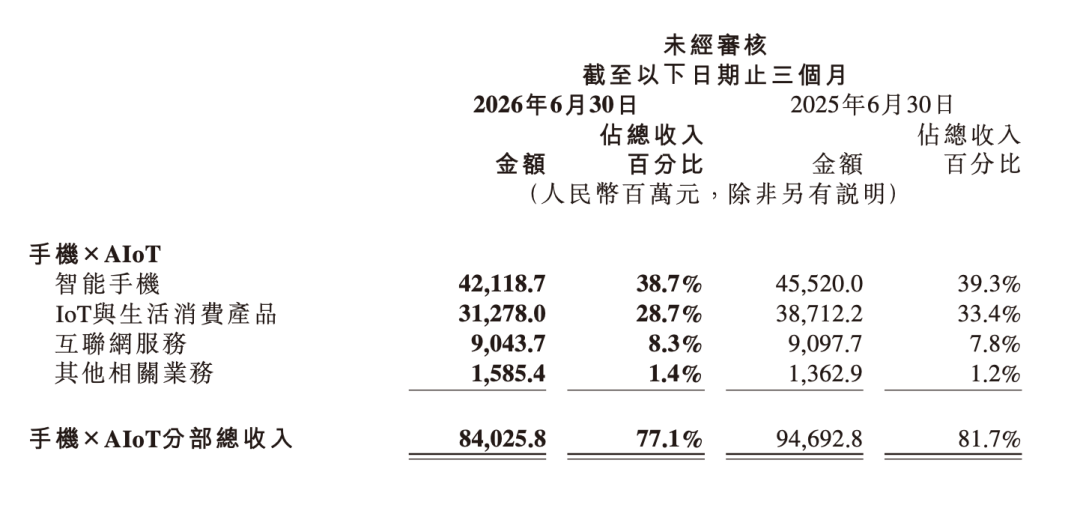
Xiaomi's Q2 2026 Financial Report
Previously, Caijing reported that to cope with rising smartphone storage costs, Xiaomi intentionally adjusted its offline strategy, shifting store revenue focus toward large appliance businesses. Appliances indeed contributed significantly to Xiaomi. In the first quarter of this year, while Xiaomi's IoT business revenue fell 23.7% year-on-year to 24.7 billion yuan, its gross profit margin remained at 25.2%, up 5.1 percentage points sequentially, becoming an important buffer against declining smartphone profits.
However, in the second quarter, while IoT revenue increased by 6.6 billion yuan sequentially, the gross profit margin fell to 20.1%. With reduced government subsidies and rising storage costs, Xiaomi's IoT business could not escape unscathed. This marked the third consecutive quarter of a 20% year-on-year decline for the IoT business.
Among traditional businesses, the only noteworthy performer was the internet services segment. Xiaomi's global MAU reached 770 million this quarter, up 4.8% year-on-year, hitting a record high. Domestic MAU reached 198 million, up 7% year-on-year. Driven by user growth, Xiaomi's internet services revenue fell only 0.6% year-on-year to 9 billion yuan, with the gross profit margin rising to 76.8%.
Waiting for Pengcheng to Turn the Tide
Last year, the automotive business was the brightest spot in Xiaomi's financial report. In the second quarter of 2025, the gross profit margin for Xiaomi's automotive and AI-related innovative businesses reached 26.4%, with operating losses narrowing to just 300 million yuan. In the second half of last year, the automotive business turned a profit for two consecutive quarters, with operating profits reaching 1.1 billion yuan in the fourth quarter.
But this year, profits turned into losses. Due to the early discontinuation of the previous-generation SU7, Xiaomi's automotive sales came under pressure, with first-quarter deliveries barely exceeding 80,000 units, nearly halving sequentially. Operating losses for automotive and AI-related innovative businesses hit 3.1 billion yuan that quarter.
In the second quarter, the new SU7 finally launched, with Xiaomi's automotive deliveries surging 28.2% year-on-year to 104,200 units. However, due to changes in the model mix, automotive business revenue increased only 15.9% year-on-year to 23.9 billion yuan. Based on rough revenue calculations, Xiaomi's automotive revenue per vehicle this quarter was approximately 229,000 yuan, hitting a near-two-year low.
Compounded by rising memory chip costs, the gross profit margin for Xiaomi's automotive and AI innovative businesses fell to 19.2% this quarter, declining for four consecutive quarters, with division operating losses still reaching 2.6 billion yuan.
Xiaomi CFO Lin Shiwei explained during the earnings call that ASP and gross profit margin have no direct correlation, and a low ASP does not necessarily equate to a low gross profit margin. "Fluctuations in ASP are more based on adjustments to our product mix," Lin said. He noted that the YU7 model accounted for a larger share of deliveries in the first quarter, while the lower-priced SU7 dominated in the second quarter, causing the ASP to decline.
Xiaomi specifically cited data from the China Passenger Car Association in its financial report, stating that domestic passenger car retail sales fell 22% year-on-year in the second quarter of this year, underscoring the difficulty of achieving Xiaomi's 28.2% growth. Xiaomi, which once set a record for new car pre-orders in China, now has to attribute its challenges to the market downturn. In the first half of the year, several new energy vehicle makers still achieved over 60% year-on-year growth in deliveries.
Monthly deliveries for the Xiaomi SU7 and YU7 have stabilized but no longer reach last year's record high of over 50,000 units in a single month. In the second quarter of this year, except for a brief spike to 36,000 deliveries in April following the launch of the new SU7, Xiaomi's monthly deliveries generally hovered around 30,000 units, even slipping slightly sequentially in July.
This year, Lei Jun set a sales target of 550,000 units for Xiaomi's automotive business, but only about 220,000 units had been delivered by July. In other words, Xiaomi needs to deliver 330,000 units in the remaining five months, averaging over 66,000 units per month.
The only potential boost for Xiaomi's automotive business is the newly released Pengcheng series. Expectations are high for Xiaomi's first foray into the extended-range SUV market, with the latest Pengcheng N90 Max priced at just 299,900 yuan, below market expectations.
During the earnings call, analysts paid particular attention to the market performance of the Pengcheng models in the second half of the year, but management did not provide a clear response. When asked by JPMorgan about sales expectations for the extended-range models, Lu Weibing replied that it was difficult to disclose specific proportions at present, expressing hope that extended-range and battery-electric vehicles could advance side by side in the future.


© All rights reserved by Shanshang. No reproduction without authorization.
-
![]()
Blockbuster Move: Jensen Huang's Strategic Investment Tied to Elon Musk's Ventures
-
![]()
When Even Boxy SUVs Embrace Smart Driving, What Future Awaits Off-Road Vehicles?
-
![]()
Three Major Factions Lock Horns in Fierce Contest, Chengdu Auto Show Sizzles with Anticipation
-
![]()
Alibaba's AI Ledger, Calculated So Clearly for the First Time | Earnings Report Insight
-
![]()
HONOR Robot Phone: Telling the Lightest AI Story with the Heaviest Hardware
-
![]()
Yu Chengdong's Harmony Intelligent Travel Achieves 'First in New Force Deliveries', Netizens: Unbeatable Win
-
![]()
Six Entities Invest 8.2 Billion to Launch Shenlong Technology
-
![]()
Give BMW X3 a Chance?