Tesla Responds: Rumors Dismissed, Case Reported to Police
 08/28 2026
 401
401
Has Tesla's FSD Launch in China Hit a Dead End?
Recently, rumors have emerged suggesting that Tesla's Shanghai data center has been shut down, with the team disbanded, and that the prospects for FSD's entry into China in the near future are bleak. On August 26, Tesla responded to China Newsweek, categorizing these claims as mere rumors.
"This is false information, and we have reported the matter to the public security authorities," Tesla stated. "Our data center is operating normally, and recruitment for our assisted driving division is ramping up. All related work is progressing smoothly."
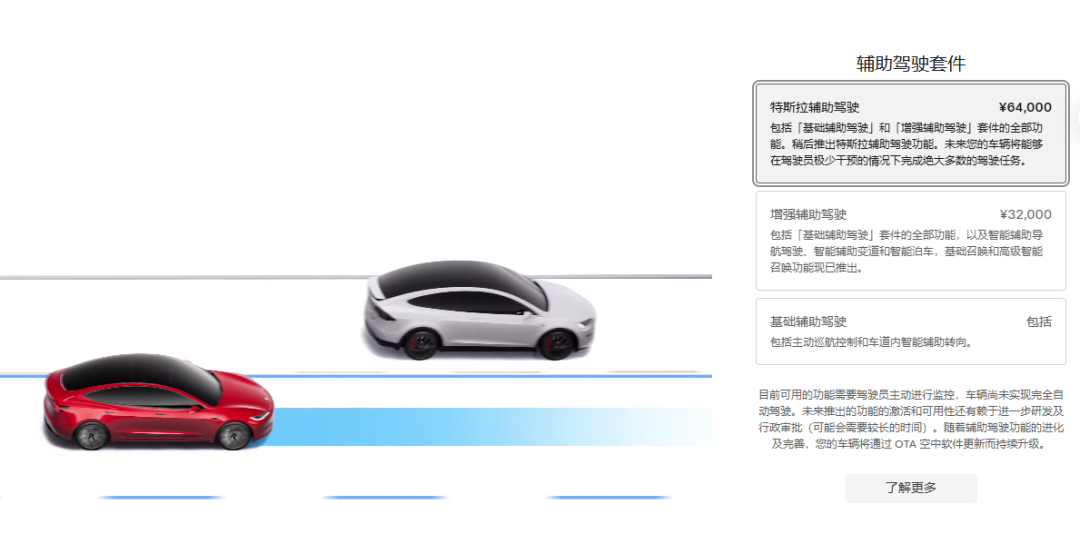
Image source: Tesla's official website
Has Tesla's FSD Launch in China Fizzled Out?
The controversy arose from an update to the list of regions eligible to subscribe to FSD Supervised on Tesla's North American official website.
The updated list revealed that only 12 regions worldwide currently offer FSD Supervised subscriptions: the United States, Canada, Mexico, Puerto Rico, Australia, New Zealand, South Korea, the Netherlands, Lithuania, Estonia, Denmark, and Belgium. Notably, China was absent from this list.
Some netizens interpreted this omission as Tesla abandoning its plans to launch FSD in the Chinese market, with the entry process grinding to a halt.
However, it is crucial to clarify that the list identifies regions where FSD Supervised "subscriptions" are currently available, which does not necessarily reflect all regions where FSD Supervised can be utilized. Currently, the FSD Supervised subscription service is not offered in the Chinese market, hence China's absence from the list.
At the same time, China remains listed among the regions where FSD Supervised is available on Tesla's U.S. official website.
Regarding the specific timeline for implementation, Tesla CFO Vaibhav Taneja disclosed during the first-quarter 2026 earnings call that Tesla has already secured some regulatory approvals in China and is collaborating closely with regulators to obtain "broader approvals." The company aims to officially secure full commercial licensing by the third quarter of this year.
In February of this year, Tao Lin, Tesla's Global Vice President, stated that while Tesla has not yet officially rolled out the "full-featured FSD" to Chinese users, the company has been continuously adapting it for the Chinese market. A training center has been established in China, and training capabilities tailored to the Chinese market have been deployed in advance.
In fact, Tesla has completed the core compliance preparations for FSD's entry into China. To align precisely with domestic regulatory requirements and eliminate conceptual confusion, Tesla's Chinese official website underwent a significant overhaul: English abbreviations such as AP (Basic Assisted Driving), EAP (Enhanced Autopilot), and FSD (Full Self-Driving Capability) were removed, and the original FSD functionality was officially renamed "Tesla Assisted Driving."
Meanwhile, to address the core issue of data compliance in domestic regulations, Tesla has constructed a comprehensive localized closed-loop system. The Shanghai Lingang Data Center has achieved in-country storage of over 3 billion kilometers of Chinese road data, strictly adhering to the regulatory requirement that critical data must not leave the country. A supporting local AI training center has been established and is operational, forming a complete chain of "data storage, local training, algorithm iteration, and global deployment." This effectively addresses the challenge of overseas algorithms not adapting well to local conditions and paves the way for the large-scale rollout of FSD.
"Steadily Progressing"
From a technical data perspective, Tesla remains a global benchmark in intelligent driving. As of May 2026, the cumulative global mileage of FSD has surpassed 10 billion miles (approximately 16.1 billion kilometers), with a major collision accident rate as low as one per 5.3 million miles, significantly outperforming human driver safety levels. Its algorithm maturity, scenario richness, and iteration speed continue to lead globally.
From a sales perspective, Tesla maintains a strong overall position. In July, Tesla's total deliveries, including exports, reached 93,579 units, setting a new monthly record. However, it is worth noting that the majority of these vehicles were sold overseas. Domestic total deliveries amounted to 27,249 units, with 25,158 units being Model Y and only 2,091 units being Model 3.
Industry analysts believe that the core challenges delaying FSD's entry into China lie in the cautious progress of regulatory approvals and the continuous refinement of localization adaptations, rather than the company voluntarily abandoning the market. The current domestic regulatory framework for intelligent driving is becoming increasingly comprehensive, imposing higher requirements on the promotional boundaries, data security, and accident liability allocation for advanced assisted driving. Tesla needs to complete full-process compliance adaptations. The claims of "data center shutdown and team withdrawal" contradict Tesla's actual actions of continuously expanding recruitment for intelligent driving R&D personnel and increasing investment in local road testing.
As competition in China's new energy vehicle market intensifies, high-level intelligent driving capabilities have become a core competitiveness for automakers. If Tesla can successfully obtain commercial licensing for FSD, it will not only complete the most crucial piece of its business puzzle in China but also compel the domestic intelligent driving industry to accelerate technological iterations.
-
![]()
Net Profit Surges 13.65% Year-on-Year! Yutong Optics Reports RMB 1.782 Billion in H1 Revenue
-
![]()
Q2 Net Profit Slashes Losses by 80%! Has Costar Emerged from Its Darkest Hour?
-
AI Agents: The Paradigm Shift from 'Conversation' to 'Execution'
-
NVIDIA Takes Bold Strides to Lead in Both Hardware and Software Realms
-
![]()
It's Hard to Build Cars, Even Harder to Build Humans, and XPENG is Doing Both
-
![]()
Valuation Soars by $57 Billion: Three Entrepreneurs Born in the 1980s Forge an AI Unicorn Now Suddenly on the Market
-
![]()
How Can We Achieve the Goal of 100,000 Hydrogen Vehicles by 2030?
-
![]()
July Online Market for Consumer-Grade Sports Cameras: Robust Double-Digit Growth in Sales Volume and Value, Mid-Range Products Fuel Market Expansion