How Can We Achieve the Goal of 100,000 Hydrogen Vehicles by 2030?
 08/28 2026
 468
468
On August 15, the Ministry of Industry and Information Technology (MIIT), the Ministry of Finance, and the National Development and Reform Commission jointly released a document. This document granted preliminary approval to five city clusters—namely, the Beijing-Tianjin-Hebei region, the Greater Bay Area, the Northeast (including Eastern Inner Mongolia)-Yangtze River Delta, Xinjiang-Chengdu-Chongqing, and the Yellow River Bend-Central Plains—to carry out comprehensive pilot programs for hydrogen energy applications over a period of four years.
In contrast to the previous round, which centered on the demonstration and promotion of fuel cell vehicles, this round places a greater emphasis on comprehensive hydrogen energy demonstration applications. The scenarios have expanded from transportation to multiple sectors, including industry, energy, and chemical engineering. However, the market remains highly attuned to the recurring question: How many hydrogen fuel cell vehicles can realistically be promoted in this round?
The answer can be found in two sets of data.
1
Two Sets of Data: Within and Beyond the City Clusters
First Set of Data: National Subsidy Allocation in the New Round of Planning
Based on the implementation plans for the city clusters, which have been approved by the five ministries and commissions, a compilation of hydrogen fuel cell vehicle promotion data for the five major city clusters has been made available in the market. This includes plans for 10,000 vehicles in Guangzhou, 6,000 in Beijing, 2,000 in Shanghai, 2,000 in Zhengzhou, and 1,000 or 500 vehicles in other cities, bringing the total to 34,100 vehicles.
These figures represent the planned number of hydrogen vehicles "within the city clusters" that are eligible for national subsidies.
Second Set of Data: How Many Will Be Promoted Outside the City Clusters?
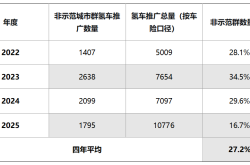
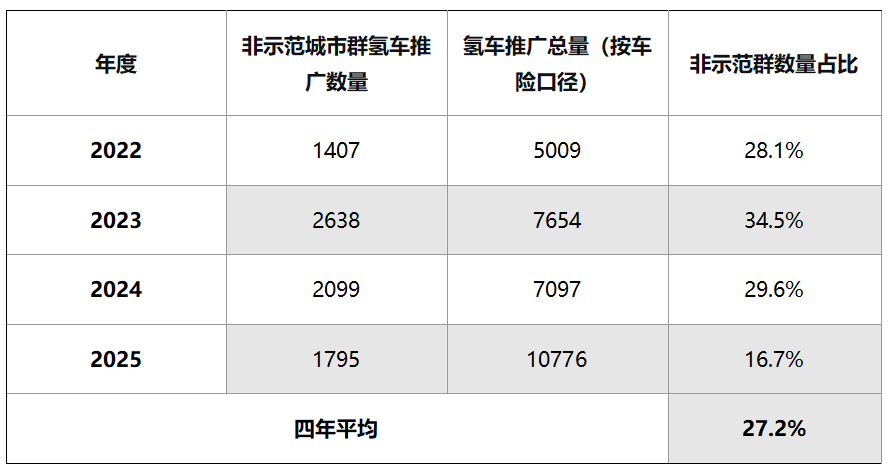
During the previous demonstration period (2021-2025), approximately 31,000 hydrogen fuel cell vehicles were insured nationwide. Among them, more than 25,000 were located within the five major city clusters, while about 6,000 were situated outside, resulting in a ratio of roughly 4:1 between vehicles inside and outside the clusters.
Source: Orion Hydrogen Energy Database
These data highlight a key fact: Even in the absence of national subsidies, certain regions are still proactively promoting hydrogen vehicles based on specific scenarios. For instance, in 2023, 2,638 hydrogen fuel cell vehicles were spontaneously promoted at the local level, accounting for 34.5% of the total 7,654 vehicles promoted that year (based on vehicle insurance data).
According to data from the Orion Hydrogen Energy Database, over the four years of the first round of fuel cell vehicle demonstration and promotion, the average promotion volume of hydrogen vehicles in non-demonstration city clusters was 27.2%.
2
First, Reduce Hydrogen Costs, Then Promote Vehicles on a Large Scale
So, how will the ratio of national subsidies for vehicles inside and outside the city clusters be determined in this new round of city cluster demonstrations?
Currently, there are three prevailing perspectives in the market.
Optimists believe that the industry has successfully navigated the technical verification phase, with national sales surpassing 10,000 units (10,782) for the first time in 2025. With cost reductions and mature application scenarios, local governments' enthusiasm for promoting vehicles is expected to grow, leading to a significant increase in the proportion of vehicles promoted outside the clusters or beyond national subsidies.
For example, in Guangzhou, according to the MIIT's comprehensive hydrogen energy application pilot, only 10,000 hydrogen vehicles are planned for promotion. However, the "15th Five-Year Plan" for Energy Development in Guangzhou envisions 50,000 hydrogen fuel cell vehicles in operation by 2030. Given that fewer than 3,000 hydrogen vehicles have been deployed in Guangzhou to date, this indicates a highly optimistic promotion plan.
The cautious camp points out that most regions eager to join the city clusters have already done so in this round. The policy incentives for the new round of demonstrations are waning, and with local financial constraints, the motivation for promotion beyond national subsidies may not be stronger, thus maintaining the proportion seen in the previous round.
The third perspective stems from regional structural observations: In this round of city clusters, major vehicle promotion cities such as Zhengzhou, Chengdu, and Chongqing (within the Chengdu-Chongqing cluster) have relatively low planned quotas compared to their industrial foundations, leaving room for surprises. Meanwhile, newly included regions like Xinjiang and Northeast China are focusing on green hydrogen production and industrial consumption, with vehicle promotion not being their top priority.
This round of demonstrations clearly establishes a target anchor point for hydrogen fuel cell vehicles: "striving to reach a national inventory of 100,000 units by 2030." By the end of 2025, the cumulative inventory of hydrogen vehicles is expected to approach 40,000 units, meaning an additional 60,000 units need to be completed in the next 4-5 years. The 34,100-unit plan within the clusters accounts for just over half of this target, placing a heavier incremental burden on regions outside the clusters.
Although only slightly over 1,000 hydrogen vehicles were promoted in the first half of this year during a policy lull, it's important to note that hydrogen fuel cell vehicles in China represent the most mature segment within the entire hydrogen energy sector in terms of industrialization, offering significant flexibility in vehicle promotion. The specific promotion volume hinges on the government's commitment to developing the hydrogen fuel cell vehicle industry.
Therefore, what will be the total promotion volume of hydrogen fuel cell vehicles in China by 2030? Orion Research Institute predicts that the 34,100-unit "national subsidy" base is likely to be achieved. The additional promotion volume beyond national subsidies will depend on the cost reduction of hydrogen and hydrogen vehicles, the expansion of application scenarios, and the government's assessment of the development trend of hydrogen fuel cell vehicles based on these factors.
If we refer to the 27.2% promotion proportion beyond national subsidies observed in the first round, then the share beyond national subsidies is expected to contribute to the promotion of nearly 10,000 vehicles. Adding this to the existing inventory of 40,000 units, the number of hydrogen vehicles in China could reach at least 84,100 units by 2030 (40,000 + 34,100 + 10,000 = 84,100).
It's worth noting that the number of hydrogen vehicles is just one aspect of the "four lists" in this round of demonstrations. The three departments are also evaluating hydrogen energy equipment research, industrial applications, and hydrogen refueling station construction. The core objective of the new round of demonstrations is to reduce the cost of terminal hydrogen use. If the terminal hydrogen price drops to around 25 yuan or even 15 yuan, the application of hydrogen fuel cell vehicles is poised to experience a significant surge.
Note: Articles from Orion Research Institute are original and not AI-generated. For more data, visit the Orion Hydrogen Energy Database. Orion has been deeply involved in the hydrogen energy industry for ten years, providing not only industry data but also consulting services, serving many top global clients in the hydrogen energy field. Welcome to communicate and experience the Orion Hydrogen Energy Database.
-
![]()
It's Hard to Build Cars, Even Harder to Build Humans, and XPENG is Doing Both
-
![]()
Valuation Soars by $57 Billion: Three Entrepreneurs Born in the 1980s Forge an AI Unicorn Now Suddenly on the Market
-
![]()
How Can We Achieve the Goal of 100,000 Hydrogen Vehicles by 2030?
-
![]()
July Online Market for Consumer-Grade Sports Cameras: Robust Double-Digit Growth in Sales Volume and Value, Mid-Range Products Fuel Market Expansion
-
![]()
A Hundred Billion Dollar Market! When Will the 'Golden Age' of Agentic AI Arrive?
-
![]()
Changzhou’s Wealthiest Woman Faces Unexpected Setback
-
![]()
FAW Seeks Efficiency Gains, Leapmotor Accelerates Expansion
-
![]()
Dual Leaders in Robot Vacuum Industry Look Overseas for Growth