July Online Market for Consumer-Grade Sports Cameras: Robust Double-Digit Growth in Sales Volume and Value, Mid-Range Products Fuel Market Expansion
 08/28 2026
 444
444
In July 2026, consumer-grade sports cameras witnessed a significant surge in demand, driven by the summer travel season, outdoor camping, and extreme sports activities. This propelled the online market into a phase of rapid expansion, with notable year-on-year increases in both sales volume and value. Simultaneously, the market's pricing landscape underwent a profound transformation, with mid-range products emerging as the primary catalyst for overall market growth.
I. Robust Double-Digit Growth in Online Sales Volume and Value, with a Structural Decline in Average Prices
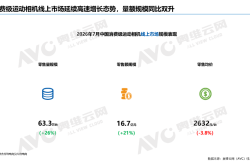
During July 2026, the online market for consumer-grade sports cameras experienced synchronized high growth in both sales volume and value. According to online monitoring data from Aowei Cloud Network (AVC), sales volume reached 633,000 units, marking a 26% year-on-year increase, while sales value soared to RMB 1.67 billion, up 21% year-on-year. The peak summer travel season, combined with the growing enthusiasm for outdoor sports, unleashed a concentrated demand for portable imaging devices, significantly expanding the market's scale. The slightly lower growth rate in sales value compared to sales volume can be attributed to a marginal decline in the average market price. In July, the average online retail price of sports cameras stood at RMB 2,632 per unit, down 3.8% year-on-year. However, unlike price declines in other categories driven by an influx of low-end products, the price drop in sports cameras was primarily a structural shift resulting from the rapid expansion of mid-range products. Overall, the industry remains on a healthy growth trajectory.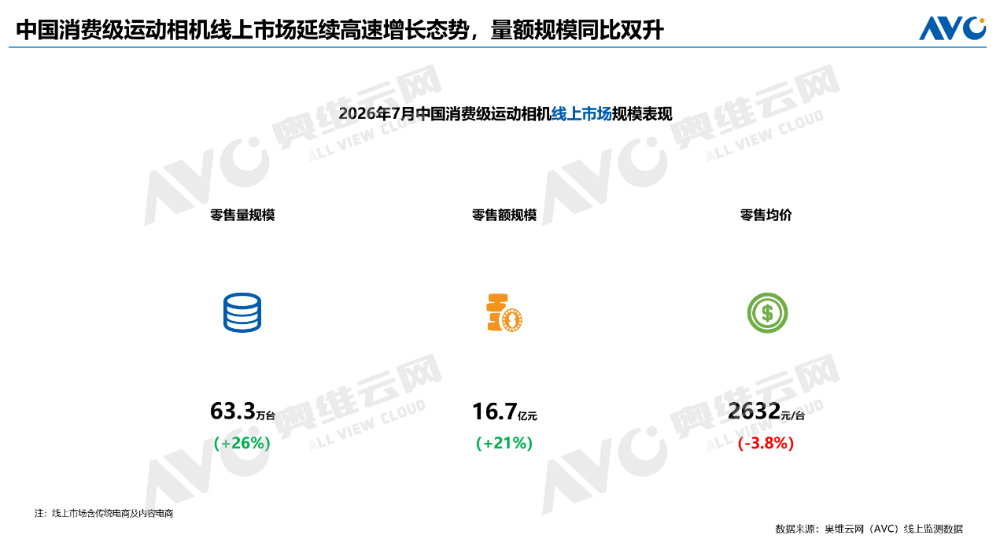
II. Profound Transformation in Pricing Structure, with Mid-Range Products Driving Market Growth
From the perspective of price segment distribution in traditional e-commerce channels, the sports camera market in July exhibited a clear pattern of 'mid-range expansion and contraction at both ends.' Mid-range products emerged as the absolute growth driver. According to Aowei Cloud Network (AVC) data, the sales volume share of the RMB 2,000-2,499 price segment reached 16.1%, a significant 10.5 percentage point increase year-on-year. The RMB 2,500-2,999 price segment accounted for 20.8% of sales volume, up 6.6 percentage points year-on-year, making it the highest sales volume share price range in the current market. Together, these two mid-range price segments accounted for over 37% of sales volume and 36.7% of sales value, with both volume and value growth rates surpassing those of all other price segments. In contrast, the high-end price segment experienced notable contraction. The RMB 3,000-3,499 price segment accounted for 16.7% of sales volume, down 5.7 percentage points year-on-year, while the RMB 4,000 and above price segment accounted for only 8.2% of sales volume, a 7.8 percentage point decrease year-on-year. Consumers now place greater emphasis on achieving a balance between overall experience, including image quality, stabilization, and battery life, and price. The low-end market also faced pressure, with the sales volume share of the sub-RMB 1,000 price segment at 11.4%, down 6.3 percentage points year-on-year. The sports camera market has not succumbed to a low-price spiral; instead, entry-level demand is shifting towards the mid-range, with consumers more willing to invest in mid-range products with reliable performance.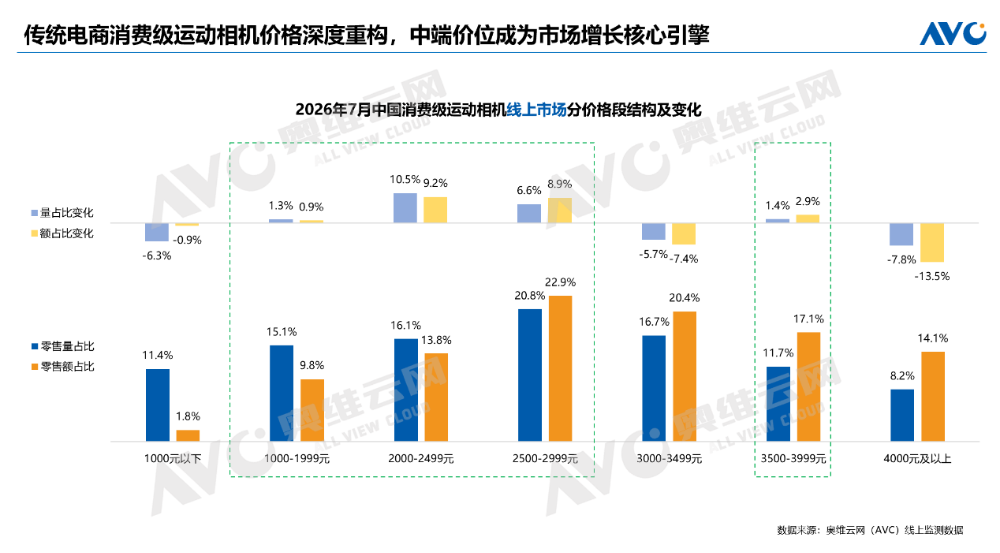
III. The Rise of Mid-Range Products: A Shift from Specifications to Experience
Overall, the growth dynamics of the online sports camera market in July are clear: summer scenario-driven demand fueled market expansion, mid-range products met the needs of mainstream consumers, and the market transitioned from a 'specifications race' to an 'experience-first' approach. The slight decline in average prices is a result of structural optimization rather than a sign of industry fragmentation. Looking ahead, with the continued penetration of scenarios such as Vlog creation and outdoor recording, the mid-range sports camera market still holds significant growth potential. The ability of brands to create hit products in the RMB 2,000-3,000 price range that combine image quality, stabilization, and intelligent experience will be crucial for competition in the next phase.
Unauthorized use or scraping of this article's content by any organization or individual for purposes such as training AI large models is strictly prohibited.
-
![]()
It's Hard to Build Cars, Even Harder to Build Humans, and XPENG is Doing Both
-
![]()
Valuation Soars by $57 Billion: Three Entrepreneurs Born in the 1980s Forge an AI Unicorn Now Suddenly on the Market
-
![]()
How Can We Achieve the Goal of 100,000 Hydrogen Vehicles by 2030?
-
![]()
July Online Market for Consumer-Grade Sports Cameras: Robust Double-Digit Growth in Sales Volume and Value, Mid-Range Products Fuel Market Expansion
-
![]()
A Hundred Billion Dollar Market! When Will the 'Golden Age' of Agentic AI Arrive?
-
![]()
Changzhou’s Wealthiest Woman Faces Unexpected Setback
-
![]()
FAW Seeks Efficiency Gains, Leapmotor Accelerates Expansion
-
![]()
Dual Leaders in Robot Vacuum Industry Look Overseas for Growth