Valuation Soars by $57 Billion: Three Entrepreneurs Born in the 1980s Forge an AI Unicorn Now Suddenly on the Market
 08/28 2026
 540
540

Cover | Graphic by Pencil News
The world's foremost open-source AI community is on the hunt for a buyer.
On August 24, Business Insider reported that Hugging Face, recognized globally as the largest open-source AI community, is considering a full sale with a valuation of at least $13 billion (approximately RMB 87.4 billion).
Established in 2016 by three French entrepreneurs born in the 1980s—Clément Delangue, Julien Chaumond, and Thomas Wolf—Hugging Face initially debuted as a chatbot tailored for teenagers. It subsequently made a complete transition into an AI development tool platform and has since grown into the world's largest open-source AI community.
Today, developers seeking open-source large models can rely on Hugging Face; those looking to download specific model versions like Qwen or DeepSeek can turn to Hugging Face; those in need of datasets for model training can find them on Hugging Face; and after training their own models, developers can upload them to Hugging Face for global download, modification, and further development.
"Three years ago, when investors inquired about Hugging Face, I mentioned it was likely to follow in GitHub's footsteps," Chen Ran, founder of the open-source AI community OpenCSG, shared with Pencil News. Just as GitHub was acquired by Microsoft, Hugging Face is also likely to be acquired by a tech giant because, on its own, "the B2B sector is challenging."
Despite the $13 billion valuation, an $8.5 billion increase from its last formal funding round (approximately RMB 57.1 billion), Chen Ran predicts the final sale price "will be higher, possibly reaching $15 billion or even $20 billion."
Because the acquisition is not merely a business decision—it's about pricing the distribution rights for open-source AI.
- 01 -High Traffic, Tough B2B
Why opt for a sale rather than an independent IPO?
Chen Ran believes Hugging Face faces the same issue GitHub did—its SaaS model is popular but not profitable.
In 2018, Microsoft acquired GitHub for $7.5 billion. GitHub, with 28 million developers and 85 million repositories, was the world's largest code hosting platform. Yet, its annual revenue was only about $200-300 million, and it had never turned a profit.
Why couldn't a company with such a vast user base generate more revenue? Because its most capable paying clients—banks, securities firms, insurers, and telecom operators—often opted for private deployments.
Rival GitLab capitalized on this by supporting private deployments and open-source routes, eventually going public. "This is very similar to GitHub's situation—high traffic, numerous users, significant industry influence, but lacking a robust B2B monetization model," Chen Ran remarked.
As of mid-2026, Hugging Face hosts over 3 million public models, more than 1 million datasets, and boasts nearly 15 million registered developers.
It also offers enterprise services, including Enterprise Hub, Inference Endpoints, and enterprise hosting, with over 30% of Fortune 500 companies having verified accounts. By user scale and ecological influence, it is undoubtedly the top platform in open-source AI.
But what about revenue? British media revealed earlier this year that Hugging Face adopts a freemium model, with only about 3% of clients paying—typically large enterprises.
Third-party estimates place its annual recurring revenue (ARR) between $100-130 million. Compared to its $13 billion valuation, the price-to-sales ratio exceeds 100x.
"Hugging Face was designed from the outset as a platform for millions or even tens of millions of online users—not as a company built around offline B2B needs. It's like a train suddenly being asked to become an electric car; you can't just swap a few parts—you'd need to rebuild it entirely."
Hugging Face now faces a situation nearly identical to GitHub's—enterprises increasingly prioritize data security and private deployments, meaning sales, security certifications, delivery, compliance, after-sales support, and extensive engineering work for client IT systems are required. A pure online SaaS model struggles to meet these demands.
"Why hasn't Hugging Face made hosting its core business? My understanding is that these individuals see a trend: more and more code will soon be generated by models and data, making [hosting] less essential," Chen Ran said. The rise of AI Coding and Vibe Coding supports this view, but by choosing this path, Hugging Face naturally hits a B2B ceiling.
- 02 -Pricing the Distribution Rights for Open-Source AI
Wang Tiezhen, former China head of Hugging Face, believes that viewing Hugging Face merely as a "model download site" greatly underestimates its value.
"The model library is just the most visible part. Beyond that, Hugging Face has done a lot of foundational work," he said, citing Transformers as an example. "Now it's not just an ordinary open-source library—it's increasingly becoming a foundational standard in the entire AI model ecosystem. When a new model architecture emerges, if it integrates with Transformers, many training, inference, and downstream tools can quickly support it."
This work may not be as flashy as training a 100-billion-parameter model, but its importance to the ecosystem cannot be overstated. Once a standard is established, it's hard to replace. 
Even more intriguing is Hugging Face's community culture. Wang recalled that during his tenure, most employees were engineers, and there wasn't a large traditional community operations team. Many engineers were community members themselves, communicating directly with developers, with discussions often happening on public channels like GitHub.
"So its ecosystem didn't emerge from 'operating a community'—it grew organically among developers," Wang said.
This is Hugging Face's most core and hardest-to-replicate asset. A company might spend money to build a model hosting platform or subsidize developers to upload models, but "developers' willingness to create on your platform" cannot be bought.
In open source, "he who wins developers wins the ecosystem." Having a large developer base on the platform is a massive strategic resource, even if it doesn't immediately reflect in revenue.
Microsoft's post-GitHub acquisition success with Copilot is a prime example. With GitHub and its vast developer ecosystem, Microsoft gained leverage in negotiating with AI companies and promoting programming tools.
"If you look solely at its current monetization capabilities, this price isn't low. But from the perspective of future open-source ecosystem competition, it's not high. Because future AI competition will heavily involve open-source competition—and open source relies on communities."
Chen Ran believes Hugging Face's $13 billion valuation isn't just that of a SaaS company—it's the pricing for distribution rights in the entire open-source AI ecosystem.
- 03 -Someone Sold for $8 Billion First
Five days before news of Hugging Face's potential sale, another significant deal closed.
On August 19, payment giant Stripe announced the acquisition of OpenRouter, an AI model routing platform, for over $8 billion. OpenRouter connects developers with over 80 model providers and 400+ models, handling unified calls, routing, and billing. The platform processes 10 trillion tokens daily, charging a 5.5% service fee on call volumes.
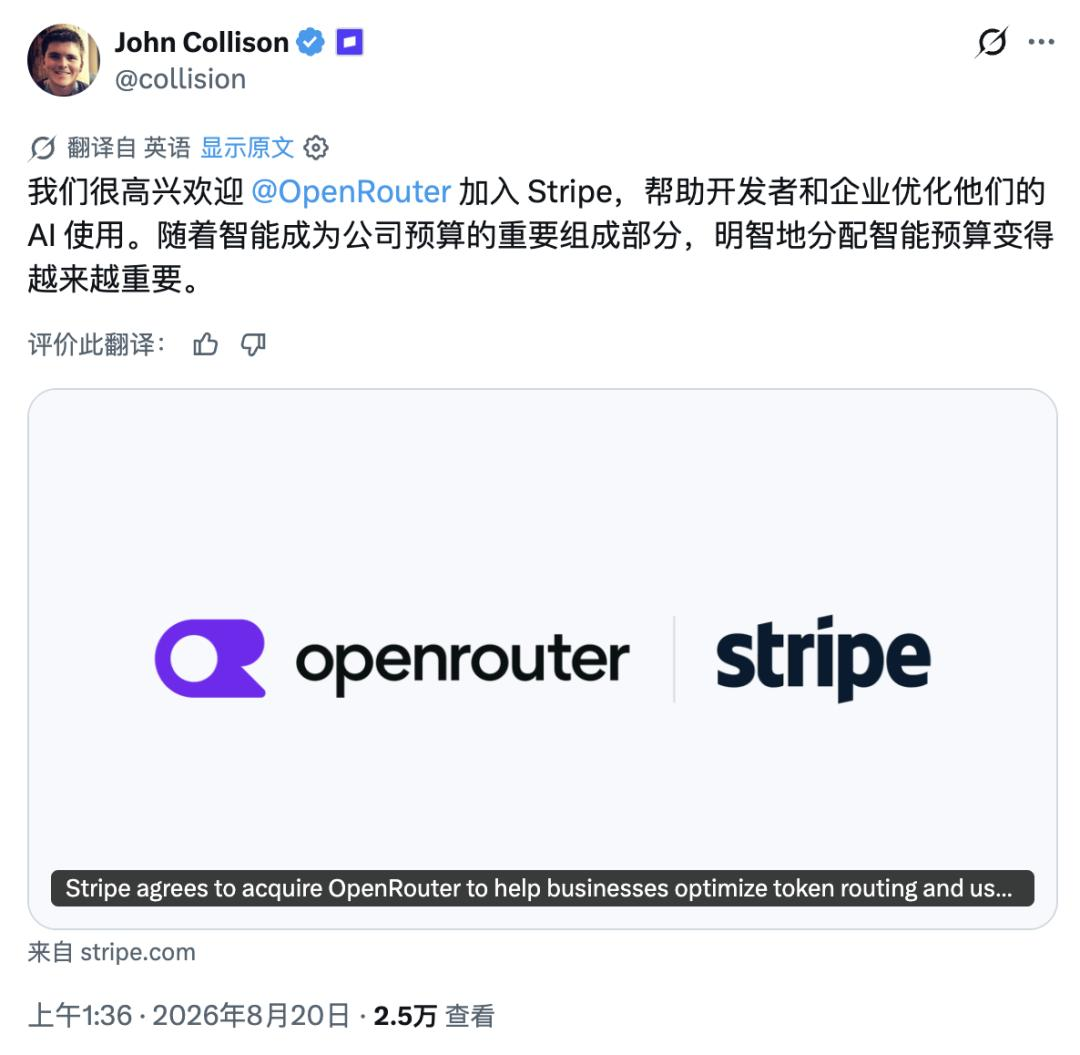
Five days later, rumors of Hugging Face's sale emerged. Together, the two deals exceed $21 billion, with both OpenRouter and Hugging Face experiencing rapid valuation growth.
This indicates that the value of AI's middle layer is quickly rising.
No potential buyers for Hugging Face have been officially disclosed, but market speculation centers on four candidates: Google needs an open-source AI developer gateway; Amazon AWS needs to deeply integrate open-source models with its computing power; NVIDIA needs to convert model demand into chip purchase orders, locking developers into the CUDA ecosystem.
"Selling to anyone might not be as good as selling to Google. Just as GitHub sold to Microsoft, Google desperately needs such a developer platform and community ecosystem," Chen Ran said. Once a tech giant's platform, model, and computing power capabilities align with Hugging Face's developer ecosystem, the value created could far exceed the acquisition price.
Microsoft's 2018 acquisition of GitHub for $7.5 billion offers the best parallel. GitHub was also unprofitable at the time, with a valuation far exceeding its revenue. But post-acquisition, Microsoft leveraged its developer ecosystem to launch Copilot, embedding AI capabilities directly into developers' workflows globally. Today, Copilot is one of Microsoft's most successful AI strategy implementations.
Hugging Face is on the same path. If any tech giant acquires it, they gain access to 15 million registered developers and 3 million models.
In 2018, Microsoft spent $7.5 billion to buy the gateway to the code era. In 2026, someone is willing to spend $13 billion for the gateway to the model era. The game has changed, but the underlying logic remains the same.
This article does not constitute any investment advice.
-
![]()
It's Hard to Build Cars, Even Harder to Build Humans, and XPENG is Doing Both
-
![]()
Valuation Soars by $57 Billion: Three Entrepreneurs Born in the 1980s Forge an AI Unicorn Now Suddenly on the Market
-
![]()
How Can We Achieve the Goal of 100,000 Hydrogen Vehicles by 2030?
-
![]()
July Online Market for Consumer-Grade Sports Cameras: Robust Double-Digit Growth in Sales Volume and Value, Mid-Range Products Fuel Market Expansion
-
![]()
A Hundred Billion Dollar Market! When Will the 'Golden Age' of Agentic AI Arrive?
-
![]()
Changzhou’s Wealthiest Woman Faces Unexpected Setback
-
![]()
FAW Seeks Efficiency Gains, Leapmotor Accelerates Expansion
-
![]()
Dual Leaders in Robot Vacuum Industry Look Overseas for Growth