Popular Science Essay | The Optical Principles Behind Artistic Expression: Perspective Imaging and Modern Light and Shadow Techniques
 04/02 2026
 446
446
The Optical Principles Behind Artistic Expression: Perspective Imaging and Modern Light and Shadow Techniques
Introduction The world we see every day is shaped by 'light,' and artists often have a more sensitive visual perception. Many well-known artworks actually have scientific optical principles behind them. Why does 'The Last Supper' so accurately reproduce the visual perception of the human eye? Where do the dappled light and shadow and the hazy sense of distance in Impressionist paintings come from? Why can modern light and shadow art installations achieve precise control over the color and shape of light beams? These seemingly artistic questions all have clear and specific optical mechanisms behind them. Artists do not write optical equations, but they have long been 'using' optics: Renaissance perspective relies on the geometric laws of pinhole imaging; the 'hazy sense' in Impressionism comes from the scattering of light by the air; and laser installations in contemporary art directly bring more complex optical principles such as interference and diffraction into the exhibition hall. This is an interdisciplinary popular science article that moves from optics to art. This article will attempt to explain, in a popular way, the physical processes behind three common artistic visual phenomena, allowing readers to understand how light makes images appear real, profound, and even dramatic.
Scientification of Space—Taking Da Vinci's 'The Last Supper' as an Example
When we look at a painting with a strong sense of space, it is easy to produce the illusion that 'the picture is like a window,' as if a three-dimensional room truly extends behind the canvas. Most paintings from the Renaissance period have this characteristic, which is precisely the 'immersive' effect created by linear perspective. It is not just a 'painting technique'; it is also a way to reconstruct the visual world using optical laws. As long as we understand how light travels from objects to the eyes, we can see why these paintings look so 'real.' The core idea of perspective is to have the picture simulate the path of light as it enters the eye (or a small hole). Imagine the painter's position as a small hole, and the canvas as a flat surface placed behind the hole. Light rays from objects at different distances will pass through this imaginary hole in straight lines and be projected onto the picture. Since objects farther away appear smaller and have smaller angular changes in the eye, the shapes on the canvas will naturally shrink with distance. In other words, the effect of 'distant objects appearing smaller' in perspective is not just an artistic convention but is inevitably produced by the way light travels in three-dimensional space. 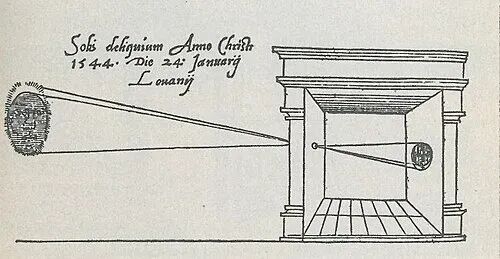
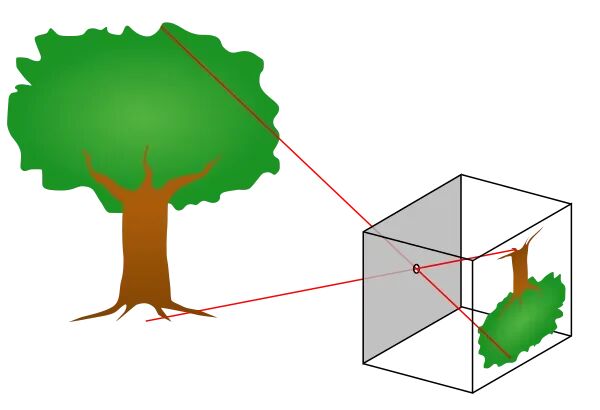
The same optical laws also explain why 'vanishing points' exist. In the real world, a set of parallel lines does not actually converge to a single point, but their light rays enter the eye at increasingly similar angles. Ultimately, when the difference in these angles becomes almost indistinguishable, they appear to 'converge' at the same point on the picture. This is the reason for the vanishing point—it is not an artistic fantasy but a physical response of the visual system to depth. Although the human eye relies on the lens rather than a pinhole for imaging, the way the eye records the direction of objects when viewing a large scene is almost identical to pinhole imaging. Therefore, when painters follow the laws of pinhole projection to draw perspective drawings, the picture will highly match the experience of the human eye viewing a real scene, giving us a natural sense of reality. 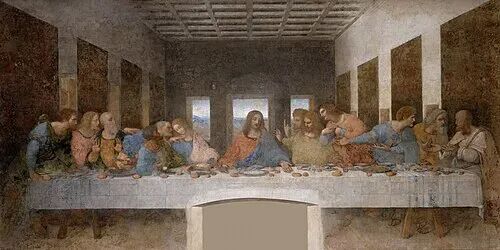
Figure 2. Leonardo da Vinci, 'The Last Supper' (The Last Supper, c.1495–1498) Image Source: Wikimedia Commons (Public Domain)
Let's return to Da Vinci's 'The Last Supper.' He arranged the extension directions of all architectural lines strictly according to projection laws, making them all point to the position of Jesus's head (this is the 'vanishing point'). The ceiling beams, wall decorations, table edges, floor brick seams... almost the entire structure of the painting is 'converging' to that one point. The viewer's gaze naturally falls on the central figure of the painting without any guidance. Here, perspective is not just a technique but a way to strengthen the theme's expression using optical mechanisms. The establishment of linear perspective allowed art to truly rely on scientific laws for the first time to depict space. It not only made the picture look realistic but also changed the way humans construct the visual world. It can be said that from perspective, artists and scientists reached a consensus on the same issue for the first time: to understand space, one must first understand the propagation of light.
Atmospheric Perspective: How Air Colors the Picture with 'the Color of Distance'—Taking Monet's Light and Fog as an Example
When we look at distant mountains, seas, or cities, we notice a common phenomenon: the farther the scenery, the blurrier, bluer, and more enveloped in a faint mist it appears. Artists do not blur the distant scenery based on intuition but are capturing the real changes that occur when light travels through the atmosphere. Air is not completely transparent; it is filled with molecules, dust, water vapor, and various particles of different sizes, which continuously scatter and absorb light, causing the scenery to exhibit systematic tonal changes as the distance increases. Many of Monet's works record these optical phenomena with a visual sensitivity akin to a 'scientific experiment.' 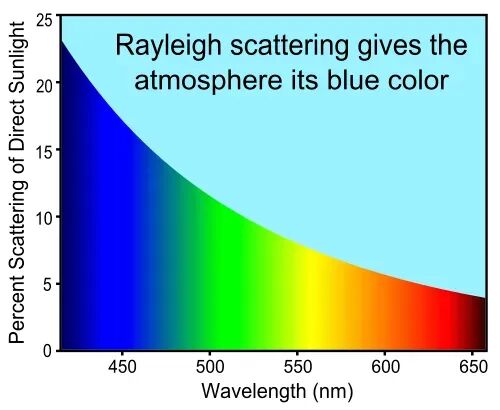
Air molecules are very small and are particularly prone to deflecting short-wavelength light, which is what we call blue light. When we look at distant scenery, this blue light is scattered in large quantities in the air, entering the eyes from all directions, while the light from the scenery itself decreases after traveling through a long distance of air. Therefore, the farther the object, the more likely it is to appear blue, gray-blue, or light purple. This is why distant mountains often appear 'blue' and why in Monet's 'Waterloo Bridge, London, at Sunset,' the bridge in the London fog seems to dissolve into the blue-purple air. A bridge that is clearly solid and distinct becomes soft and hazy in the painting because Monet depicted the light 'filtered' by the air, not the bridge itself. 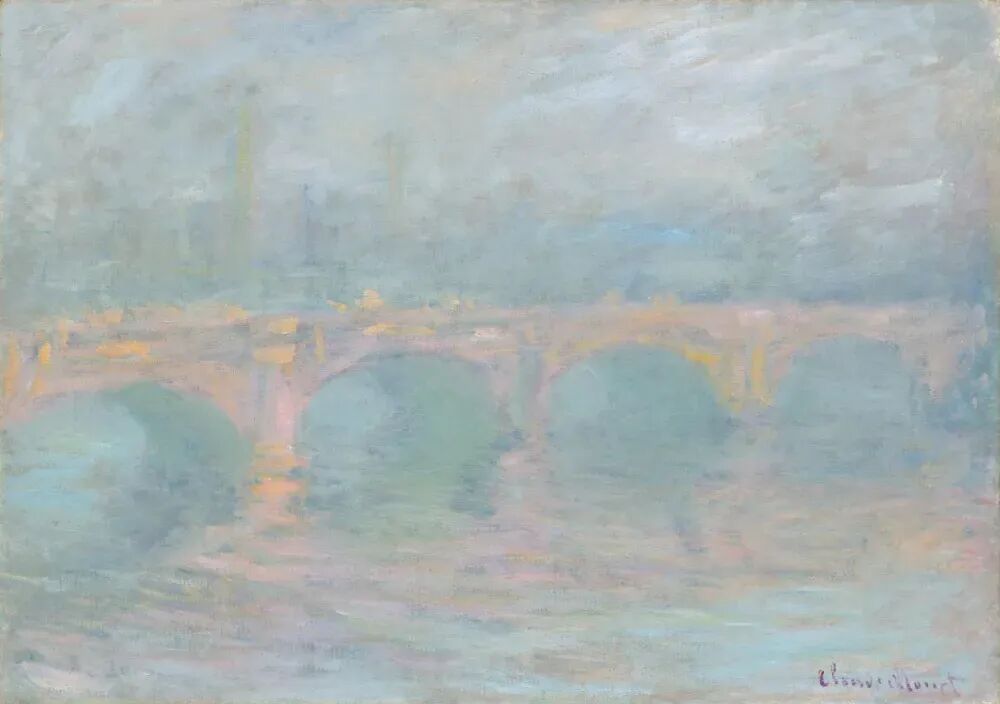
Figure 4. Claude Monet, 'Waterloo Bridge, London, at Sunset' [1904] Image Source: National Gallery of Art, Washington (Public Domain / Courtesy NGA)
But atmospheric perspective does not just make colors blue; it also makes the scenery fade, turn gray, and decrease in contrast. The particles in the air weaken the light from the object as it travels, while the 'air light' scattered into our eyes increases, narrowing the difference between the two. The edges of distant scenery naturally become less clear. This law of brightness fading with distance also creates a natural hierarchy between the distant and near scenery in the picture. When Monet depicted the coastline in 'Cliffs at Pourville,' he relied on this physical phenomenon: the nearby rocks have saturated colors and clear structures, while the distant sea and sky gradually merge, becoming lighter in color and lower in contrast, as if the air itself has become the protagonist of the picture. 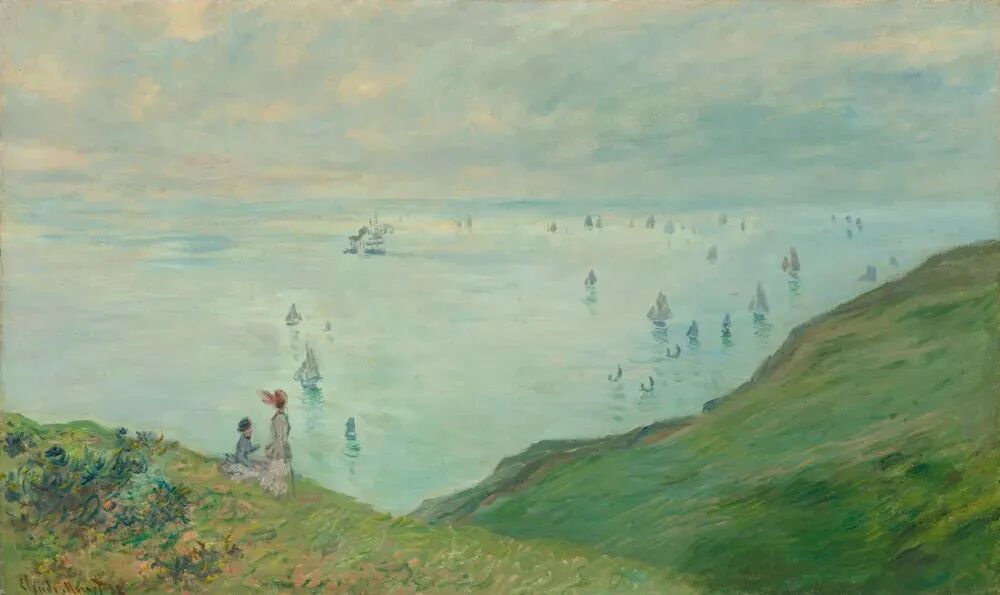
Figure 5. Claude Monet, 'Cliffs at Pourville' [2018] Image Source: National Gallery of Art, Washington (Public Domain / Courtesy NGA)
Besides molecular scattering, larger water droplets, fog droplets, or dust in the air produce another scattering mode—this scattering is not selective in color and makes the scenery appear hazy like white fog. This is why foggy scenery is not 'blue and hazy' but 'white and hazy.' Monet's 'London Series' was created in this highly humid and particle-dense air, capturing the changes in air color under different weather conditions: blue in sunny weather, gray in cloudy weather, white in foggy weather, and warm orange mist floating at sunset. This is not random color imagination but the real color changes that occur when light passes through different 'air media'—air itself becomes the palette. In other words, atmospheric perspective is not an artistic invention but a natural result of optical phenomena. The gradual fading, lightening, bluing, and softening of scenery are all processes of light being scattered, weakened, and redistributed as it travels through the air. Impressionist painters keenly realized that to depict the real world, one must not only paint the objects themselves but also paint the 'air.' They made the air a 'visible presence' in the picture, turning optical laws into perceptible color changes on the canvas. Monet's delicate capture of fog, humidity, air particles, and sunlight angles is a model practice of transforming the scientific process of light propagation into artistic language. Atmospheric perspective gives depth to a two-dimensional canvas, allowing viewers to read 'distance' from the color changes. In this regard, artists and physicists see the same thing: distance is quietly written in light by the air.
Lasers and Modern Light and Shadow Art: From Stimulated Emission to Light Field Design—Taking Matthew Schreiber's Laser Installations as an Example
At concerts, electronic music festivals, or stage shows, the most memorable elements are often not light bulbs or projection screens but the laser beams that can 'cut through the air.' The stronger the rhythm, the more they resemble sharp blades of light, slicing from the stage toward the audience; the slightly raised mist in the air makes the path of the light beams clearly visible, like a temporary 'architecture of light.' Everyone intuitively senses that this is not ordinary illumination but a visual force that directly acts on space. This strong spatial effect is what distinguishes lasers from all ordinary light sources. Laser beams have extremely pure colors and precise directions, and their paths can be 'seen' in the air and even manipulated like objects. Therefore, contemporary artists have begun to move lasers from the stage into exhibition halls, treating 'light' as a malleable material, allowing viewers to not just see light but to enter an environment composed of light. Among them, the works of American artist Matthew Schreiber are particularly typical. He utilizes the directionality, coherence, and spatial geometry of lasers to amplify optical phenomena originally found in laboratories to the scale of immersive experiences, allowing viewers to truly enter a 'space of light.' 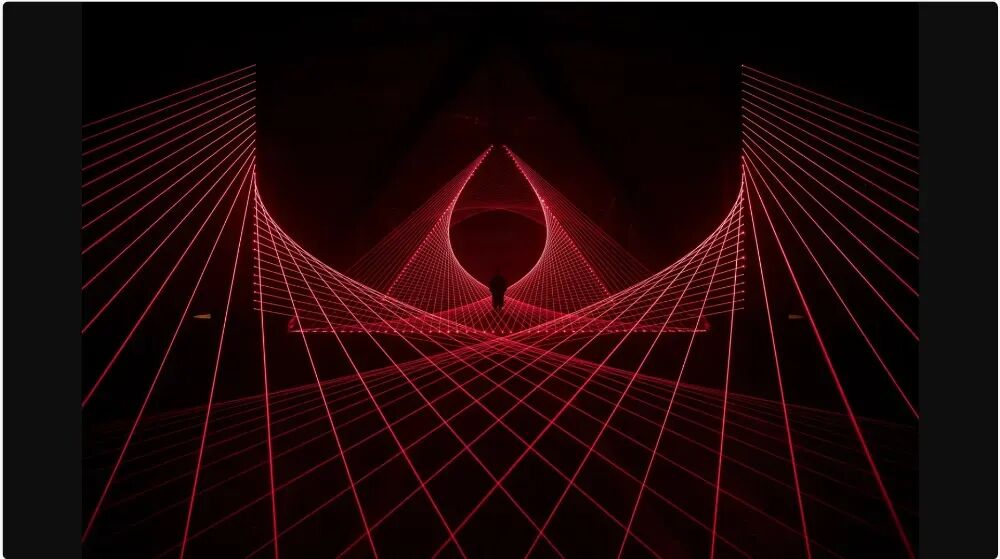
Figure 6. Matthew Schreiber, 'Leviathan' (2018) Image Source: Matthew Schreiber's official website Image © Matthew Schreiber (for academic citation) 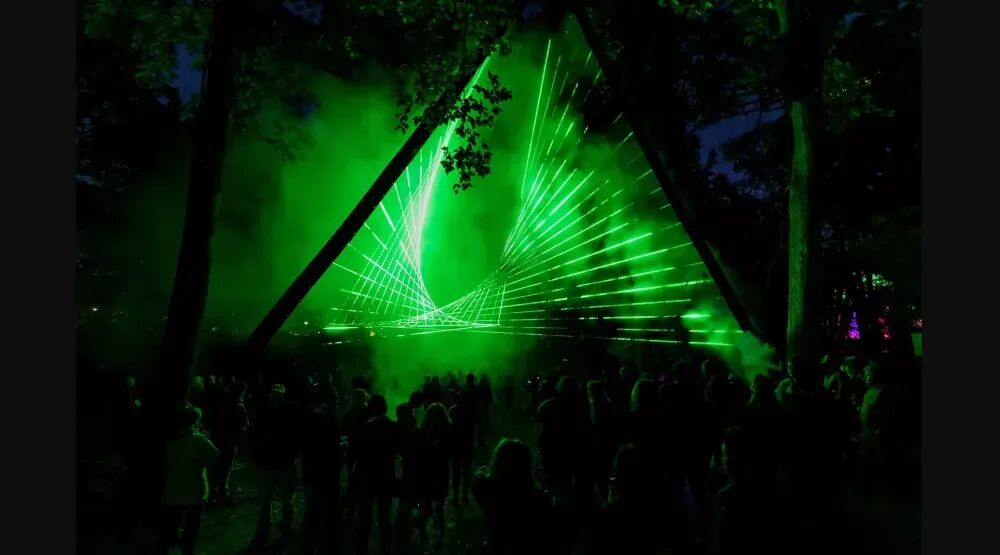 Figure 7. Matthew Schreiber, 'Gemini' (2018) Image Source: Matthew Schreiber's official website Image © Matthew Schreiber (for academic citation)
The Birth of Lasers: From 'Stimulated Emission' to Extreme Controllability of Light Beams
To understand why Schreiber can 'carve light,' we first need to clarify why lasers are completely different from ordinary light. The English acronym for laser, LASER, explains it very clearly: 'Light Amplification by Stimulated Emission of Radiation'—using stimulated emission to amplify light. Ordinary light comes from spontaneous emission, so each photon has a random direction and disordered phase; while light from stimulated emission is like being 'copied': when a photon with frequency ν hits an atom in an excited state, it induces the atom to release an identical photon—same direction, same color, same phase. 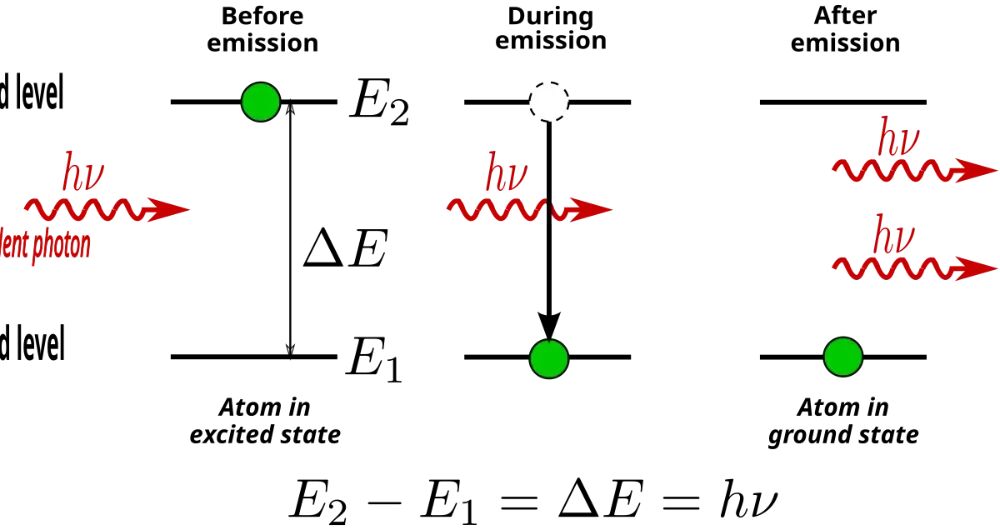 Figure 8. Energy level diagrams of stimulated emission and spontaneous emission. Source: Wikimedia Commons, author V1adis1av
This means that if a large number of atoms are in an excited state and stimulated by the same type of photon, they will continuously 'copy' identical photons. To achieve this, there must be more excited-state atoms than ground-state atoms, a state artificially created called population inversion. A laser uses an external pump (such as a flashlamp, electric current, or other light sources) to continuously 'push' atoms up, allowing stimulated emission to occur continuously. However, the 'copying' of light is just the first step. To give lasers extremely high directionality and color purity, a key structure must be used: the resonant cavity. A typical laser consists of two parallel mirrors, one fully reflective and the other partially transmissive. When light reflects back and forth in the cavity, only specific wavelengths that satisfy 2L = mλ (L is the cavity length) can form stable standing waves and be continuously amplified; light that does not meet the conditions is either canceled out or leaked out. In this way, almost all the remaining light is of 'the same color' and 'the same direction,' thus forming the familiar laser beam. 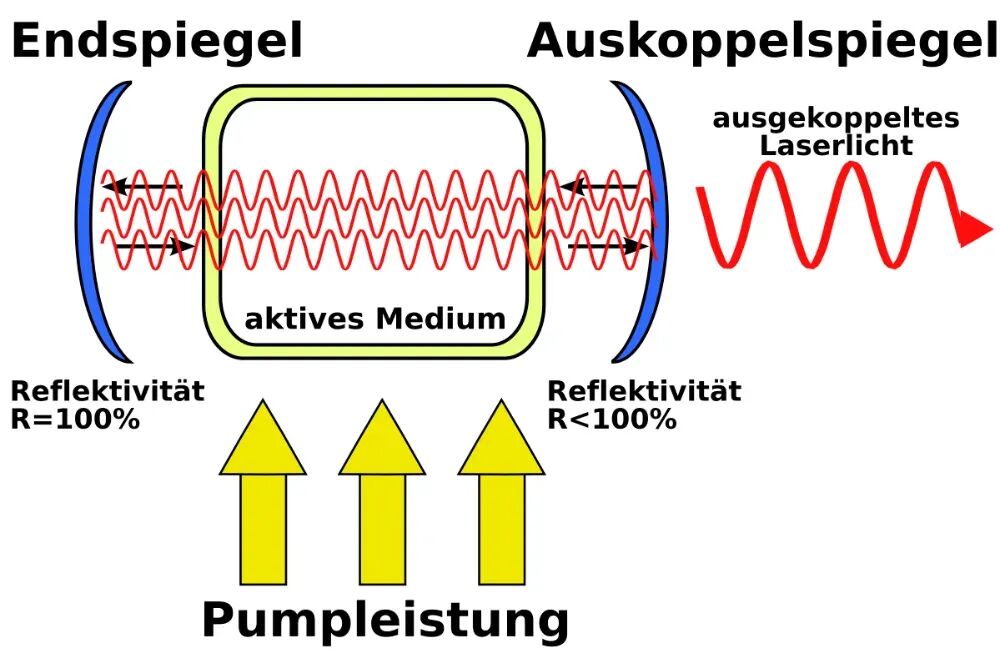 Figure 9. Schematic diagram of a laser resonant cavity structure. The gain medium is clamped between two reflective mirrors, and photons repeatedly reflect between the mirrors, undergo stimulated amplification, and are finally output through the partially transmissive mirror. Source: Wikimedia Commons, author Sgbeer, CC BY-SA 3.0
This is the most fundamental difference between laser and ordinary light: it is a group of strictly uniform photons 'forming a team' and moving in the same direction. This 'uniformity' gives the laser three major capabilities: pure color, extremely stable direction, and the ability to form a clear path in the air. These characteristics make it the most suitable light source for 'shaping'.
The Geometric Plasticity of Light: How Matthew Schreiber Makes Laser 'Form Structures'
If stage lasers demonstrate that lasers can 'draw lines,' Matthew Schreiber's works showcase that lasers can 'shape forms.' In the spaces he creates, viewers are no longer standing outside the light but directly entering geometric structures composed of light—as if an optical laboratory has been enlarged a hundredfold, immersing people within it. Schreiber's works typically take place in completely dark exhibition halls, with only a few dozen low-power lasers traversing the air. These beams are not randomly placed but are precisely calculated, combined with mirrors, refractors, and spatial sequences, allowing the light to form visible 'wireframes' in the air. In his works Leviathan (2018) and Gemini (2018), he makes light appear as both 'lines' and 'surfaces.'
The Directionality of Light: Treating Beams as 'Lines in Space'
Lasers have an extremely small divergence angle, meaning they barely spread out even over long distances. Thus, in Schreiber's works, each beam resembles a 'straightened' line segment, stretching from a corner to the ceiling or diagonally from the floor into the air. Viewers move among these straight beams as if navigating a transparent building constructed of light. If replaced with flashlights or car headlights, no matter how bright, they could not create this sense of 'geometric lines.' This is because ordinary beams diffuse too quickly to maintain clear boundaries in the air. Schreiber's use of directionality allows viewers to 'see the path of light'—an experience ordinary light sources can never achieve.
The Coherence of Light: Making Light Overlap into 'Thin Planes'
Beyond line segments, Schreiber also transforms light into 'films.' In Gemini, multiple lasers with consistent phases are arranged to form a thin, lightweight light curtain in the air. When viewers approach, they see an almost transparent 'light plane' floating gently. When a hand reaches into the curtain, the light splits and distorts like a curtain being parted, then recombines elsewhere. This effect is only possible with lasers because only coherent light can form stable interference in space, keeping the boundaries of the 'light curtain' clear. Ordinary light sources cannot maintain phase consistency, so no matter how bright, they cannot create a true 'thin surface of light' in the air.
Light as an 'Experiential Material'
In Schreiber's spaces, light is no longer just a medium to illuminate objects but an object worthy of 'approaching, touching, interrupting, and disturbing' in itself. The viewer's body position constantly alters how the light overlaps; even slight movements can create ripples in the light curtain. Thus, abstract physical phenomena—directionality, coherence, interference—become directly experienceable visual events.
The Significance of Laser Art: Making Optical Laws a Space to Enter
In Schreiber's light fields, what we see is not just a simple visual effect but a 'spatialized' presentation of optical laws. The physical properties of lasers themselves constitute the visual language of the works: monochromaticity makes the light appear exceptionally pure; directionality allows light to form thin, stable paths in the air; coherence enables light to overlap into surfaces, surfaces to fold into structures; airborne particles make the beams visible, forming 'light architecture.' These are not effects 'simulated' by the artist but the inherent appearance of physical laws. What Schreiber does is allow us, for the first time, to step inside and experience the behavior of light: watching it draw lines in the air, fold in space, and vibrate through interference. From stage performances to art galleries, from the microscopic process of stimulated emission to real-time interactions between the human body and light, lasers are shaping human understanding of space in an unprecedented way. If perspective helped artists understand 'how the human eye sees the world,' then laser art helps us understand 'how light itself constitutes the world.'
-
![]()
Market Share Dilemma: DJI vs. Insta360—Is It '40-40' or '60-30'?
-
![]()
Market Share Dilemma: DJI vs. Insta360 – A '40-40 Split' or '60-30 Split'?
-
![]()
It's Kunlunxin's Turn to Play
-
![]()
Is the New Performance Peak Just the Starting Point? What Will Be Crystal-Optech's Next Destination?
-
![]()
Goertek Pours 69 Million Yuan into Elite Precision: Ramping Up Optical Precision Manufacturing and R&D Capabilities
-
![]()
Avatr Attempts HKEX Listing Again, With 20,000 Vehicles Sold in First Five Months
-
![]()
NVIDIA Announces 10-Fold Production Capacity Increase in 2 Years, Disrupting the Energy Storage Industry
-
![]()
AI Enters the Second Half: Models Are No Longer Scarce, What’s Truly Scarce Are Computing Power, Scenarios, and Trust