Ultra Pure Inc. Bets Nearly 350 Million Yuan on Optics After Formal IPO Approval
 05/07 2026
 480
480
On April 30, during the 20th review meeting of the 2026 listing review committee for the Shenzhen Stock Exchange's ChiNext board, Chengdu Ultra Pure Applied Materials Co., Ltd. (hereinafter referred to as "Ultra Pure Inc.") successfully passed its initial public offering (IPO) review.
This marks a significant milestone, as Ultra Pure Inc. is the first domestic company to focus on "special coating components for semiconductor equipment" in its listing. It also highlights a burgeoning industrial trend that has remained relatively under the radar. The top priority in its fundraising plan is precisely the industrialization of core optical components for semiconductor equipment, with a proposed investment of nearly 350 million yuan, accounting for over 31% of the total funds raised.
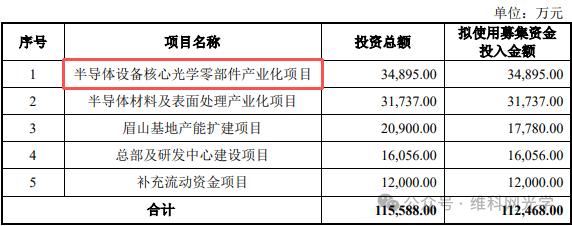
A company that has built a successful business model through coating technology is now placing its largest bet at this critical IPO stage on optical components—a decision that merits in-depth analysis.
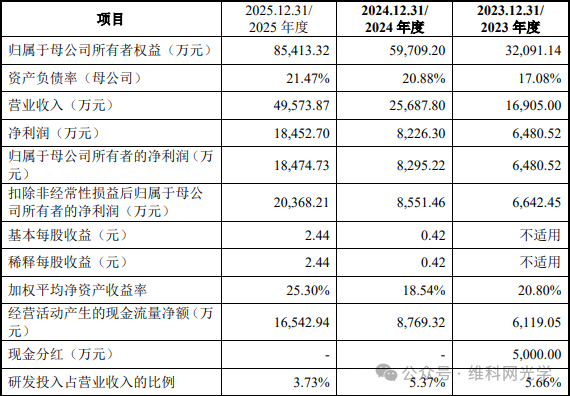
To understand this strategic move, we must first examine Ultra Pure Inc.'s fundamentals. Founded in 2005, the company has been deeply involved in the semiconductor coating field for 21 years. Its revenue has skyrocketed from 169 million yuan in 2023 to 496 million yuan in 2025, with a compound annual growth rate exceeding 71%. Net profit attributable to shareholders has risen from 65 million yuan to 185 million yuan, with a year-on-year increase of over 120% in 2025. Its gross margin remains stable at around 60%, an impressively high level for the manufacturing sector.
Technologically, Ultra Pure Inc. has achieved mass production of core components for 5nm and below advanced process etching equipment, making it one of the few domestic manufacturers capable of this feat. Its client base includes leading domestic semiconductor equipment companies such as Naura Technology Group and Advanced Micro-Fabrication Equipment Inc. (AMEC). Additionally, it has secured early investments from industrial capital players like BYD, Shangqi Capital (a subsidiary of SAIC Motor), and TCL Ventures.
According to Frost & Sullivan data, Ultra Pure Inc. ranked first in market share among Chinese domestic manufacturers in 2024, holding a 5.7% share in the Chinese mainland region.
However, taking a broader view of the entire industrial chain reveals that Ultra Pure Inc.'s core strength lies in material surface modification technology. By applying special coatings to metal or ceramic base components, it imparts extreme properties such as plasma erosion resistance, particle contamination resistance, high-temperature endurance, and low outgassing. These properties enable long-term stable operation under the extreme conditions inside semiconductor equipment chambers.
When this technological logic is extended, it becomes evident that it is not inherently limited to etching and thin-film deposition equipment. When precision and stability requirements are pushed to extreme levels, optical components face similar challenges. For example, windows, lenses, and mirrors in photolithography and etching equipment, which are directly exposed to plasmas or corrosive gases, also require special coatings to resist erosion and maintain stable optical performance. This demand has long been dominated by overseas suppliers, which forms the underlying rationale for Ultra Pure Inc.'s foray into optical components.
Judging from the historical evolution disclosed in the prospectus, the company has long accumulated technical expertise in precision optical devices. Notably, the current scale of its precision optics business remains small and even in a relative contraction phase. This is not due to a decline in technical capability but rather because the company has prioritized resource allocation to its core coating business in recent years to complete capacity ramp-ups and certification barriers for key clients. Consequently, the optical business has been placed in a reserve phase rather than a decline phase.
By designating optical components as the absolute focus of its fundraising projects, Ultra Pure Inc. is essentially migrating its existing core capabilities to new scenarios. It is pursuing a differentiated route that redefines the extreme performance of optical devices through material modification capabilities, first solving the problem of "whether it can survive inside the chamber."
For the optical industry, the implications for valuation logic may be even more profound. If Ultra Pure Inc.'s optical fundraising projects are successfully implemented and semiconductor clients are onboarded, coating processes will no longer be a subsidiary step for optical components but rather the core capability defining their extreme performance.
In the future, when capital markets evaluate a precision optics company, possession of "semiconductor-grade" process certifications will largely determine the benchmark for assessing its technological value. This shift in perception is expected to prompt capital to re-evaluate the value distribution across the entire precision optics sector, elevating semiconductor-grade optical components from a niche category to center stage.
Of course, any optimistic narrative must be examined within realistic parameters. Judging from Ultra Pure Inc.'s current revenue structure, income from special coating components accounts for over 95%, while the precision optics business remains small.
During the listing committee meeting, inquiries directly targeted R&D investment issues. The company's R&D expenditure ratio is lower than the industry average, and whether its ongoing projects and technical reserves can support sustained pursuit of overseas giants will be a key metric to monitor post-listing.
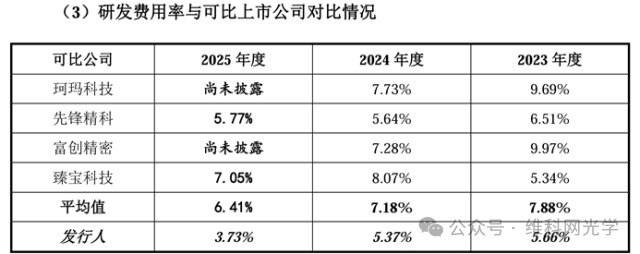
However, the value of direction often outweighs speed. When a coating company solemnly elevates optical components to the center stage of its IPO fundraising plans, it may signal that a new product category is quietly entering the main battlefield of domestic substitution.
Whether optical companies can leverage this round of capital catalysis to leap from traditional optical sectors into the core semiconductor industrial chain is a question that OFweek Optical will continue to track.
-
![]()
Hunan’s Wealthiest Entrepreneur Eyes Comeback with Apple’s Foldable iPhone
-
![]()
Planning to Secure 1.055 Billion Yuan to Propel AR Optics Forward! Lante Optics Receives Green Light for Private Placement on the Science and Technology Innovation Board
-
![]()
MiniMax: At the Heart of the AI Maelstrom
-
![]()
Securing 600 Million Yuan in Funding: This AR Optics Company Steps into the Limelight!
-
![]()
From a 706% Surge to a $340 Billion Market Cap Plummet: Has MiniMax's Moment Passed?
-
![]()
High Demand, Low Stock Price: Can the Emotional Companion Robot Ease UBTECH’s Worries?
-
![]()
Why Does Yin Qi, Who 'Doesn't Listen to Advice,' Insist on Making AI Agent Smartphones? | Interview with Jieyue Xingchen
-
![]()
AI-Generated Code Reveals Surprise That Thrills China