"The eVTOL Competition Intensifies: A Collective Emphasis on Financing, Orders, and Production Capacity | Low-Altitude Economy Annual Special No.04"
 01/30 2026
 828
828
By 2025, the low-altitude economy has evolved from a mere mention in the government work report at the start of the year to being designated as a strategic emerging industry in the "15th Five-Year Plan" proposals by year-end, marking its transition from a "nice-to-have" to a "must-have" sector. Conversely, capital investment is gradually cooling down, shifting its focus from speculative hype to intrinsic value. Given the rigorous stratification of low-altitude economy commercialization, we are launching the "2025 Low-Altitude Economy Annual Special" to delve into the fervor and challenges of the 2025 low-altitude economy through the lens of application scenarios.
In 2025, China's low-altitude economy has made a pivotal shift from policy-driven growth to systemic advancement. As a core component, eVTOL (electric Vertical Take-Off and Landing) has steadily advanced amidst policy support, technological breakthroughs, increased capital investment, and commercialization exploration.
The industry has moved beyond the initial validation phase of rapid growth and entered the realm of meticulous operation. Leading companies are now concentrating on airworthiness certification and production capacity expansion, accelerating the construction of ecological barriers, and continuously expanding application scenarios from pilot demonstrations to comprehensive urban coverage.
As the "15th Five-Year Plan" unfolds in 2026, this industrial revolution centered on the "third space" is nearing a critical inflection point for commercialization.
Dual Struggle: Scaling Up Amidst Growing Pains
In 2025, China's eVTOL industry is leading the global market with a growth rate significantly surpassing the global average, underscoring notable industrial agglomeration effects. Multiple authoritative sources indicate that the market size of China's eVTOL industry will reach RMB 12.8 billion in 2025, with the manufacturing and supply chain sectors alone surging from RMB 3.2 billion in previous years to RMB 5.75 billion, marking a year-on-year increase of 79.69%. The global eVTOL market size is projected to reach USD 7.85 billion, with expectations to soar to USD 32.68 billion by 2030, boasting a compound annual growth rate (CAGR) of 33.2%. Furthermore, data from the Civil Aviation Administration of China (CAAC) reveals that the operating revenue of eVTOL models with airworthiness certification in China has reached RMB 1.82 billion. Evidently, eVTOL, particularly in China, has emerged as the core growth engine for the global low-altitude economy.
Behind this explosive growth lies the collaborative empowerment of technological maturity, moderate opening of low-altitude airspace, and expansion of application scenarios. Industrial clusters centered around Shanghai, Shenzhen, and Hefei have begun to take shape.
The restructuring of the capital landscape is particularly noteworthy. In 2025, industry financing has officially entered a new phase characterized by collaborative efforts between "state-owned assets + industrial capital," replacing the previous short-term speculative model led by venture capital/private equity (VC/PE) and exhibiting distinct characteristics of centralization and long-term orientation.
Statistics show that the eVTOL complete aircraft R&D and manufacturing sector remains at the forefront, with 42 financing events accounting for 27% of the total. Projects in the middle to late stages, including B rounds and beyond, account for over 60%. Among them, there are 32 projects with financing exceeding RMB 100 million, collectively accounting for 40% of the total annual financing volume. Leading companies such as Aerofugia, Volant Aero, Tech-X, Zero Gravity Aircraft Industry, Manta Aircraft, Dream Chaser Aerospace, Weijian Aerospace, and Yidong Aerospace continue to secure substantial funding. Investors include top investment institutions, industrial capital, and local state-owned asset funds. In the fourth quarter alone, companies like Volant and Manta Aircraft completed multiple rounds of financing, with funds precisely directed towards key areas such as airworthiness certification, mass production preparation, and scenario implementation, forming a closed-loop industrial empowerment model of "capital empowerment + resource collaboration."
Despite the rapid growth, structural pain points in the industry persist, posing core constraints to large-scale implementation.
Firstly, the airworthiness and airspace management systems lag behind, resulting in lengthy certification cycles and high operational costs for manned eVTOLs, placing short-term profitability under pressure. The dilemma of "multi-department management and cumbersome approval processes" for airspace has not been fundamentally resolved, making it difficult to meet the high-frequency and immediate demands of low-altitude logistics and urban commuting.
Secondly, the supply of infrastructure is inadequate, with a scarce number of takeoff and landing sites lacking unified construction standards and an imperfect route planning system, which cannot support future large-scale operations.
Thirdly, there are shortcomings in technical performance. Most aircraft models face issues such as poor weather adaptability, limited endurance and payload capacity, and immature multi-aircraft collaboration technologies. High failure rates and maintenance costs make it difficult to meet the core commercialization requirements of "continuous, stable, and economical flight."
Fourthly, business models and industry standards have not yet taken shape. Application scenarios are still primarily government-procured public services, with insufficient cultivation of the C-end consumer market. Freight aircraft models need to overcome the cost and fare balance dilemma for ton-scale operations. Insufficient commercialization operations among enterprises and differentiated technological routes have led to rising costs in the industrial chain, constraining commercialization efficiency.
In 2025, China's eVTOL industry has achieved breakthroughs in scale and capital investment but remains constrained by multiple pain points. The competitive landscape in the industry has become clear, with leading companies leveraging their technological and capital advantages to break through using differentiated strategies.
From "Spring and Autumn" to "Warring States": The Differentiated Breakthrough Battle Among Leading Players
In 2025, the competitive landscape of China's eVTOL industry is accelerating towards clarity, transitioning from a "chaotic Spring and Autumn period" to a "fragmented Warring States era." Original equipment manufacturers (OEMs), including EHang, AutoFlight, and Aerofugia, are heavily investing in core areas such as complete aircraft manufacturing, flight control systems, electric propulsion technologies, and composite materials. Application scenarios are extending from single demonstrations to multiple fields including freight, rescue, cultural tourism, and commuting, indicating the initial emergence of a full industry chain competition.
EHang is capitalizing on its first-mover advantage by "trading time for space." As the first company in the world to achieve "four certificates" for eVTOL, EHang focused on commercialization operations and product iteration in 2025, deepening its "manned + cargo" dual-wheel drive strategy. Its EH216-S model has completed full airworthiness certification, while the VT-35 model has entered the certification process, maintaining a global lead in manned eVTOL commercialization. Leveraging its Hefei industrial base, EHang continues to strengthen production capacity construction, collaborating with local governments, operators, and supply chain partners to promote the large-scale implementation of urban air mobility and low-altitude logistics scenarios.
AutoFlight adheres to a pragmatic strategy of "cargo first, then passengers," achieving global breakthroughs in the freight sector in 2025. Its ton-class cargo eVTOL, the V2000CG, became the first ton-class or above model in the world to obtain "three certificates," securing 2,000 commercial orders throughout the year, including 300 confirmed orders, and achieving large-scale order conversion. In terms of scenario validation, AutoFlight completed landmark projects such as the nation's first ton-class unmanned eVTOL cross-Qiongzhou Strait transportation and cross-city low-altitude logistics flights in the Yunnan-Guizhou Plateau. It also released the world's first "marine-air integrated low-altitude economy solution," constructing a full industry chain ecosystem encompassing "R&D - production - operations - infrastructure."
Aerofugia, backed by Geely Group's capital support, focused on airworthiness certification and technological iteration in 2025. Its core model, the AE200 (a 5-6 seat tilt-rotor eVTOL), made key progress, with its Production Certificate (PC) application officially accepted in May, aiming to obtain the Type Certificate (TC) in 2026. Simultaneously, Aerofugia is laying out a synergistic industrial chain of "aviation + new energy," actively participating in the formulation of airworthiness standards, and deepening communication and collaboration with the Civil Aviation Administration of China to promote the implementation of scenario validation for medium and large manned eVTOLs.
Meanwhile, major OEMs in 2025 are focusing on four core areas: order expansion, production capacity building, financing implementation, and airworthiness certification, closely pursuing growth with pragmatic strategies and strong technological iteration capabilities. Companies such as Volant Aero and Tech-X have formed solid echelons, with impressive performances in overseas orders, continuously refreshing order volumes worth billions. Financing processes for companies like Manta Aircraft and Dream Chaser Aerospace have also accelerated, securing substantial funding. Several companies, including Zero Gravity, are precisely investing in production line implementation, supply chain perfection, and preparation for large-scale mass production, forming synergies with airworthiness progress.
Comparison of Selected Chinese eVTOL OEMs in 2025:
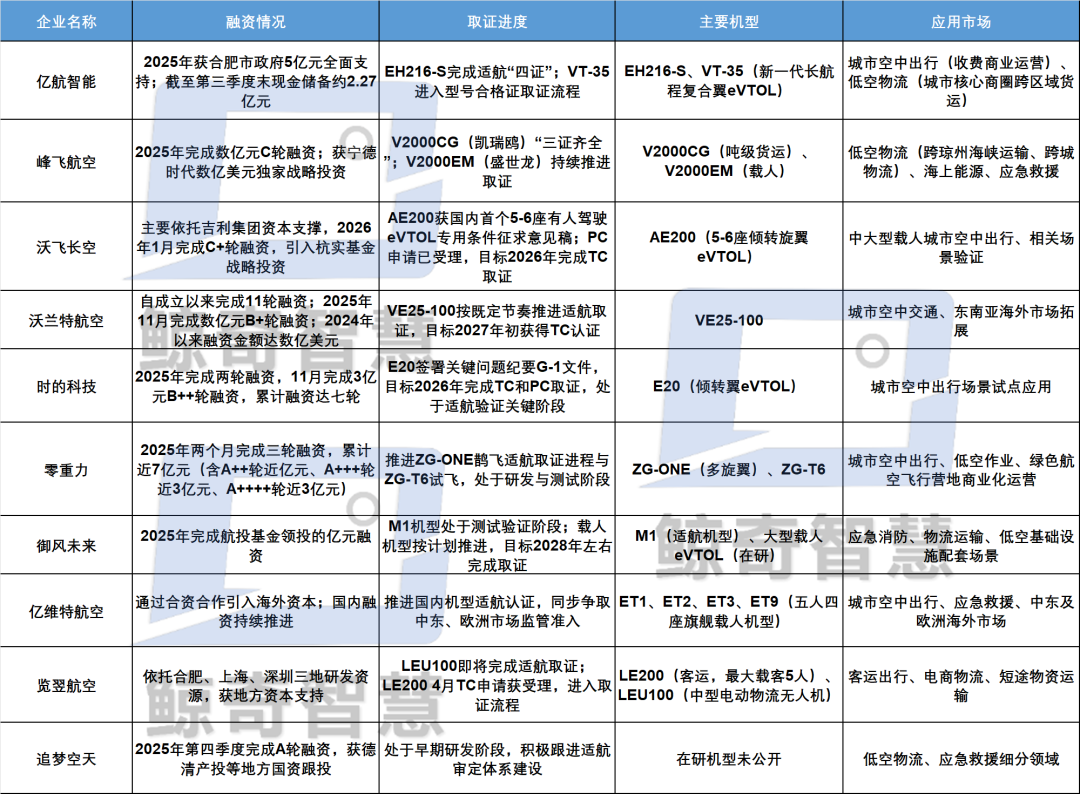
It can be said that the eVTOL industry is presenting a competitive landscape of diversity and strength. Leading and echelon companies are simultaneously seizing global opportunities, using overseas orders as a springboard to export Chinese technologies and products, and actively promoting mutual recognition of Chinese and foreign standards to lay a solid foundation for Chinese eVTOLs to enter the international market.
2026: Potentially the Inaugural Year of eVTOL Commercialization
As the inaugural year of the "15th Five-Year Plan," 2026 is widely recognized by the industry as the year when eVTOL commercialization will truly take off. By this time, eVTOLs will have transcended their status as mere aircraft, becoming a core hub connecting airspace management, smart transportation, and urban operational systems. The industry's competitive focus will shift from technological verification to commercialization implementation efficiency and market strategy optimization, with risk logic transitioning from technological risks to execution risks and cash flow management.
Integration across the entire industry chain will accelerate, with leading enterprises continuing to lead with their advantages in funding, supply chains, and airworthiness progress. Differentiated routes will become key for small and medium-sized players to break through.
Scenario implementation will witness a large-scale outbreak, with the B-end market taking the lead in breakthroughs and propelling the industry from "technological takeoff" to "industrial takeoff." Low-altitude logistics will serve as a core scenario, transitioning from cross-regional pilots to regular operations with the batch delivery of freight models such as AutoFlight's Kerry Orca and Lanyee's LEU100, covering areas including e-commerce logistics, medical supply transportation, and remote area resupply.
Among them, AutoFlight's "marine-air integrated" solution will accelerate its promotion, addressing transportation bottlenecks in coastal and island areas through "zero-carbon waterborne airports." Companies like EHang and Manta Aircraft will focus on constructing urban low-altitude logistics networks, achieving rapid distribution closed loops between core business districts and surrounding areas.
The emergency rescue scenario will undergo standardized and large-scale upgrades. eVTOLs will be widely applied in material delivery and personnel search and rescue during natural disasters such as earthquakes and floods, as well as in cross-regional medical emergency transportation. Government-enterprise collaborations will establish emergency rescue fleets and rapid response mechanisms. Simultaneously, relevant technical standards and operational norms will gradually improve, further enhancing rescue efficiency and safety, and becoming an important verification scenario for technological iteration.
The urban air mobility (UAM) scenario will see a continuous expansion of pilot ranges. Companies like EHang and Volant will launch routes between airports and city centers, as well as between scenic spots and urban areas, in core cities such as Shanghai and Shenzhen. Ticket prices for manned eVTOLs will gradually become more affordable, accelerating the cultivation of the C-end consumer market. Niche scenarios such as "eVTOL + low-altitude tourism" and "eVTOL + business travel" will emerge, forming diversified commercial operation models.
Furthermore, industrial application scenarios will continue to penetrate, with eVTOLs replacing traditional manpower in areas such as power line inspection, agricultural and forestry patrols, and border surveillance. Models like the ET3, in their pure electric and hydrogen-lithium hybrid versions, will achieve ultra-long endurance and all-weather operations, meeting the diversified needs of the public safety sector.
Globalization and Initial Public Offerings (IPOs) are set to emerge as the primary engines propelling the growth of Electric Vertical Take-Off and Landing (eVTOL) aircraft. Chinese eVTOL companies have already attained a competitive edge on the global stage, boasting superior technology and cost-effectiveness. This has spurred robust demand in burgeoning markets like the Middle East and Southeast Asia. On the financial front, pathways to capitalization are clearly delineated for enterprises through mechanisms such as Chapter 18C of the Hong Kong Stock Exchange and the Fifth Set of Listing Criteria on the Science and Technology Innovation Board. It is anticipated that within the next 1-2 years, 3-5 companies will make their debut on capital markets, thereby bolstering the industry's financing capabilities and enhancing its brand influence.
It is crucial to recognize that the commercialization journey of eVTOLs hinges on the collaborative endeavors of policymakers, regulatory bodies, enterprises, and ecosystem participants. On one hand, there is a pressing need to expedite the accumulation of airworthiness verification expertise and overhaul airspace management frameworks to pave a seamless path from model certification to operational permits. On the other hand, it is equally vital to concurrently progress the construction of takeoff and landing infrastructure, the deployment of charging and battery swap networks, and the refinement of operational maintenance service systems, thereby establishing a replicable and scalable commercial operation model.
The low-altitude economy demands "patience" and a commitment to long-term investment to surmount technological and institutional hurdles, enabling the industry to genuinely acquire sustainable "takeoff" momentum.
Whale's Perspective
By 2025, China's eVTOL industry will have accomplished a pivotal transition from technological research and development to commercialization pilots, marked by swift market expansion and the nascent formation of a competitive landscape led by industry frontrunners. Despite facing challenges such as inadequate infrastructure, technological bottlenecks, and nascent business models, the industry's underlying fundamentals continue to strengthen.
As the dawn of the "15th Five-Year Plan" breaks in 2026, with enhancements to airworthiness systems, breakthroughs in core technologies, and widespread scenario implementations, China's eVTOL industry is poised to embark on a new phase of high-quality development. It is on track to assume a leading role in the global low-altitude economy competition. For enterprises, the linchpin to success lies in concentrating on core technological innovation, deepening ecological collaboration, capitalizing on policy and market opportunities, and driving the evolution of eVTOLs from merely "able to fly" to "able to fly continuously, stably, and economically." This, in turn, will empower the low-altitude economy to serve as the cornerstone growth engine of national strategic emerging industries.
-
![]()
Net Profit Surges 13.65% Year-on-Year! Yutong Optics Reports RMB 1.782 Billion in H1 Revenue
-
![]()
Q2 Net Profit Slashes Losses by 80%! Has Costar Emerged from Its Darkest Hour?
-
AI Agents: The Paradigm Shift from 'Conversation' to 'Execution'
-
NVIDIA Takes Bold Strides to Lead in Both Hardware and Software Realms
-
![]()
It's Hard to Build Cars, Even Harder to Build Humans, and XPENG is Doing Both
-
![]()
Valuation Soars by $57 Billion: Three Entrepreneurs Born in the 1980s Forge an AI Unicorn Now Suddenly on the Market
-
![]()
How Can We Achieve the Goal of 100,000 Hydrogen Vehicles by 2030?
-
![]()
July Online Market for Consumer-Grade Sports Cameras: Robust Double-Digit Growth in Sales Volume and Value, Mid-Range Products Fuel Market Expansion