Guangzhou’s Inaugural Major Gathering of the New Spring: Four Pivotal Signs!
 02/28 2026
 733
733
On the ninth day of the first lunar month, Guangzhou hosted its ‘First Major Meeting of the New Spring’ for the fourth consecutive year. Just the day before, three special trains, carrying nearly 1,900 migrant workers, arrived at Guangzhou South Railway Station, marking the beginning of a new chapter.
On one side stands the bustling railway station, a symbol of mobility and opportunity; on the other, the Baiyun International Convention Center, a hub for intellectual exchange. These two scenes, intertwined, vividly depict Guangzhou’s essence in 2026: a city brimming with people, energy, and a sense of urgency to embark on new endeavors!
A Sprint from the Get-Go: Guangzhou’s ‘Triple Identity’
This year marks the commencement of the ‘15th Five-Year Plan’. At this crucial juncture, Secretary Feng Zhonghua clearly outlined Guangzhou’s aspirations: to establish itself as a ‘pacesetter, leader, and locomotive’.
What does this entail?
Being a pacesetter means pioneering new paths; being a leader entails effectively guiding the team; being a locomotive signifies possessing the power to pull and the speed to advance.
Secretary Feng succinctly put it: Guangzhou must cultivate an ambitious spirit, always striving for excellence, strengthening its resolve to achieve incremental success, and fostering a vibrant new atmosphere. In essence, Guangzhou must not only lead the race but also propel the entire province forward.
This year’s theme is equally captivating—‘concurrent growth of industry and commerce, fostering deep integration and collaborative development of the manufacturing and service sectors’.
Among China’s major cities, Guangzhou stands out as a unique ‘hexagonal warrior’—both a national advanced manufacturing base capable of producing automobiles, chips, and providing aircraft maintenance, and an international business hub.
At yesterday’s Guangdong Provincial High-Quality Development Conference, Provincial Party Secretary Huang Kunming underscored the need to ‘leverage manufacturing strength to drive service excellence and enhance manufacturing prowess through service excellence’.
Today’s Municipal High-Quality Development Conference also emphasized the key term ‘integration of the two industries’. Guangzhou will unveil an implementation plan to promote the integration of manufacturing and services, aiming to create a national-level demonstration zone for integrated development.
How will this integration unfold? An example will clarify. One might assume GAC Motor solely manufactures cars and Huawei exclusively produces smartphones. However, GAC and Huawei have launched the ‘Qijing’ project, with Huawei’s R&D team stationed directly in Guangzhou. The two companies have transcended a simple ‘buyer-seller’ relationship, becoming ‘co-dreamers’. This exemplifies the ‘embedded integration’ of manufacturing and services.

The Return of Talent: The Strongest ‘Start to the Year’
Who ultimately drives high-quality development? People.
Following the Spring Festival, Guangzhou is witnessing a large-scale influx of workers. According to data from the Guangdong Provincial Human Resources and Social Security Department, 94.0% of migrant workers who returned home for the Spring Festival in 2026 plan to resume their jobs afterward. It is estimated that by the Lantern Festival, Guangzhou’s return-to-work rate will reach 87.8%, on par with the previous year.
This represents an upgraded version of Guangzhou’s true ‘demographic dividend’. In the past, coming to Guangzhou might have meant working on an assembly line; now, it signifies pursuing careers in design, beauty, catering, or intelligent manufacturing.
Why are people so eager to return? Because there’s work to be done, money to be earned, and a bright future ahead.
This ‘sprint from the start’ mentality was already evident during the Spring Festival holiday. This year, Guangzhou welcomed over 20 million visitors, with a 14.3% increase in tourists from outside the province. Cultural and tourism spending surpassed 20 billion yuan. Guangzhou Baiyun International Airport became the first airport in China to handle over 5 million passengers during the Spring Festival travel rush, setting a new record.
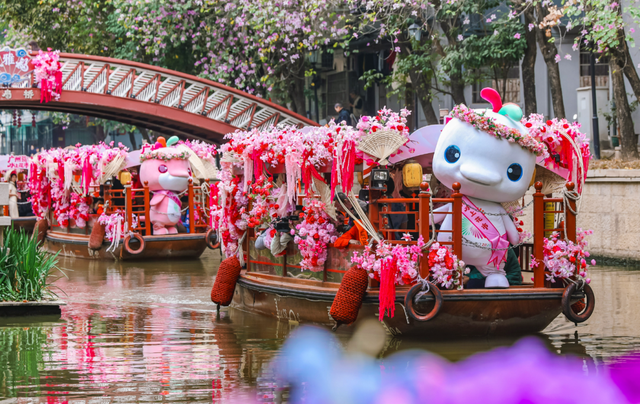
These vibrant figures represent Guangzhou’s optimal starting posture in the first year of the ‘15th Five-Year Plan’.

From ‘Single Focus’ to ‘Combined Strategy’
The most noteworthy aspect of this conference is the transformation in Guangzhou’s economic approach.
Secretary Feng Zhonghua proposed several robust measures in his speech:
First, implement the ‘Ten-Hundred-Thousand’ industrial project plan. Facilitate the landing of 10 billion-yuan projects, the expansion of 100 projects with investments exceeding 100 million yuan, and the ‘digital transformation and technological upgrading’ of 1,000 enterprises.
Second, accelerate AI empowerment across industries. Launch a campaign to scale up computing power, continuously build 10 AI service platforms, 100 vertical large models, and 1,000 typical application scenarios, and nurture the ‘AI + robotics’ industrial cluster.
Zhang Jianhua, Director of the Municipal Industry and Information Technology Bureau, stated at the conference that Guangzhou will seize the ‘key variable’ of AI, deeply implement the ‘AI + manufacturing’ initiative, and plan to allocate over 80% of industrial development funds to support ‘AI + manufacturing’ enterprise projects.
Third, explore new paradigms for commercializing scientific and technological achievements. Plan the construction of a ‘science and technology innovation special zone’. In simpler terms, Guangzhou aims to transform the entire city into a vast ‘experimental field’ where new technologies and products can be tested and validated.
Xie Ming, Director of the Municipal Science and Technology Bureau, also mentioned that Guangzhou will establish national-level technology innovation centers in fields such as brain-computer interfaces and high-end scientific instruments, promote the implementation of 100 future industry scenarios, and strive to create a national future industry pilot zone.
Fourth, create a fund matrix that invests early, in small-scale projects, for the long term, and in hard technologies, while supporting financial product diversification by institutions like the Guangzhou Futures Exchange.
For instance, if you’re developing robotics, Guangzhou offers ‘robotics +’ specialized scenarios; if you’re in ophthalmology, Guangzhou provides access to the country’s top specialized hospitals for applying ‘vertical models’. This ‘first-try, first-use’ boldness is highly appealing to hard technology enterprises.

Not Just Racing Ahead, But Going the Distance
2026 is not only the Year of the Horse in the lunar calendar but also the inaugural year of the ‘15th Five-Year Plan’.
At this pivotal moment, Guangzhou has not rested on its laurels as the ‘ancient merchant capital’ but has chosen a more arduous path—maximizing the potential of ‘concurrent growth of industry and commerce’.
The message is clear: in this foundational year, we must generate the momentum for a strong start; in this critical year, we must achieve pivotal breakthroughs.
Advanced manufacturing must ‘innovate’, transcending mere contract manufacturing to focus on R&D, standards, and branding.
Modern services must ‘take root’, moving beyond mere intermediation to focus on empowerment, ecosystems, and solutions.
In the past, it was ‘Guangdong goods going global’; in the future, it will be ‘Guangdong technology + standards + services going global’.
The hum of the return-to-work trains has not yet subsided, but the drums of the ‘First Major Meeting of the New Spring’ are already resonating. From Guangxi, Guizhou, and Yunnan to Guangzhou South Railway Station, from production workshops to R&D labs, from traditional manufacturing to artificial intelligence, Guangzhou is charging ahead at full speed on the new track of the ‘15th Five-Year Plan’.
In 2026, Guangzhou, this ‘horse’, must not only race ahead but also endure the journey.
-
![]()
Net Profit Surges 13.65% Year-on-Year! Yutong Optics Reports RMB 1.782 Billion in H1 Revenue
-
![]()
Q2 Net Profit Slashes Losses by 80%! Has Costar Emerged from Its Darkest Hour?
-
AI Agents: The Paradigm Shift from 'Conversation' to 'Execution'
-
NVIDIA Takes Bold Strides to Lead in Both Hardware and Software Realms
-
![]()
It's Hard to Build Cars, Even Harder to Build Humans, and XPENG is Doing Both
-
![]()
Valuation Soars by $57 Billion: Three Entrepreneurs Born in the 1980s Forge an AI Unicorn Now Suddenly on the Market
-
![]()
How Can We Achieve the Goal of 100,000 Hydrogen Vehicles by 2030?
-
![]()
July Online Market for Consumer-Grade Sports Cameras: Robust Double-Digit Growth in Sales Volume and Value, Mid-Range Products Fuel Market Expansion