In 2026, during the 'Warring States Period' of unmanned delivery vehicles, who will have the last laugh? Jiushi, Neolix, Bai Rhino, Cainiao, Xiaozhu, Banmo E-Travel, Mingwei, Desay SV, Zhuoyu, QCraft,
 03/02 2026
 803
803
Introduction
In late January, Jiushi Intelligence and Cainiao Unmanned Vehicles announced their 'integration', with Jiushi securing Cainiao's unmanned vehicle business and becoming the first unicorn in the unmanned delivery sector with a valuation exceeding 10 billion yuan.
In the same week, Xiaozhu Unmanned Vehicles, a subsidiary of Minieye, signed an order for 900 units, aiming to reach a fleet size of 10,000 by 2026. Newcomers like Banmo E-Travel and Mingwei Automobile made their debuts, while SF Express and China Post placed one large order after another.
If 2025 was the 'ignition year' for unmanned delivery, then the start of 2026 is a 'fanning the flames' melee.
But interestingly, the competition is no longer just about 'who delivers more' but has escalated to 'who operates better'.
Yu Enyuan, CEO of Neolix, hit the nail on the head: 'The race in 2026 is no longer about who delivers more but about who can provide customers with the best operational experience at the lowest cost.'
Unmanned Vehicles Are Coming (WeChat Official Account: Unmanned Vehicles Are Coming) believes that the shift from 'selling vehicles' to 'selling services' indicates that the unmanned vehicle war is entering deep waters.
(For further reading, please click: '2026: New Round of Financing of $300 Million! Jiushi Intelligent Unmanned Vehicle: The First Unicorn in the L4 Autonomous Driving Logistics Vehicle Sector with a Valuation Exceeding 10 Billion Yuan, Boasting the World's Largest Fleet of 20,000 Vehicles After Merging with Cainiao')
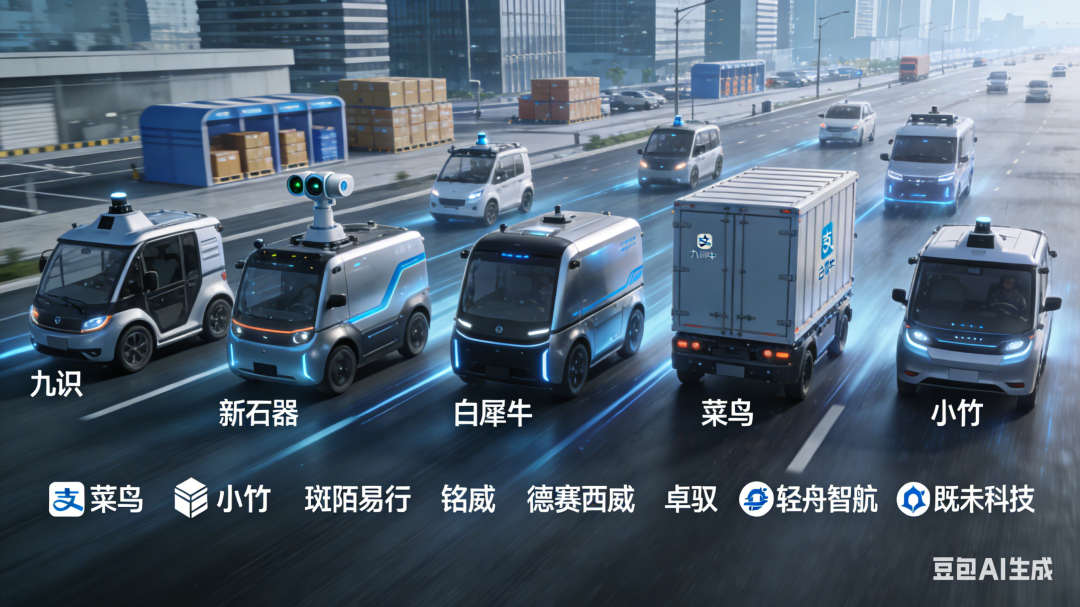
I. The Table Is Full: Players Expand from 'A Few Mahjong Tables' to 'A Hundred-Person Battle'
Let's first look at how many new players have joined the fray in the first month of 2026.
On January 29, Banmo E-Travel released its first logistics delivery robot, the T6. The background of this company is quite interesting—its parent company, Tuojiangzhe, originally specialized in intelligent remote operation of construction machinery, with business covering mines and ports.
The transition from mining to express delivery is quite a leap.
(For further reading, please click: 'Banmo E-Travel T6: The 'Dark Horse' of Unmanned Delivery Vehicles, Featuring a 6-Cubic-Meter Cargo Box, a 550 TOPS Hardware Platform, 360° Panoramic Perception, and a 'Lego'-Style Design! Should JD.com and SF Express Be Worried?')
On the same day, Jiangsu Heyi delivered its first batch of over 20 unmanned delivery vehicles to SF Express.
Xiaozhu Unmanned Vehicles, a subsidiary of Minieye, went even further, directly securing an order for 900 units in Hunan and announcing its goal of reaching a fleet size of 10,000 by 2026. Having partnered with Chery Commercial Vehicles in November last year, it has already launched operations in Suzhou, Jinhua, and Wuhu.
There's also Mingwei Automobile—previously focused on automotive design and components—which has now entered the market by releasing unmanned delivery vehicles, with its first batch of 50 Mingwei autonomous delivery vehicles officially deployed in Zhenjiang, Jiangsu, in January.
This doesn't even account for the passenger vehicle intelligent driving suppliers like Desay SV, Zhuoyu, and QCraft, which entered the market last year.
In September 2025, Desay SV's brand 'Chuanxing Zhiyuan' was officially launched in Shanghai.
Zhuoyu collaborated with leading commercial vehicle companies to jointly design and define unmanned logistics vehicles.
On January 23, 2026, QCraft announced its entry into the L4 unmanned logistics market, valued at trillions of yuan, while releasing its first mass-production-oriented unmanned logistics vehicle solution and the Robo-X autonomous driving open platform, marking a crucial step toward the large-scale commercial deployment of L4 technology.
From automakers to Tier 1 suppliers, from construction machinery to component design, players from various sectors are crowding the unmanned delivery sector, turning it into a 'rush hour'.
II. The Money Is in Place: Nearly 10 Billion Yuan in Financing, Over 10,000 Units Delivered
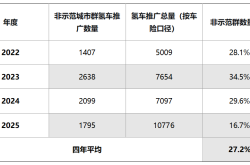
In 2025, the total financing in the unmanned delivery industry reached nearly 10 billion yuan.
Neolix completed two rounds of financing in 2025, totaling over 5 billion yuan, with its 600 million USD Series D round in October setting a new industry record.
Bai Rhino completed three rounds of financing during the year, totaling several hundred million USD, with investors including SF Express.
Jiushi Intelligence completed multiple rounds of financing, receiving continuous support from Ant Group and Meituan, with its Series B financing totaling 400 million USD.
(For further reading, please click: '2026: New Round of Financing of $300 Million! Jiushi Intelligent Unmanned Vehicle: The First Unicorn in the L4 Autonomous Driving Logistics Vehicle Sector with a Valuation Exceeding 10 Billion Yuan, Boasting the World's Largest Fleet of 20,000 Vehicles After Merging with Cainiao')
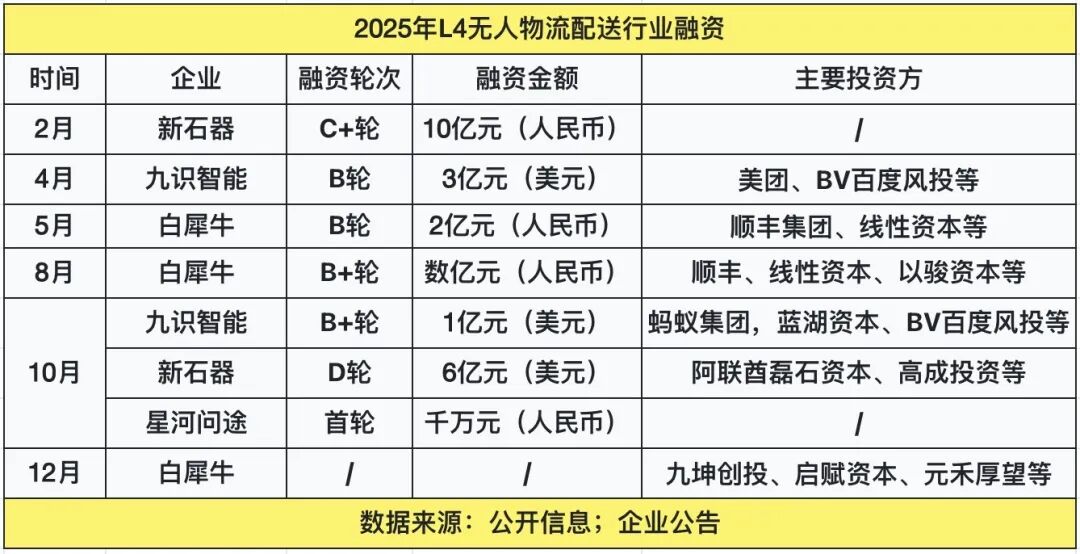
Image Source: Prepared by Liu Xi, Reporter from National Business Daily
The delivery volume of unmanned delivery vehicles is also surging.
In September 2025, Neolix announced that its cumulative deliveries had exceeded 10,000 units, with over 2,000 units delivered in a single month. That same month, Jiushi also announced it had surpassed 10,000 deliveries.
For reference, domestic sales of unmanned logistics vehicles were only 5,100 units in 2024.
(For further reading, please click: 'Neolix Unmanned Vehicle: From 0 to 10,000 Units in Seven Years of Technological Leap; From 'Express Delivery' to 'Urban Distribution': Layouting the 'New Battlefield' of Logistics; From Domestic to Overseas: Seizing 'Unique' Strategic Opportunities')
In January this year, Jiushi officially merged with Cainiao's unmanned vehicle business, resulting in a fleet size exceeding 20,000 units, covering over 300 cities in 20 countries worldwide.
Neolix, on the other hand, plans to deliver over 50,000 units in 2026.
III. The Price War Has Reached 'Loss-Leading Volume'
With the table full and the money in place, the next step is 'intense competition'.
In the second half of 2025, the price war in the unmanned delivery sector intensified. Industry insiders revealed that some players even engaged in 'loss-leading volume' tactics.
The prices of unmanned logistics vehicles have plummeted from hundreds of thousands of yuan to the 15,000-20,000 yuan range for some mainstream players.
(For further reading, please click: 'Jiushi Intelligent E-Series Unmanned Vehicle: Only 19,800 Yuan! Also Launching an Industry-Disrupting FSD (Fully Autonomous Driving) Monthly Subscription Service for as Low as 1,800 Yuan/Month')
The price of LiDAR has dropped to the 1,000-1,500 yuan range, a decrease of over 60% from early 2024.
But is this really a good thing?
Concerns are emerging in the industry:
Against the backdrop of companies investing hundreds of millions or even billions of yuan in R&D, extremely low gross margins per vehicle can easily trap companies in a vortex of 'increasing deliveries but not alleviating cash flow pressure'.
Guo Long, Vice President of Minieye, revealed that the company expects to sell tens of thousands of units in 2026, generating revenue of approximately 400-500 million yuan, with gross margins maintained at 20-30%. While this figure is not low for the hardware industry, whether it can cover R&D investments depends on scale.
IV. The Real Battlefield: Shifting from 'Selling Vehicles' to 'Selling Services'
Despite the fierce price war, smart players are already transitioning.
Neolix, in its delivery operations at a home textile and apparel warehouse in Nantong, Jiangsu, relies on cage vehicles for automatic loading and unloading, eliminating the need for manual high-intensity bending and lifting. This reduces the overall operation time by 1.5 hours and lowers comprehensive costs by 60%.
Its deployed vehicles also often operate at night, achieving a 24-hour increase in transportation capacity.
(For further reading, please click: 'Neolix Unmanned Vehicle Teams Up with Nantong Textile Finder: Using 260 Unmanned Vehicles to Achieve 1 Million Kilometers of Zero Accidents! From 'Tricycle-Clogged Cities' to 'The First Autonomous Driving Production City'?')
Jiushi launched the 'Jiushi Urban Distribution' APP, providing customers with one-stop services ranging from vehicle customization and delivery tracking to daily operational management.
During this year's Spring Festival, a fleet of Jiwei Technology's 'Ling Xiaoju' unmanned delivery vehicles quietly took over from couriers at YTO Express outlets in Qingdao and Yunda Express outlets in Baigou, Baoding.
Operating 24/7 from the 23rd day of the twelfth lunar month (Little New Year) until the 15th day of the first lunar month (Lantern Festival), these vehicles used their 'fully self-developed Linglong Architecture' to plan routes and traveled at 40 km/h between outlets and stations, delivering over 1,000 parcels per day and reducing last-mile delivery costs by 60%.
(For further reading, please click: 'Jiwei Technology Unmanned Vehicle: Operating 24/7 from Little New Year to the Lantern Festival, Reducing Last-Mile Delivery Costs by 60%! What Is the Charm of These 'Tech Fire Horses' That Never Stop During the Spring Festival?')
Minieye, through a tripartite strategic cooperation with Shenzhen Post and Eastern Bus, jointly launched unmanned logistics operations.
Chairman Liu Guoqing explained: 'Bus companies possess resources such as depots and charging facilities that are currently underutilized. Involving local bus or state-owned enterprises can not only activate their idle resources but also effectively reduce our comprehensive operational costs.'
These cases demonstrate that business models are shifting from mere 'whole vehicle sales' to diversified paths such as 'transportation capacity leasing, after-sales maintenance, and system services'.
V. The Cost Equation Is Clear: 4 Cents per Delivery
Operational data from Neolix in Qingdao shows that the preferential price for a single unmanned vehicle delivery starts at 9.9 yuan, with transportation costs being only 50% of traditional methods. Some business owners reported that their monthly logistics fees, previously five to six thousand yuan, have now dropped to just over two thousand yuan.
After Minieye's Xiaozhu Unmanned Vehicle was deployed in Xiangtan, a single vehicle could deliver up to 2,500 parcels per day, with the cost per parcel dropping to 4 cents, compared to over 10 cents in traditional models.
(For further reading, please click: 'Minieye: Xiaozhu Unmanned Vehicle Secures 100-Unit Order from Xiangjiang Intelligent! Previously, Minieye Successfully Launched Unmanned Minibus Operation Routes in Xiangjiang New Area, Hunan')
Jiushi's main model, the Z5, enables express franchisees to control the comprehensive monthly cost per vehicle (including depreciation, electricity, etc.) between 2,000 and 3,000 yuan, reducing the cost per delivery from 0.2 yuan to 0.1 yuan.
Behind these numbers, L4 unmanned delivery is transforming from a 'test product' into a 'productivity tool'.
VI. The Inflection Point Approaches: 30,000 or 100,000 Units?
Kong Qi, CEO of Jiushi Intelligence, once predicted that the industry might reach a turning point when over 30,000 unmanned logistics vehicles are operational nationwide.
ZoZocar Research comprehensively predicts that unmanned delivery vehicle shipments could reach 100,000 to 150,000 units in 2026.
However, there are concerns beneath the surface of prosperity.
Technologically, long-tail problems remain challenging—sensor failures in severe weather, human-vehicle interactions at complex intersections, and boundary recognition on unstructured roads. While these extreme scenarios account for less than 1% of cases, they consume over 90% of R&D investments.
Standardization-wise, the lack of unified access thresholds and road rights management rules nationwide, with varying requirements across regions, increases the cost of cross-regional scaled deployments for enterprises.
Operationally, the average daily utilization rate of vehicles in some deployed areas is less than 60%, making it difficult to sustain long-term profitability through mere equipment accumulation.
As Wu Shengyang, Secretary-General of the Hunan Provincial Express Industry Association, said:
'The current unmanned delivery industry is characterized by 'technology leading but standards lacking'. There is an urgent need to establish a three-tier standard system comprising national mandatory standards, industry guidance standards, and enterprise-specific standards.'
VII. Conclusion: Who Will Have the Last Laugh?
At the start of 2026, the unmanned delivery sector is already in a fierce battle.
With nearly 10 billion yuan in financing, over 10,000 deliveries, a surge of new players, and a price war pushing some to sell at a loss, the real competition has shifted from 'who delivers more' to 'who operates better'.
As Jiushi merges with Cainiao, as Neolix weaves an operational network of 1,200 vehicles in Qingdao, and as Minieye drives the cost per delivery down to 4 cents, these signals remind us:
Unmanned delivery is transitioning from a 'scale war' to an 'efficiency war'.
The deciding factor will not be who offers cheaper vehicles but who offers better-performing ones; not who raises more funds but whose services retain customers.
Whether it's Kong Qi's 30,000 units or Yu Enyuan's 50,000 units, they are just numbers. The real inflection point will come when 'unmanned vehicles' become 'everyday infrastructure'.
In short, Unmanned Vehicles Are Coming (WeChat Official Account: Unmanned Vehicles Are Coming) believes:
The 2026 war is not about unmanned vehicles but about the last mile of commercialization. Whoever can help customers crunch the numbers will survive the next decade.
What do you think, dear reader?
#UnmannedVehiclesAreComing #AutonomousDriving #SelfDriving #UnmannedVehicles
-
![]()
Net Profit Surges 13.65% Year-on-Year! Yutong Optics Reports RMB 1.782 Billion in H1 Revenue
-
![]()
Q2 Net Profit Slashes Losses by 80%! Has Costar Emerged from Its Darkest Hour?
-
AI Agents: The Paradigm Shift from 'Conversation' to 'Execution'
-
NVIDIA Takes Bold Strides to Lead in Both Hardware and Software Realms
-
![]()
It's Hard to Build Cars, Even Harder to Build Humans, and XPENG is Doing Both
-
![]()
Valuation Soars by $57 Billion: Three Entrepreneurs Born in the 1980s Forge an AI Unicorn Now Suddenly on the Market
-
![]()
How Can We Achieve the Goal of 100,000 Hydrogen Vehicles by 2030?
-
![]()
July Online Market for Consumer-Grade Sports Cameras: Robust Double-Digit Growth in Sales Volume and Value, Mid-Range Products Fuel Market Expansion