Zhongshan’s Pioneering ‘Vehicle No. 001’ Takes to the Streets: Collaborative Tech Showcase by Bai Rhino, Jishi Intelligence, and Neolix with Zhongshan Bus, SF Express, and China Post for a 22.4-Kilome
 03/19 2026
 714
714
Introduction
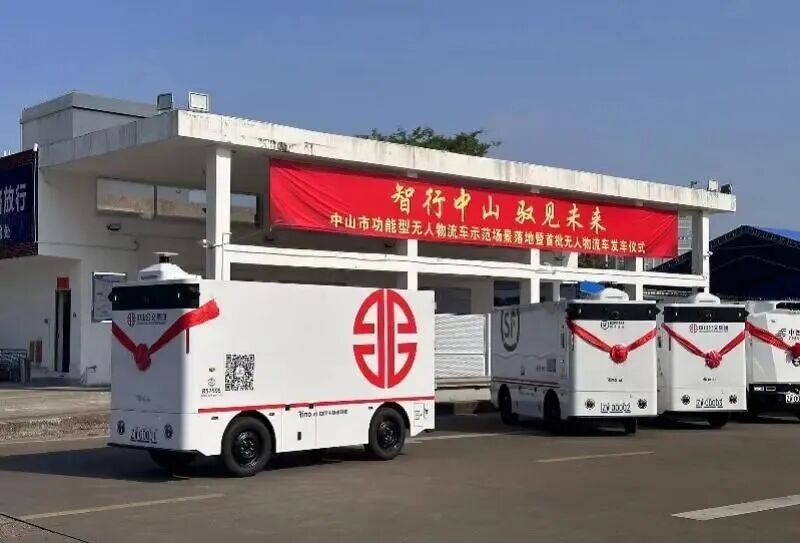
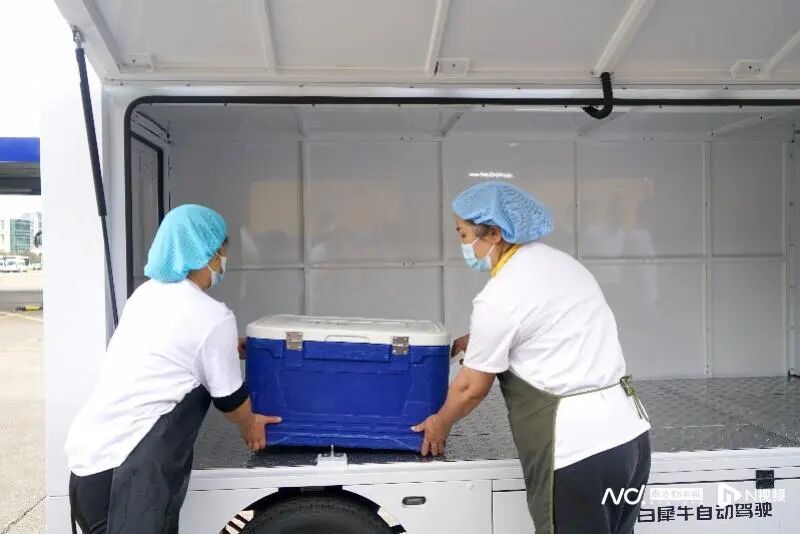
At 9:30 AM on March 18, a fleet of white autonomous logistics vehicles embarked from the Chengdong Bus Station of Zhongshan Bus Group. Their rooftop sensors sparkled under the clear sky, with the prominent license plate number ‘001’ leading the way.
These vehicles represent the first batch of operational autonomous logistics vehicles in Zhongshan to officially take on their roles. Covering four demonstration routes totaling 22.4 kilometers, they traverse the Huoju Development Zone and Cuixing New Area.
Three L4 autonomous driving companies—Bai Rhino, Jishi Intelligence, and Neolix Huitong—have teamed up with Zhongshan Bus Group, SF Express, and China Post to launch a live demonstration of ‘autonomous vehicles entering the city.’
However, the true highlight isn’t the start signal but the strategic ‘combination punch’ Zhongshan has delivered: integrating bus catering, express delivery, and instant logistics scenarios simultaneously, propelling autonomous vehicles from ‘pilot’ to ‘practical use.’
(For further reading, please click: ‘315 Special Report: Six Consecutive Months Zero Accidents! Jishi and Cainiao Operate Autonomous Vehicles with ‘Textbook-Level Safety’ in Shenzhen’)
I. The Special Mission of Vehicle No. 001: Delivering Meals to Bus Drivers
The most eye-catching aspect is the purpose of ‘Vehicle No. 001’—it undertakes the catering delivery task for the bus station.
This scenario is ingeniously chosen.
Bus stations feature fixed routes, relatively controlled road conditions, and consistent demand, making them ideal ‘training grounds’ for autonomous vehicles to transition into real-world operations.
Zhang Chi, Deputy General Manager of Zhongshan Bus Group, explained the rationale: blending the public welfare aspect of buses with the commercial value of logistics to ensure convenient travel for citizens while helping enterprises reduce costs and enhance efficiency.
In simpler terms, the strategy involves first automating logistics support at bus stations, refining the model, gathering data, and then expanding to more complex urban road conditions. This ‘point-to-area’ approach is far more cautious than immediately venturing into busy downtown areas.
II. Express Couriers Save an Hour Every Day
Now, let’s examine the express delivery scenario. Zhang Kai, Deputy General Manager of SF Express’s Western Guangdong Region, calculated: a single autonomous vehicle completes 4-6 daily trips, handling 250-500 parcels, significantly boosting delivery efficiency compared to traditional methods.
More importantly, autonomous delivery enables express couriers to save about an hour of commuting time daily, allowing them to focus more on door-to-door services and customer interaction.
What does an hour signify?
For couriers delivering over a hundred parcels daily, this hour translates to visiting dozens more households and reducing overtime by an hour.
As one courier on-site remarked, ‘The vehicle runs errands for us, while we run hearts for our customers.’
Bai Rhino’s R5 autonomous delivery vehicle is likened to a ‘seasoned driver’ who ‘understands traffic rules, follows instructions, yields when necessary, and provides appropriate reminders.’
Equipped with 360-degree sensors, high-definition cameras, high-precision positioning, emergency braking, remote monitoring, and commercial insurance—this setup ensures maximum safety redundancy.
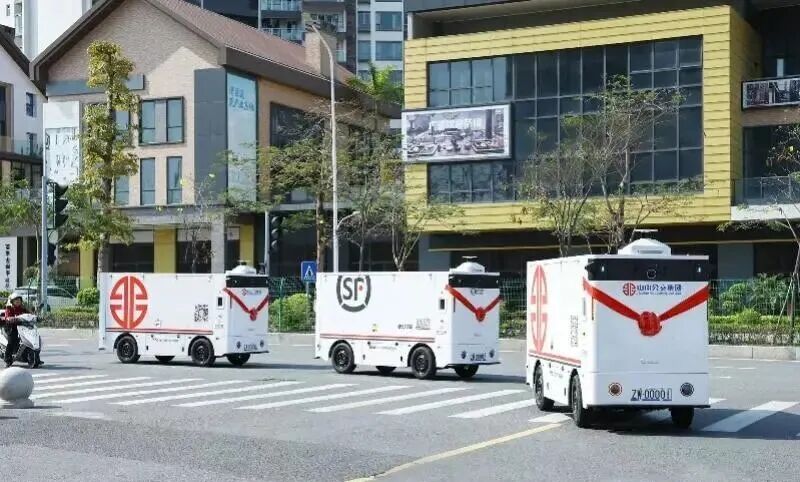
Jishi’s Z5 model, leveraging light map technology, eliminates the need for high-precision maps, with backend support available around the clock.
SF Express has ambitious long-term plans:
- Initially launch two routes each in Huoju and Cuixing, deploying four vehicles;
- Subsequently, as road access gradually expands, plan to deploy over 60 autonomous vehicles across more than 55 routes citywide.
From closed parks to the final 100 meters of building deliveries, from network node connections to mainline transit yards, a four-stage, full-scenario application is unfolding.
III. Instant Logistics: A Leap from ‘Planned’ to ‘On-Demand’
The most anticipated aspect is Neolix Huitong’s concept of ‘instant logistics.’
Li Ting, Head of Safety and Compliance for Neolix in Guangdong Province, explained it succinctly:
The core logic of instant logistics is to achieve direct, point-to-point delivery from end-user to end-user. Users place orders via a mobile app, and the autonomous vehicle retrieves the goods and delivers them precisely along the planned route.
This is entirely distinct from the current ‘planned logistics.’
Currently, most autonomous logistics vehicles operate on fixed routes, at fixed times, and at fixed stops, essentially replacing some manual transportation with machines.
Instant logistics, however, aims to be as responsive as ride-hailing—you want to send a package today, place an order on the app, and the autonomous vehicle arrives at your building independently.
Neolix has already successfully implemented this model in Qingdao, operating 2,000 vehicles.
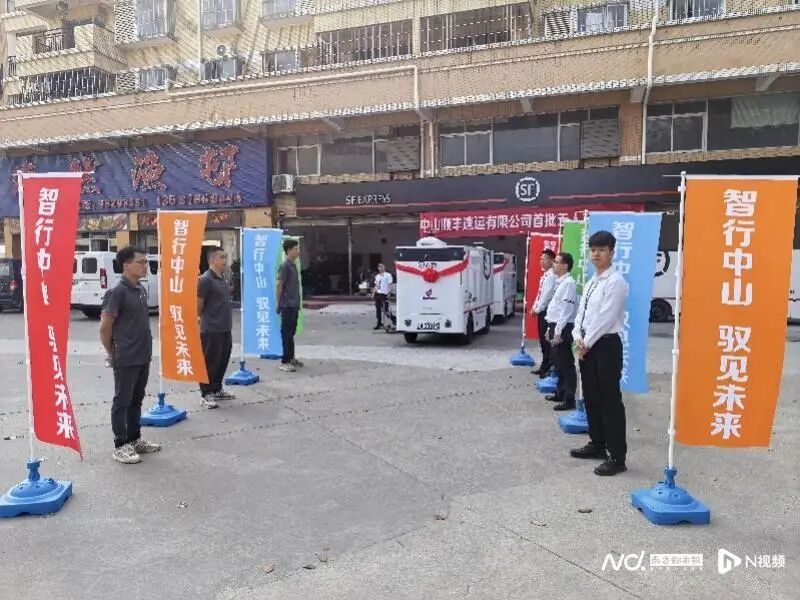
In Zhongshan, their goal is to launch instant logistics within this year, becoming the third city in Guangdong after Shenzhen and Foshan.
This requires not just technological advancements but also breakthroughs in road access policies.
Li Ting acknowledged that currently, most autonomous logistics vehicles in the province are approved for planned logistics, while road access approvals for on-demand logistics are still under exploration. Whether Zhongshan can lead the way is worth observing.
IV. The Symbolic Significance of Vehicle No. 001
Zhongshan’s acquisition of ‘Vehicle No. 001’ holds significant symbolic weight.
Since last year, autonomous delivery has flourished across the country: Foshan Nanhai issued the first license, Nantong put 300 vehicles on the road and began setting regulations, and Wuhan deployed 138 vehicles into the central city area.
But Zhongshan’s uniqueness lies in creating a model for integrating ‘bus + logistics’ scenarios.
Liang Jincan, Deputy Director of the Municipal Transportation Bureau, clarified:
- Formulated a trial method for assessing the impact of functional autonomous logistics vehicles on road traffic operations, creating a favorable environment for new technology implementation;
- Collaborated with local towns and streets to accelerate application deployment, further expanding open testing and demonstration application roads while ensuring safety and controllability.
This approach can be summarized in two sentences: establish regulations first, then gradually expand scenarios.
In short, ‘Autonomous Vehicles Are Here’ (WeChat Official Account: Autonomous Vehicles Are Here) believes:
When Vehicle No. 001 set off, it carried lunch for bus drivers. Although a small meal, it signals three things:
- Autonomous vehicles are no longer ‘exhibits’ but ‘tools’ running 22.4 kilometers daily, delivering meals and parcels;
- Closed and controllable scenarios like bus stations can serve as ‘training camps’ for autonomous vehicles entering cities;
- Only when couriers save an hour daily, and users can summon an autonomous vehicle via an app for pickup, does autonomous delivery truly ‘take off.’
Zhongshan’s Vehicle No. 001 is just the beginning.
What are your thoughts, dear readers?
References: Southern Metropolis Daily ‘Vehicle No. 001 Hits the Road! Zhongshan’s First Batch of Autonomous Logistics Vehicles Officially Take Their Posts’ Reporter: Liu Xianpei Correspondent: Tan Zhifu, Gao Qilin
#AutonomousVehiclesAreHere #AutonomousDriving #SelfDriving #AutonomousVehicles
-
![]()
Net Profit Surges 13.65% Year-on-Year! Yutong Optics Reports RMB 1.782 Billion in H1 Revenue
-
![]()
Q2 Net Profit Slashes Losses by 80%! Has Costar Emerged from Its Darkest Hour?
-
AI Agents: The Paradigm Shift from 'Conversation' to 'Execution'
-
NVIDIA Takes Bold Strides to Lead in Both Hardware and Software Realms
-
![]()
It's Hard to Build Cars, Even Harder to Build Humans, and XPENG is Doing Both
-
![]()
Valuation Soars by $57 Billion: Three Entrepreneurs Born in the 1980s Forge an AI Unicorn Now Suddenly on the Market
-
![]()
How Can We Achieve the Goal of 100,000 Hydrogen Vehicles by 2030?
-
![]()
July Online Market for Consumer-Grade Sports Cameras: Robust Double-Digit Growth in Sales Volume and Value, Mid-Range Products Fuel Market Expansion