Jianghai District, Jiangmen City: The 'Human-Machine Synergy' Revolution Driving 98% Cleanliness with Autonomous Sweeping Vehicles in Action
 04/02 2026
 637
637
Introduction
In late March, a group of 'unheralded helpers' quietly commenced their duties at Fushan Park in Jianghai District, Jiangmen City, Guangdong Province.
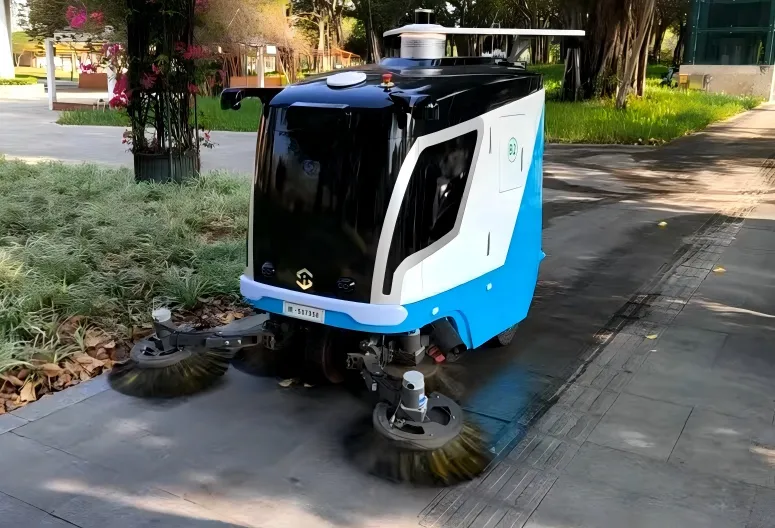
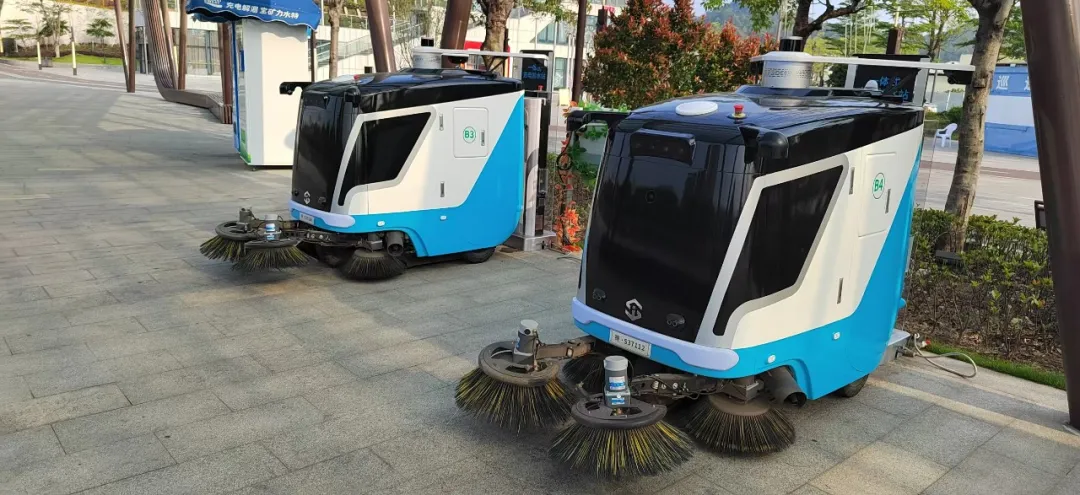
These vehicles boast a clean and minimalist design, devoid of cockpits or steering wheels, yet they undertake the dirtiest and most labor-intensive task on sidewalks—sweeping.
The laser radar atop the vehicle works in harmony with high-definition cameras on the body, providing the autonomous sweeping vehicle with a '360° all-encompassing intelligent perspective'.
They adeptly avoid pedestrians, navigate around obstacles, sweep debris along edges, and simultaneously perform dust suction and water spraying for dust control, all quietly and efficiently, without noise or dust pollution.
These are the autonomous sweeping vehicles deployed by Hemei Company in Jianghai District, with the first batch undergoing pilot operation along the Central Green Corridor (spanning from Xiasha Park to Youwan Park).
From this moment onward, sanitation workers in Jiangmen have embraced their first batch of 'AI colleagues'.
Let's delve deeper into this with 'Autonomous Vehicles Are Here' (WeChat Official Account: Autonomous vehicles have arrived)!
(For further reading, please click: 'Who Will Lead in Autonomous Sanitation Vehicles by 2026? Vote Now: City Light, Gaoxian, Yingfeng, Fulonma, Kowa, Xantu, Wenyuan, Saite, Xingcheng, Yuhe Tian, Qiaoyin, Jiushi Jijing, Kusa, Nuenchi')
I. 8-Hour Endurance, 24-Hour Cyclic Operation: Surpassing Human Capabilities
These autonomous sweeping vehicles are far from being mere showpieces.
Their technical specifications are remarkable: equipped with an advanced multi-sensor fusion system and powered by electricity for environmental sustainability, they offer up to 8 hours of endurance and support 24-hour cyclic operation.
With intelligent features such as automatic return for charging and autonomous waste dumping, they truly achieve 'uninterrupted operation without human intervention'.
What does this signify?
Traditional sanitation operations grapple with high labor costs, inconsistent operational standards, and significant safety risks. A sanitation worker working an 8-hour day experiences a notable decline in efficiency during extreme weather conditions like scorching heat, heavy rain, or biting cold.
Autonomous sweeping vehicles are impervious to weather, tireless, and unafraid of dirt. They can operate for 8 hours on a single charge, return to charge automatically when depleted, and resume work promptly after charging.
A representative from Hemei Company calculated:
Under traditional models, multiple sanitation workers are required to clean a single road section in shifts;
With the intervention of autonomous sweeping vehicles, 'human-machine collaboration' can be realized—machines handle the most repetitive and physically demanding basic sweeping, while humans perform inspections, maintenance, and detailed cleaning.
As efficiency improves, sanitation workers transition from physically demanding laborers exposed to the elements to technical operators managing equipment.
Data indicates that since the pilot operation, the road cleanliness compliance rate in the deployment area has consistently remained above 98%, surpassing the average level of traditional manual cleaning.
II. From 'Experience-Driven' to 'Data-Driven': A Leap in Sanitation Management
The value of autonomous sweeping vehicles extends beyond 'labor savings' to 'standard elevation'.
Traditional sanitation operations heavily rely on the experience and responsibility of sanitation workers for cleaning quality.
The same road section may yield varying results when cleaned by different individuals;
Even the same person may produce different outcomes at different times. Managers can only monitor operational quality through manual inspections, which are inefficient, limited in scope, and slow to respond.
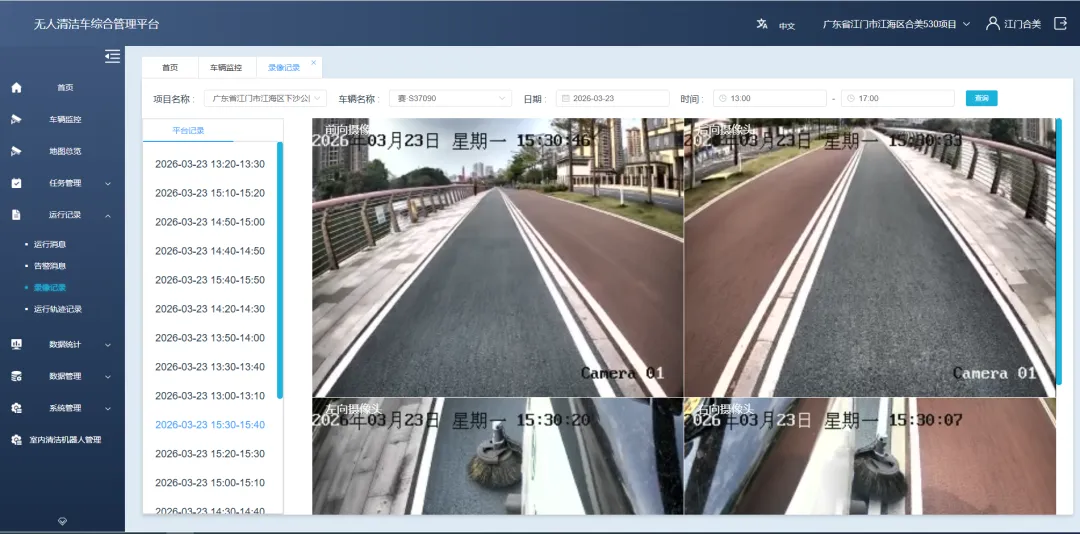
The introduction of autonomous sweeping vehicles has revolutionized this scenario.
By connecting to a smart sanitation management platform, managers can monitor operational trajectories, cleaning quality, and equipment status in real-time. Which roads have been cleaned, which remain, how clean they are, and whether there are equipment malfunctions—all are visible, traceable, and controllable.
Hemei Company encapsulates this transformation in eight words: a shift from 'experience-driven' to 'data-driven'.
This is not technological ostentation but management evolution.
When cleaning operations transform into quantifiable, traceable, and optimizable data streams, the level of refinement in sanitation management takes a significant leap forward.
III. Jianghai District's 'Smart Sanitation' Model: Next Steps for District-Wide Adoption
Jianghai District's decision to pilot the project first along the Central Green Corridor is strategic.
Fushan Park, Xiasha Park, and Youwan Park are core scenic areas in Jianghai District and major recreational spots for residents.
These areas demand high environmental hygiene standards and are sensitive to operational noise and dust control.
Autonomous sweeping vehicles, operating quietly and efficiently without noise or dust, perfectly align with the concept of 'harmonious coexistence of technological services and urban livability'.
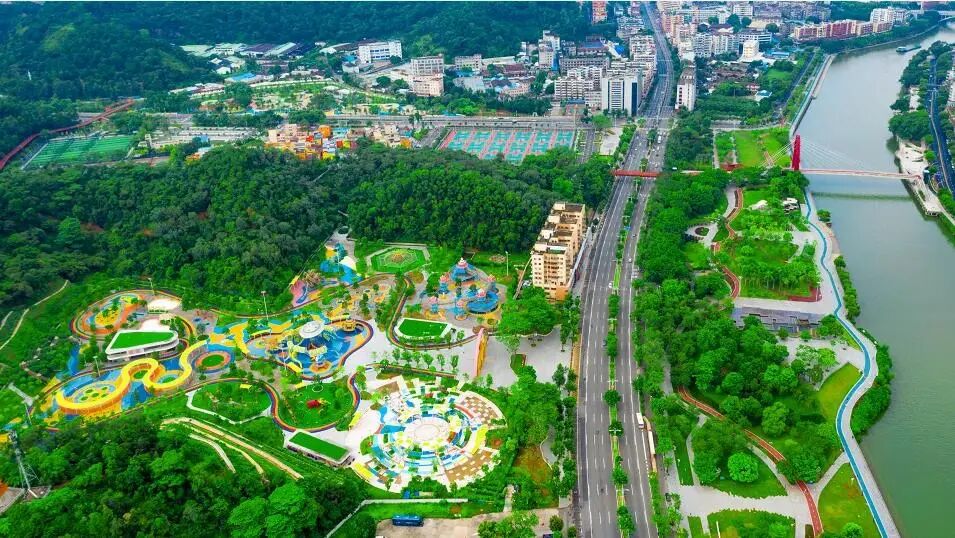
According to Hemei Company's plan, the deployment of autonomous sweeping vehicles will focus on core areas of Jianghai District, including the Central Green Corridor, areas around the district government, and sections of the Safety Emergency Intelligent Robot Industrial Park.
Next, the company will comprehensively summarize the pilot operation experience along the Central Green Corridor, gradually expand the deployment scope, continuously optimize operational modes, and deepen the construction of a smart sanitation management system.
This signifies that Jianghai District's 'smart sanitation' initiative is not merely for show but is poised for district-wide implementation.
IV. From Jiangmen to the Nation: The 'Tipping Point' for Autonomous Sanitation Has Arrived
Jiangmen's pilot is not an isolated incident.
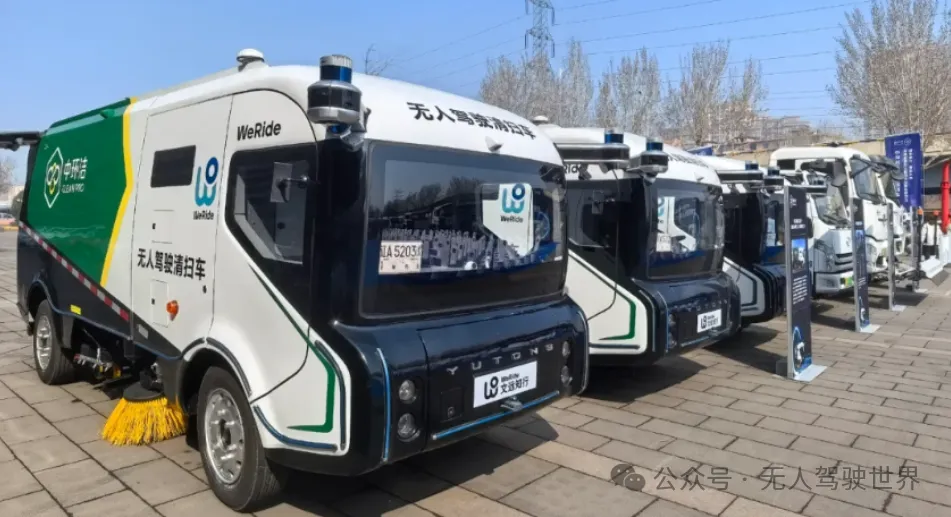
In March 2026, almost simultaneously, Shenyang deployed 12 L4-level Wenyuan Zhixing autonomous sweeping vehicles, forming the largest integrated autonomous sanitation fleet serving urban main roads in China.
(For further reading, please click: '12 Wenyuan Zhixing Autonomous Sweeping Vehicles Hit the Roads in Shenyang! Zhonghuanjie's 'AI+Urban Services' New Model: China's First Integrated, Full-Scenario Coverage Autonomous Sanitation Application Project')
Earlier, cities like Shanghai, Beijing, Shenzhen, and Suzhou had also initiated autonomous sanitation pilots.
A consensus is emerging in the industry: autonomous sanitation has reached the tipping point from 'demonstration' to 'commercialization'.
The driving forces stem from three levels:
1. Technological maturity: Multi-sensor fusion, L4-level autonomous driving, and cloud-based dispatch platforms have been thoroughly validated and are ready for large-scale deployment.
2. Cost reduction: The costs of core components such as lidar and computing platforms continue to decline, with the overall cost of autonomous sweeping vehicles dropping from the million-yuan range a few years ago to the two to three hundred thousand yuan range now.
3. Urgent demand: The sanitation industry has long faced challenges in recruiting and retaining workers, with severe aging issues. Autonomous solutions are an inevitable choice.
A representative from Hemei Company encapsulated the key point: 'The zero-emission, low-noise intelligent sweeping mode not only aligns with the national 'dual carbon' strategic requirements but also injects new vitality into the construction of green and ecological cities.'
V. Conclusion: When 'AI Colleagues' Become Commonplace, the 'Future' of Urban Governance Has Arrived
In Fushan Park, Jiangmen, the little white vehicle continues to sweep quietly.
It has no emotions, does not complain of fatigue, requires no social security, and does not suffer from heatstroke in high temperatures.
But it is not here to 'replace jobs'—its presence allows sanitation workers to stop waking up at 4 a.m. to sweep the streets, stop picking up garbage under the scorching sun, and stop clearing leaves in freezing winds.
Those arduous tasks are now entrusted to the machines.
Humans can focus on more meaningful endeavors.
In summary, 'Autonomous Vehicles Are Here' (WeChat Official Account: Autonomous vehicles have arrived) believes:
When you encounter these 'AI cleaners' on the streets of Jiangmen, please yield to them actively and avoid touching or hitting them.
They are harnessing the power of technology to make this city cleaner and more livable. And this is precisely what a smart city should embody.
What are your thoughts, dear readers?
References: Article from the WeChat Official Account of the Jianghai District Urban Management and Comprehensive Law Enforcement Bureau, 'Sanitation Workers Welcome AI Colleagues? Autonomous Sweeping Vehicles 'Officially On Duty'!'
#AutonomousVehiclesAreHere #AutonomousDriving #SelfDriving #AutonomousVehicles
-
![]()
Net Profit Surges 13.65% Year-on-Year! Yutong Optics Reports RMB 1.782 Billion in H1 Revenue
-
![]()
Q2 Net Profit Slashes Losses by 80%! Has Costar Emerged from Its Darkest Hour?
-
AI Agents: The Paradigm Shift from 'Conversation' to 'Execution'
-
NVIDIA Takes Bold Strides to Lead in Both Hardware and Software Realms
-
![]()
It's Hard to Build Cars, Even Harder to Build Humans, and XPENG is Doing Both
-
![]()
Valuation Soars by $57 Billion: Three Entrepreneurs Born in the 1980s Forge an AI Unicorn Now Suddenly on the Market
-
![]()
How Can We Achieve the Goal of 100,000 Hydrogen Vehicles by 2030?
-
![]()
July Online Market for Consumer-Grade Sports Cameras: Robust Double-Digit Growth in Sales Volume and Value, Mid-Range Products Fuel Market Expansion