Chongqing Releases 'Detailed Rules for the Administration of Expressway Testing of Intelligent Connected Vehicles (Trial)': Permitting L3+ Vehicles on Expressways: The 'Practical Examination' for Auto
 05/11 2026
 553
553
Introduction
On May 6, the 'Detailed Rules for the Administration of Expressway Testing of Intelligent Connected Vehicles,' jointly issued by three departments in Chongqing, have been hailed by the industry as the 'most stringent ever' regulations for L3+ expressway testing.
Comprising a 26-article 'examination paper' supplemented by eight appendices, these rules clearly convey a message to all stakeholders:
The journey from autonomous driving being a mere 'novelty' to becoming a practical 'tool' is devoid of shortcuts—only rigorous mileage accumulation, stringent safety measures, and multi-tiered regulatory oversight can pave the way.
This not only imposes strict controls on technology but also lays the foundational 'cornerstone' for the industry's commercialization.
(For further insights, please refer to: 'CCTV Reporter Experiences L3 Autonomous Driving in Chongqing—How Was It?')
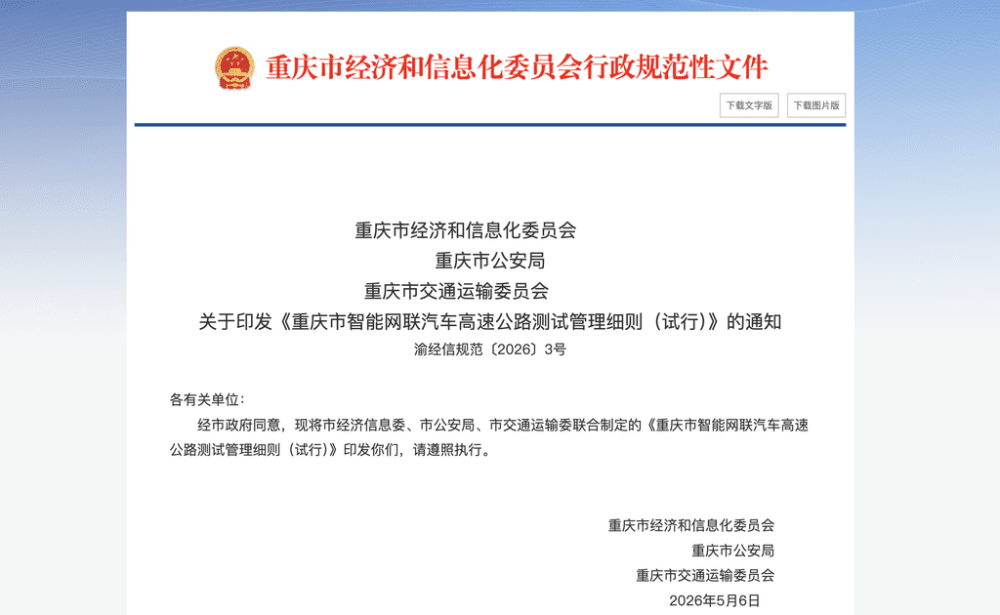
Image Source: Official Website of Chongqing Economic and Information Commission, Diyi TV-Hualong Network
I. Not Everyone Can Access the Expressway: The Strictest 'Admission Ticket' Issuance Rules in History
Chongqing's new regulations first and foremost achieve one significant feat: elevating the standards for issuing 'admission tickets' for autonomous driving testing on expressways to unprecedented heights.
They clearly define a 'capability baseline'—
For L3 vehicles, the cumulative safety mileage per batch must be no less than 2,000 kilometers, with each vehicle contributing no less than 200 kilometers;
For L4 and above levels, the cumulative safety mileage per vehicle must reach 10,000 kilometers.
Behind these figures lies a rigorous screening logic: systems that have not undergone testing in sufficiently complex environments have no right to venture into higher-risk scenarios. This effectively blocks those attempting to pass muster by 'accumulating easy miles.'
More critically, this 'admission ticket' is not a one-time pass.
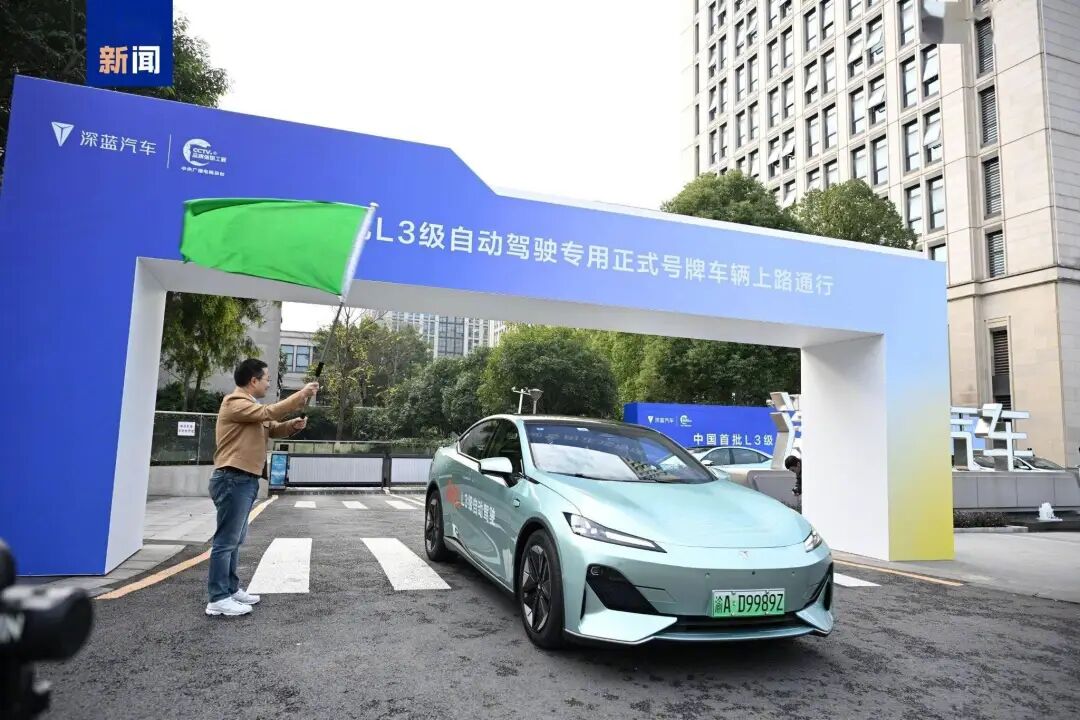
Image Source: Chongqing Daily
The new regulations introduce a 'three-stage progressive testing' model, akin to the 'expressway practical examination' for autonomous driving.
In the initial stage, test vehicles must be accompanied by safety vehicles both in front and behind, akin to being cradled in protective gear;
Only after accumulating more than 5,000 kilometers of safety mileage can they progress to the second stage, where the front safety vehicle is removed, leaving only the rear safety vehicle as a 'safety net';
Only after accumulating an additional 10,000 kilometers in the second stage and demonstrating sufficient reliability and takeover capability can they finally enter the third stage—independent testing without safety vehicles.
This process, transitioning from 'being supported' to 'being monitored' to 'going solo,' essentially utilizes vast amounts of real-world road data to conduct mandatory 'stress testing' and 'fault tolerance training' for system reliability.
Besides being stringent on vehicles, the new regulations are equally uncompromising towards 'humans.'
Test drivers must not only possess more than three years of driving experience and have no serious traffic violations but must also undergo no less than 20 hours of expressway-specific practical operation and emergency takeover training.
This means that the safety officer seated in the driver's seat is no longer a mere 'supervisor' but must be the 'last line of defense' capable of instantly identifying risks and taking decisive action.
The regulations even go as far as requiring companies to purchase traffic accident liability insurance of no less than 5 million yuan for each vehicle, clearly delineating financial compensation responsibilities.
It can be said that Chongqing has implemented comprehensive and meticulous safety measures across the four dimensions of 'humans, vehicles, venues, and responsibilities' for expressway testing.
II. Why Expressways? The 'Coming-of-Age Ceremony' and 'Ultimate Examination' for Autonomous Driving
So, why expressways? Aren't urban roads complex enough?
The rationale is that expressway scenarios serve as the 'litmus test' and 'dividing line' for determining whether an autonomous driving system is truly mature.
In urban areas, vehicles move at slower speeds, and while scenarios are complex, they are relatively predictable;
On expressways, however, vehicles are in a state of continuous high-speed motion (with a specified testing speed of no less than 60 km/h in principle), drastically compressing the system's decision-making error tolerance time.
It must not only cope with adverse environments such as heavy rain, dense fog, and road debris but also handle unique high-speed scenarios like large truck blind spot incursions, sudden vehicle failures ahead, and lane narrowing in construction zones.
Therefore, opening up expressway testing is equivalent to providing autonomous driving technology with a 'stress testing chamber' that pushes it to its limits.
This is also why at the Beijing Auto Show, supply chain companies showcased core technologies such as 'physical AI,' 'world models,' and 'wire-controlled chassis.'
Chongqing's new regulations precisely provide an official 'examination venue' that is legal, safe, and clearly standardized for this 'ultimate test.'
III. Opening Up and Tightening: The Dual Nature of Policies and the 'Guiding Batons' of the Industry
Another astute aspect of Chongqing's new regulations lies in their dual nature of 'opening up while tightening.'
On the one hand, they indeed open a crucial 'door' for high-level autonomous driving.
They fill the institutional gap for expressway scenario testing, providing companies with a clear compliance path to conquer this core technological frontier.
This is undoubtedly a significant boon for companies aiming for commercialization.
For instance, Qianli Technology's subsidiary has officially submitted an application for an L3 intelligent driving test license, with the new regulations providing clear action guidelines.
But on the other hand, this door is opened with extreme caution, even somewhat 'harshly.'
The regulations clearly emphasize that expressway testing is only permitted for 'scientific research and finalized trials,' strictly prohibiting any form of 'demonstration operations' and 'driverless testing.'
This completely eliminates any gray space for 'operating under the guise of testing,' clearly drawing the safety red line.
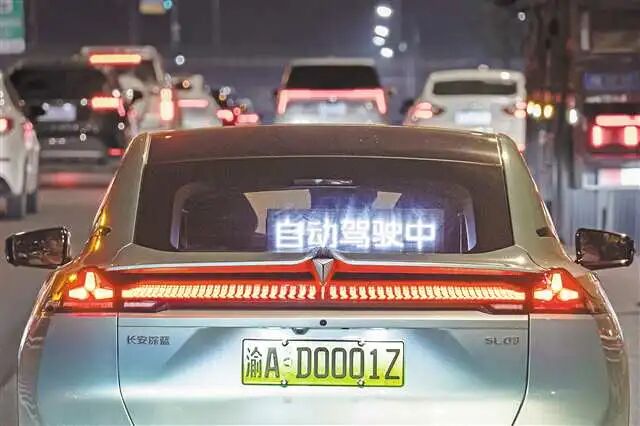
Image Source: Chongqing Daily
At the same time, the new regulations impose systematic requirements on network and data security.
They require companies to establish a cybersecurity protection system covering the entire lifecycle of the vehicle and its components, manage software upgrades throughout the entire process, and mandate that all personal information and important data collected must be stored domestically, with outbound transfers subject to security assessments.
This means that future intelligent vehicles are not just modes of transportation but also mobile data hubs, with their safety boundaries extending from the physical world to the digital world.
The policy 'guiding baton' is steering the industry away from merely pursuing flashy functions towards building a comprehensive safety system encompassing functional safety, expected functional safety, and cybersecurity.
IV. From Chongqing to the Nation: A Prelude to Scaling Up About 'Trust'
Among so many cities nationwide, why did Chongqing dare to be the first to issue expressway testing regulations?
The answer lies in two words: terrain. Chongqing, known as the '8D Magic City,' is replete with multi-layered overpasses, tunnels connecting tunnels, and dense slopes and curves. While this poses a nightmare for ordinary drivers, it is a natural 'examination venue' for autonomous driving.
On December 26, 2025, 46 specially licensed Deepal SL03 vehicles officially commenced pilot operations on designated roads in Chongqing, marking the first practical use of China's first batch of L3 autonomous driving special licenses.
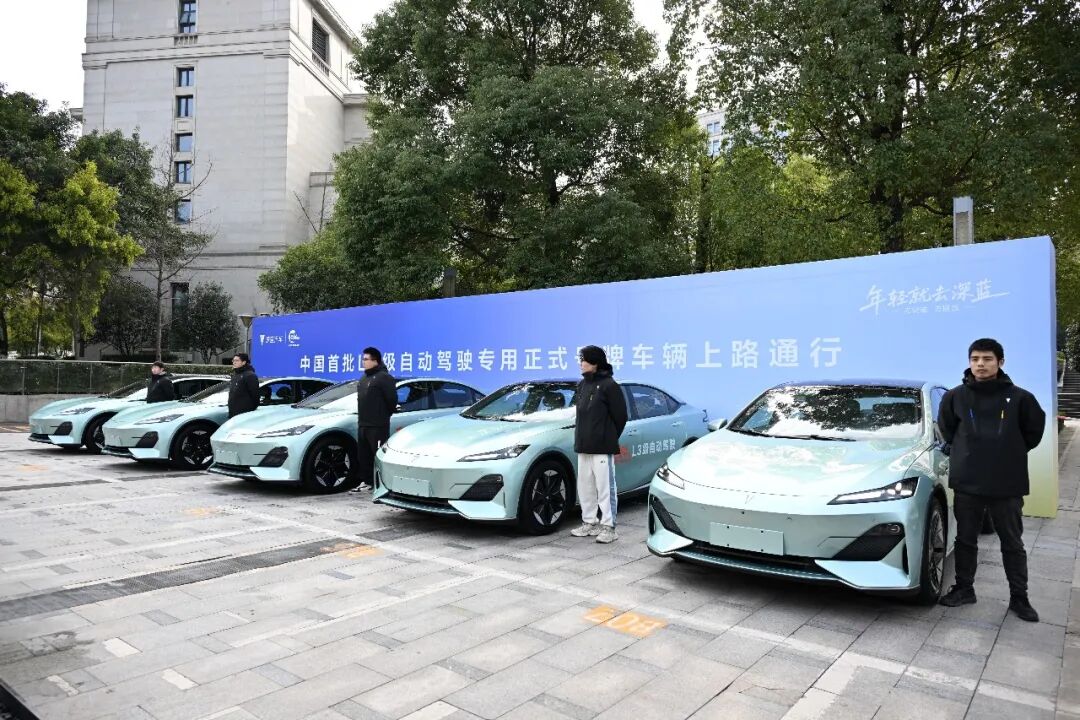
Image Source: Qianzhan Economics App
By the end of March 2026, Changan Automobile had just obtained Chongqing's L4 Robotaxi test license, with its Tianshu intelligent end-to-end large model rapidly iterating amidst Chongqing's complex road conditions.
Changan Automobile plans to invest a cumulative 50 billion yuan in building a core technology system for intelligent driving, with L4 Robotaxi and mass-produced L2 and L3 vehicle technologies sharing the same origins and highly reused underlying algorithms.
Chongqing's move is by no means an isolated event.
It represents a pioneering policy step at a critical juncture as China's intelligent connected vehicle industry transitions from 'demonstration exploration' to 'large-scale commercialization.'
Against this backdrop, Chongqing's 'Detailed Rules' serve more like a 'standardized answer sheet,' providing crucial references for other cities and even the national level in formulating similar regulations.
Chongqing's new regulations, on the surface, are about 'allowing access,' but in reality, they are about 'setting rules.'
L3 vehicles must run 2,000 kilometers, L4 vehicles 10,000 kilometers, three-stage progressive testing, 20 hours of driver training—every number reflects an extreme consideration for safety.
In short, 'Autonomous Vehicles Are Coming' (WeChat Official Account: Autonomous Vehicles Are Coming) believes:
When autonomous driving truly hits the expressways, the test is no longer about 'whether it can recognize traffic lights' but 'what to do when encountering a sudden brake from the vehicle ahead at 120 km/h.'
Chongqing has provided its answer through a complete set of institutional designs.
As for whether this answer can be rolled out nationwide? Let's see how far this 'pacesetter' from the mountain city can go.
Hey! What do you think?
References: Media reports from the Official Website of Chongqing Economic and Information Commission, Diyi TV-Hualong Network, Dahe Finance and Economics, Traffic Release, Shancheng Industry-City Observer, China Changan Automobile Group Co., Ltd., Upstream News, New Chongqing-Chongqing Daily, Financial Sector, Qianzhan Economics App, etc.
#AutonomousVehiclesAreComing #Driverless #AutonomousDriving #AutonomousVehicles
-
![]()
Net Profit Surges 13.65% Year-on-Year! Yutong Optics Reports RMB 1.782 Billion in H1 Revenue
-
![]()
Q2 Net Profit Slashes Losses by 80%! Has Costar Emerged from Its Darkest Hour?
-
AI Agents: The Paradigm Shift from 'Conversation' to 'Execution'
-
NVIDIA Takes Bold Strides to Lead in Both Hardware and Software Realms
-
![]()
It's Hard to Build Cars, Even Harder to Build Humans, and XPENG is Doing Both
-
![]()
Valuation Soars by $57 Billion: Three Entrepreneurs Born in the 1980s Forge an AI Unicorn Now Suddenly on the Market
-
![]()
How Can We Achieve the Goal of 100,000 Hydrogen Vehicles by 2030?
-
![]()
July Online Market for Consumer-Grade Sports Cameras: Robust Double-Digit Growth in Sales Volume and Value, Mid-Range Products Fuel Market Expansion