Financial Agent Procurement: Large Orders Missing, Governance Takes Center Stage
 10/13 2026
 452
452

The financial industry's focus on agent implementation has transitioned from platform construction to in-depth scenario development. In 2025, newly established platform projects were the mainstay of financial agent procurement, but they have gradually been replaced by second-phase renovations, feature additions, and specific scenario developments each month.
According to previous statistics from 01CAI, the proportion of newly established platform projects had fallen below 30% by the first half of 2026 and further dropped to less than 20% in both July and August.
As pilot projects evolve into production systems, institutions have shifted their focus from "functionality" to "stability and cost-effectiveness." MCP protocols, multi-agent collaboration, agent observability, and security governance have evolved from technical discussions to specific procurement requirements.
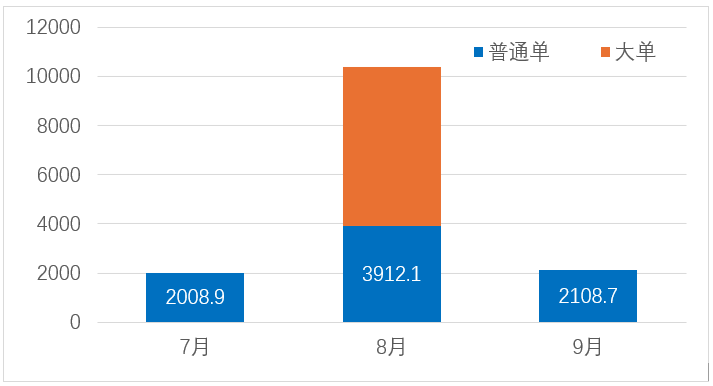
The market trend continued in September, with 33 bids, a decrease of 7 from August's 40 but still significantly higher than July's 28. There were 14 bid awards and transaction announcements, with 10 disclosing amounts totaling approximately RMB 21.09 million, less than a quarter of August's total.
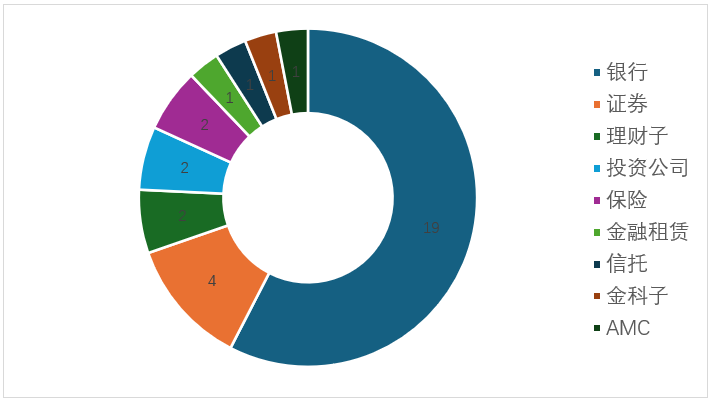
Changes are evident at both ends of the market. On the demand side, agents are increasingly integrated into system construction project lists, either as part of existing system renovations or targeting specific business scenarios. On the subject side, banks remain the dominant force, accounting for nearly 60% of the bids, with trusts and investment firms reappearing after a hiatus of over six months. Following China Great Wall, China Cinda, one of the five major AMCs, has also initiated agent procurement.
01 Overall Decline, Large Orders Absent
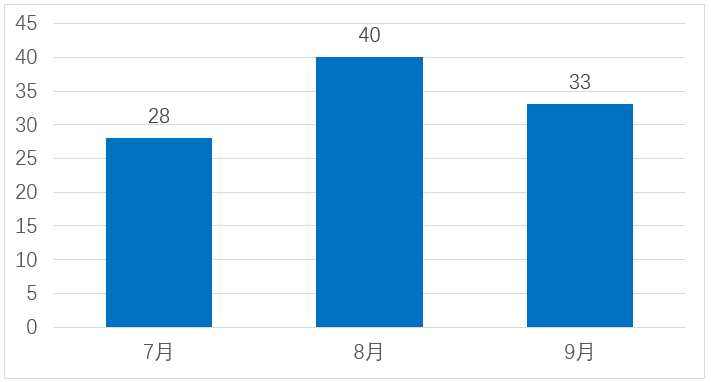
Bid volumes fluctuated, with 28 in July, 40 in August, and 33 in September, failing to sustain August's rebound or revert to July's low.
Figure 1: Number of Financial Agent Bid Announcements from July to September 2026
Data Source: Enterprise Early Warning, Compiled by 01CAI
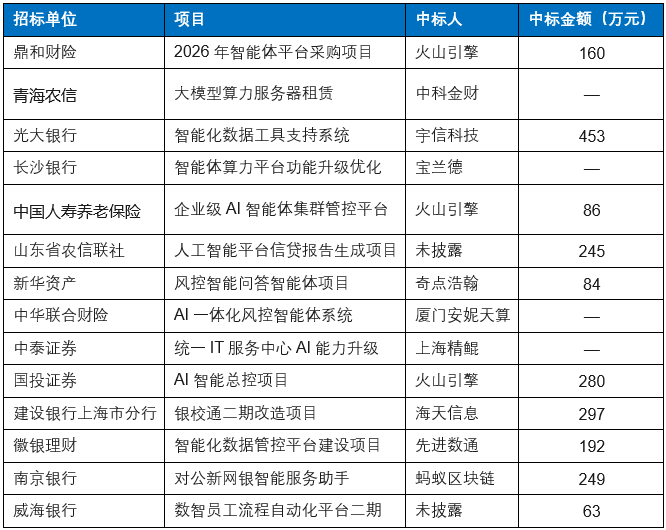
The shift in bid award forms is more pronounced. Of the 14 announcements, 10 disclosed amounts totaling approximately RMB 21.09 million, averaging about RMB 2.11 million per transaction. In terms of single transaction structure, 6 fell between RMB 1 million and RMB 3 million, 3 were below RMB 1 million, and the highest, China Everbright Bank's new project for intelligent data tool support systems, was only RMB 4.529 million.
August presented a contrasting picture: 18 announcements, 12 disclosing amounts totaling approximately RMB 104 million [after retrospective correction, it should be 18, two more than previously reported], including a single transaction of RMB 64.896 million for China Zheshang Bank's "agent basic software and hardware."
September's lower total is directly attributable to the absence of similarly large orders.
Figure 2: Disclosed Amounts (RMB millions) for Financial Agent Bid Awards and Transactions from July to September 2026
Data Source: Enterprise Early Warning, Compiled by 01CAI
02 Banks Dominate, Trusts and Investments Re-enter
Banks (including rural credit cooperatives) remain the primary force, with 19 bids in September, accounting for 57.6% of the total, an even higher proportion than before.
Among them, the Export-Import Bank of China issued three bids within a month for a knowledge management platform, an AI application development human resources pool framework agreement, and a credit review agent.
Four bids came from state-owned major banks, all at the branch level: China Construction Bank's Shanghai Branch developed a scientific research fund management agent for smart hospital construction in top-tier hospitals, while its Tianjin Branch embedded intelligent compliance reviews in the approval process of its financial sharing center; Bank of China's Shanghai Branch procured an agent security management platform; and Bank of Communications' Shanghai Branch incorporated AI financial agent transaction matching into the construction of a campus AI settlement and intelligent control system.
Four bids came from joint-stock banks, with Industrial Bank accounting for three: digital human management terminals, digital marketing strategy management application phase II, and an AI-native R&D platform for its Chengdu Branch; the fourth came from Evergrowing Bank, focusing on enhancing observability capabilities for existing platforms.
Eight bids came from city commercial banks, rural commercial banks, and rural credit systems, covering scenarios such as corporate online banking, computing power lease renewals, network security situation awareness, financial intelligent reviews, and enterprise-level agent platforms.
Figure 3: Bidder Structure for Financial Agents in September 2026
Data Source: Enterprise Early Warning, Compiled by 01CAI
Securities firms decreased to 4 bids but moved up in hierarchy. China Merchants Securities plans to build a DeepResearch end-to-end investment research engine and custom investment research SKILLs for its investment research information plaza, supporting autonomous tool invocation for mainstream agents and MCP tool management; China International Securities launched a master stock diagnosis agent for APP clients, leveraging large models for stock selection; GF Securities sought AI security scanning vendors, explicitly covering agent permission bypass and MCP security detection; and Zhongtai Securities upgraded the AI capabilities of its unified IT service center through a single-source approach.
From peripheral scenarios like content operations and knowledge management to investment research engines, client-facing stock diagnosis, and security scanning, securities firms have integrated agents more deeply into their core business chains.
Insurance companies had 2 bids, with China Rongtong Property Insurance budgeting RMB 1.5 million for an AI middleware platform and agents, and Taikang Pension replicating the intelligent achievements from its first phase of board office automation to core areas like finance and human resources.
Wealth management subsidiaries returned after a July hiatus, with Huiyin Wealth Management building an intelligent data control platform incorporating an AI agent system, and Ningbo Bank Wealth Management soliciting an AI agent platform for investment research scenarios.
Trust and investment firms, which appeared in the first quarter, reappeared after more than six months. Kunlun Trust launched the "Kun Xiaoxin" intelligent scenario, planning four types of business agents at once: due diligence, compliance risk review, system operations, and intelligent investment advisory. Jiaokong Capital procured an investment decision-making model agent, and China Insurance Investment bundled computing power leasing with agent development.
Additionally, China Cinda developed AI intelligent office quick-win scenarios, marking the second release of agent bid demands by the five major AMCs since China Great Wall in September last year.
03 From Standalone Bids to System Modules
Analyzing the 33 bids individually, projects centered on "platforms" and built from scratch were the minority: Beibu Gulf Bank's agent development platform (SaaS), Beijing Rural Commercial Bank's enterprise-level agent platform, Industrial Bank's AI-native R&D platform, and Kunlun Trust's unified intelligent application support platform.
More projects integrated agents into the renovation lists of existing systems.
For example, Nanjing Bank aimed to build an intelligent service assistant for corporate online banking, Xiamen International Bank to build a new generation of mobile banking and retail scenario agents, Tianjin Bank to add AI noise reduction, agent control, and compliance tracing based on its existing network security situation awareness platform, and Henan Rural Commercial Bank to procure a financial audit model agent and 500 financial audit rule models.
The commonality of these projects is that they no longer treat the agent itself as the deliverable but as a component embedded within existing processes. This applies to backend credit reviews, financial audits, and fund management, as well as frontend mobile banking, stock diagnosis, and transaction matching.
The position of agents is shifting from standalone procurement items to modules within system construction project lists.
Delivery rhythms are also diversifying.
The Export-Import Bank of China initiated procurement for a 2026-2028 AI application development human resources pool framework agreement, incorporating agent development, knowledge base and RAG applications, workflow orchestration, and large model fine-tuning capabilities into a three-year vendor pool, transitioning from a project-based to a capability-ready approach; China Insurance Investment, on the other hand, required development, integration, testing, and go-live within 6 weeks of contract effectiveness, followed by a three-month free warranty period after acceptance, following a short-cycle delivery model.
04 From "Building Up" to "Managing Up"
Governance and security saw the most significant growth in September.
Bank of China's Shanghai Branch's agent security management platform, GF Securities' security scanning targeting agent permission bypass and MCP interfaces, and Tianjin Bank's agent control capabilities represent three facets of this change.
More explicitly, Beijing Rural Commercial Bank incorporated agent evaluation, agent observability, and memory management into the procurement requirements for its enterprise-level agent platform. Governance capabilities are no longer a remedial measure after platform completion but a mandatory deliverable at the time of bidding.
"Observability," which first appeared in procurement items in August, continued to materialize in September, with Evergrowing Bank adding an agent observability functional module to its existing HiAgent platform. The objects of control are also becoming more detailed, extending from agents themselves to model invocation chains, prompts, and MCP interfaces.
05 Volcano Engine Emerges as Frequent Bid Winner
In September, Volcano Engine was the most frequent bid winner, securing contracts with China Life, Dinghe Property Insurance, and China International Securities, though none of the single transactions were large.
The two largest transactions went to bank IT service providers: Yusys Technologies won the bid for China Everbright Bank's new project for intelligent data tool support systems for RMB 4.529 million, covering scenario-based agents, intelligent data querying, and data governance; Shanghai Haitian Information undertook the second-phase renovation of China Construction Bank's Shanghai Branch's bank-school connectivity project for RMB 2.97 million, including model monitoring and operations, agent development management, and business system integration and interaction.
Ant Blockchain won Nanjing Bank's intelligent service assistant for corporate online banking for RMB 2.48625 million, Beijing Advanced Digital Technology won Huiyin Wealth Management's data control platform for RMB 1.92 million, and Qidian Haohan won Xinhua Asset Management's risk control intelligent Q&A agent for RMB 842,000.
Table 1: Financial Agent Bid Awards in September 2026
Data Source: Enterprise Early Warning, Compiled by 01CAI
-End-
-
![]()
Financial Agent Procurement: Large Orders Missing, Governance Takes Center Stage
-
![]()
Downward Adjustment of Export Tax Rebate Rate for New Energy Vehicles: Not a Bid to Reap 'Profits' from Overseas Expansion
-
![]()
Who is the Apple in the Era of Embodied AI?
-
![]()
Laughing No More! Brake Pedal Snaps—Is Lei Jun Actually the Biggest Winner? Netizens Say: Genius Move!
-
![]()
Huawei’s ‘Cullinan’ Rival Makes Its Debut: China’s First SUV with a Vertical Emblem—Is It More Prestigious Than Aito or Zunchi?
-
![]()
Blockbuster Move: Geely's Li Shufu Secures Approval to Acquire Stake in Century-Old Ford Motor's Spanish Unit
-
![]()
LiDAR Battle: RoboSense Sells 590,000 Units but Still in the Red, While Hesai Earns 70 Million—What's the Difference?
-
![]()
Vivo's Misstep: The Fallout from Widespread Flash Memory Controversy