Downward Adjustment of Export Tax Rebate Rate for New Energy Vehicles: Not a Bid to Reap 'Profits' from Overseas Expansion
 10/13 2026
 437
437

Lead
Introduction
The intention is not to deter overseas expansion but to propel Chinese automakers into a new era of global competition!
A few days ago, asserting that the overseas expansion of new energy vehicles was a lucrative venture would have drawn no objections. However, today, the belief that merely selling cars abroad ensures profitability is likely to be met with significant resistance.
On October 12, the Ministry of Finance and the State Taxation Administration announced that, starting from April 1, 2027, the export tax rebate rate for value-added tax on new energy vehicles would be reduced from 13% to 9%.
Why has a mere 4% reduction sparked such intense industry attention? The answer is straightforward—it directly impacts profits.
The downward adjustment of the export tax rebate rate will inevitably diminish automakers' export profits. To sustain profitability, they must either further cut costs or increase prices for consumers. Given the fierce competition in the new energy vehicle market today, the latter option is evidently more straightforward and commercially viable.
But with higher prices, can Chinese vehicles retain their competitive edge in overseas markets?
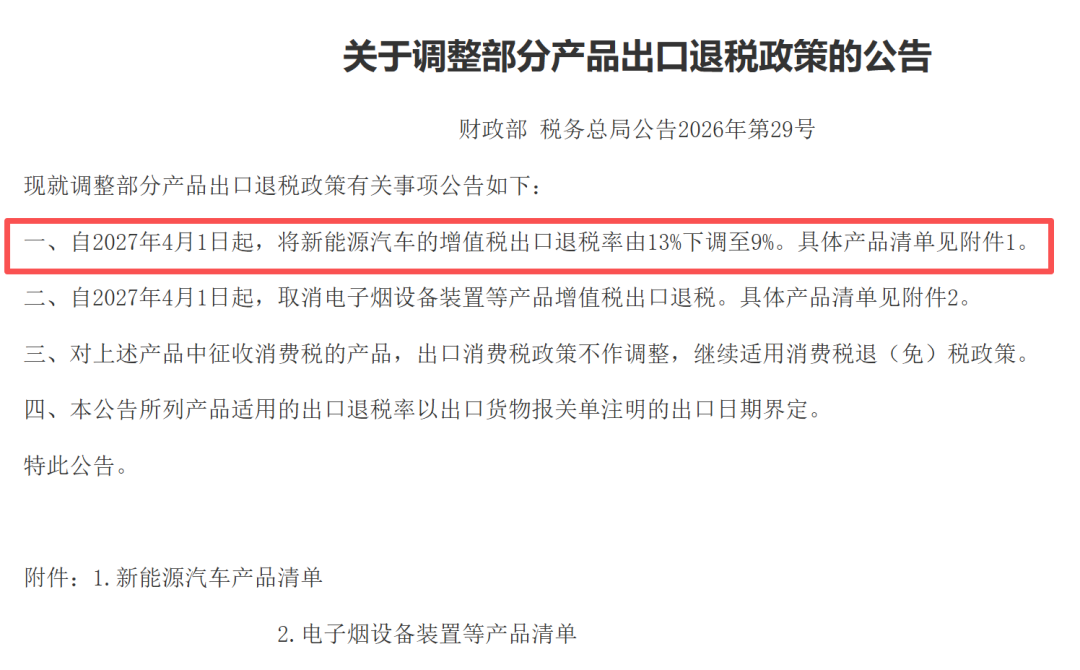
Estimates suggest that this tax rate adjustment will raise export costs by RMB 4,000 for every RMB 100,000 of the ex-factory price (excluding tax).
In other words, for a new energy vehicle with an ex-factory price of RMB 200,000, the export cost will rise by approximately RMB 8,000. For an automaker exporting 100,000 vehicles annually, this equates to an additional cost of RMB 800 million per year.
In today's challenging market environment with narrow profit margins, these extra costs are akin to 'cutting into' automakers' profits. Moreover, the challenges automakers face in going global do not end there—local protectionism, high tariffs, geopolitical issues, and more, all pose significant obstacles.
Over the past few years, Chinese new energy vehicles have risen to the occasion, leveraging a comprehensive industrial chain, high production efficiency, and rapid product iteration capabilities to swiftly gain a foothold in overseas markets.
However, now, an even greater challenge looms:
As the 'tax rebate dividend' wanes, the focus shifts away from how much more tax the state collects or how much less profit automakers make. The crux is that the time has come for Chinese vehicles to compete head-to-head with world-class automakers based on product and brand prowess.
01 Can Chinese Automakers Continue to Dominate Overseas Markets with Low Prices?
Firstly, it must be clarified that the reduction of the 'tax rebate dividend' is not a hasty decision but an inevitable outcome of the development of China's new energy vehicle industry.
According to statistics, China's automobile exports reached a staggering 1.053 million units in September, marking a significant year-on-year increase of 61.4%. From January to September, cumulative exports stood at 8.205 million units, up 65.8% year-on-year.
To date, China's automobile exports have surpassed the 1 million unit mark for four consecutive months, maintaining robust growth momentum in overseas markets.
Among these, new energy vehicle exports have been particularly outstanding.
In September, 571,000 new energy vehicles were exported, a 1.6-fold increase year-on-year. The proportion of new energy vehicle exports in total automobile exports has exceeded 50% for four consecutive months, becoming the core driver of export growth.
Actual data attests that Chinese vehicles have achieved a phased goal of large-scale overseas expansion. Even when considering only new energy vehicles, their export scale remains impressive.
However, true long-term success necessitates healthy self-sufficiency and self-adjustment capabilities. If automakers merely ship vehicles abroad and rely solely on tax rebates for profit, they will inevitably suffer from this policy adjustment.

Of course, when people witness the reduction of the 'tax rebate dividend,' their initial thought may still be that automakers will no longer profit as much from overseas expansion as before.
However, policy adjustments do not imply that China's automobile export advantages will vanish. The downward adjustment of the tax rebate rate is merely a new variable affecting export returns. Chinese vehicles are gaining global popularity not solely because they are inexpensive.
Undoubtedly, the capabilities amassed by Chinese new energy vehicles in areas such as power batteries, component sourcing, research and development iteration, and manufacturing efficiency remain vital competitive foundations in the global automotive market.
This is also why Europe, an important cradle of the modern automotive industry, is willing to engage in patient negotiations with us.
It is reported that on October 8-9, China and Europe held economic and trade consultations in Beijing, reaching a consensus on trade arrangements for hybrid electric vehicles.
On October 12, China's Ministry of Commerce further clarified that the relevant arrangements would be based on the volume of hybrid electric vehicles imported by the EU from China in 2025, allowing for subsequent export growth and emphasizing that quotas should not be lower than those for other import source countries.
Compared to a 'no-dialogue' approach of imposing blanket restrictions, engaging in equal dialogue to establish rules is more conducive to the overseas expansion of Chinese automobiles.
Despite the fact that many major global markets still employ high tariffs to block Chinese vehicles, after this incident, Chinese vehicles will shed the 'cheap' label and penetrate deeper into the global market with a renewed image.
02 From Selling Cars to Global Operations: The Logic of Overseas Expansion Has Evolved
A foreseeable future awaits: in the next six months, the window of opportunity left by the policy change will further bolster the export of Chinese new energy vehicles. After all, exporting more vehicles now may help further reduce costs.
However, ultimately, compared to one-time sales driven by 'price wars,' what truly determines how far Chinese vehicles can go in overseas markets is whether companies can establish a more robust profit model that balances product, cost, brand, and local operations.
Firstly, product and brand trust are paramount.
Clearly, Chinese automakers can already offer competitive electrified products. However, in some overseas markets, consumer perceptions of the brand, trust in after-sales service, and long-term usage costs also influence purchasing decisions.
If companies rely solely on low prices to secure orders, once competitors follow suit with price cuts, their original advantage may quickly diminish. Only by imbuing products with clearer differentiated value can companies better maintain prices and profits.
Currently, only BYD and Tesla may have achieved this.
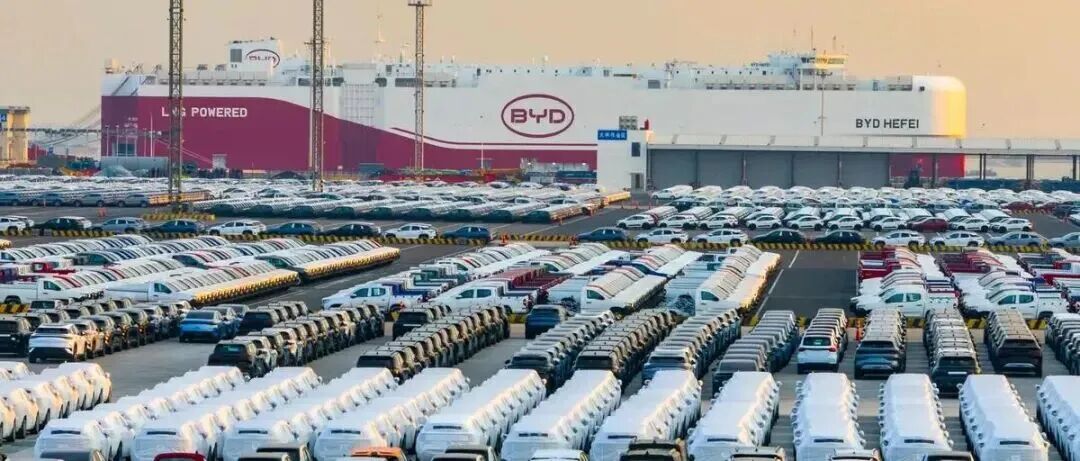
Next, supply chain and operational efficiency are crucial. The advantages of China's automotive industry chain are not merely reflected in manufacturing costs but also in research and development speed, component sourcing, and product iteration efficiency.
Note that this does not imply promoting 'quick-fix' vehicles but emphasizing high efficiency.
Companies need to extend these advantages to overseas markets, reducing unnecessary cost expenditures through more accurate product planning, stable supply chains, and reasonable inventory management.
While economies of scale can indeed dilute some costs, the prerequisite is that products sell well and production capacity is effectively utilized, rather than blindly expanding investment in pursuit of export figures.
Finally, overseas operational capability is essential.
As export businesses deepen, companies need to gradually establish sales channels, maintenance services, component supply, and customer operation systems. In suitable markets, improving response efficiency through local production and procurement will also become a key factor in long-term consumer choice.
However, localized operations require continuous investment. Building factories may not necessarily be more profitable than exporting finished vehicles. Companies need to make comprehensive considerations based on market size, policy environment, capacity utilization, and return on investment before proceeding.
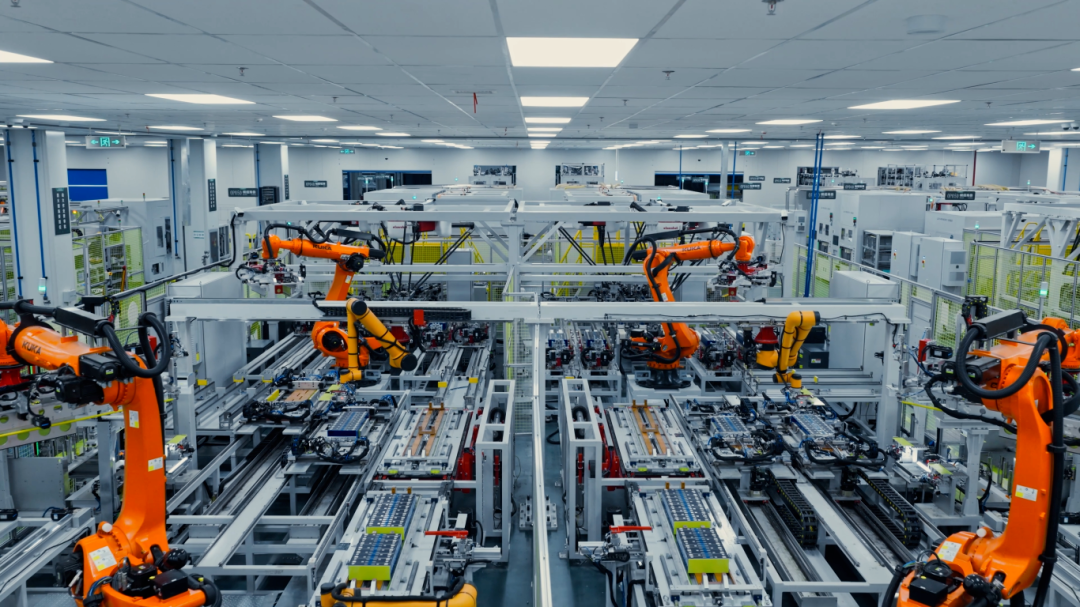
In fact, the continuous rise in export volumes already proves that Chinese vehicles possess the strength to compete globally. However, as the saying goes, sales growth and profit growth are never synonymous.
Exchange rate fluctuations may erode some gains, overseas channel construction requires continuous investment, and local policy changes may also disrupt companies' original cost calculations. If companies focus solely on export scale and neglect these operational details, selling more does not necessarily equate to earning more.
This means that Chinese automakers need to recalibrate their overseas expansion strategy—identifying which markets are worth long-term investment, which models can support reasonable prices, and which links must be kept in-house—all of which will influence companies' future global layouts.
What Chinese automakers truly need to shed is their reliance on a single cost advantage and instead establish a brand image in the global market.
In short, while prices can help companies quickly penetrate markets, they cannot shoulder the burden of exchange rate risks, channel investments, and long-term operational costs.
The downward adjustment of the export tax rebate rate serves more as a 'catalyst,' exposing problems that were easily masked by growth and directly reflecting them in companies' subsequent market performance.
By then, it will become evident that the overseas expansion of Chinese automobiles has transitioned from a period of superimposed policy dividends and cost advantages to a new phase that truly tests automakers' profit quality.
Editor-in-Charge: Du Yuxin Editor: He Zengrong

THE END
-
![]()
Downward Adjustment of Export Tax Rebate Rate for New Energy Vehicles: Not a Bid to Reap 'Profits' from Overseas Expansion
-
![]()
Who is the Apple in the Era of Embodied AI?
-
![]()
Laughing No More! Brake Pedal Snaps—Is Lei Jun Actually the Biggest Winner? Netizens Say: Genius Move!
-
![]()
Huawei’s ‘Cullinan’ Rival Makes Its Debut: China’s First SUV with a Vertical Emblem—Is It More Prestigious Than Aito or Zunchi?
-
![]()
Blockbuster Move: Geely's Li Shufu Secures Approval to Acquire Stake in Century-Old Ford Motor's Spanish Unit
-
![]()
LiDAR Battle: RoboSense Sells 590,000 Units but Still in the Red, While Hesai Earns 70 Million—What's the Difference?
-
![]()
Vivo's Misstep: The Fallout from Widespread Flash Memory Controversy
-
![]()
Why Did Vivo Stumble Amidst the Flash Memory Mixing Fiasco?