Laughing No More! Brake Pedal Snaps—Is Lei Jun Actually the Biggest Winner? Netizens Say: Genius Move!
 10/13 2026
 561
561
These days, car brake safety is dominating the headlines, and a video featuring Lei Jun with Xiaomi Auto has resurfaced, prompting netizens to take another look.
To be honest, the situation is quite ironic. Earlier brake tests for the Xiaomi SU7 were met with widespread jokes and criticism online. Instead of applause, Lei Jun’s on-site demonstrations were greeted with laughter. Now, however, many can’t afford to laugh anymore.
Numerous people are revisiting Xiaomi Auto’s quadruple brake safety redundancy, a point Lei Jun repeatedly stressed. Reflecting on the YU7 GT’s extreme braking live stream that faced heavy criticism six months ago, the tide of public opinion has shifted. Netizens now express emotional reflection (note: kept as-is for cultural context, meaning 'reflect with emotion'): "Investing so much in brake safety—Lei Jun’s foresight is finally being recognized."
Lei Jun explained this fail-safe logic as follows:
1. Even if the brake pedal fails completely, pressing and holding the P button activates emergency braking.
2. If the P button’s electronic brake fails, two backup systems—DPB and ESB—take over.
3. If all electronic components fail, the most primitive mechanical hydraulic brake still functions.
4. Finally, motor regenerative braking serves as the last line of defense.
Every extreme worst-case scenario is accounted for, proving the adage: Safety is a car’s most expensive luxury.
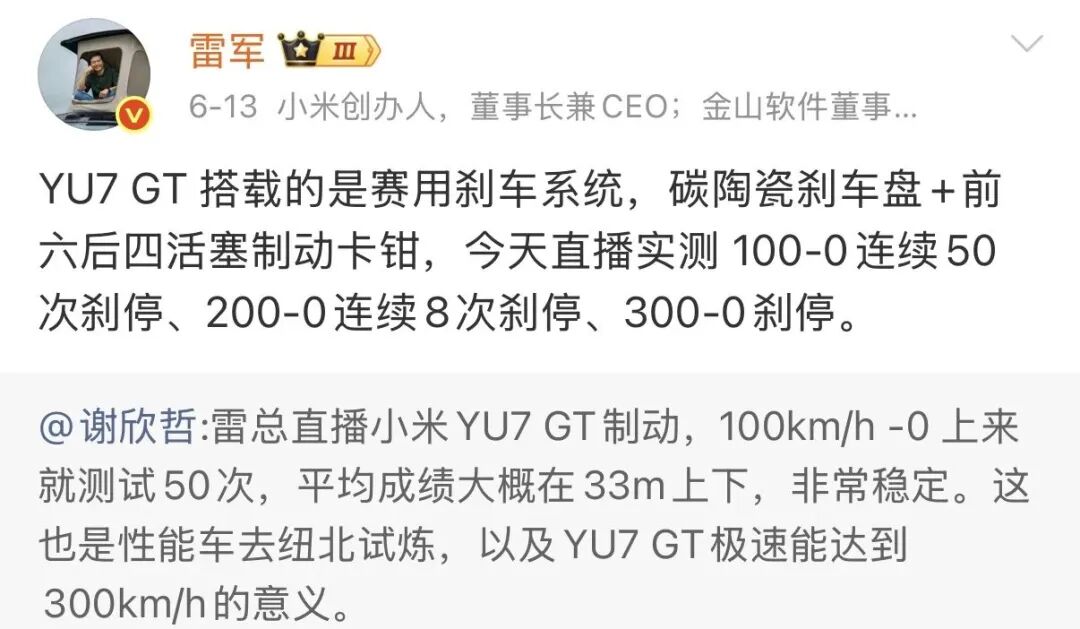
Image Source: Weibo
This theoretical framework was put to the test in June’s live stream at the Yancheng Test Track. Lei Jun oversaw the event as the YU7 GT performed 50 consecutive stops from 100km/h without pausing or cooling the brakes—all in one continuous shot.
Few automakers dare to push their limits in this manner. The video immediately sparked debate. Most netizens dismissed it: "Who drives like this in real life? Pure clickbait." But a top-rated comment went viral: "You might never brake that hard in your life, but your car must be capable of it."

Image Source: Weibo
The data speaks for itself: The first stop from 100km/h was 33.69 meters; after 50 consecutive stops, it was just 34.28 meters—minimal fluctuation. What seemed like grandstanding was actually building in extra safety margins. National standards are merely the passing grade—Xiaomi aims higher. Lei Jun’s quote, “When it comes to safety, ‘good enough’ isn’t enough,” once sounded like empty rhetoric. Now, it’s clear it’s his bottom line. What defines luxury? Not big screens, leather, or long range—but safety in the unseen places that matter when it counts.
Behind the Memes: The 200km/h Stop and Pedal Snapping Reality Check
Remember the viral meme from earlier this year? Lei Jun shared a video about braking from 200km/h, and the internet went wild: “Xiaomi brakes are the best—can stop instantly from 200!” It became a mocking (note: kept as-is, meaning 'mocking') meme. Questions flooded in: Why did it still hit the green belt (note: kept as-is, meaning 'median strip')? Edited accident clips spread like wildfire, branding it the “Median Strip Warrior.”
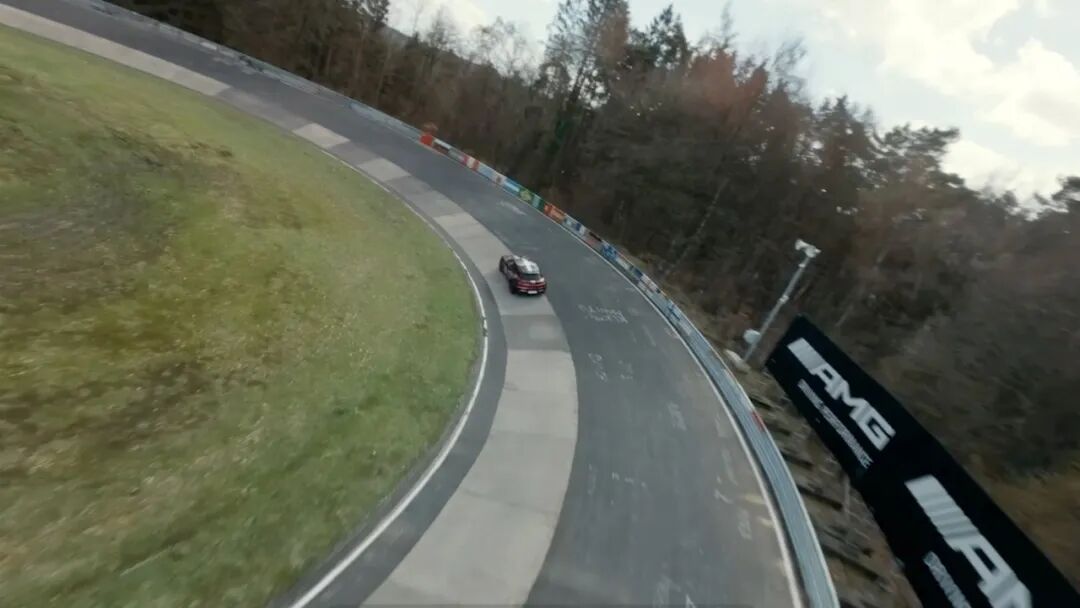
Xiaomi YU7 GT (Image Source: Xiaomi Auto Official Website)
Xiaomi later clarified it was an offhand remark after being impressed by carbon-ceramic brake performance, but it was taken out of context. Many “median strip” clips were edited and couldn’t be blamed on brake hardware.
No one expected a brake pedal snapping incident months later, silencing the harshest critics. Theoretically, a brake pedal shouldn’t break no matter how hard it’s pressed. But in panic, people slam the brake with full force. Testing shows it takes approximately 1,600N to snap a pedal; domestic standards recommend withstanding 1,500N for 5 seconds. Here’s the catch: National standards only care if the car stops—not how much force the pedal bracket can take before snapping.
Comparison
Xiaomi YU7 GT / Xiangjie V800
Test Date / 2026-06-13 / 2026-10-08
Tester / Xiaomi Official Live Stream / Dongchedi (Third-Party)
Key Results / 50 consecutive stops, no thermal fade / Pedal bracket snapped on stops 2–4
Braking Distance / 32.28m – 35.41m / ~38m → ~140m
Whether the pedal holds depends on if automakers invest in reinforcement. Some push failure thresholds to 3,000–4,000N; BYD’s premium models use metal pedals with internal standards up to 2,500N. Meeting national standards is easy—exceeding them shows integrity.
Back to the SU7’s brakes. It uses Bosch systems, where normal braking relies on electronic signals controlling hydraulic brakes. The worst-case scenario? Electronic failure. The quadruple redundancy exists for this: If systems fail, deep-pressing the pedal switches to mechanical hydraulics—the most primitive, reliable method.
Lei Jun personally tested 200km/h emergency stops; executives live-tested blowouts. The message is clear: No safety test is too extreme. Meanwhile, some automakers use plastic brackets, with some reinforcing them generously and others barely meeting minimums.
At new car launches, everyone competes on screens and AI—but what saves lives are the unseen brackets and brake hardware under the dashboard. A car can be fast and smart, but only if it can stop reliably.
50 Consecutive Hard Stops: Marketing Gimmick or Safety Baseline?
Back to Xiaomi’s June 13 Yancheng live stream. The YU7 GT performed 50 consecutive stops from 100km/h without cooling. The best stop was 32.28 meters. After 50 stops, the variation was under 1 meter—no pedal snapping. Netizens were divided: Some called it a stunt (“No one brakes like this normally”). Others said live-streaming such extreme conditions shows confidence. Let’s get real.
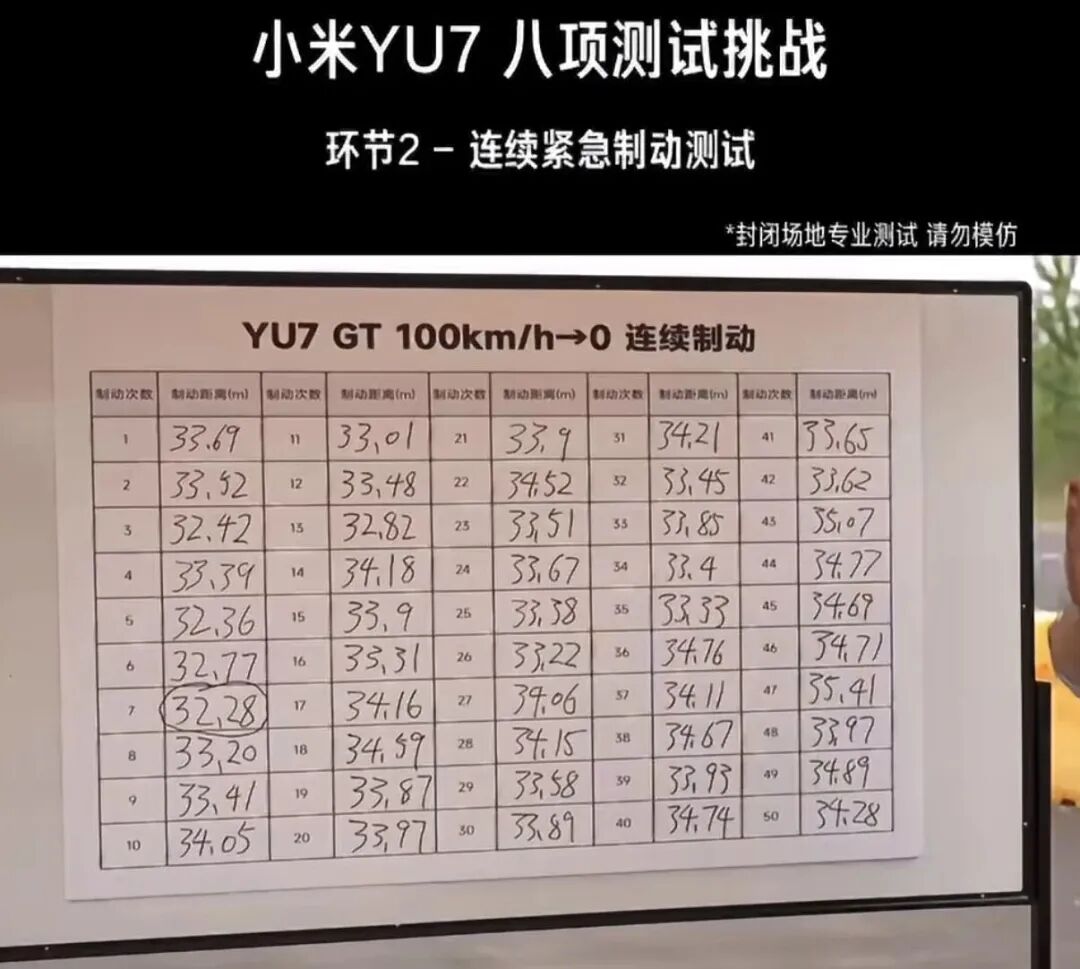
Image Source: Weibo
Braking is simple: Friction converts kinetic energy to heat. Rub your hands together—they get hot. Too much heat reduces friction, so brake performance drops. It feels like braking on cotton—pressing harder doesn’t slow you down. That’s thermal fade.
It’s not just for tracks. Mountain drives, continuous curves, or heavy loads downhill can trigger it in family cars. Daily driving rarely needs 50 stops, but one long-downhill fade could be life-or-death. Extreme testing isn’t about daily driving—it’s about building safety buffers.
Safety Arms Race: Beyond National Standards, Where Integrity Shows
The May 2025 update to brake national standard GB 21670—2025 takes effect January 1, 2026. Key changes: ABS mandatory; no default single-pedal stopping; brake lights must activate during strong regenerative braking. Interestingly, most drafting units were domestic brands—who sets the bar shapes the industry’s future.
To tell if tests are gimmicks or real, ask: Does every delivered car have this capability? Redundant brakes, overheat warnings, and strict internal tests shouldn’t be live-stream props—they should come standard. This is how domestic brands improved safety: Less hype, more hidden safety margins. Braking logic is simple: Burn money testing instead of failing when it matters.
Interactive Topic: When buying a car, do you prioritize unseen safety redundancies or visible features like big screens and long range? Share in the comments!
Disclaimer: This is financial commentary, not investment advice. All data and events are from public sources. Images are sourced online—contact for copyright removal.
-
![]()
Downward Adjustment of Export Tax Rebate Rate for New Energy Vehicles: Not a Bid to Reap 'Profits' from Overseas Expansion
-
![]()
Who is the Apple in the Era of Embodied AI?
-
![]()
Laughing No More! Brake Pedal Snaps—Is Lei Jun Actually the Biggest Winner? Netizens Say: Genius Move!
-
![]()
Huawei’s ‘Cullinan’ Rival Makes Its Debut: China’s First SUV with a Vertical Emblem—Is It More Prestigious Than Aito or Zunchi?
-
![]()
Blockbuster Move: Geely's Li Shufu Secures Approval to Acquire Stake in Century-Old Ford Motor's Spanish Unit
-
![]()
LiDAR Battle: RoboSense Sells 590,000 Units but Still in the Red, While Hesai Earns 70 Million—What's the Difference?
-
![]()
Vivo's Misstep: The Fallout from Widespread Flash Memory Controversy
-
![]()
Why Did Vivo Stumble Amidst the Flash Memory Mixing Fiasco?