Vivo's Misstep: The Fallout from Widespread Flash Memory Controversy
 10/13 2026
 428
428
Don't Treat Consumers Who Splurge 7,999 Yuan on Phones Like Second-Class Citizens
Smartphone manufacturers have now descended to the realm of 'lottery-style' flash memory 'education' for their customers.
From Xiaomi to Apple, controversies surrounding mixed flash memory configurations have erupted time and again. Apple, the global smartphone leader with the highest profit margins, faced significant backlash for its mixed flash memory approach: the 256GB and 512GB models utilize TLC, while the more expensive 1TB and 2TB variants switch to QLC.
According to public reports, the 1TB model also features a mix of two types of flash memory particles, with most batches using QLC and a select few using TLC—leaving buyers at the mercy of chance. The 2TB model is rumored to exclusively use QLC. Despite paying more for higher capacities, consumers are not guaranteed improved performance.
Consumer dissatisfaction is understandable: paying the same price for the same phone model may result in different internal components. Especially when opting for higher-capacity versions at a premium, users expect upgrades—not concerns over whether they've received a subpar performance variant.
While manufacturers cite supply chain and cost considerations, consumers counter with a straightforward question: Since the cost savings aren't passed on to us, why should we accept performance disparities?
Despite the criticism, sales remain largely unaffected. Imaging capabilities, chipsets, operating systems, and brand reputation offer alternative selling points that overshadow the controversies. Flash memory, hidden within the device, remains invisible before purchase and non-selectable, leading consumers to console themselves that similar daily performance justifies the mixed usage.
Recently, consumers uncovered Vivo's audacity: the X300 model faced hardware quality control issues with mixed flash memory, while the camera UI was simplified, lacking features like new filters and functionalities.
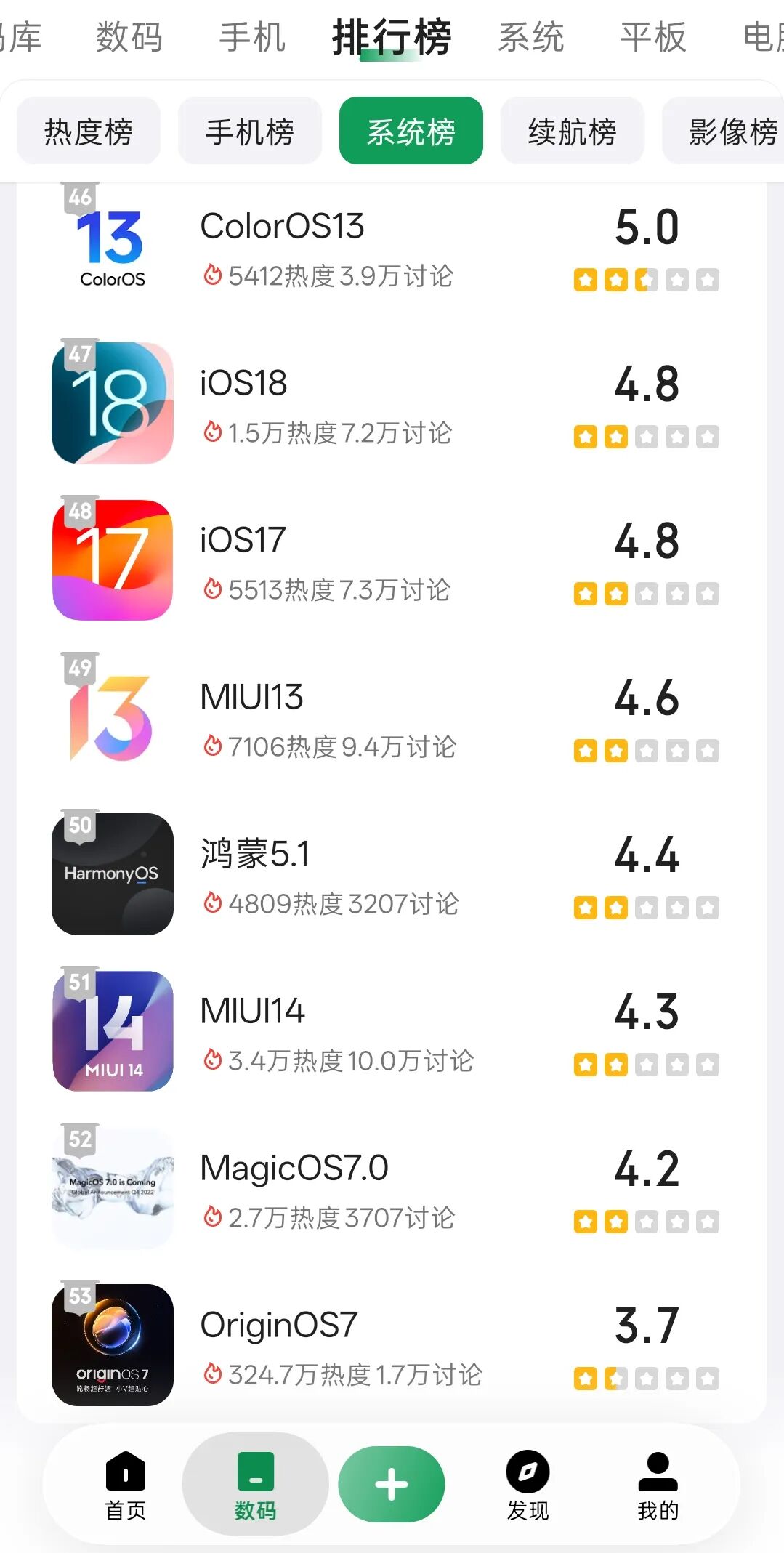
Most absurdly, the new OriginOS 7 system was rolled out to the public beta with unresolved bugs, causing compatibility issues. Its Coolapk rating plummeted from 9.7 to 3.7 within days, transforming a top-rated system into the worst—what does this say about consumer trust?
When consumers stop questioning 'whether it's from the same supplier' and merely demand 'comparable performance,' Vivo's flash memory controversy has pushed this already-low bar even lower: How significant can performance gaps be under the same 'flagship specification' label?
01
Flash Memory Can Be Mixed, But Flagships Shouldn't Be a 'Lottery'
Mixed flash memory is hardly a novelty in the smartphone industry.
For manufacturers, this represents standard supply chain management. Capacity, pricing, and delivery timelines vary across suppliers, making it impractical for flagship phones to rely solely on one vendor for a stable supply.
From Apple to Xiaomi, controversies over mixed suppliers for flash memory, screens, and RAM persist. However, consumers don't truly mind which components are used—they care about significant performance gaps at identical prices. While supply chain differences are acceptable, consumers reject performance lotteries for identical models marketed under the same standards.
Vivo's current controversy stems from users reporting far more than 'slightly slower' performance.
User-shared storage tests reveal X300 models scoring over 140,000 points, while X300 Pro variants lag at 60,000 points. More puzzlingly, some devices show sequential read/write speeds of 3,000-4,000MB/s but significantly slower random access.
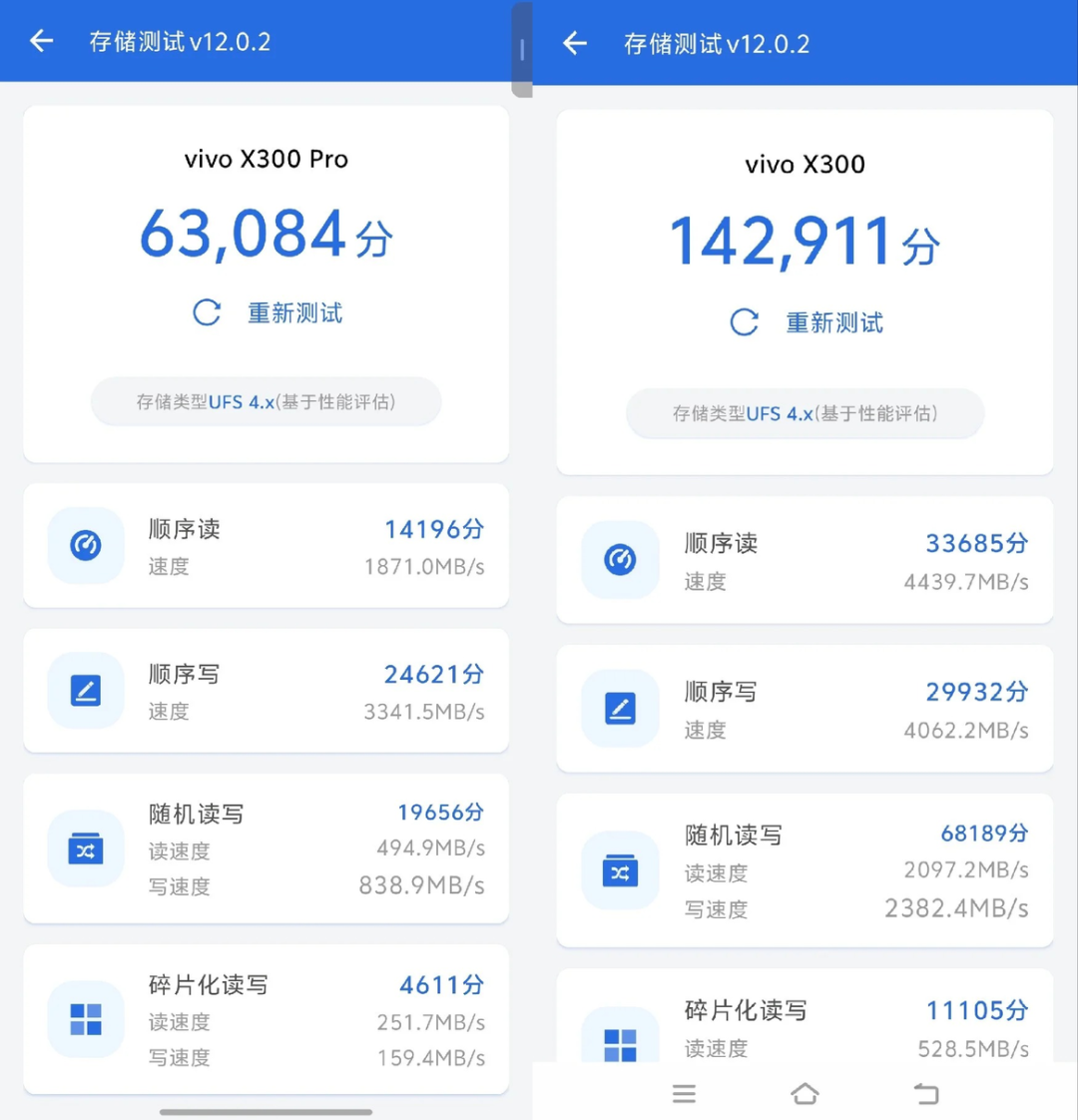
For example, in one comparison, the X300 Ultra's random read speed reached only 268.4MB/s, while the X300 Pro achieved 2,055.2MB/s—nearly 7.7 times faster. Random write speeds differed by approximately 6.5 times.
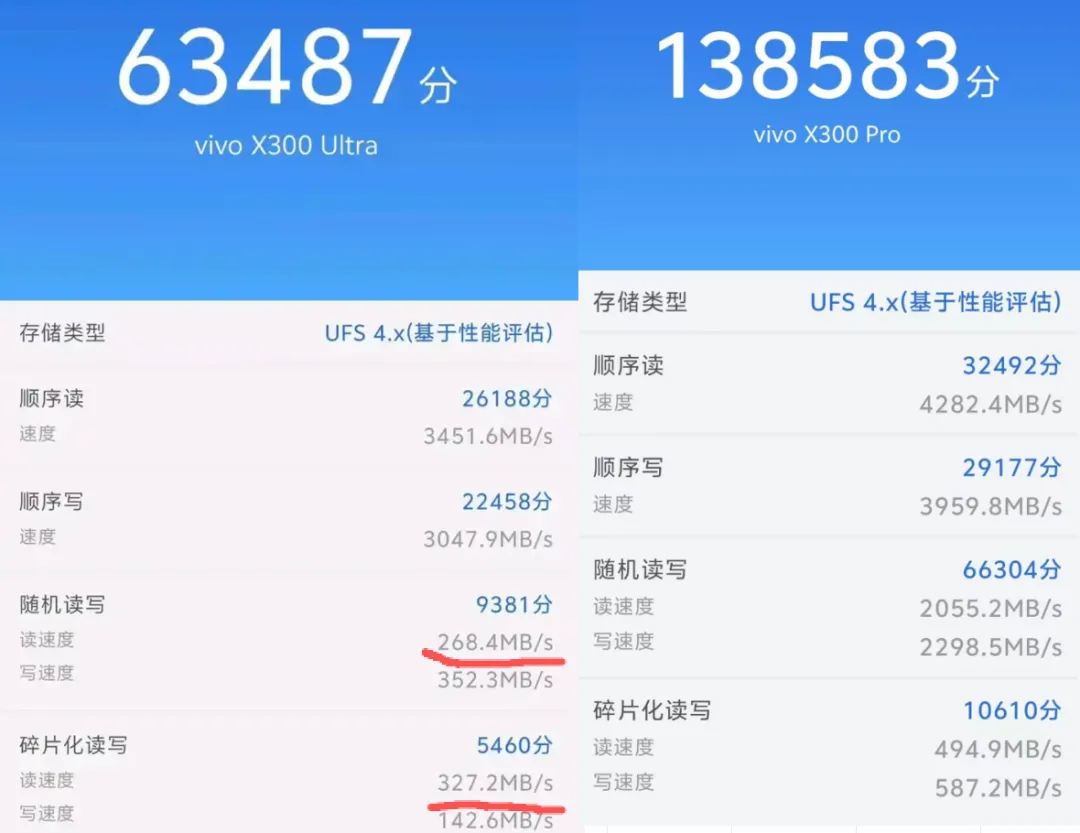
While these screenshots don't represent standardized benchmarks and can't directly translate multipliers into real-world experience gaps, consumers rightly question why higher-priced flagships deliver significantly lower scores—and by how much they're shortchanged.
As benchmark disparities went viral, new concerns emerged among Vivo users about whether their 'low-scoring' devices truly feature advertised UFS 4.1 storage.
After all, UFS 4.1 isn't a user-added specification—it's explicitly listed on X300 Pro and Ultra official parameter pages. Faced with stark test results, users demand confirmation that actual hardware matches advertising—a reasonable request.
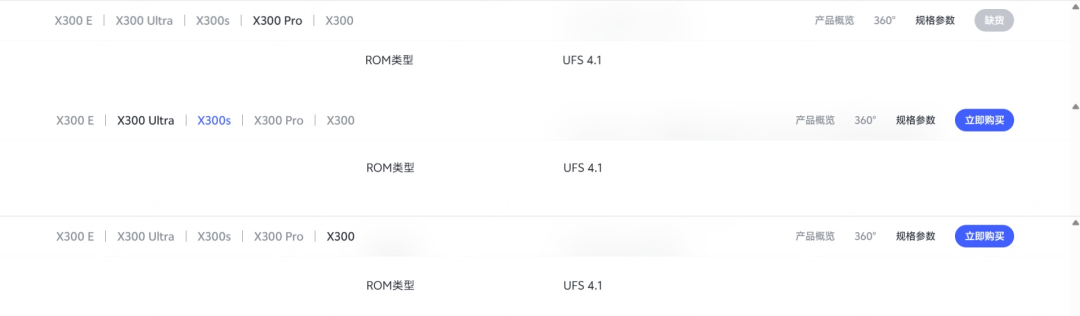
In response, Vivo's online customer service claimed the storage chips initially followed UFS 4.0 standards but were later upgraded to UFS 4.1 via firmware updates after meeting hardware requirements, with specifications documents updated accordingly. The persistence of UFS 4.0 in online queries was attributed to delayed information updates.
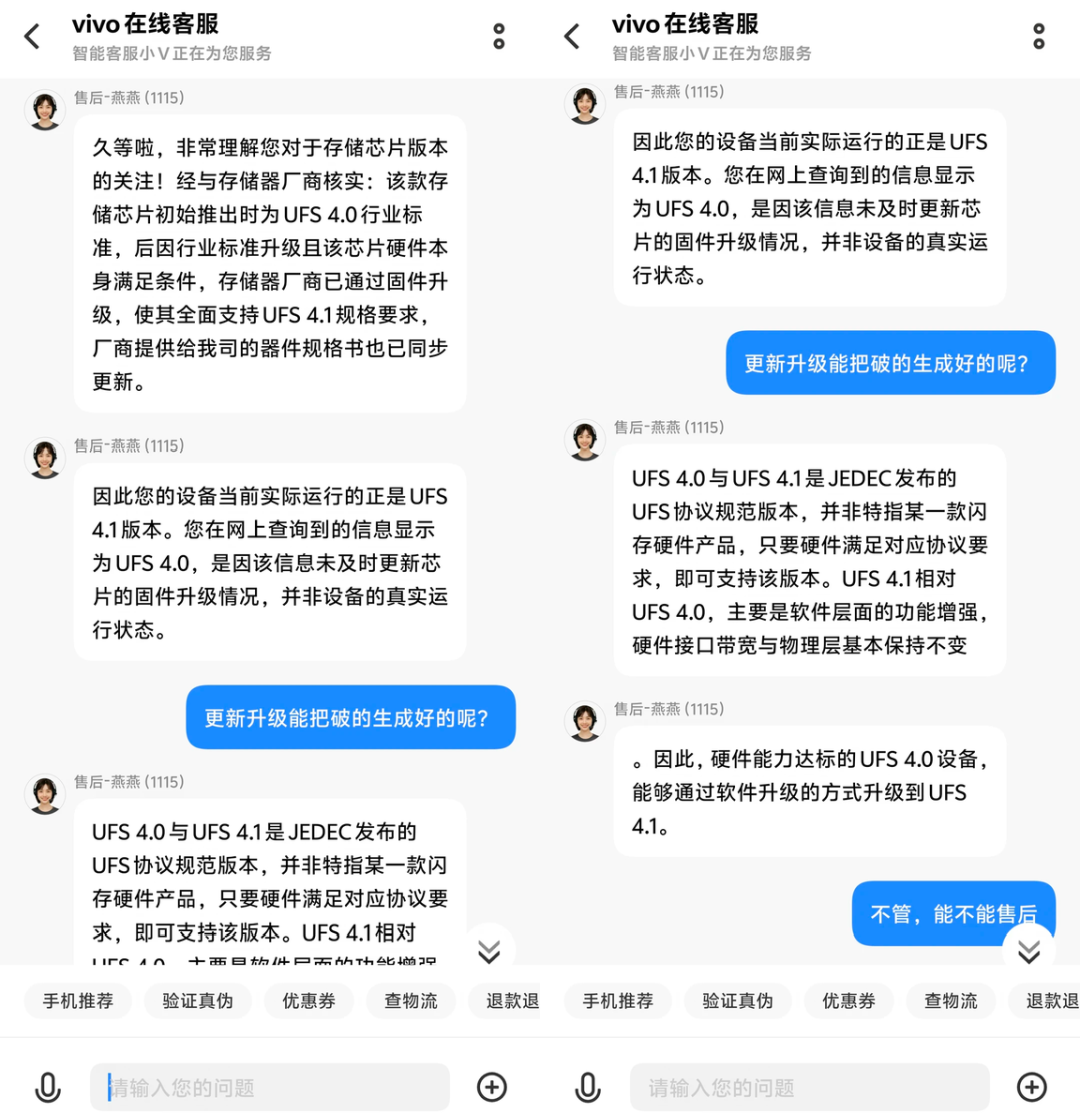
Under this explanation, user-received devices comply with UFS 4.1. However, consumers initially inquired about performance gaps, yet received primarily technical specifications—explaining why 4.1 labeling is valid but failing to address why some devices perform noticeably worse.
An X300 Ultra user told HyperFocus their storage test scored just over 90,000 points—lower than their backup phone—prompting them to sell the device ahead of new flagship releases.
An iQOO 15 user reported that while officially encoded H1 UFS4.1 models score 120,000 points, their G1-encoded device scored only 90,000 points with random read/write speeds less than half. They alleged permanent hardware locking to UFS4.0, incompatible with OTA upgrades to UFS4.1, demanding compensation or returns over suspected batch discrepancies.
Thus, Vivo faces not just debates over whether a flash memory chip should be labeled 4.0 or 4.1, but broader consumer doubts: Can identical specification sheets guarantee comparable products?
Some users accept mixed flash memory as logical product differentiation but reject stark performance gaps within the same model. Consumers may not care about component branding but will notice paying identical prices for demonstrably slower performance.
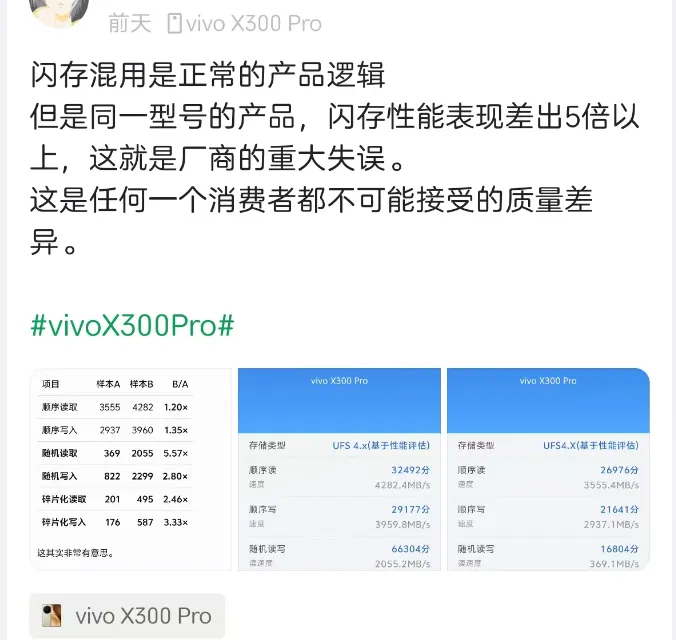
While specifications must align with advertising claims and performance gaps require standardized verification, this controversy won't automatically resolve even if both chip variants prove UFS 4.1-compliant. A unified specification label cannot erase performance doubts or replace manufacturer explanations for gaps and remedies.
Mixing suppliers is a procurement choice, but controlling variations is the manufacturer's responsibility. Consumers cannot select components pre-purchase yet must investigate models, run tests, and contact support to understand what they've bought—turning ordinary purchases into absurd ordeals.
When consumers concede to 'not caring about suppliers,' manufacturers must uphold product consistency. They cannot promote top scores while dismissing poor ones with 'all meet specifications,' leaving consumers to resolve identical-price-different-performance dilemmas alone.
02
Another Flagship Controversy: Defining 'Ownership'
If flash memory debates expose gaps between flagship specifications and real-world performance, another recent controversy surrounding the Vivo X300 series stems from its celebrated imaging capabilities themselves.
Some X300 Pro users discovered that despite sharing flagship-grade imaging hardware and Blueprint Imaging features with the series, their devices lacked software functionalities available on X300 Ultra and X300S models.
For example, in the Blueprint Color Palette feature, some X300 Pro users can adjust colors but cannot share color schemes via QR codes or import schemes from other users—key elements for community creation and interaction.
Additionally, users reported that new filters and updated camera interfaces rolled out to other series models never arrived on their X300 Pro devices. This raised questions: Has Vivo created such rigid 'hierarchies' within its product line that capable hardware is intentionally crippled?
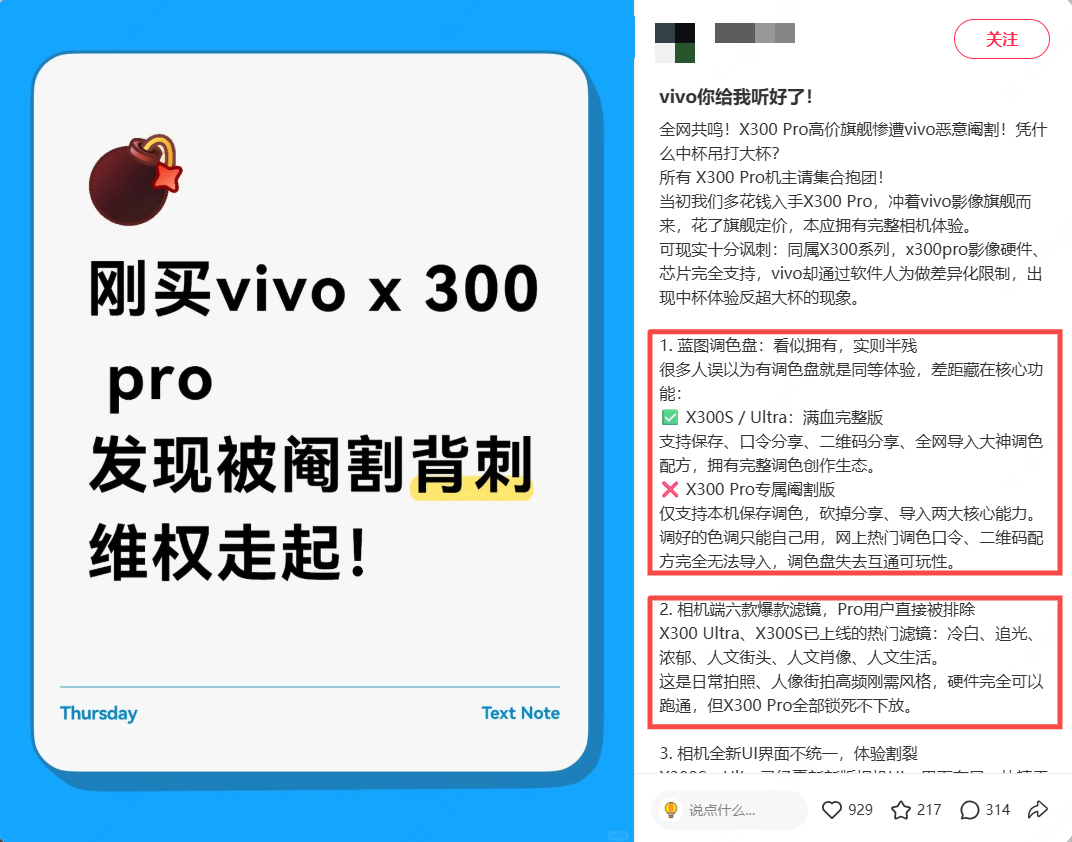
Vivo's response to functional disparity complaints sparked fresh controversy.
While differentiating flagship models through functional tiering is industry standard, how manufacturers define and communicate these differences tests their judgment and expression.
In a sensitive context, Vivo product lead Wang Qiao responded to reasonable user requests in a Weibo comment thread with: 'Childish behavior should just be happy. I think maturity matters more.'
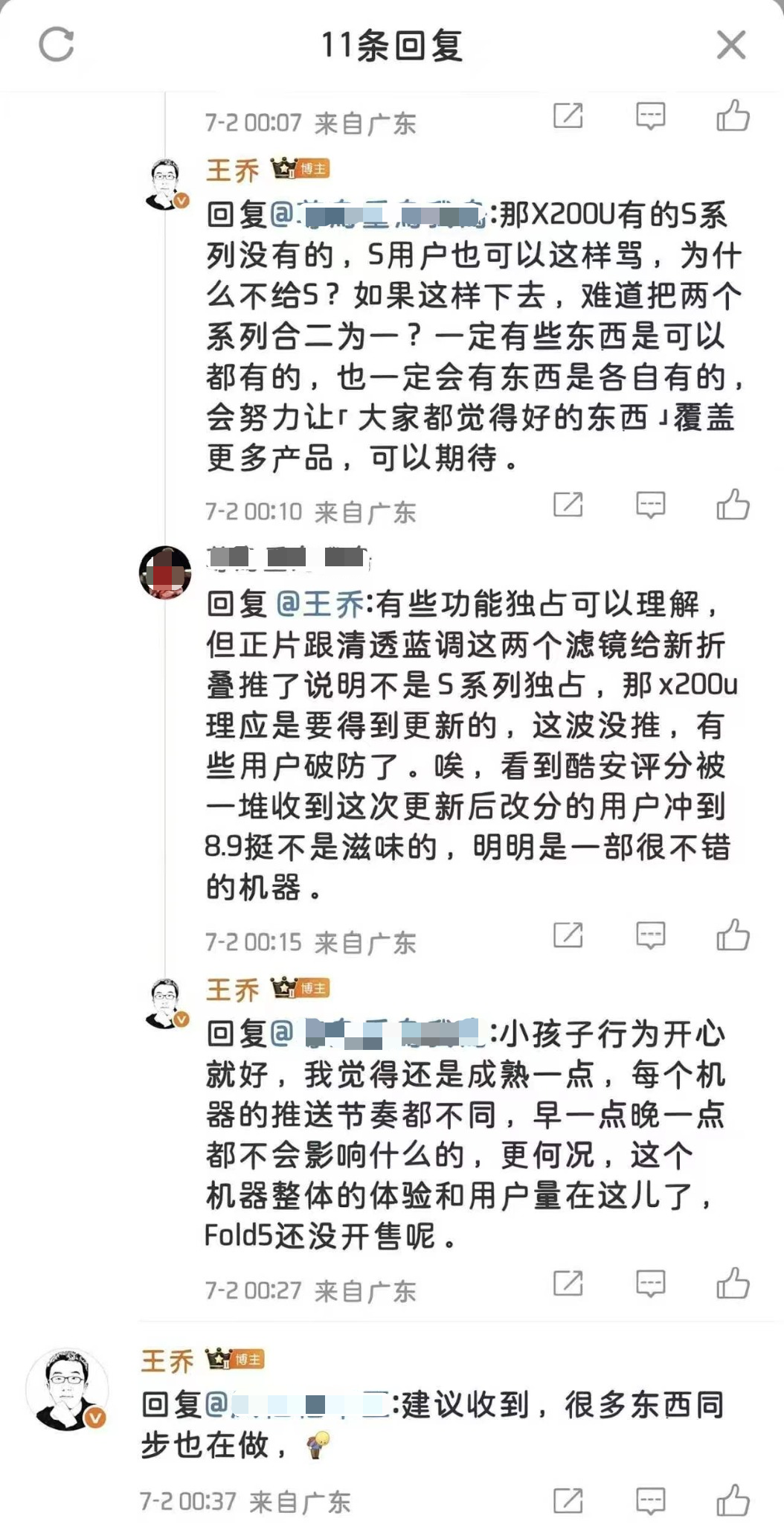
While potentially a personal remark in a specific discussion, this comment stung amid current product controversies. Users weren't debating trivial emotions but questioning why a flagship phone priced near 10,000 yuan lacked features available on cheaper series models.
Consumers don't expect manufacturers to fulfill all demands but seek simple explanations: Why are hardware-compatible series models denied features? When will access be granted? Will future optimizations arrive?
Instead, when users raised product experience concerns, they received judgmental remarks about 'maturity.' Spending 7,999 yuan on a phone only to be 'seated at the kids' table' by executives further inflamed dissatisfaction.
Similar situations emerged in iQOO series discussions. Users inquired about expanding high-refresh-rate adaptations to more apps, but iQOO's Wang Kan evaded the question before dismissively stating, 'The 15 doesn't support it. Is that really hard to understand?'
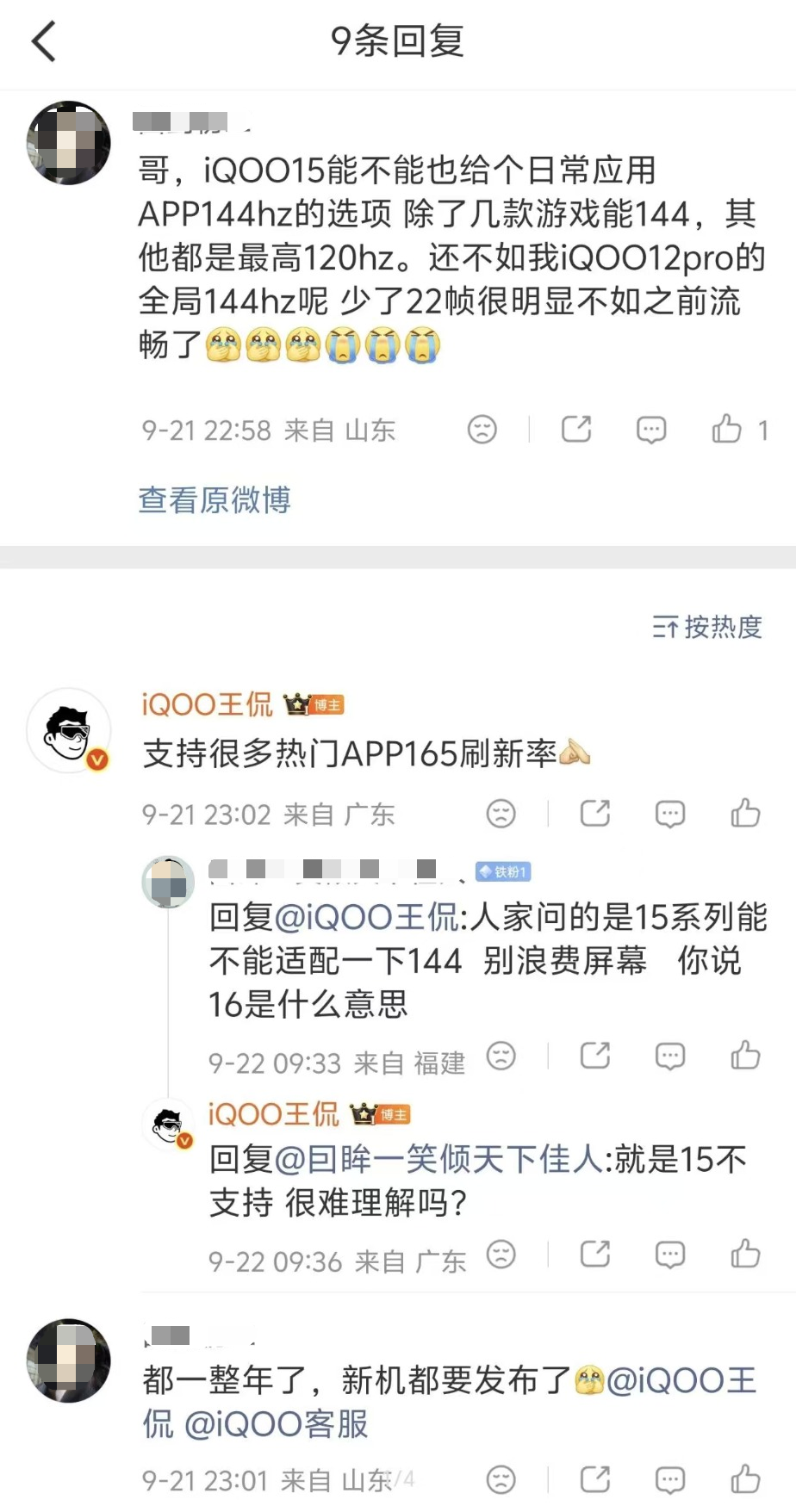
This contrasts with Vivo's brand image cultivated over recent years.
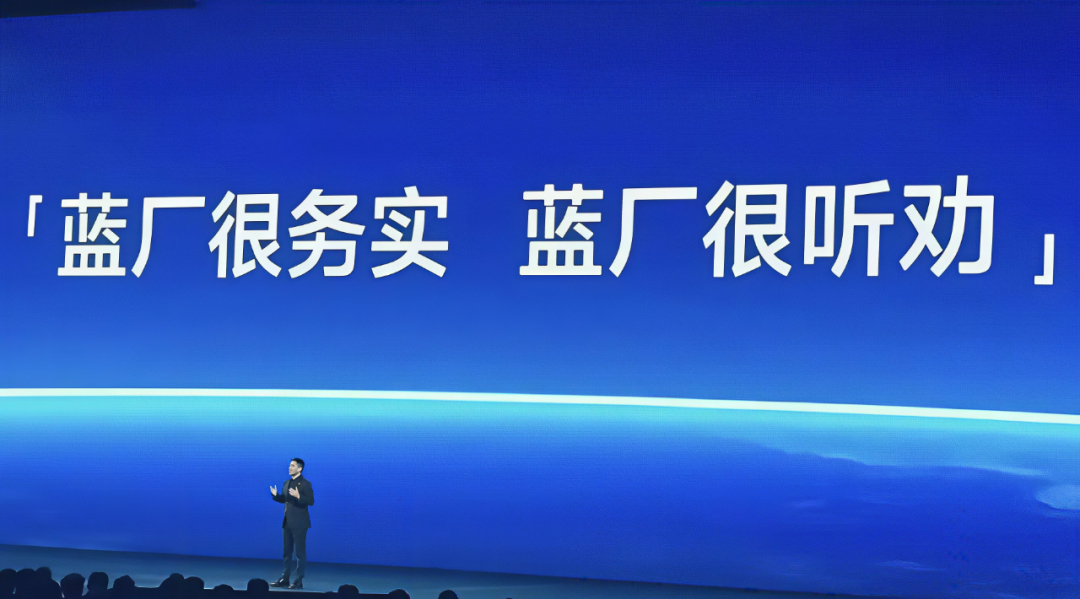
'Pragmatic' and 'responsive to feedback' became Vivo's defining traits after CEO Shen Wei emphasized 'fundamental values' in internal meetings and product launches since 2023—setting Vivo apart from competitors.
Unlike rivals prioritizing marketing hype, Vivo stressed product refinement and user feedback, continuously optimizing experiences through collected input. This approach helped amass a loyal user base.
To reinforce this responsive image, Vivo executives like product VP Huang Tao and OriginOS leads became highly active on Weibo and Coolapk in early 2024, engaging with user complaints about system usability or missing features (e.g., desired imaging mode integrations, periscope macro logic optimizations, requests to backport new functions to older models). High-ranking staff would often reply directly with 'Received, will arrange,' with Vivo frequently implementing user demands in subsequent OTA updates within short timeframes.
However, when 'responsiveness' becomes core brand equity, recent incidents and official social media responses—marked by evasion and confrontation—appear glaringly inconsistent. This 'selective responsiveness' rapidly erodes hard-won pragmatic credibility, leaving consumers who've invested real money feeling betrayed by marketing rhetoric.
In today's highly saturated smartphone market, competition in hardware parameters is approaching its limits. The trust established between manufacturers and users is becoming a rarer competitive edge than the parameters themselves.
What Vivo has built is a trust system based on user feedback and product co-creation. However, trust takes a long time to build but can be eroded with just a few disappointments.
When consumers are confronted with differences in flash memory performance, they receive explanations that it 'meets specifications.' When users raise issues about functional experiences, they are met with evaluations about 'maturity.' In such cases, their doubts extend beyond a specific feature or chip; they question whether the user relationship they once trusted still exists.
In the 'zero-sum game' (this term refers to a situation where market growth has plateaued, and companies compete for existing market share rather than new growth; a close equivalent in English might be 'competition for market share in a saturated market') of the second half of the smartphone market, the real challenge for Vivo may be to ensure that 'listening to advice' is not just a brand label but that 'integrity' is truly reflected in every user interaction.
- END -
-
![]()
Downward Adjustment of Export Tax Rebate Rate for New Energy Vehicles: Not a Bid to Reap 'Profits' from Overseas Expansion
-
![]()
Who is the Apple in the Era of Embodied AI?
-
![]()
Laughing No More! Brake Pedal Snaps—Is Lei Jun Actually the Biggest Winner? Netizens Say: Genius Move!
-
![]()
Huawei’s ‘Cullinan’ Rival Makes Its Debut: China’s First SUV with a Vertical Emblem—Is It More Prestigious Than Aito or Zunchi?
-
![]()
Blockbuster Move: Geely's Li Shufu Secures Approval to Acquire Stake in Century-Old Ford Motor's Spanish Unit
-
![]()
LiDAR Battle: RoboSense Sells 590,000 Units but Still in the Red, While Hesai Earns 70 Million—What's the Difference?
-
![]()
Vivo's Misstep: The Fallout from Widespread Flash Memory Controversy
-
![]()
Why Did Vivo Stumble Amidst the Flash Memory Mixing Fiasco?