Ignite the Tokens! The Capital Efficiency Test for Cloud Providers in the Agentic Cloud Era
 10/20 2026
 327
Foreword TrueView
Computing power is the most essential ticket to entry in the AI era. Tech giants with cash flow seem to naturally have the confidence to continuously increase capital expenditures. From training large models to supporting the large-scale deployment of ten thousand agents, cloud providers are initiating a computing power arms race, attempting to seize the high ground of the Agentic Cloud era with massive infrastructure. However, capital is not infinite. When continuous expansion meets long payback periods, the booming computing power expansion could easily turn into a high-risk capital gamble. Behind the divergence between industry optimism and secondary market pessimism lies the real challenge: not how much money can be spent, but whether invested capital can be transformed into sustainable returns.
This article will focus on analyzing
1. Why does agent deployment force cloud providers to complete a full-stack rewrite of their architectures?
2. What are the visible costs brought about by this computing power arms race?
3. How can domestic chip substitution and business model iteration improve ROIC?
4. What is the dividing line in the second half of the Agentic Cloud era?
Content / Chen Chongshan
Editor / Yong E
Proofreader / Mang Fu
Do tech giants truly possess infinite resources to support nearly endless capital expenditures in the AI era?
In the second quarter of 2026, the combined quarterly capital expenditures of Alibaba, Tencent, and Baidu, three domestic tech giants, reached RMB 131.852 billion, a staggering 114% increase from RMB 61.583 billion in the same period last year. Breaking it down, Alibaba's quarterly capital expenditure was RMB 67.678 billion, a 75% year-on-year increase; Tencent's was RMB 52.784 billion, a 176% year-on-year surge; and Baidu's was RMB 11.390 billion, with a year-on-year increase approaching 200%.
The core variable driving this round of multi-billion-dollar heavy investments is the accelerating deployment of AI agents. As enterprise AI moves from the model pilot stage to the large-scale commercial operation of ten thousand agents, traditional cloud computing architectures are struggling to handle explosive and sustained inference demands. Thus, Agentic Cloud has become the new track (translated as 'new arena') collectively bet on by global cloud providers.
At the Hangzhou Cloud Town Conference on September 22, Alibaba Cloud CEO Wu Yongming announced that by 2032, the scale of Alibaba Cloud's data centers would exceed 20GW.
This power scale is roughly equivalent to the full-load operation of 20 large nuclear power units, certainly no small feat. According to Goldman Sachs estimates, Alibaba Cloud's current deployed computing power is approximately 56GW, up from just 2GW in 2022, meaning Alibaba aims to expand its computing power base tenfold within a decade.
The market's reaction to this figure has been intriguingly split. Goldman Sachs, Citigroup, and UBS all view it as the most incrementally valuable information from the Cloud Town Conference and have reassessed Alibaba Cloud's long-term revenue potential. Based on the potential for hundreds of billions in external revenue per GW, 20GW is an anchor point capable of rewriting valuation models.
Yet on the other side, Alibaba's ADRs on the U.S. stock market have cumulatively retracted by over 40% since October 2025, and once (translated as 'once') fell more than 4% in pre-market trading after the August earnings release.
The contrast between the industry's booming computing power expansion, investment banks' optimistic profit forecasts, and the secondary market's cautious stance with its feet is stark.
The essence of the divergence does not lie in doubts about the long-term value of AI clouds but rather in the paradigm shift from the first half of cloud computing, which sold resources, to the second half of Agentic Cloud, which outputs intelligence. Cloud providers have bet unprecedented levels of capital expenditure, but no one truly knows when or how this money will be recouped.
Agentic Cloud is rewriting the underlying logic of the cloud, with inference replacing training, stateful tasks replacing stateless requests, and the Token economy replacing the traditional resource economy. Astronomical capital expenditures are now inevitable, but scale is no longer the sole path to victory. ROIC, free cash flow, and GPU utilization have become the new lifelines of competition.
Part.1 The Full-Stack Rewrite: A Must-Have Ticket to the Agentic Cloud
To understand why this round of investment is so intense, one must first grasp a fundamental change: the primary consumers of the cloud are shifting from humans to agents, and cloud services are transitioning from providing resources and computing power to delivering capabilities and intelligence.
Before 2023, the cloud industry was collectively anxious. With the Mobile Internet (translated as 'mobile internet') dividend (translated as 'dividend') peaking and enterprise digitalization growth slowing, where would the next growth engine come from? At the time, no one could have imagined the answer would arrive in such a dramatic fashion.
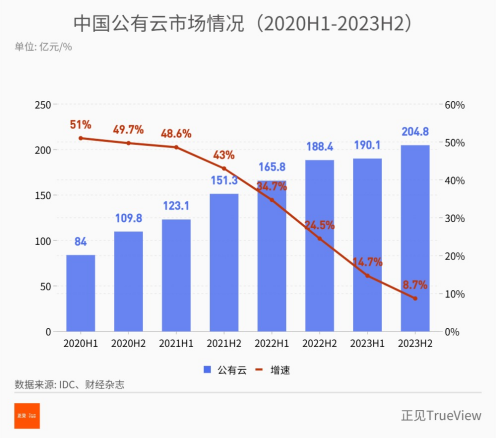
The advent of ChatGPT kicked open the door to the large model era, but at that time, the primary workload on the cloud was concentrated on model training, with computing power demand subsiding after training tasks were completed.
The true industrial inflection point came not in 2023 but in 2025. According to Tencent Cloud executives, DeepSeek ignited the market in the first half of the year, and agents took over in the second half, significantly boosting market vitality.
Behind this, cloud providers underwent a role transformation, shifting from water sellers in the digital era to computing power gatekeepers in the AI era. Water sellers sold standardized, general-purpose resources that any market participant could purchase, while computing power gatekeepers sell scarce computing power access, the prerequisite foundation for AI business operations.
The financial implications of this role shift are enormous, implying a reshuffling of industry pricing power.
Data from overseas markets provides a reference. Research by Barclays shows that for every $100 in revenue generated by U.S. AI large model companies, approximately $35 to $40 ultimately flows to AWS, Azure, and Google Cloud. Cloud providers capture about $10 to $20 in operating profit from this, corresponding to profit margins of 35%-45%.
In other words, the more prosperous AI applications become, the larger the profit share eaten up by cloud providers. While model companies compete on price upfront, cloud providers count their money in the background.
Signals from the Chinese market are flashing in sync. In the second quarter of 2026, revenue from Baidu's AI cloud infrastructure, Kingsoft Cloud, and Tencent Cloud's FBS segment grew by 50%, 30.8%, and 9% year-on-year, respectively. Alibaba Cloud's AI-related product revenue achieved triple-digit growth for 12 consecutive quarters. Data from the China Academy of Information and Communications Technology (CAICT) shows that in 2025, China's public cloud large model Token calls reached 2,000 trillion, a more than 16-fold increase from 114 trillion in 2024.
The real technological qualitative change occurred in 2026. Google unveiled its Agentic Cloud strategy at Next’26, Alibaba Cloud completed a full-stack agentization upgrade, Amazon launched AgentCore, and Microsoft's Foundry Agent Service officially went commercial.
The synchronized actions of the world's top four cloud providers around a similar time window are rare in cloud computing history. Forrester summarizes this round of transformation as enterprise AI moving from the pilot era to the era of large-scale management.
This is a complete generational architectural shift. As CAICT points out, typical agent tasks follow a multi-round closed-loop logic of 'perception-reasoning-action-feedback,' with reasoning run through (translated as 'running through') the entire process, triggering dozens of chained calls and tool executions. The task lifecycle extends from milliseconds to minutes, hours, or even days.
In contrast, traditional cloud-native architectures were designed for short-cycle, stateless, and replaceable work units. Once task computation is complete, containers are immediately reclaimed and destroyed. The underlying logic of the two is fundamentally mismatched.
The practical pain points caused by this architectural incompatibility are highly prominent. A widely circulated case in the tech community involves an agent program that took four hours to process 400 documents. An error occurred when processing the 301st document, and due to the lack of a checkpoint mechanism, the entire task had to be restarted from scratch. If the network interrupted, all intermediate runtime states were directly lost.

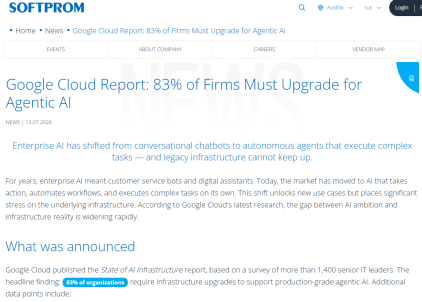
Google Cloud surveys also show that 83% of organizations believe their existing infrastructure cannot support the deployment of production-grade Agentic AI.
Another core dividing line for Agentic Cloud is that inference workloads are replacing training as the mainstream business on the cloud. Gartner predicts that by 2026, 55% of AI-optimized IaaS spending will be for inference business, rising further to 59% by 2027.
This shifts the cloud resource consumption model from one-time, pulsed training investments to uninterrupted, ongoing operational expenses. Countless agents continuously initiate Token calls, resembling a factory that never stops working.
This also explains why cloud providers must undergo a full-stack rewrite rather than simply adding more GPUs. Chips, scheduling systems, storage, runtimes, and inference platforms all need to be redesigned for long-cycle, stateful, high-concurrency inference tasks.
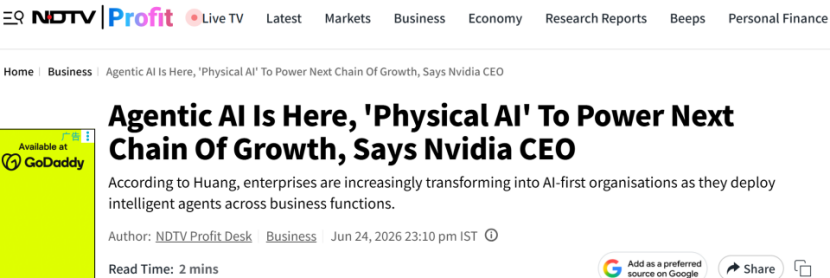
Jensen Huang put it bluntly at the June annual shareholders meeting: Traditional data centers provided services like storage, while AI factories now manufacture Tokens, with each Token representing a unit of profit.
Agentic Cloud is not a gradual upgrade involving simply adding GPU hardware and modifying some code but a complete full-stack rewrite covering chips, scheduling, storage, runtimes, and inference platforms.
Part.2 The Cost of Full-Stack Rewriting: A Colossal Bill Looms
Translating full-stack rewriting into financial terms means a steep rise in the capital expenditure curve.
Goldman Sachs estimates that expanding Alibaba Cloud's data center scale from the current ~5-6GW to 20GW will require adding 1-2GW annually in the coming years, with annual capital expenditures of approximately RMB 200-300 billion. They project RMB 209 billion, RMB 243 billion, and RMB 260 billion for 2027, 2028, and 2029, respectively.
ByteDance has raised its full-year capital expenditure plan for 2026 to over RMB 200 billion, the highest investment intensity domestically.
Overall, Morgan Stanley predicts that capital expenditures by China's core cloud providers and major internet companies will reach RMB 995 billion in 2026, a 121% year-on-year increase, far outpacing the 41% growth in the U.S. during the same period. From 2026 to 2030, China's AI-related capital expenditures are expected to total RMB 8.5 trillion.
The global trend is similar. TrendForce's October updated estimates show that capital expenditures by nine major cloud providers—Google, Amazon, Meta, Microsoft, Oracle, ByteDance, Tencent, Alibaba, and Baidu—will rise to over $957 billion in 2026 and may exceed $1.5 trillion in 2027.
These massive numbers easily evoke images of an arms race. However, a closer look at the structure reveals that this round of investment differs from any previous cloud expansion.
Past cloud expansions competed on data center floor space, server counts, and bandwidth capacity, with economies of scale as the core. Larger scale meant lower unit costs and higher marginal profits—a linear narrative.
But this round of Agentic Cloud expansion competes on how much output per unit of computing power, how many agents per Token, and how much revenue per agent—core is capability density.
This is a nonlinear narrative where capital investment can double, but if capability density falls short, business output will not grow proportionally and may even yield negative returns.
The high costs have directly resulted in collective cash flow pressure for enterprises.
In August, Alibaba quantified the AI computing power payback period for the first time. CFO Xu Hong stated that computing power services equipped with self-developed chips generally achieve break-even within three years. Based on a five-year equipment lifecycle, at least two more years are needed after break-even to generate positive free cash flow.
In other words, even in the most optimistic scenario, it takes five years from heavy investment to actually recouping cash.
In the second quarter of 2026, the combined free cash flow of Alibaba, Tencent, and Baidu showed a net outflow of RMB 66.424 billion.
Tencent's free cash flow was RMB 13.8 billion, turning negative for the first time in history, primarily due to RMB 51.4 billion in prepayments for computing power procurement. Alibaba's free cash flow showed a net outflow of RMB 46.61 billion in FY2026 and continued to outflow by RMB 44.67 billion in Q1 FY2027. Over the past four quarters, Alibaba's AI + cloud segment capital expenditures were approximately RMB 120 billion, with another RMB 54.136 billion in signed but unpaid obligations.
Once known for their abundant cash flow, domestic internet giants are now collectively seeing red on their balance sheets. Research by Minmetals Securities shows that the ratio of AI capital expenditures to corresponding revenue for the top five cloud providers surged from 59.2% in 2023 to 128.3% in the first half of 2026. Capital input now exceeds corresponding revenue by more than double, with massive costs being frontloaded.
Meanwhile, the risks of idle computing power and overcapacity continue to rise. Data from the National Data Administration shows that as of June 2026, China had over 500 operational intelligent computing centers, with nearly 400 projects under construction or planned. Zhang Jin from Tencent Cloud mentioned publicly at the MWC26 Intelligent Data Center Summit that the average utilization rate of intelligent computing centers nationwide is only 20%-30%, with some enterprise-level centers below 10%.
CAICT data similarly shows that in 2025, the actual utilization rate of intelligent computing resources in China was only 36.8%. For every RMB 100 invested in building computing power, approximately RMB 70 worth of resources remain idle.
Gartner, based on a survey of 3,412 participants, warns that by the end of 2027, over 40% of Agentic AI projects will be canceled due to high costs, ambiguous commercial value, and inadequate risk management.
If a large number of agent projects fail to meet deployment expectations, the massive computing power built for Agentic Cloud will face the risk of unmet demand.
Controlling hardware costs has thus become a rigid constraint in this competition, accelerating the substitution of domestic chips.
Tencent plans to raise the procurement share of domestic chips to over 65%, primarily sourcing training cards from Enflame and inference cards from Cambricon. Goldman Sachs judges that domestic AI chips could account for 70%-85% of server deployments.
China has also included multiple domestic AI chips on its security-reliable list. Seven companies, including Huawei's Ascend and Alibaba's Pingtouge Zhenwu series, have a total of nine chips rated at the highest security level. Pingtouge's new-generation training-inference integrated chip, Zhenwu M900, delivers three times the performance of its predecessor.
This is not just about ensuring supply chain autonomy and controllability, but also a hard constraint to reduce unit computing power costs and improve return levels.
Part.3 After the Trillion-Dollar Bill, ROIC is the Ultimate Knockout Round
Since large-scale capital investment is a foregone conclusion, the core of industry success hinges on who can convert investments into actual returns faster and more efficiently.
Morgan Stanley introduces the ROIC analysis framework from mature North American markets, dissecting three business paths: self-built GPU, third-party computing power leasing, and MaaS. Their calculations show that domestic cloud providers' ROIC falls within the 13%-20% range, with a cash recovery period of about 3 years. The report also points out that the capital expenditure per server in China is about three times that of similar configurations in the U.S., directly driving up depreciation costs. This once again confirms that domestic chip substitution is a key variable in whether ROIC can catch up.
Iterating business models is the second main path to enhance ROIC.
The China Academy of Information and Communications Technology points out that the billing model for computing power services is shifting from per-card-hour and cabinet leasing to billing based on Token consumption and outcome-based delivery. Product forms have evolved from GPU bare-metal leasing to Token-as-a-Service (TaaS), Agent-as-a-Service (AaaS), and Result-as-a-Service (RaaS).
This essentially transforms cloud providers from equipment landlords into value factory owners, charging not based on equipment rental duration but on the actual intelligent value produced by AI outputs.
Alibaba Cloud's operating performance can serve as a reference sample. In Q2 2026, Alibaba Cloud's external commercial revenue grew 45% year-on-year, with AI-related product revenue maintaining triple-digit growth for 12 consecutive quarters. J.P. Morgan estimates its weighted ROIC could rise to 16%, approaching 20% in steady state.
Wu Yongming proposed three optimization paths: 'increasing the proportion of high-margin MaaS revenue, reducing hardware procurement costs through self-developed chips, and jointly building data centers with partners while collecting prepayments,' aiming to compress the payback period to 22.5 years.
Even so, the capital markets are not entirely convinced. After Alibaba released its earnings report in August 2026, its U.S.-listed shares fell over 4% in pre-market trading. Since October 2025, Alibaba's ADR market capitalization has retracted by over 40%.
Morgan Stanley also cautions that Tencent's capital expenditures have annualized to over RMB 200 billion, which will exert upward pressure on Alibaba's capital expenditure plans.
When industry participants are forced to follow suit with capacity expansions, the ROIC competition evolves into a race to reach the breakeven point first.
The industry inflection point may arrive sooner than expected. Morgan Stanley predicts that capital expenditure growth for data centers among leading cloud providers will sharply decline from about 60% in 2027 to 12% in 2028.
This cliff-like drop in growth means that by 2028, the market will no longer chase how much computing power is built but will instead question how high the utilization rate of computing power is and how much revenue each unit of capital expenditure can generate.
In the Agentic Cloud era, the competitive logic for cloud providers has been rewritten. In the past, the focus was on data center scale and GPU quantity; now, it's about how to convert computing power into Tokens, models into Agents, and Agents into tangible revenue.
Free cash flow will become the industry's dividing line. Currently, the entire industry is in a phase of expansion at the expense of cash flow. The first companies to navigate the valley of death between investment and return will pull ahead with cash flow advantages. By then, external financing windows will tighten, making it difficult for lagging participants to rely on capital infusions for a comeback.
Therefore, the true indicators to observe in the Agentic Cloud competition are the cross-signals of four variables: GPU utilization rate, inference gross margin, Token unit price, and free cash flow.
In this decade-long wave of computing power expansion, the new king may not be the largest in scale but the one with the healthiest ROIC.
The astronomical computing power bills have been issued. Whoever can build the most efficient Token factory with the least money will seize the initiative in the second half of the cloud computing race.
END
-
![]()
Bosch Secures Multi-Million-Unit Orders, Horizon Robotics' Chips Go Global: What Will Mobileye's Next Move Be?
-
![]()
Is Douyin Still Reliant on the 'Little Yang Brother' Phenomenon?
-
![]()
NIO’s Workforce Declines by Over 10,000 in a Year, with RMB 930 Million in Stock-Based Compensation in H1: Implications for 35,000 Employees
-
![]()
Real-World Testing Reveals: Flash Models are Transitioning from 'Lite' to Practical Office Tools
-
![]()
China's Brake-by-Wire Systems Start to Compete with Bosch's Market: Who Will Supply the Core Driver Chips?
-
![]()
Li Auto Cuts Workforce by 3,970 in a Year: Insights into Average Monthly Salary and the Dominance of Sales Staff (40%)
-
![]()
Ignite the Tokens! The Capital Efficiency Test for Cloud Providers in the Agentic Cloud Era
-
![]()
The Data Centers of AI Giants Are Hitting a Wall Harder Than Chips