Bosch Secures Multi-Million-Unit Orders, Horizon Robotics' Chips Go Global: What Will Mobileye's Next Move Be?
 10/20 2026
 462
According to Nikkei, Horizon Robotics has secured over 20 million overseas orders, with partners including industry giants such as Bosch, OmniVision, and Denso.
◎ Bosch's fourth-generation multi-function camera, the MPC4, developed using the Journey 6B architecture, has been selected for more than 40 vehicle models, with life cycle orders reaching into the tens of millions.
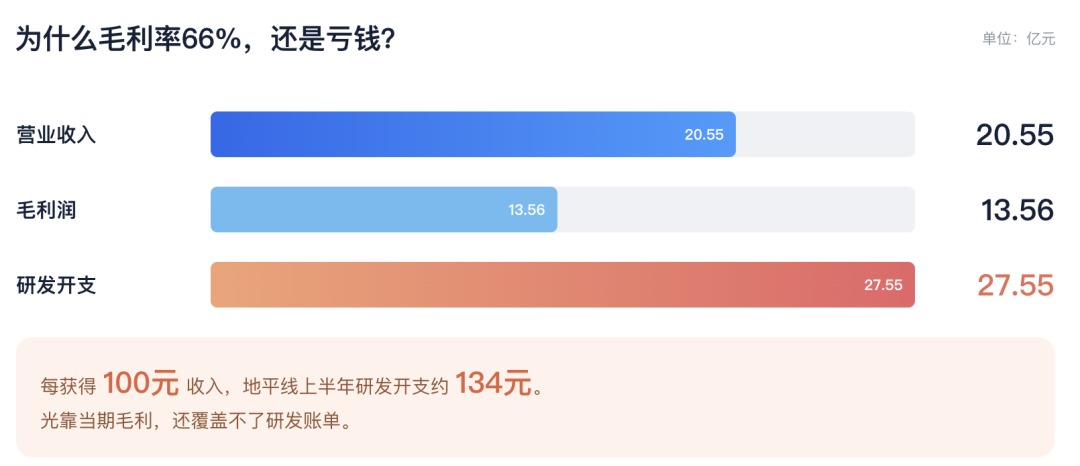
◎ In the first half of 2026, Horizon Robotics reported revenue of RMB 2.055 billion, a gross margin of 66%, R&D expenses of RMB 2.755 billion, and an adjusted net loss of RMB 1.671 billion.
How much profit can a chip company with a 66% gross margin generate after securing 20 million overseas orders?

Part 1: Why Did Bosch Entrust Multi-Million-Unit Camera Orders to Horizon Robotics' Chips?
Bosch revealed that its MPC4 camera platform, built on the Journey 6B architecture, has been selected for over 40 vehicle models, with cumulative order volumes reaching into the tens of millions. The first project is scheduled for mass production in the third quarter of 2026.
Consider a global vehicle model selling 200,000 units annually; over a five-year lifecycle, this would amount to 1 million units. Integrating a camera platform into over a dozen popular models can easily accumulate to tens of millions of units.

However, for a Chinese automotive chip company, gaining recognition from Bosch is far more challenging than securing orders from a single domestic vehicle model.
Overseas automakers have well-established development and validation systems for ADAS procurement. Chips must pass automotive-grade reliability verification, accompanied by functional safety documentation, software development tools, compilers, diagnostic systems, and compliance with regulations in different countries.
Once a chip is selected, the entire camera platform must undergo long-term algorithm adaptation, vehicle calibration, and mass production validation—a process that can take years.
Bosch's MPC4 selected the Journey 6B, a low-computing-power platform designed for basic Level 2 assisted driving, with computing power around 10 TOPS.
While Chinese automakers have been promoting 100 TOPS, 500 TOPS, and even 1000 TOPS as selling points in recent years, the global automotive market offers much larger business opportunities. A vast number of ordinary family cars only require basic functions such as automatic emergency braking, lane keeping, adaptive cruise control, and traffic sign recognition. Automakers prioritize camera system costs, algorithm stability, power consumption, and validation expenses.
After the front-view camera captures images, it must perform image preprocessing, object recognition, lane detection, and traffic participant tracking before delivering perception results to the vehicle control system.
A 10 TOPS-class chip must optimize every bit of computing power. Using Transformer to improve complex scene recognition requires strict control over model parameters, memory bandwidth, and real-time performance.
Chip area, memory configuration, and system power consumption directly affect BOM costs. For global vehicle models, reducing hardware costs by RMB 10 per unit translates to RMB 100 million in savings for 10 million units.
This market has long been dominated by Mobileye.
Horizon Robotics entered by leveraging the Journey 6B's computing architecture, toolchain, and open software ecosystem:
◎ Bosch continues to handle camera hardware, algorithm integration, safety validation, and vehicle delivery.
◎ Horizon Robotics provides computing chips and development support.

Horizon Robotics previously disclosed that the Journey 6B has been selected by over 25 global automakers, with life cycle orders exceeding 20 million units across more than 50 vehicle models. Horizon Robotics' global expansion initially targets the largest segment: basic ADAS.
Part 2: From 36% Gross Margin Selling Chips to 90% Selling Licenses: Horizon Robotics' Evolving Profit Model
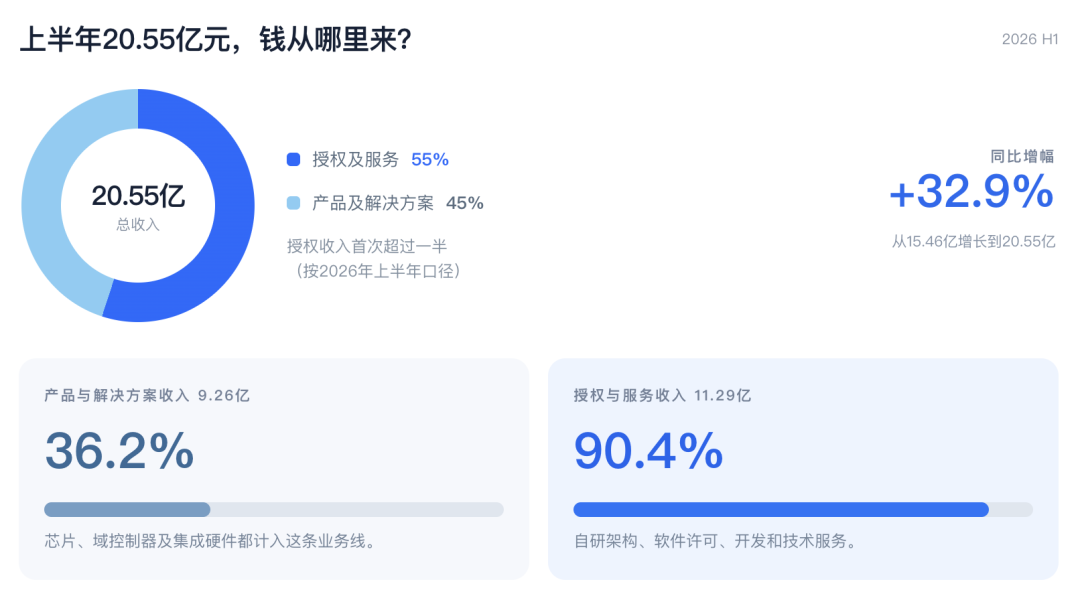
In the first half of 2026, Horizon Robotics reported total revenue of RMB 2.055 billion, a 32.9% YoY increase. This included RMB 926 million from products and solutions and RMB 1.129 billion from licensing and services.
◎ Software licensing has surpassed hardware to become the largest revenue source.
◎ Products and solutions had a 36.2% gross margin, while licensing and services achieved a 90.4% gross margin, resulting in a combined 66% gross margin.
Every chip produced incurs costs for wafer fabrication, packaging, testing, and logistics. Domain controllers also require PCBs, memory, power chips, and connectors.
To help some customers accelerate HSD solution mass production, Horizon Robotics offers integrated hardware like domain controllers with minimal markup on non-core components and manufacturing costs, lowering product business gross margins. Excluding these, the adjusted product business gross margin is 48.1%.
The licensing business operates differently. Core costs for BPU architecture, algorithms, toolchains, and development services are incurred during the R&D phase. A mature software solution can serve multiple customers, and new licenses do not require additional physical chip production.
◎ The product business, with a 36.2% gross margin, earns from manufacturing each chip, but its ceiling is constrained by wafer costs and packaging prices.
◎ The licensing business, with a 90.4% gross margin, earns from the reusable value of R&D investments, with nearly no additional cost for each new customer.
Shifting revenue focus from hardware to licensing is a standard signal of a chip company transitioning from a product-selling model to a platform-based model, a path already taken by Qualcomm and Mobileye.
In Horizon Robotics' interim report, licensing and services accounted for 55% of revenue, indicating a completed shift in focus.
In the first half of 2026, Horizon Robotics shipped 2.218 million units of its Journey series, a 12.1% YoY increase. Dividing the RMB 926 million product revenue by 2.218 million units yields approximately RMB 418 per chip.
The 20 million overseas orders cover different vehicle models and supply cycles, with varying chip models and licensing methods. Assuming full delivery of 20 million units, each contributing RMB 200, RMB 300, or RMB 500 in revenue, the cumulative revenue would be RMB 4 billion, RMB 6 billion, or RMB 10 billion, respectively.
First-half R&D expenses reached RMB 2.755 billion, RMB 700 million higher than revenue, with an adjusted net loss of RMB 1.671 billion.
The RMB 3.784 billion net profit on paper appears profitable but primarily stems from fair value changes in financial liabilities and gains from discontinuing the merger with Digu Robot.
Horizon Robotics simultaneously maintains its Journey chips, BPU architecture, development toolchains, foundational models, and advanced assisted driving software platforms—a system that continuously burns cash.
The value of the 20 million overseas orders lies in the same architecture and software being applicable to both Chinese automakers and products from Bosch, OmniVision, and Denso, amortizing upfront R&D investments across more models and longer life cycles. Whether scale translates into profit depends on trends in chip transaction prices, licensing revenue, and R&D expenses.
Summary
From beginning mass production in 2020 to surpassing 15 million cumulative Journey chip shipments by September 2026, Horizon Robotics has established a domestic delivery scale over six years. Now entering the global supply chain involving Bosch, OmniVision, and Denso, its order volume has the potential to grow further.
The 20 million orders have propelled Horizon Robotics into a market dominated by global Tier 1 suppliers and traditional automotive semiconductor companies, offering a domestic intelligent driving chip company the opportunity to share in the global basic ADAS business for family cars.
-
![]()
Bosch Secures Multi-Million-Unit Orders, Horizon Robotics' Chips Go Global: What Will Mobileye's Next Move Be?
-
![]()
Is Douyin Still Reliant on the 'Little Yang Brother' Phenomenon?
-
![]()
NIO’s Workforce Declines by Over 10,000 in a Year, with RMB 930 Million in Stock-Based Compensation in H1: Implications for 35,000 Employees
-
![]()
Real-World Testing Reveals: Flash Models are Transitioning from 'Lite' to Practical Office Tools
-
![]()
China's Brake-by-Wire Systems Start to Compete with Bosch's Market: Who Will Supply the Core Driver Chips?
-
![]()
Li Auto Cuts Workforce by 3,970 in a Year: Insights into Average Monthly Salary and the Dominance of Sales Staff (40%)
-
![]()
Ignite the Tokens! The Capital Efficiency Test for Cloud Providers in the Agentic Cloud Era
-
![]()
The Data Centers of AI Giants Are Hitting a Wall Harder Than Chips