NIO’s Workforce Declines by Over 10,000 in a Year, with RMB 930 Million in Stock-Based Compensation in H1: Implications for 35,000 Employees
 10/20 2026
 358
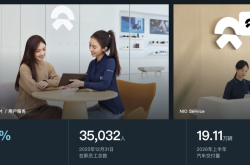
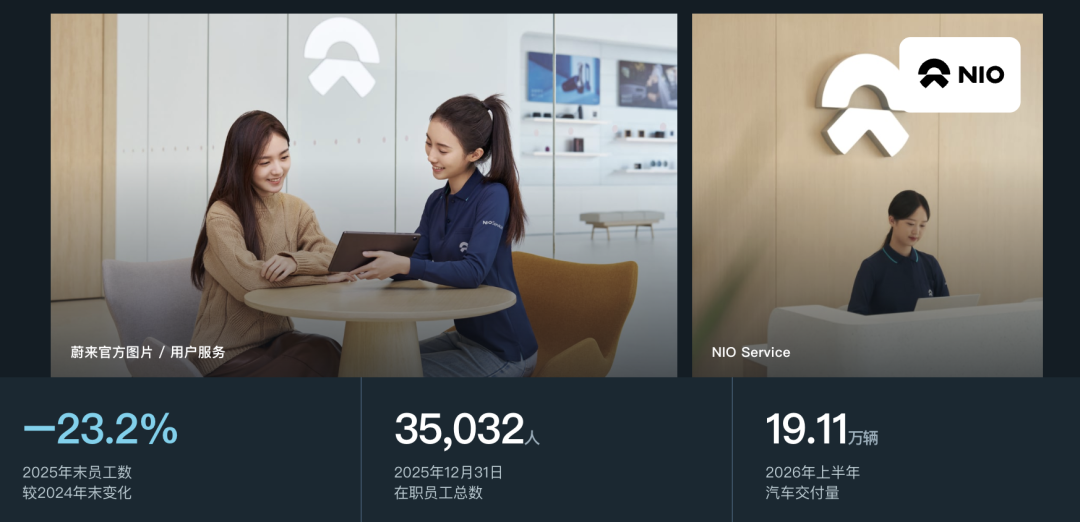
As of the end of 2024, NIO employed 45,635 staff. By the end of 2025, this figure had decreased to 35,032, representing a net reduction of 10,603 employees in a single year—a 23.2% drop in total headcount. Despite this significant downsizing, NIO improved its operational efficiency and increased its sales volume.
In the first half of 2026, NIO delivered 191,100 vehicles and generated RMB 57.67 billion in revenue, marking an 85.8% year-over-year increase. However, the company still reported a net loss of RMB 860 million.
Interestingly, NIO recognized RMB 930 million in share-based payment expenses in the first half of the year, exceeding its net loss for the same period. Excluding this expense, the half-year net profit would have been approximately RMB 69.55 million. Despite reducing its workforce, NIO maintained substantial stock-based incentives. What shifts are occurring in NIO’s labor costs?
01
A Net Reduction of 10,603 Employees in One Year: Where Are NIO’s 35,000 Employees Now?
NIO has undergone significant organizational changes in workforce size over the past two years.
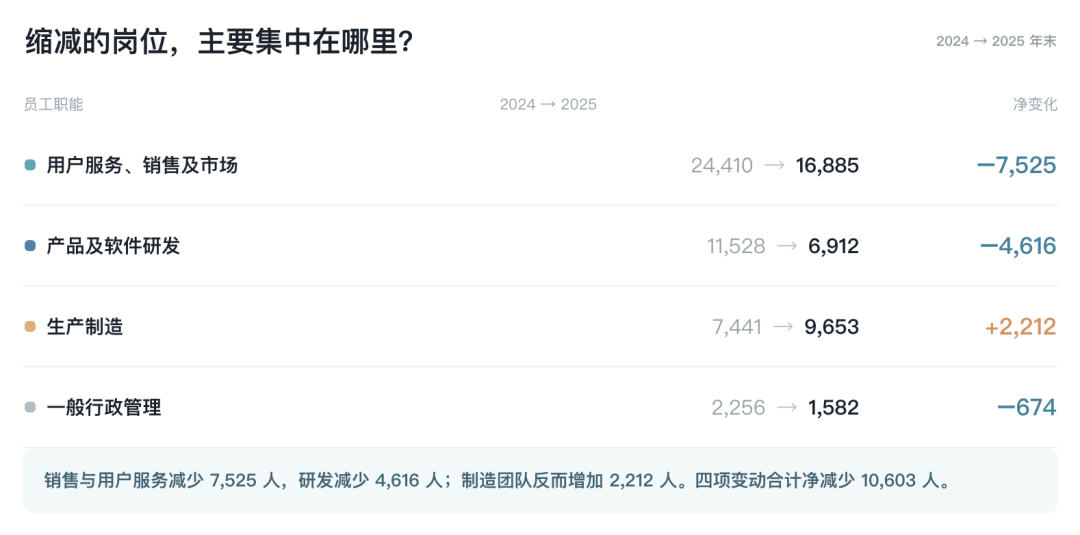
◎ By the end of 2023, the company had 32,820 employees.
◎ By the end of 2024, this number expanded to 45,635, an increase of 12,815 employees in one year.
◎ By the end of 2025, the workforce had decreased to 35,032 employees.
Over two years, NIO experienced a cycle of rapid expansion followed by significant contraction.
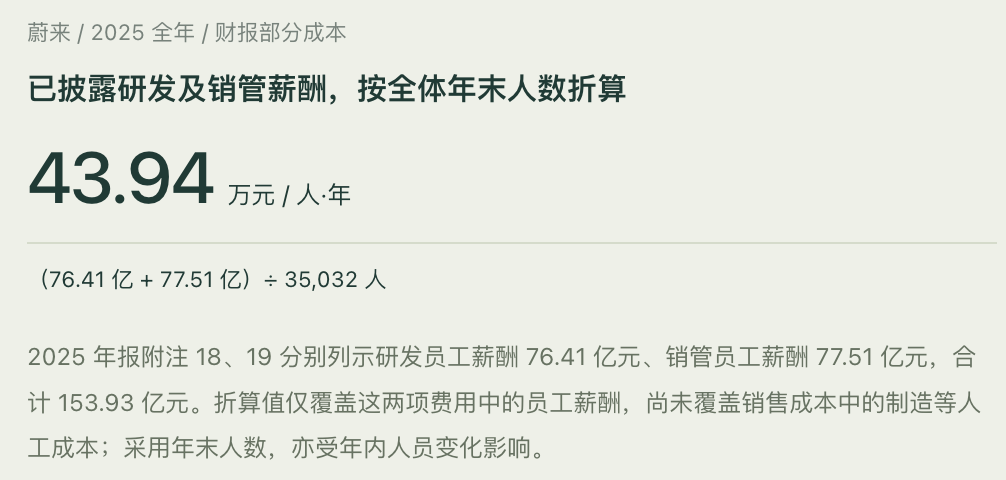
The current distribution of the remaining 35,000 employees is notable.
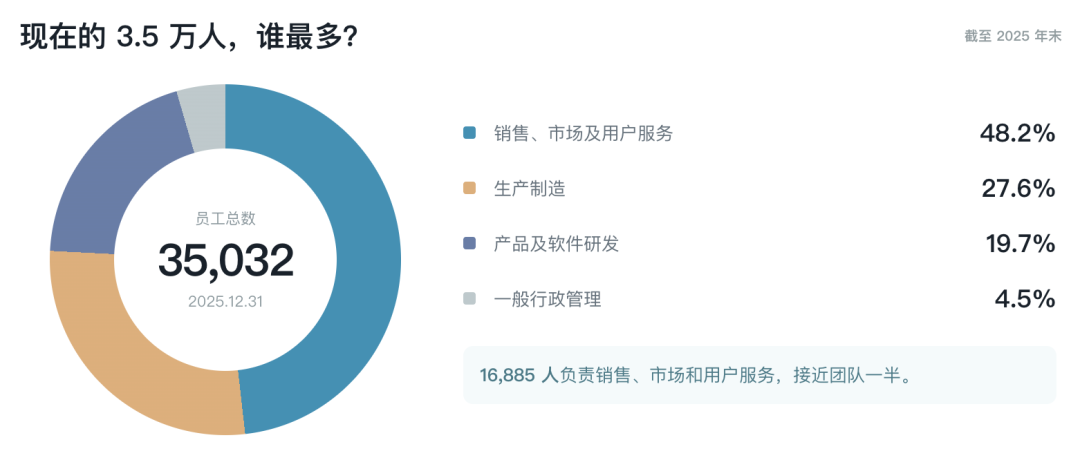
◎ Sales, marketing, and user service personnel number 16,885, accounting for nearly half of the total workforce, similar to Li Auto. This reflects NIO’s long-standing direct sales and user service model.
◎ NIO House, NIO Space, brand marketing, sales consultants, delivery, and after-sales user services require continuous staffing. Even with increasing vehicle sales, the sales and service network needs sufficient manpower.
◎ NIO also operates a battery swap network, charging services, and user communities. While some facilities operate automatically, vehicle sales, user services, equipment maintenance, and regional operations still require significant personnel.
These investments contribute to service quality but also incur substantial fixed operating expenses.
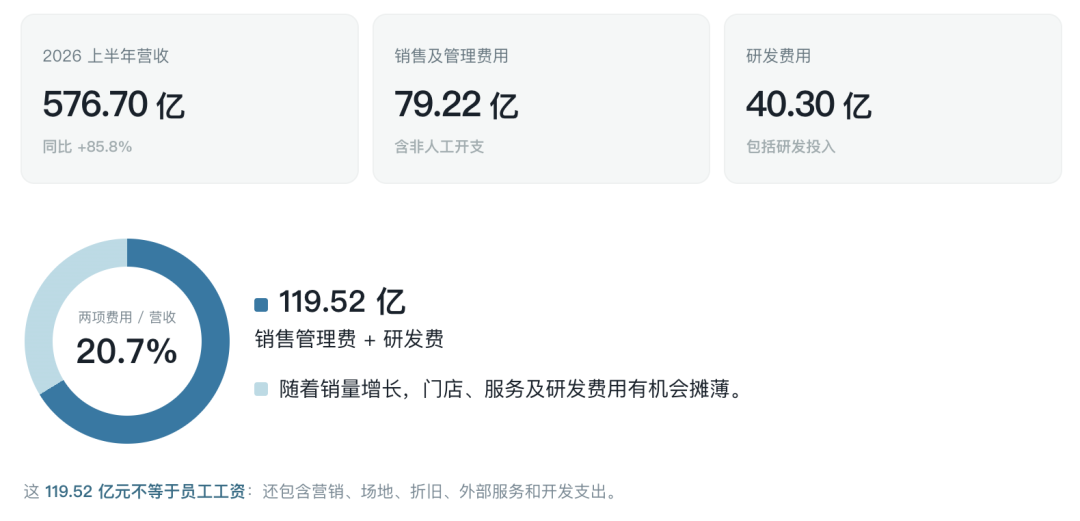
In the first half of 2026, NIO’s selling, general, and administrative (SG&A) expenses reached RMB 7.922 billion, while R&D expenses were RMB 4.030 billion, totaling RMB 11.952 billion, equivalent to 20.7% of revenue for the same period.
SG&A expenses include marketing, rent, depreciation, logistics, and other costs, not solely salaries. NIO’s direct sales and operational model remains a significant cost factor. Now, with a notably higher annual sales volume—191,123 vehicles delivered in the first half of 2026, including 107,658 in the second quarter alone—the fixed costs of stores, sales teams, and service networks can be spread across more vehicles.
NIO’s next challenge is to enhance the productivity of its workforce and service network.
Note: The mid-year 2026 financial report did not disclose the latest total employee count or full compensation expenses.
02
RMB 930 Million in Stock-Based Incentives in H1: Why Does the Company Still Report a Loss of RMB 860 Million?
The reduction in workforce did not lead to a proportional decrease in NIO’s stock-based incentive expenses.
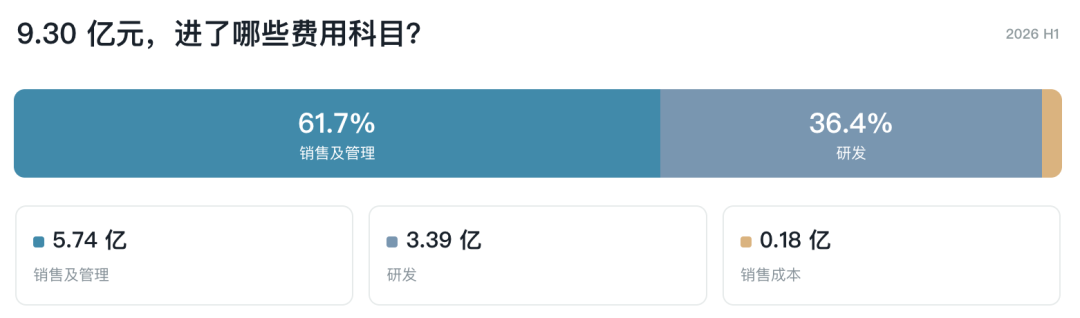
In the first half of 2025, NIO’s share-based payment expenses were RMB 897 million; these increased to RMB 930 million in the first half of 2026, a year-over-year rise of approximately 3.6%.
These expenses were primarily allocated to three categories: SG&A accounted for 61.7% (including corporate management personnel), and R&D accounted for 36.4%.
In comparison, in the first half of 2026, Li Auto’s share-based payment expenses were approximately RMB 375 million, XPeng’s were about RMB 297 million, and Leapmotor’s were around RMB 61 million. NIO’s RMB 930 million significantly exceeded those of the other three companies.
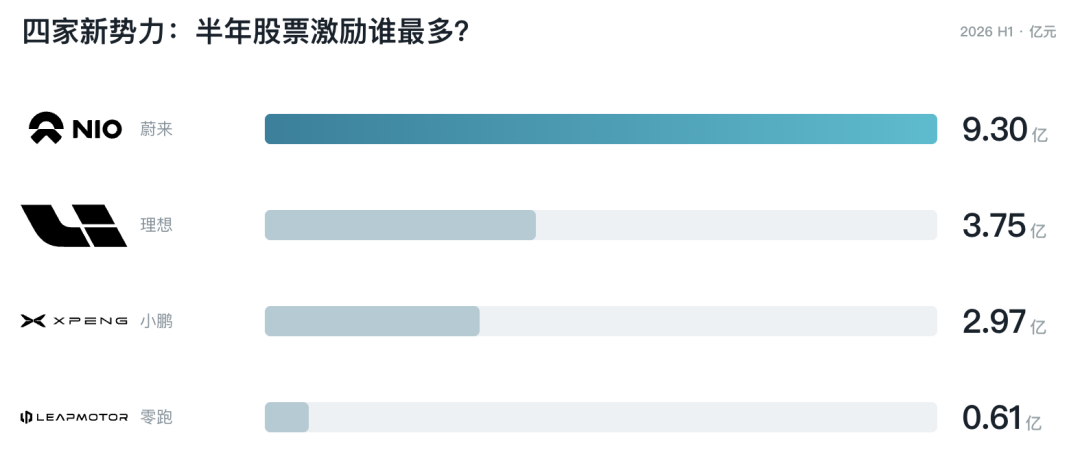
Substantial differences have emerged among these companies in their investment in stock-based incentives.
How do share-based payments affect profits? Suppose a company grants restricted stock units (RSUs) to employees, who must meet certain service periods or performance targets to vest. Under accounting standards, the company must recognize share-based payment expenses during the relevant vesting periods.
These expenses do not require the company to pay an equivalent amount of cash in the current period but are recorded in the income statement, reducing accounting profit. For existing shareholders, new stock issuances may also lead to equity dilution.
This year, NIO granted 248.45 million RSUs linked to long-term performance targets to CEO William Li, with vesting conditions spread over ten batches.
Such incentives are part of long-term performance arrangements. The number of shares granted does not equal the share-based payment expenses recognized in the current period, nor can it be directly converted into employees' annual salaries.
When examining the first half of 2026's profits together, the relationships become clear.
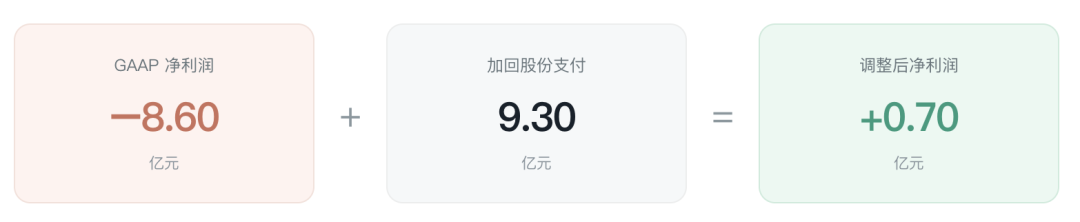
◎ Increased sales volume has led to higher revenue, improved automotive gross margins, better expense control, and the effects of previous organizational adjustments are now reflected in the financial statements.
◎ Stock-based incentives remain an economic cost for attracting and retaining talent, differing only in form from cash salaries.
NIO’s GAAP net loss for the first half of 2026 was RMB 860 million, a significant reduction compared to previous half-year losses often exceeding billions.
NIO’s next challenge is to shift from sustaining investments amid large-scale losses to covering remaining R&D, sales, and stock-based incentive costs through sales volume and gross margin growth.
Summary
With a net reduction of 10,603 employees in one year, NIO has undergone a significant organizational contraction. As of the end of 2025, 16,885 employees were still engaged in sales, marketing, and user services, indicating that the direct sales model continues to require substantial manpower. In the first half of 2026, RMB 930 million in share-based payments highlights that stock-based incentives remain a significant talent cost for the company.
As delivery volumes expand across NIO’s three brands—NIO, Leapmotor, and Firefly—the R&D, sales, and service networks established in the past are now supported by greater revenue.
For NIO, its 35,000-strong workforce is already leaner compared to its peak. It will be interesting to observe the year-end employee count and compensation trends.
-
![]()
Bosch Secures Multi-Million-Unit Orders, Horizon Robotics' Chips Go Global: What Will Mobileye's Next Move Be?
-
![]()
Is Douyin Still Reliant on the 'Little Yang Brother' Phenomenon?
-
![]()
NIO’s Workforce Declines by Over 10,000 in a Year, with RMB 930 Million in Stock-Based Compensation in H1: Implications for 35,000 Employees
-
![]()
Real-World Testing Reveals: Flash Models are Transitioning from 'Lite' to Practical Office Tools
-
![]()
China's Brake-by-Wire Systems Start to Compete with Bosch's Market: Who Will Supply the Core Driver Chips?
-
![]()
Li Auto Cuts Workforce by 3,970 in a Year: Insights into Average Monthly Salary and the Dominance of Sales Staff (40%)
-
![]()
Ignite the Tokens! The Capital Efficiency Test for Cloud Providers in the Agentic Cloud Era
-
![]()
The Data Centers of AI Giants Are Hitting a Wall Harder Than Chips