China's Brake-by-Wire Systems Start to Compete with Bosch's Market: Who Will Supply the Core Driver Chips?
 10/20 2026
 396
Produced by Zhineng Zhixin
In the first half of 2024, Bosch held approximately 53.68% of the domestic brake-by-wire market share, while the top ten local suppliers collectively held 32.57%.
By 2025, Bethel becomes the second-largest player with an 8.6% share.
Starting in March 2026, small-batch deliveries of the next-generation electronic mechanical brake (EMB) will commence.
Domestic substitution at the system level is gaining momentum. Silan Micro has released the SZ9305, a four-channel automotive current driver chip that supports ASIL-D functional safety, achieves 1% current control accuracy, and is designed for ESC, active suspension, and transmission solenoid valves.
Chinese automakers are now developing their own braking systems, with the next step being to replace chassis chips with domestic alternatives.
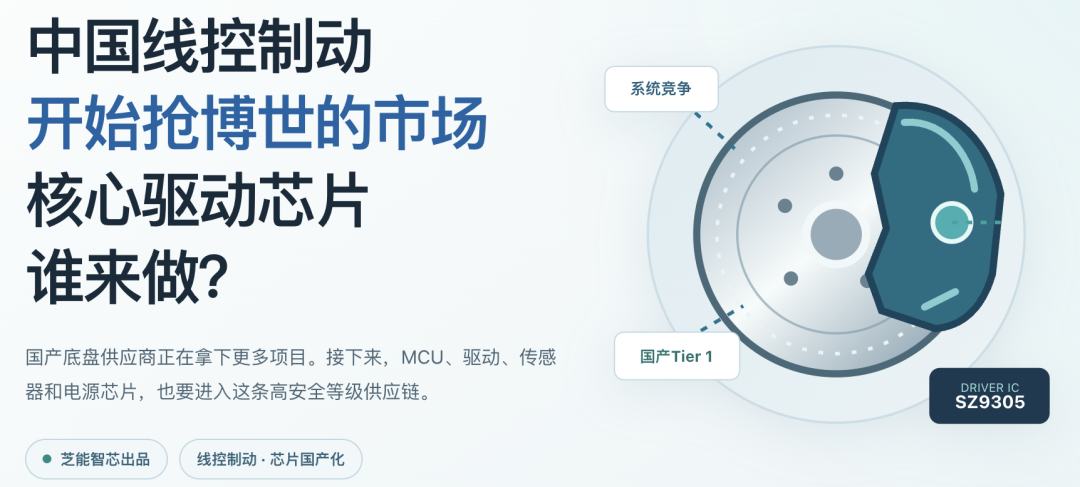

Part 1: China's Brake-by-Wire Chassis Competition Enters Bosch's Core Market
For more than a decade, Bosch, Continental, and ZF have dominated the automotive chassis electronic control market.
This is particularly true for braking systems, where advancements from ABS and ESC to electronic brake boosters and One-Box integrated braking solutions have relied on long-term accumulated expertise in algorithms, hydraulic control, mechanical design, and vehicle safety validation.
Chinese local suppliers previously focused on traditional braking components and electronic parking brakes (EPB) but have now expanded their competitive scope.
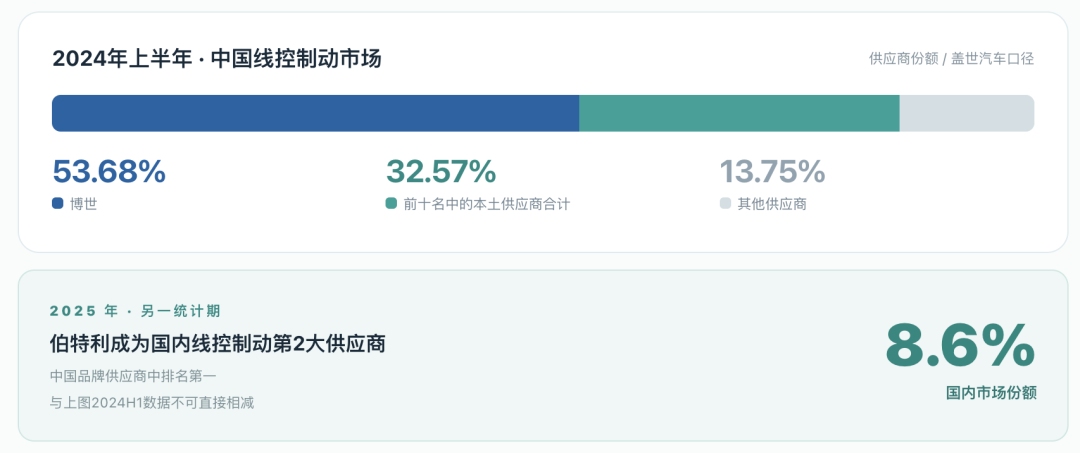
◎ By 2025, Bethel secures approximately 8.6% of the brake-by-wire market share, ranking first among Chinese brand suppliers. Its WCBS product line includes two generations of platforms (1.X and 2.X), with WCBS 2.0H supporting redundancy requirements for L3 autonomous driving.
◎ In the first half of 2026, Bethel's revenue reaches RMB 6.27 billion, up 21.5% year-on-year, with smart electronic control product sales growing by 39.1%.
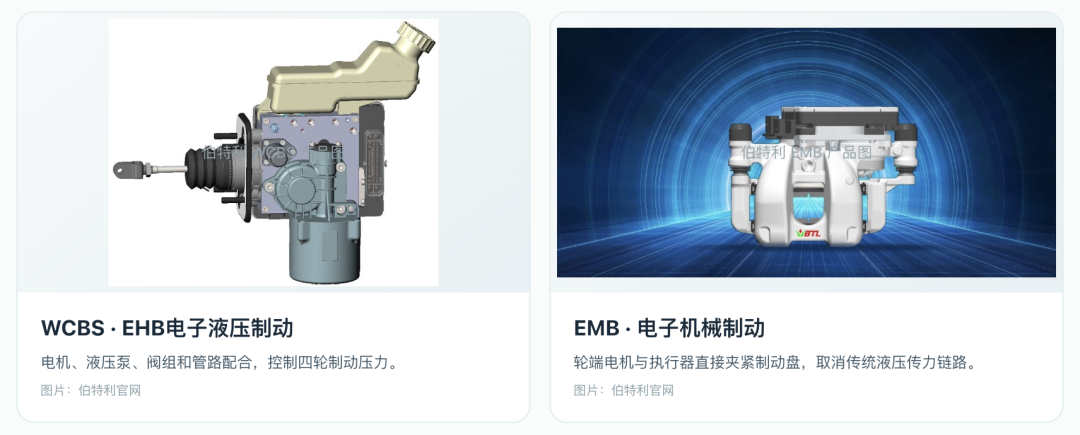
A more significant shift is occurring with EMB.
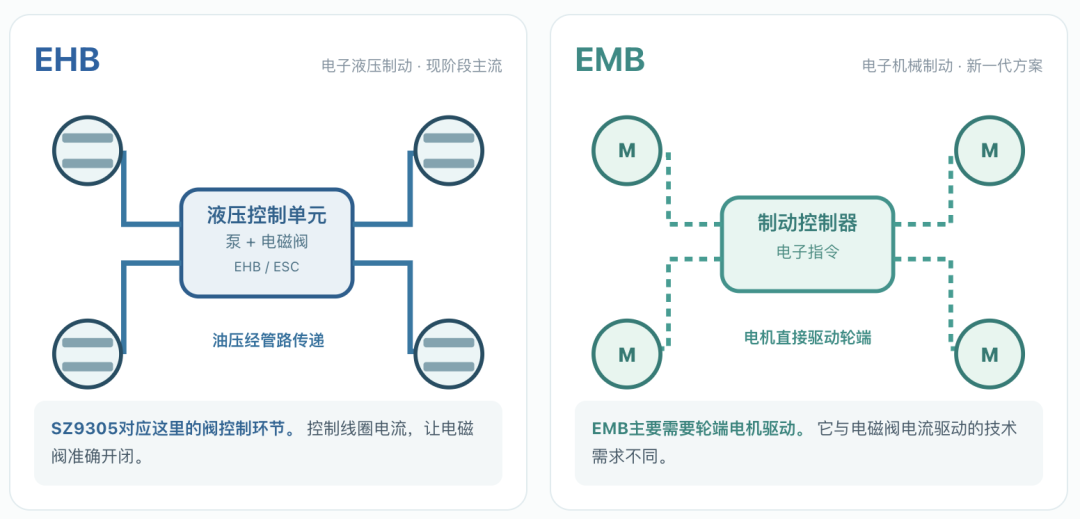
◎ Traditional EHB (Electro-Hydraulic Brake) systems still rely on hydraulic circuits, using motors, pumps, and valves to establish and regulate brake pressure.
◎ EMB eliminates hydraulic transmission, generating braking force directly through electric actuators at the wheel end.
Bethel secured multiple EMB project designations in 2025 and began small-batch deliveries in March 2026, marking the entry of domestic companies into the industrialization phase of next-generation braking technology.
Similar developments are underway in steer-by-wire systems.
On October 14, ThyssenKrupp Automotive Technology announced a collaboration with United Power to develop steer-by-wire systems, combining expertise in steering systems, electronic control, software, actuators, and industrialization capabilities. Earlier in October, Luxshare Precision completed its acquisition of Jingxi Zhixing, expanding its presence in suspension and braking chassis businesses.
China's intelligent chassis industry now features two types of companies: Bethel and Jingxi Zhixing offer complete chassis systems, while United Power extends its capabilities in motors, electronic control, and actuators into the chassis domain.
The growing market share at the system level is creating opportunities for upstream chip suppliers.
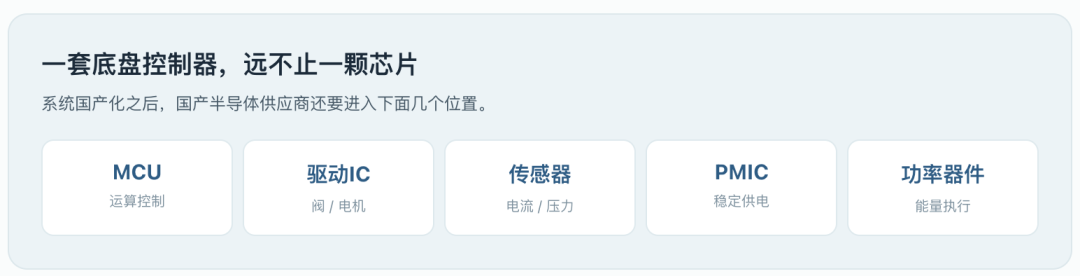
A brake-by-wire system requires four types of chips in addition to hydraulic units, motors, brakes, and control software: MCUs for motion control calculations, sensors for measuring pressure, position, and current, driver chips for controlling solenoid valves or motors, and power management chips for reliable power supply.
System stability largely depends on the coordination between chips and actuators.
The more market share domestic Tier 1 suppliers secure, the greater the opportunities for local chips to enter the chassis controller supply chain.
Part 2: Why Did Silan Micro Start with a Solenoid Valve Driver Chip?
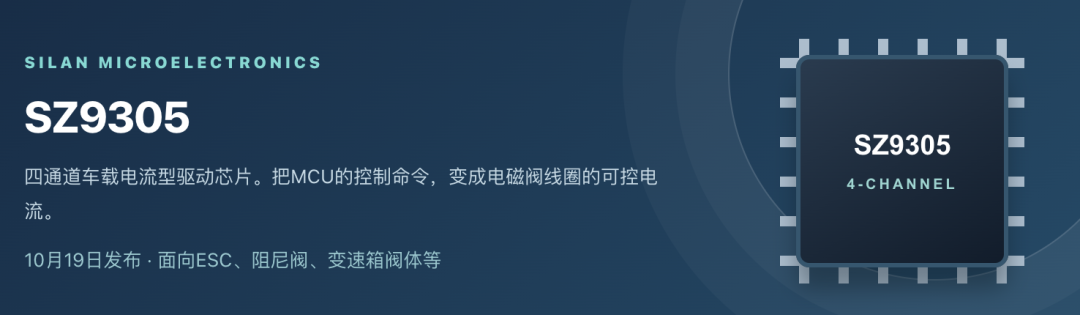
The SZ9305 is a typical high-safety automotive intelligent driver chip: it independently controls four solenoid valve channels, supports high-side and low-side driving, operates with a recommended power supply of 5.5V to 19V, and achieves ±1% current control accuracy within a 0 to 1.5A range.
It primarily serves hydraulic braking and chassis actuation systems that still widely use solenoid valves.
Take ESC (Electronic Stability Control) as an example. When a vehicle experiences understeer or oversteer, the controller determines which wheels require braking force adjustments based on wheel speed, steering angle, and yaw rate. Solenoid valves in the hydraulic control unit switch oil paths as instructed, working with the hydraulic pump to regulate brake pressure. The chip converts digital commands from the MCU into precise coil currents.
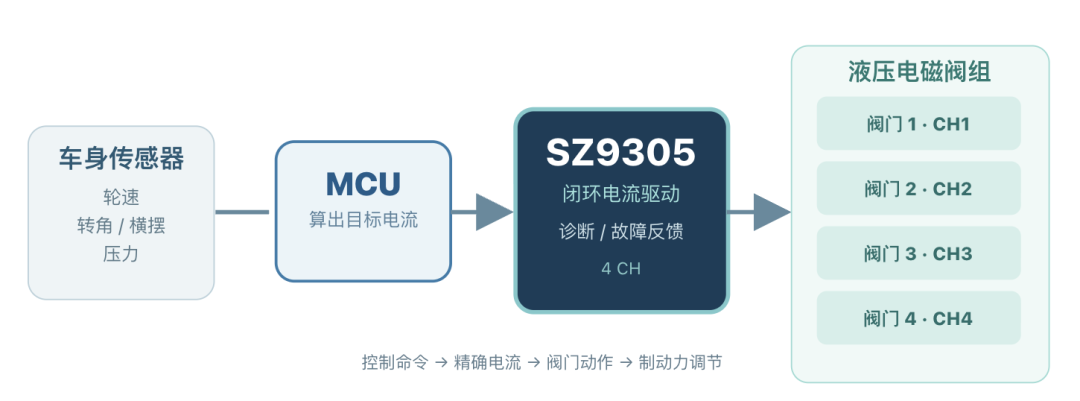
Achieving 1% current control accuracy is crucial because solenoid valve activation, holding, and response speed depend on coil electromagnetic force, which is affected by temperature-dependent coil resistance. Outputting a fixed voltage cannot ensure consistent current under all operating conditions.
The driver chip must continuously monitor current, adjust output to maintain target values, and promptly report faults such as short circuits, open circuits, or overheating to the controller.
The SZ9305 integrates 13-bit current setting, fixed and variable frequency control, dither modulation, an internal charge pump, and BIST self-testing.
Dither modulation is particularly beneficial for hydraulic solenoid valves: small current perturbations reduce static friction during valve spool movement.
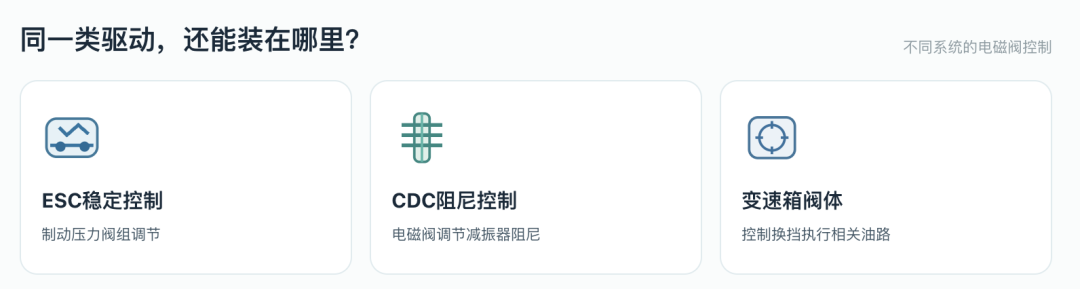
The same technology applies to electronically controlled suspensions. CDC (Continuous Damping Control) shock absorbers adjust damping via solenoid valves, with the controller continuously varying damping valve currents based on vehicle body status, wheel motion, and driving modes.
While CDC, air suspension, and fully active suspension systems use different actuators (solenoid valves, motors, hydraulic pumps, or higher-power actuators), the SZ9305 covers the valve control aspect.
ASIL-D compliance represents the chip's second major challenge.
On January 1, 2025, China's new mandatory national standard GB 21670-2025, "Technical Requirements and Test Methods for Passenger Car Braking Systems," took effect, imposing functional safety requirements on braking electronic control systems.
When selecting chips, brake controller suppliers require not only product specifications but also engineering documentation such as failure mode analysis, diagnostic coverage rates, and safe usage conditions.
Silan Micro provides accompanying FMEDA (Failure Modes, Effects, and Diagnostic Analysis) documentation, enabling Tier 1 suppliers to access device-level safety information during controller development.
While domestic analog chip companies have previously established market presence in body control, power management, and comfort electronics, chassis chips face stricter validation requirements: any abnormal output from braking systems can affect vehicle motion. Only by offering dedicated driver chips that meet ASIL-D development requirements can domestic suppliers qualify for high-safety-level chassis controller development.
Summary
China's brake-by-wire chassis market is undergoing transformation. System supplier Bethel has secured market share in brake-by-wire systems and commenced EMB deliveries, while Luxshare and United Power expand their chassis businesses, with domestic Tier 1 suppliers participating in increasingly diverse areas.
Upstream chips, including MCUs, drivers, power management, sensors, and power devices for braking and suspension systems, are beginning to create product development opportunities for Chinese semiconductor companies.
-
![]()
Bosch Secures Multi-Million-Unit Orders, Horizon Robotics' Chips Go Global: What Will Mobileye's Next Move Be?
-
![]()
Is Douyin Still Reliant on the 'Little Yang Brother' Phenomenon?
-
![]()
NIO’s Workforce Declines by Over 10,000 in a Year, with RMB 930 Million in Stock-Based Compensation in H1: Implications for 35,000 Employees
-
![]()
Real-World Testing Reveals: Flash Models are Transitioning from 'Lite' to Practical Office Tools
-
![]()
China's Brake-by-Wire Systems Start to Compete with Bosch's Market: Who Will Supply the Core Driver Chips?
-
![]()
Li Auto Cuts Workforce by 3,970 in a Year: Insights into Average Monthly Salary and the Dominance of Sales Staff (40%)
-
![]()
Ignite the Tokens! The Capital Efficiency Test for Cloud Providers in the Agentic Cloud Era
-
![]()
The Data Centers of AI Giants Are Hitting a Wall Harder Than Chips