Can Tmall Turn Tokens into a Mass Consumer Product on Double 11?
 11/05 2026
 383
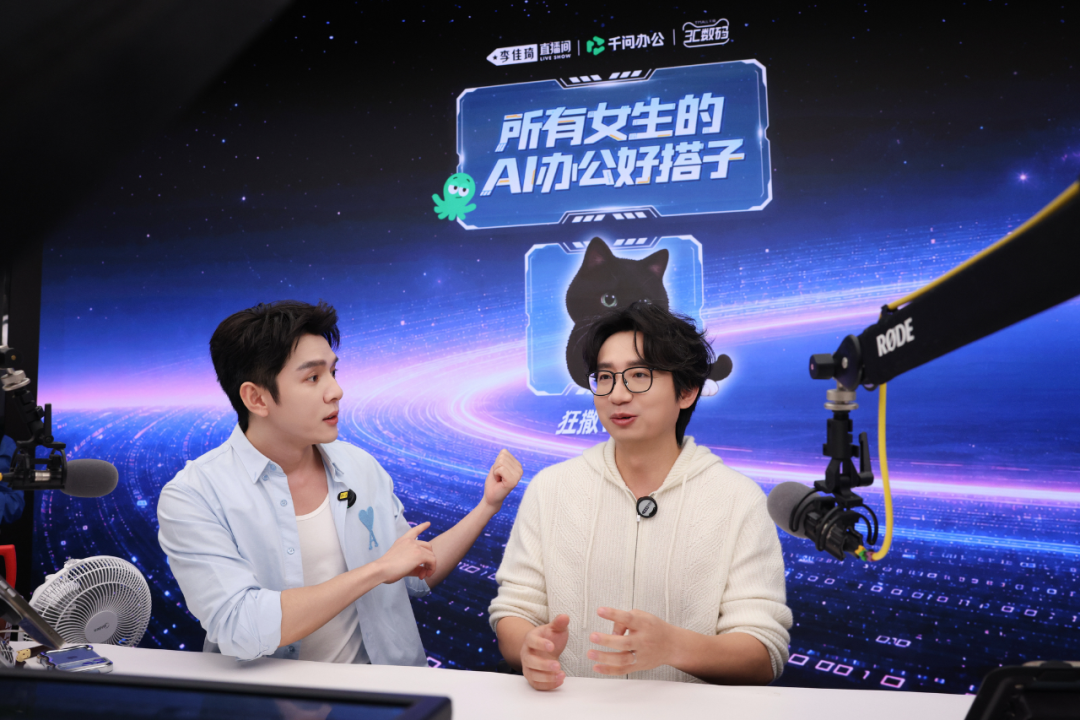
Tokens have made their way into the livestream room.
On the evening of November 2, Li Jiaqi began selling Tokens in his livestream. In under half an hour, he moved 100,000 Qwen Office personal membership monthly cards—roughly 2 trillion Tokens—making it one of the breakout hits of this year's Double 11.
That night, the livestream comments kept flooding with "321, put up the Tokens." His livestream shelves also featured three AI computers with built-in Qwen Office, along with AI products that consume Tokens, such as DingTalk A1 and QwenNote A2.
During the livestream, Li Jiaqi asked guest Chen Yusen, CEO of Qwen Office: "Can you help me make an AI avatar that chats with the girls 24 hours a day?" The reply won over fans: "AI cannot replace Li Jiaqi. I would rather help fans use AI to handle life's trivial matters—leaving work on time, keeping cats and dogs company, and taking care of family."
This livestream had two highlights: Tokens became goods that can be hawked, and AI vendors became brands in the livestream room. Tmall matched them in the middle, brought in the person in China who is best at selling goods, and connected the transaction.
But behind the 2 trillion "Token" carnival, the real question is: Tokens are now on the shelves like phone credit. Can they keep selling?
What Has Changed, What Has Not
Tmall had been laying the groundwork for this livestream for two months.
On September 2, Zhipu, the "first listed large-model company," officially opened a flagship store on Tmall. The only products listed were four Token packages at different price points. The next day, Tmall launched the "AI Space Station" Token recharge center, initially connecting Alibaba Cloud, Zhipu, Kimi, MiniMax, and DeepSeek.
On the first day of Double 11 sales, transaction value in Taobao's Token category rose 450% month on month. By November 2, Li Jiaqi was selling Qwen Office personal membership monthly cards to "all the girls."
It could even be said that Tmall's more than two months of preparation was all for this one night. Tokens have also officially turned from a technical term into a product on e-commerce shelves that can be price-compared, ordered, and stockpiled.
But the play of acquiring new users for a penny is nothing new. The 2 trillion Tokens are only entitlement quotas and have not really been burned yet. The real intention is to buy traffic and exposure.
Sales outside the livestream room confirm this even more. According to my observation, Zhipu's Tmall flagship store has sold several hundred Token products in total, and MiniMax even fewer. Moreover, most large-model stores do not participate in Double 11 discounts. Zhipu's discount was only symbolic: the monthly card dropped from 118 yuan to 115 yuan—3 yuan cheaper.
So Li Jiaqi's livestream was more like a nationwide advertisement: letting millions of viewers know that AI can indeed be bought by the month and by usage, like phone credit.
If the effect is evaluated on this basis, the consumer group for Tokens is already changing. In addition to programmers—the heavy Token users driven by work needs—first- and second-tier white-collar workers, small shop owners, and parents looking for tutoring for their children all poured into the livestream room to snap up and stockpile Token packages.
Previously, they had almost no direct connection with AI computing power and did not care about model benchmark scores. They might not even understand Tokens, but they know that "AI can help get work done"—automatically writing weekly reports or organizing wrong answers for children.
These were exactly the scenarios Chen Yusen and Li Jiaqi repeatedly demonstrated in the livestream room.
In fact, Tmall is not the only one selling Tokens in livestream rooms. JD.com also launched an "AI Software Recharge Hall" in September, externally selling Token packages from JD Cloud, DeepSeek, Zhipu, MiniMax, Kimi, and Qwen. On Double 11 itself, JD.com's 3C procurement and sales livestream room listed a 0.01 yuan Token pack and gave away 1 billion Tokens within one hour of broadcasting.
On Douyin's side, Doubao Work has been livestreaming every day since October 26, selling monthly cards, annual cards, and team seats, and memberships for Jianying and Jimeng were also put on the shelves.
In my view, with Tokens on e-commerce shelves, the value of channels has become more prominent. In the past, large-model vendors generated revenue through the B2B model: knocking on the doors of CIOs, talking about technology and parameters, always with the goal of helping enterprises reduce costs and increase efficiency. This path had long payment cycles and high thresholds; customers were held in the hands of sales teams, and the annual business scale had a ceiling.
Now the approach has changed. Monthly cards costing tens of yuan are placed on shelves, and the selling point is still that they can get work done—but they bypass enterprise IT procurement and are sold directly to ordinary users, letting them start using AI at the lowest threshold.
Take Zhipu as an example. It lacks a store with customer traffic. Zhipu's revenue model is shifting from "selling projects" to "selling subscriptions," forming a business logic of "API + subscription": as long as calls continue, revenue continues; the larger the user base and the better the renewals, the more stable the accounts.
Zhipu also wrote a custom formula into its mid-year financial report: "AGI commercial value = intelligence upper bound × Token consumption scale."
Its logic is that the intelligence upper bound determines what tasks the model can handle, the task boundary determines the value density of each Token, and then the Token consumption scale amplifies it. Tokens used for daily chatting and Tokens used to complete software engineering and discover vulnerabilities in production systems represent different commercial values.
It also customized a "computing multiplier" to measure how much open platform and API revenue is generated per one yuan invested in training and inference computing power, claiming a year-on-year increase of about 14 times in the first half. But Zhipu did not disclose the absolute value or the calculation process, and the outside world cannot independently verify it for now.
Geek Park commented that Zhipu wrote these custom indicators into its interim report in an attempt to show that it is competing for the right to interpret the valuation of large-model companies. That is, in addition to revenue, profit, and cash flow, it also hopes investors will pay attention to model capabilities, Token consumption, unit task cost, and the efficiency of converting computing power into revenue.
You should know that subscription is a business that lives on renewals, and renewals depend on a steady stream of new users.
But Zhipu's ability to attract new customers on its own is limited: professional developers are familiar with APIs and will study configurations themselves. But many individual developers, small teams, and small and medium-sized enterprises with procurement needs can hardly be reached through the official website.
What Tmall fills is exactly this gap for vendors; shelves and payment systems are ready-made. Double 11 also opened up traffic accumulated over more than ten years to Tokens for the first time this year. Double 11 was originally a shopping carnival created by Alibaba; in the past people stockpiled daily necessities, and now they can stockpile computing power.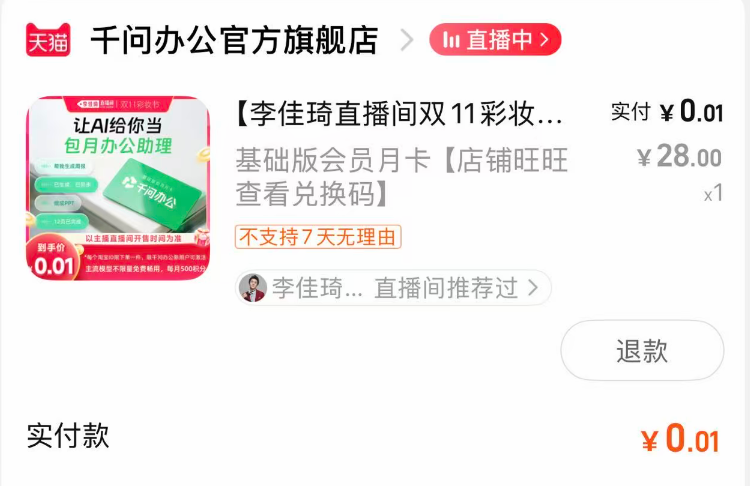
Qwen Office personal membership monthly card. Image source: transaction order screenshot
Therefore, the greater value of Chen Yusen teaming up with Li Jiaqi for the livestream is that they proved at a major promotion node that Tokens can go through retail channels like daily necessities, and that many people are willing to pay.
Why Tmall
Tmall is the first platform to list Tokens as an independent promotional category. It applied the full set of retail rules, including search, price comparison, brand stores, and top streamer sales.
More importantly, only Tmall can gather large-model vendors. This new business happens to grow on Tmall's turf. Because coding subscriptions are search-based and planned needs, users come with a purpose and place orders after comparing packages.
By contrast, Pinduoduo's low-price mindset cannot catch this type of customer, and Douyin's interest-based seeding cannot drive it either. Tmall's search plus brand stores are the main venue for Token transactions.
It packages Tokens into monthly cards and memberships and sells them like video memberships and cloud drive memberships. In Taobao's recharge center, the entry for Tokens is next to phone credit recharge, data recharge, and utility bill payments.
Tmall wants to make Token services "as convenient as paying utility bills" and become the first major AI consumption battleground where large models are closest to users.
More critically, with Tokens on the shelves, Tmall also has a chance to gain channel pricing power. Previously, vendors decided how Tokens were priced, and buyers received API bills and rarely used them for horizontal "price comparison." Now similar products are placed side by side, and prices can be looked at together for the first time.
This means Tmall's retailization of Tokens precedes standardization, and the shelf is the catalyst. Pricing power for Tokens has also shifted from vendors to the platform.
Previously, the pricing system for large models was very chaotic. Research institutions of relevant departments also pointed out that the counting and pricing rules for Tokens are still unilaterally set by platforms and lack a verifiable measurement standard.
For example, Kimi's Pro tier charges 26 yuan per million Tokens for input and 136 yuan for output; DeepSeek charges 1 yuan for input and 4.5 yuan for output during idle periods—a price gap of dozens of times.
To some extent, Tmall is also setting rules in the AI software category to make Token prices transparent. In April, it issued the "Specifications for Publishing AI Software and Application Products," requiring merchants to clearly state Token quotas, model versions, and API validity periods, and banning phrases such as "never banned."
For Tmall, its foundation is brand mindshare. I said before that when brand merchants open stores on Tmall, the significance is not limited to selling goods; more importantly, it is the enhancement of brand value.
Under this circumstance, whichever e-commerce platform can first make pricing standards transparent can win the trust of C-end users. Once Tokens become shelf goods like phone credit, retail standards and pricing power will change from vendor self-discipline to competitive necessity.
It is worth noting that telecom operators have also come in after smelling the opportunity. In May, China Telecom trial-commercialized Token packages, with the cheapest at 9.9 yuan per month, and China Mobile and China Unicom followed. Traditional traffic business has hit its ceiling—the three major operators' revenue only rose 0.1% last year, while net profit fell 2.3%—and Tokens are the next data package.
After Li Jiaqi sold Tokens, Tmall commented that "from livestreaming ordinary goods to selling Tokens, AI is entering thousands of households."
But for the platform to make this business run smoothly, it still needs to face three challenges: Why do users come? How many monthly card users will renew? Is the link from transaction to use smooth?
Take the transaction link as an example. The monthly card in JD.com's Zhipu self-operated store has a 67% positive review rate. Some reviews complained that the recharge process was not connected and required manual assistance before it arrived; Qwen Office has similar problems. When I jumped to the web version through the app recharge, it repeatedly asked me to scan the code and log in again.
Video websites took nearly ten years to make membership subscriptions a mass habit. There is no reason Tokens should be faster.
Livestreaming can bring traffic, but retaining users still depends on products and experience.
That is to say, when Tokens are truly sold as "new phone credit," the next competition among large models will no longer be about who has higher parameters, but about who can first turn "recharge after use" into a stable business.
Among the 100,000 monthly cards Li Jiaqi sold in half an hour, how many will become renewing users is the real answer beyond the shelf.
Reference: Tang Chen, "Zhipu Sets Up a Stall on Tmall, Wants to Sell Tokens Like Phone Credit"
-
![]()
October 2026 EV Startup Sales Roundup: Silver October Surge! These Three Automakers All Hit New Highs
-
![]()
Tmall's Token Sales Go Viral During Double 11: How Far Is AI From Becoming Like "Utilities"?
-
![]()
How Can AI-Generated Interfaces Escape the "AI Feel"?
-
![]()
Like-new phones become hot commodities, why are second-hand phones so popular?
-
![]()
"I Bought an Extended-Range Car — No Regrets Six Months Ago, But Now I Do"
-
![]()
Can Tmall Turn Tokens into a Mass Consumer Product on Double 11?
-
![]()
What Is the Real Reason for Buying a New Energy Vehicle?
-
![]()
When India Takes Over Iveco, a New Roadblock Emerges for Chinese Commercial Vehicles Going Global